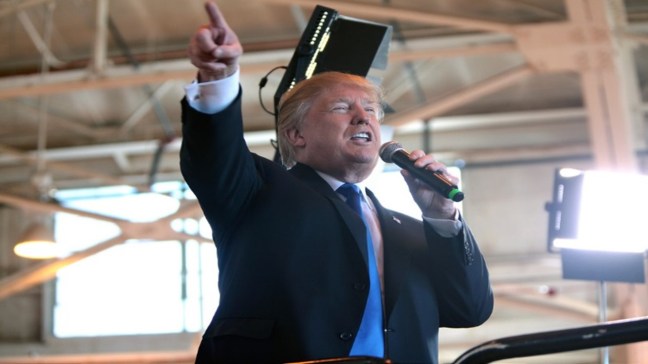
Corporations and Health Under Trump

Credit.

The election of Donald Trump is expected to bring about significant changes in how the federal government regulates corporations to protect public health and the environment.  It will take some time to analyze what changes are likely and how public health advocates can respond most effectively.  To begin that analysis, Corporations and Health Watch highlights some of the first such assessments.

What President Donald Trump Will Mean for U.S. Food Policy

President-elect Donald Trump made a few issues central to his platform: immigration, taxes, and healthcare among them. Food policy has gone largely ignored, though Trump’s statements on other issues will certainly inform the way food policy will look for the next four years — and possibly beyond that, writes Virginia Chambee for Eater.  Trump has been especially vocal about immigration. His plan to build a wall on the southern border of the U.S. will likely hit the agricultural and restaurant industry hard. He has called climate change a “hoax,” which means it likely won’t be high on his list of priorities; this could be devastating for farmers. When it comes to minimum wage, Trump believes it’s an issue best left up to states (so don’t expect a higher federal minimum any time soon). And on employee benefits, Trump wants to repeal President Obama’s Affordable Care Act, but is seemingly in favor of paid maternity leave (though it’s unclear if that plan will cover single mothers). Chamlee takes a closer look at where Trump stands on policies related to food safety, agriculture, and workers’ rights.

Trump Expected to Seek Deep Cuts in Business Regulations

Hours after Donald J. Trump won the race for the White House, scores of regulations that have reshaped corporate America in the last eight years suddenly seemed vulnerable, writes The New York Times. While many questions remain about how Mr. Trump will govern, a consensus emerged Wednesday in many circles in Washington and on Wall Street about at least one aspect of his impending presidency: Mr. Trump is likely to seek vast cuts in regulations across the banking, health care and energy industries.  “This is going to be a president who will be the biggest regulatory reformer since Ronald Reagan,” Stephen Moore, one of Mr. Trump’s economic advisers said in an interview on Wednesday. “There are just so many regulations that could be eased.”

Get Used To High Drug Prices As Big Pharma Emerges From Election Stronger Than Ever

On the campaign trail, Hillary Clinton, Bernie Sanders, and Donald Trump agreed on at least one thing: the need to control America’s spiraling costs of prescription drugs, writes Buzz Feed News.  But after Tuesday’s election, the likelihood of drug pricing reform seems small. In California, Big Pharma spent more than $100 million to help defeat a ballot measure that would have pegged the state’s drug purchases to the discount rates currently offered to the Veterans Administration (VA).

That’s not to say that Big Pharma is thrilled with president-elect Trump, who has suggested that the huge Medicare program, which provides health insurance for senior citizens, should be able to negotiate prices with drug companies — something that’s currently prohibited by law. But with both houses of Congress remaining firmly under GOP control, legislation to shake up drug pricing seems unlikely. And specific plans proposed by Clinton, including fines for companies that jacked up prices without clear justification, are now off the table.
Blacklisted Businesses: Social Activists’ Challenges and the Disruption of Corporate Political Activity

Credit

A new paper explores whether and how social activists’ challenges affect politicians’ willingness to associate with targeted firms. The authors study the effect of public protest on corporate political activity using a unique database that allows them to analyze empirically the impact of social movement boycotts on three proxies for associations with political stakeholders: the proportion of campaign contributions that are rejected, the number of times a firm is invited to give testimony in congressional hearings, and the number of government procurement contracts awarded to a firm. The authors show that boycotts lead to significant increases in the proportion of refunded contributions, as well as decreases in invited congressional appearances and awarded government contracts. These results highlight the importance of considering how a firm’s sociopolitical environment shapes the receptivity of critical non-market stakeholders.

Continue reading Blacklisted Businesses: Social Activists’ Challenges and the Disruption of Corporate Political Activity

Nutrition and marketing of baby and toddler food and drinks

Birth to two years is a critical period for developing healthy food preferences and eating habits and preventing childhood obesity. Baby Food FACTS, a new report by the Rudd Center for Food Policy and Obesity provides a comprehensive analysis of the nutritional content of food and drink products marketed to parents for their babies and toddlers (up to age 3), the messages used to promote these products, and how well the marketing messages correspond with expert advice about feeding young children. However, baby and toddler food and drink products and the marketing messages used to promote them do not always support experts’ recommendations for feeding babies and toddlers.

Why Tobacco Companies Are Spending Millions To Boost A Cigarette Tax

For many Missouri health advocates, an increase in the state’s tobacco tax is long overdue. But, according to the California public radio station KCLU, onlookers might be surprised to hear that tobacco companies are spending a fortune this election year to get one or another increase in that tax passed, while health groups are urging a no vote. Groups like Tobacco Free Missouri, the Health Care Foundation of Greater Kansas City and Campaign for Tobacco-Free Kids have joined fiscal conservatives in opposing Amendment 3. These anti-smoking groups worry that creating such a small tax now might eliminate the chance of future tax that would be big enough to significantly change smokers’ behavior.

Investigation: The DEA slowed enforcement while the opioid epidemic grew out of control

Credit

A decade ago, according to a new series of articles in The Washington Post, the Drug Enforcement Administration launched an aggressive campaign to curb a rising opioid epidemic that was claiming thousands of American lives each year. The DEA began to target wholesale companies that distributed hundreds of millions of highly addictive pills to the corrupt pharmacies and pill mills that illegally sold the drugs for street use.

Leading the campaign was the agency’s Office of Diversion Control, whose investigators around the country began filing civil cases against the distributors, issuing orders to immediately suspend the flow of drugs and generating large fines.

But the industry fought back. Former DEA and Justice Department officials hired by drug companies began pressing for a softer approach. In early 2012, the deputy attorney general summoned the DEA’s diversion chief to an unusual meeting over a case against two major drug companies.  Read more.

Coca-Cola’s secret plan to monitor Sydney University academic Lisa Bero

According to The Sydney Morning Herald, Coca-Cola has been exposed as having a secret plan to monitor research at Sydney University that examines how private companies influence public health outcomes in areas such as obesity. In a leaked internal email, a paid consultant to Coca-Cola South Pacific writes that a “key action” for the global soft-drinks manufacturer is to “monitor research project outcomes through CPC [Charles Perkins Centre] linked to Lisa Bero’s projects”. Professor Lisa Bero has been targeted for “monitoring” by Coca-Cola for her research on nutrition and bias.

NRA Top Trump Funder

National Rifle Association committees making independent campaign expenditures to oppose Democratic presidential nominee Hillary Clinton have spent more than $14 million on the race, surpassing the spending of the most active pro-Trump Super PAC. According to FEC filings collected by ProPublica covering spending through October 20, the NRA Institute for Legislative Action has spent $7,057,970 opposing Clinton and the NRA Political Victory Fund has spent $7,127,423.

Advocates debate Prop. 61, which seeks to regulate CA drug prices

Advocates debated Proposition 61 — a California state ballot measure that aims to standardize drug prices — at a panel last week at University of California Berkeley, reports The Daily Californian.  If passed, Proposition 61 would tie prescription drug prices paid by certain state agencies to the discounted price that the U.S. Department of Veterans Affairs pays. While Dan Johnston, research director for the California Nurses Association, argued that Proposition 61 addresses a pressing need for bold action to reduce drug prices, Kathy Fairbanks, a spokesperson for the “No On Prop 61” campaign said passing the measure could have unintended consequences for veterans and could result in higher drug prices for California or reduce access to medicine. The language of the initiative would restrict state agencies from entering into purchasing contracts with drug manufacturers where the price is higher than the price the VA pays. The VA gets a 24 percent discount on drugs, per a federal mandate.

Billionaires vs. big soda: inside the high-stakes soda tax fight

Voters in four US cities will have the rare opportunity on November 8 to decide whether sugary beverages should be taxed, and billionaires and soda makers are pouring huge sums of money into swaying their choice at the polls, writes Vox. San Francisco, Oakland, and Albany, California, all have ballot measures that would levy a penny-per-ounce tax on distributors of sugary drinks. The people of Boulder, Colorado, will also vote on a two-cent-per-ounce excise tax on distributors. The stakes this year — for the beverage industry and for health-minded philanthrocapitalists who want to fight obesity — are high.

Food Policy Action Releases 114th Congress National Food Policy Scorecard

Today, Food Policy Action, a national food advocacy organization, released its National Food Policy Scorecard for the 114th Congress. This is the 5th annual Congressional scorecard released by the organization to educate the public about votes taken by Congress on critically important food issues. While there was some headway on the passage of good food policies – and scores overall increased by 6 points since the 113th Congress – Washington is still falling short, showing little progress on major food policy in the last two years.

“This year’s Scorecard shows that Congress owes the American public much better leadership on these issues,” said FPA co-founder, food advocate, and chef Tom Colicchio. “Food is connected to every critical issue facing our nation – everything from our health, economy, and immigration, to labor and the environment. These issues matter to Republicans, Democrats, and independents. How Members of Congress vote on related policies has a tremendous impact on our food system.  Food Policy Action also announced its targets  and its endorsements for the 2016 election.”