In a commentary in FoodTank, Tiffany Finck-Haynes, the Pesticides & Pollinators Program Manager at Friends of the Earth, rates three leading Democratic candidates, Joe Biden, Bernie Sanders and Elizabeth Warren on their policies related to food. Friends of the Earth Action is focusing on two key agriculture issues in the Presidential campaigns: where candidates stand on corporate consolidation and what their plans are to transition to a just, ecologically regenerative agriculture system which is both climate-friendly and resilient. Fink-Haynes summarizes the positions of the three candidates on these two issues.
Cities vs. Big Pharma: Municipal Affirmative Litigation and the Opioid Crisis
The opioid crisis has been called the worst drug epidemic in American history, writes Nino Monea in the Urban Law Journal. It has already killed thousands and scarred millions more. Over the last few years, there has been a rise in affirmative litigation by municipalities, proactive suits that seek to vindicate some public interest, not merely the municipality’s corporate interests. This article examines the recent wave of lawsuits by cities and counties against the opioid industry.
Continue reading Cities vs. Big Pharma: Municipal Affirmative Litigation and the Opioid Crisis
The Corporation, the Individual and Public Health
Since corporations are at the center of many of the world’s most serious public health crises, improvements in health require more focus on the harmful practices of global corporations. In an interview with Corporate Crime Reporter, a newsletter for those concerned about corporate crime, Corporations and Health Watch’s Nicholas Freudenberg explained the rationale for this approach to public health. In decent societies, Freudenberg said, healthy choices ought to be easy choices.
Continue reading The Corporation, the Individual and Public Health
USMCA (NAFTA 2.0): tightening the constraints on the right to regulate for public health
In late 2018 the United States, Canada, and Mexico signed a new trade agreement, the United States-Mexico-Canada Agreement, or USMCA, to replace the 1994 North American Free Trade Agreement (NAFTA). Although not yet ratified, the agreement is widely seen as indicative of how the US will engage in future international trade negotiations.
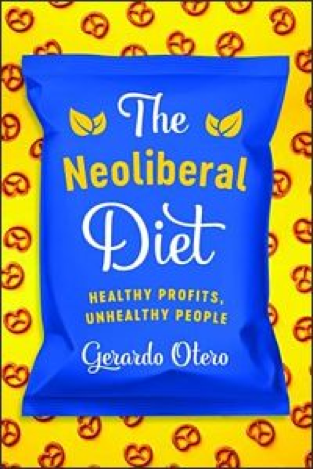
The capitalist diet: Energy-dense and profitable. A Review of The Neoliberal Diet: Unhealthy Profits, Unhealthy People by Gerardo Otero. (2018).
A recent book by Gerald Otero, The Neoliberal Diet: Unhealthy Profits, Unhealthy People, analyzes how global diets have changed in recent decades, what caused these changes, and who loses and gains by the transformation. In the book, Otero describes how the global diet that emerged at the turn of the 21st century has contributed to world-wide increases in overweight and obesity and how neoliberalism, the variant of capitalism that evolved in this period, promotes obesogenic diets.
The Philip Morris-funded Foundation for a Smoke-Free World: tax return sheds light on funding activities
In September, 2017, notes a new letter in Lancet, Philip Morris International, one of the world’s largest tobacco companies, set up the Foundation for a Smoke-Free World, with almost US $1 billion of funding over 12 years. The Foundation claims to be an independent scientific body aiming to “accelerate an end to smoking”. Yet controversy has surrounded the Foundation since its inception; its claims of legitimacy and independence have been strongly disputed and WHO and hundreds of public health organizations globally have taken a strong stance in rejecting collaboration with the Foundation.
Two Cheers for Air Pollution Control: Triumphs and Limits of the Mid-Century Fight for Air Quality
A smoggy Los Angeles street in 1960. Credit
As President Trump, the auto industry and the state of California battle over air pollution standards, a new article in Public Health Reports analyzes the early years of 20th-century air pollution control in Los Angeles. In both scholarship and public memory, mid-century efforts at the regional level were overshadowed by major federal developments, namely the Clean Air Act and creation of the US Environmental Protection Agency in 1970.
Science institute that advised EU and UN “actually industry lobby group”
An institute whose experts have occupied key positions on European Union and United Nations regulatory panels is, in fact, reports The Guardian, an industry lobby group that masquerades as a scientific health charity. The revelations, based on a review of more than 17,000 documents released under U.S. freedom of information laws, appear in a new article in Globalization and Health. Sarah Steele, the lead author and a researcher at Cambridge University said: “Our findings add to the evidence that this nonprofit organization has been used by its corporate backers for years to counter public health policies. ILSI should be regarded as an industry group—a private body and regulated as such, not as a body acting for the greater good.” Among the companies that support ILSI are Coca Cola and Monsanto.
In Runup to 2020 election, Renewed Action to Regulate the Pharmaceutical Industry
Overt the last several years, the pharmaceutical industry has been accused of inappropriately and misleadingly advertising prescription drugs to consumers, charging exorbitant prices, paying competitors not to release less expensive generic drugs, and negotiating trade agreements that benefit the industry at the expense of the public. As public concern about these practices grows and as the 2020 election gets closer, Big Pharma is getting closer scrutiny.
A few recent actions illustrate this new climate. Earlier this month, reports The New York Times, the Trump administration announced that for the first time will, it will require pharmaceutical companies to include the price of prescription drugs in television advertisements if the cost exceeds $35 per month. The move is the most visible action the administration has taken so far to address the rising cost of prescription drugs. It has been a key issue for American voters and one that both Republicans and Democrats have vowed to address.
In Congress, Reps. Judy Chu (CA-27) and Devin Nunes (CA-22) last month introduced the Sunshine for Samples Act of 2019. This bill would amend the Sunshine Act, which requires pharma companies to report payments to doctors, to require companies that manufacture drugs, devices, biologics, or medical supplies to publicly make available the number and value of free drug samples given to health care providers and charities each year. The bill closes a loophole in the Sunshine Act and does not prevent drug and device manufacturers from continuing to provide free samples, nor does it add any new burdens to providers under the Open Payment Programs.
Both the Federal Trade Commission and Congress have also acted to oppose “pay for delay” a costly legal tactic that more and more branded drug manufacturers have been using to stifle competition from lower-cost generic medicines. These drug makers have been able to sidestep competition by offering patent settlements that pay generic companies not to bring lower-cost alternatives to market. Last month , Congressman Jerrold Nadler introduced H. R. 2375 , the Preserve Access to Affordable Generics and Biosimilars Act. The bill proposes to prohibit prescription drug companies from compensating other prescription drug companies to delay the entry of a generic drug, biosimilar biological product, or interchangeable biological product into the market.
These recent actions suggest that the 2020 election will provide public health professionals and advocates with opportunities to educate the American people and elected officials about the practices of the pharmaceutical industry and to counteract pharma’s extensive spending to influence Congress.
Do alcohol control policies work? An umbrella review and quality assessment of systematic reviews of alcohol control interventions (2006– 2017)
The 2010 World Health Organization Global Strategy to Reduce the Harmful Use of Alcohol recommends countries adopt evidence-based interventions. A recent review in PLOS One updated, summarized, and appraised the methodological rigor of systematic reviews of selected alcohol control interventions in the Strategy. The authors identified 42 systematic reviews. Most reviews identified only observational studies with no studies from low or lower-middle income (LMIC) countries. Ten reviews were rated as low risk of bias. Methodological deficiencies included publication and language limits, no duplicate assessment, no assessment of study quality, and no integration of quality into result interpretation. We evaluated the following control measures as possibly beneficial: 1) community mobilization; 2) multi-component interventions in the drinking environment; 3) restricting alcohol advertising; 4) restricting on- and off-premise outlet density; 5) police patrols and ignition locks to reduce drink driving; and 6) increased price and taxation including minimum unit pricing. The authors concluded that robust and well-reported research synthesis is deficient in the alcohol control field despite the availability of clear methodological guidance. The lack of primary and synthesis research arising from LMIC should be prioritized globally.
Citation: Siegfried N, Parry C. Do alcohol control policies work? An umbrella review and quality assessment of systematic reviews of alcohol control interventions (2006–2017). PLoS One. 2019 Apr 10;14(4):e0214865.