Dirty dancing: Health journalists and the pharmaceutical industry

A new report analyzes the complex ways in which Belgian magazines deal with health information on the pharmaceutical industry supplied by PR practitioners.  Based on content analysis of health items in a representative sample of magazines and interviews with magazine health journalists and their editors, the authors found that academic and medical experts were  the most important sources for journalists.  While the researchers found few explicit references to pharmaceutical industry sources, the interviews suggest that pharmaceutical PR creeps into health coverage in a more indirect and much more sophisticated manner, for instance by offering additional services such as contacts with scientists or patients. The authors concluded that the influence of pharmaceutical PR in magazine health news is stronger than would be expected based solely on quantitative analyses of editorial content.

Full citation: De Dobbelaer R , Van Leuven S, Raeymaeckers K. Dirty dancing: Health journalists and the pharmaceutical industry a multi-method study on the impact of pharma PR on magazine health. Public Relations Review (2017), http://dx.doi.org/10.1016/j.pubrev.2017.02.002
What’s at stake as GOP moves to slash regulations? For starters, clean air

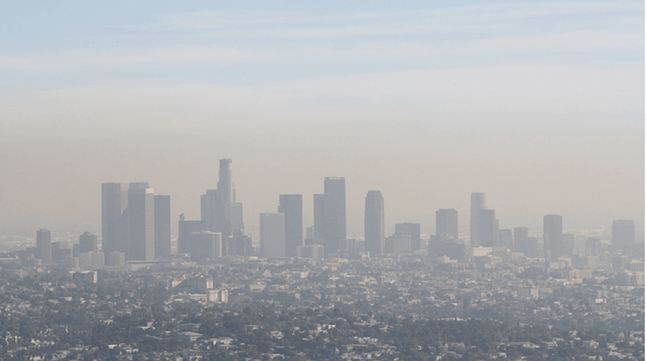
Air pollution over Los Angeles. Credit

The linchpin of a new 87-page proposal being considered by Congress is a directive to regulators that may be impossible to meet, reports the LA Times.  Regulatory agencies would have to prove they have taken the least costly option possible to business before imposing any major new rule. A similar mandate became stifling when applied for decades to the regulation of chemicals such as asbestos because it allowed companies to keep rules at bay by continually arguing for cheaper approaches. “I don’t think lawmakers are focusing on how extreme this legislation is,” said Paul Billings, lobbyist for the American Lung Association, which has joined several major public health groups imploring congressional leaders to apply the brakes. “It has been viewed as this abstraction that creates improvements in the regulatory process. This would undermine bedrock public health laws.”

Public health impact of excess nitrous oxides emissions from Volkswagen diesel passenger vehicles in Germany

A report in Environmental Health Letters estimates that 1,200 people in Europe will die prematurely because of excess nitrous oxide emissions released in Germany after Volkswagen installed “defeat device” software that allowed the cars to cheat on emissions test.  The MIT authors also estimate that by recalling and repairing the affected cars in Germany to meet current emissions standards by the end of 2017, Volkswagen could avert 2,600 additional premature deaths and save 4.1 billion euros in health costs.

Full citation: Chossière GP, Malina R, Ashok A, et al. Public health impacts of excess NOx emissions from Volkswagen diesel passenger vehicles in Germany. Environ. Res. Lett. 2017; 12:1-14.

Big Pharma Quietly Enlists Leading Professors to Justify $1,000-Per-Day Drugs

As it readies for battle with President Donald Trump over drug prices, writes Pacific Standard, the pharmaceutical industry is deploying economists and health-care experts from the nation’s top universities. In scholarly articles, blogs, and conferences, they lend their prestige to the lobbying blitz, without always disclosing their corporate ties. Over the last three years, pharmaceutical companies have mounted a public relations blitz to tout new cures for the hepatitis C virus and persuade insurers, including government programs such as Medicare and Medicaid, to cover the costs. That isn’t an easy sell, because the price of the treatments ranges from $40,000 to $94,000 — or, because the treatments take three months, as much as $1,000 per day.

Why Many Tobacco-Friendly Business Groups Are Now Switching Sides

The local chamber of commerce is usually a reliable ally in battles against regulation. But when it comes to smoking rules, many business groups have decided they would rather switch than fight, reports Reuters. Even in states where tobacco has played an important role in the economy—including North Carolina, Kentucky and Missouri—chambers have endorsed cigarette tax hikes, raising the smoking age and other efforts to curb tobacco habits. The shift has accelerated since 2016, driven by a growing awareness that smoking drives up healthcare costs for employers, business groups said. Smoking restrictions often are part of broader wellness initiatives, such as promoting exercise and nutrition, aimed at improving health—and business. “Smoking isn’t just killing us, it’s bankrupting us,” said Ashli Watts, a spokeswoman with the Chamber of Commerce for Kentucky, where one in four adults uses tobacco, the lung cancer rate is the nation’s highest and related healthcare and lost productivity costs nearly $5 billion a year. “Companies do look at the health of a workforce,” Watts said. An unhealthy workforce “is a deterrent.”

In Mexico, Evidence of Sustained Consumer Response Two Years after Implementing a Sugar-Sweetened Beverage Tax

Mexico implemented a 1 peso per liter excise tax on sugar-sweetened beverages on January 1, 2014, and a previous study found a 6 percent reduction in purchases of taxed beverages in 2014. A new study published in Health Affairs estimated changes in beverage purchases for 2014 and 2015. The authors used store purchase data for 6,645 households from January 2012 to December 2015. Purchases of taxed beverages decreased 5.5 percent in 2014 and 9.7 percent in 2015, yielding an average reduction of 7.6 percent over the study period. Households at the lowest socioeconomic level had the largest decreases in purchases of taxed beverages in both years. Purchases of untaxed beverage increased 2.1 percent in the study period. Findings from Mexico may encourage other countries to use fiscal policies to reduce consumption of unhealthy beverages along with other interventions to reduce the burden of chronic disease.

Citation: Cochero MA, Rivera-Dommarco J, Popkin BM, Ng SW. In Mexico, Evidence Of Sustained Consumer Response Two Years After Implementing A Sugar-Sweetened Beverage Tax. Health Aff (Millwood). 2017. pii: 10.1377/hlthaff.2016.1231.

Lawsuit alleges automakers knew of deadly Takata air-bag defects

Court documents filed this week allege that five auto companies were aware of defects that caused Takata air bags to potentially harm or kill motorists but continued to use them anyway to save on costs, reports The Washington Post. The documents claim that Honda, Ford, BMW, Toyota and Nissan have known about the issues with the Japanese manufacturer’s air bags for more than a decade but still used them because Takata was cheaper than its competitors and could produce the bulk quantities the automakers needed, according to the court documents.

Dangerous FTC Decision on Vehicle Safety Defects

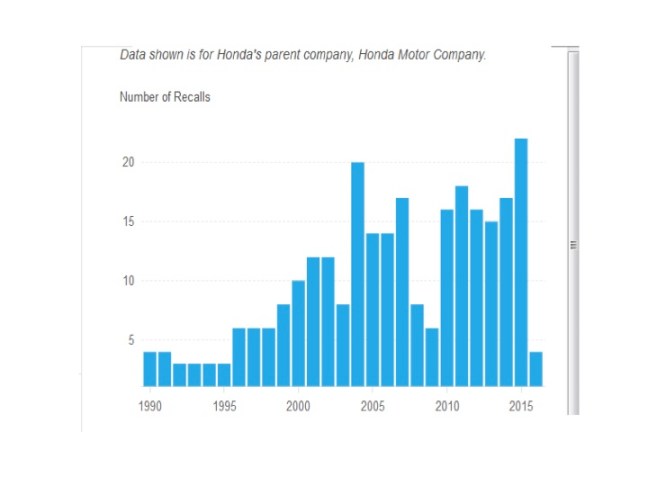
Honda Recalls 1990-2015. Honda earned the distinction as the car manufacturer with the most safety recalls, with over 13 million models affected in this period. For perspective, Honda’s recalls affected more vehicles than all the recalls of Mercedes-Benz, Hyundai, BMW, Nissan and Mitsubishi combined. Credit

A decision late last year by the Federal Trade Commission (FTC) was a repudiation of their statutory duty to protect consumers, writes Cathy Chase, Vice President of Governmental Affairs at the Advocates for Auto and Highway Safety. By finalizing consent orders with General Motors (GM) and the Lithia and Koons auto dealership chains, which allow them to advertise used cars with unrepaired safety defects under recall using misleading terms, consumers are duped and safety is jeopardized.  Unsuspecting consumers will be tricked by labels such as safe, repaired for safety, having passed a rigorous inspection, and using the imprimatur of certified.  Families will walk into dealerships to buy cars, be informed that the vehicles have been given a safety stamp of approval, be required to sign a pile of papers with a message tucked in that the car may be subject to un-repaired recalls for safety issues, and will drive off the lot at their own peril and a danger of everyone on the roads.

PHARMA to launch campaign against Cuomo’s plan to control prescription drug prices

Big Pharma is striking back at Gov. Cuomo’s proposal to control the price of prescription drugs, reports the New York Daily News. The Pharmaceutical Research and Manufacturers of America is set to launch a new campaign on Wednesday calling on state lawmakers to reject Cuomo’s plan, saying it will do nothing to improve patient access to needed prescription drugs while threatening research and development and New York jobs. The “Prescribe Real Solutions” campaign will include online ads, a new website and a series of events across the state urging New Yorkers to contact their legislators, those close to the effort say. State of Politics, meanwhile reports that Gov. Cuomo’s top health officials told state lawmakers that price control regulations will withstand legal challenges.

As Obesity Rises, Remote Pacific Islands Plan to Abandon Junk Food

While many governments struggle to ban soda to curb obesity, writes The New York Times, the tiny Torba Tourism Council in the remote Pacific island nation of Vanuatu is planning to outlaw all imported food at government functions and tourist establishments across the province’s 13 inhabited islands. Provincial leaders hope to turn them instead into havens of local organic food. The ban, scheduled to take effect in March, comes as many Pacific island nations struggle with an obesity crisis brought on in part by the overconsumption of imported junk food. “We want to ban all other junk food from this province,” Luke Dini, the council’s chairman and a retired Anglican priest, said in a telephone interview from Torba.