Alcohol exposure between 1990 and 2017 and forecasts until 2030: a global modelling study

Alcohol use is a leading risk factor for global disease burden, and data on alcohol exposure are crucial to evaluate progress in achieving global non-communicable disease goals. A new report in Lancet presents estimates on the main indicators of alcohol exposure for 189 countries from 1990–2017, with forecasts up to 2030.

The authors found that between 1990 and 2017, global adult per-capita consumption increased from 5·9 L to 6·5 L, and is forecasted to reach 7·6 L by 2030. The report forecasts that abstinence will decrease to 40% by 2030 and the proportion of current drinkers will increase to 50% by 2030. In 2017, 20% of adults were heavy episodic drinkers (compared with 1990 when it was estimated at 18·5%, and this prevalence is expected to increase to 23% in 2030.

Based on these data, global goals for reducing the harmful use of alcohol are unlikely to be achieved, and known effective and cost-effective policy measures should be implemented to reduce alcohol exposure.

Citation: Manthey J, Shield K, Rylett M, Hasan OS, Probst C. JR Alcohol exposure between 1990 and 2017 and forecasts until 2030: a global modelling study. Lancet.2019https://doi.org/10.1016/S0140-6736(18)32744-2

Public Policies to Reduce Sugary Drink Consumption in Children and Adolescents

maychw

Credit

Excess consumption of added sugars, especially from sugary drinks, contributes to the high prevalence of childhood and adolescent obesity, especially among children and adolescents who are socioeconomically vulnerable. It also increases the risk for dental decay, cardiovascular disease, hypertension, dyslipidemia, insulin resistance, type 2 diabetes mellitus, fatty liver disease, and all-cause mortality. The 2015–2020 Dietary Guidelines for Americans recommend that added sugars contribute less than 10% of total calories consumed, yet US children and adolescents report consuming 17% of their calories from added sugars, nearly half of which are from sugary drinks. A new reportfrom the American Academy of Pediatrics and the American Heart Association finds that decreasing sugary drink consumption is of particular importance because sugary drinks are the leading source of added sugars in the US diet, provide little to no nutritional value, are high in energy density, and do little to increase feelings of satiety. To protect child and adolescent health, the report recommends, broad implementation of policy strategies to reduce sugary drink consumption in children and adolescents is urgently needed.

Round up of Bayer’s recent legal woes from Monsanto

Bayer

Agricultural Application Trends of Glyphosate in the United States According to U.S. Geological Survey (USGS) Data Credit from  new ATSDR Report on Glyphosate

A French court has ruled that Monsanto was liable for the sickness of a farmer who inhaled one of its weed killers, in another legal setback for the Bayer-owned business over health claims, reports Reuters.

In the latest stage of a decade-long legal tussle, the appeals court in Lyon on Thursday found in favor of farmer Paul Francois’ claim that Monsanto’s Lasso weed killer had made him sick and that the product’s labeling had been inadequate. Francois, 55, says he suffered neurological problems, including memory loss, fainting and headaches, after accidentally inhaling Lasso in 2004 while working on his farm.

“Mr. Francois justifiably concludes that the product, due to its inadequate labeling that did not respect applicable regulations, did not offer the level of safety he could legitimately expect,” the court said in its ruling.

Another Reuters story reported that  Bayer said it would comply with a U.S. federal judge’s order to enter mediation with a plaintiff who claims the company failed to warn against an alleged cancer risk from its Roundup weed killer. Bayer has seen $34 billion wiped off its market value since August, when a first U.S. jury found Bayer liable because Monsanto, the Creve Coeur-based company acquired by Bayer for $63 billion last year, had not warned of the alleged risk from Roundup, which is based on active ingredient glyphosate. It suffered a similar courtroom defeat last month and more than 10,000 cases are pending.

U.S. District Judge Vince Chhabria, who presided over the first two cases in federal court, said in a filing dated Thursday that Bayer and another plaintiff, Elaine Stevick, were ordered to start confidential mediation.

A third Reuters post reported that one of Bayer’s largest shareholders tore into the company’s management on Wednesday for underestimating the legal risks of its takeover of Monsanto, setting the stage for a fiery annual general meeting after a 30 percent plunge in the shares. “It’s quite drastic when a takeover triggers such value destruction and reputational damage so quickly. There can be no talk of a successful takeover anymore,” Ingo Speich, the head of sustainability and corporate governance at Deka Investment, told Reuters.

“What’s startling is that things have effectively moved beyond management’s control because we’re now at a point where the decisions over future development are made in court rooms,” he said, adding Bayer had clearly underestimated the risks.

Finally, a public health agency of the U.S. Department of Health and Human Services (DHHS), the Agency for Toxic Substances and Disease Registry (ATSDR), released the long-awaited Draft Toxicological Profile for Glyphosate.  The report supports and strengthens the 2015 cancer assessment of another health agency, the International Agency for Research on Cancer (IARC).

As the environmental group NRD Cnotes, a pattern is emerging: non-industry experts (Zhang et al 2019) and health agencies IARC and ATSDR are finding a link with glyphosate and cancer; whereas, regulatory agencies are lining up with Monsanto and Bayer that it does not cause cancer, even when reviewing the same scientific evidence.

Advancing public health policy making through research on the political strategies of alcohol industry actors

April 2019 CHW

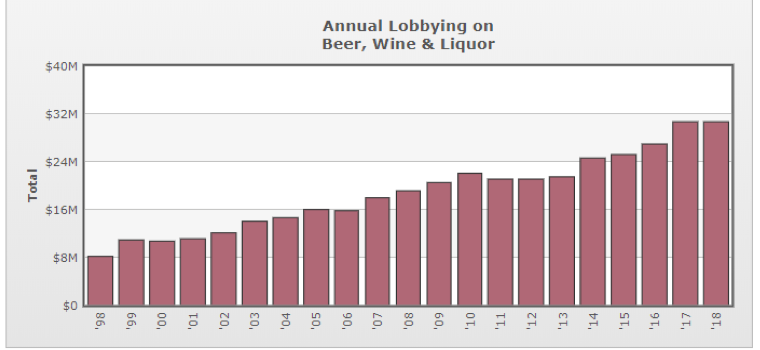
Lobbying expenses U.S. Beer, Wine and Liquor Industry. Source: Open Secrets

Development and implementation of evidence-based policies is needed in order to ameliorate the rising toll of non-communicable diseases (NCDs). Alcohol is a key cause of the mortality burden and alcohol policies are under-developed. This is due in part to the global influence of the alcohol industry. The authors propose that a better understanding of the methods and the effectiveness of alcohol industry influence on public health policies will support efforts to combat such influence, and advance global health. Many of the issues on the alcohol research agenda will inform, and be informed by, research into the political influence of other commercial actors.

Citation: McCambridge J, Kypri K, Sheldon TA, Madden M, Babor TF.   Advancing public health policy making through research on the political strategies of alcohol industry actors. Journal of Public Health. 2019; doi.org/10.1093/pubmed/fdz031.

Alcopops 2020 Time to End Big Alcohol’s Predation on Youth

Alcopops comprise a wide array of low-price, sugary, carbonated, heavily flavored alcoholic beverages. They can be very strong and very large, going as high as 14% alcohol by volume (ABV) and coming in single-serving cans as large as 25 oz. Their strength, combined with their resemblance in both packaging and flavor to sodas and energy drinks, makes them extraordinarily attractive—and dangerous—for youth. Read a new report on alcopops by Alcohol Justice.

New Report on Banks and Firearm Industry

Screen Shot 2019-04-04 at 7.19.09 PM

Credit

Firearm manufacturers are flooding our communities with militarized high-capacity handguns, assault rifles, pistols, and rifles, increasing the lethality of armed encounters and empowering mass killers.

“Is Your Bank Loaded?” is a new report by Guns Down America, a nonprofit group, that brings together key stakeholders to push America’s largest banks to stop doing business with the gun industry and its lobby until we adopt strict laws that make firearms significantly harder to get and impose safety standards on firearms. Guns Down America and its partners reviewed public financial and legal filings to determine how much business the nation’s 15 largest banks have conducted with gun manufacturers, the NRA, and the top recipients of NRA contributions in Congress. Based on this information, we have graded the banks on a 100-point scale.

Purdue Pharma and Sacklers Reach $270 Million Settlement in Opioid Lawsuit

CHW MArh 28

credit

Purdue Pharma, the maker of OxyContin, and its owners, the Sackler family, reports The New York Times,  agreed to pay $270 million to avoid going to a state court trial over the company’s role in the opioid addiction epidemic that has killed more than 200,000 Americans over the past two decades. The payment, negotiated to settle a case brought by the state of Oklahoma, was far larger than two previous settlements Purdue Pharma had reached with other states. It could jolt other settlement talks with the company, including those in a consolidated collection of 1600 cases overseen by a federal judge in Cleveland. “Purdue appears to have concluded that it was less risky to settle the Oklahoma case than have the allegations publicly aired against it during a televised trial and face exposure to what could have been an astronomical jury verdict,” said Abbe R. Gluck, a professor at Yale Law School who directs the Solomon Center for Health Policy and Law.

As more museums say no to Sackler donations, family trust halts its giving

In another story, The Washington Post writes that facing rejection from three major art museums, the philanthropic trust of the Sackler family, which built its wealth from Purdue’s  sale of opioids, announced that it would stop making donations. “I remain fully committed to all the causes the Sackler Trust supports, but at this moment it is the better course for the trust to halt all new giving until we can be confident that it will not be a distraction for institutions that are applying for grants,” Theresa Sackler, chairwoman of the trust, said in a statement on its website. The decision by many nonprofits to stop accepting Sackler donations may contribute to a de-normalization of the marketing practices of big pharmaceutical companies, a change that could set the stage for stronger public health regulation of these practices.

Causes, Consequences, and Control of High Cancer Drug Prices

We have seen a sharp increase in cancer drug prices in recent years, far exceeding the rates of inflation, writes Bishal Gyawaliin a chapter in a new book Cancer and Society. This increasing cost of cancer drugs has many adverse consequences not only for the economy of the country but also in clinical outcomes of cancer patients, a phenomenon referred to as “financial toxicity,” Indeed, the increasing cost of cancer drugs is no longer just a policy issue; it is also a clinical issue with clinical consequences such as increased risk of mortality, poor quality of life, and lack of adherence to medications among others. The author explores the causes and consequences of high cancer drug prices in detail and explores different strategies that have been proposed to control these costs.

Gyawali B. Causes, Consequences, and Control of High Cancer Drug Prices. In Cancer and Society 2019 (pp. 39-57). Springer, Cham.

Public health and the ultra-processed food and drink products industry: corporate political activity of major transnationals in Latin America and the Caribbean

chw pic march

To identify examples of the ‘corporate political activity’ (CPA) of the industry producing and selling ultra-processed food and drink products (UPP) in Latin America and the Caribbean, researchers searched the national websites and social media accounts of large industry actors in fifteen countries in Latin America and the Caribbean.  Coding was deductive and based on a framework for classifying the CPA of the food industry.

During the pilot study, more than 200 examples of CPA were found in Latin America and the Caribbean. The UPP industry lobbied governments during the development of national health policies. UPP companies tried to build alliances with health professionals, but also with communities where they operated and with policy makers. In addition, the UPP industry fought against regulation in court and proposed weaker alternatives to public health policies, such as self-regulation.

The authors concluded that food systems in low- and middle-income countries, including in Latin America and the Caribbean, are increasingly penetrated by the UPP industry. These countries are at risk of being influenced by the CPA strategies described in the present study. There is a need to further identify, monitor and evaluate the impact of these CPA strategies on public health policies and public opinion in the region, in order to develop mechanisms to effectively prevent such interference.

Mialon M, Gomes FDS. Public health and the ultra-processed food and drink products industry: corporate political activity of major transnationals in Latin America and the Caribbean. Public Health Nutr. 2019:1-11. doi: 10.1017/S1368980019000417. [Epub ahead of print]