Case Studies on Corporations & Global Health Governance, edited by Nora Kenworthy, Ross MacKenzie and Kelley Lee, presents interdisciplinary case studies on how corporations influence global health governance and how they could be held more accountable. The empirical studies examine several industries across high, low and middle income countries and explore the impact of corporations and their allies on the governance processes that shape population health.
Gays Against Guns: civil disobedience campaign to target gun companies

Hundreds of gay activists will begin a campaign of civil disobedience and direct action against gun companies and their supporters, to demand an end to the epidemic of gun violence blighting the US, reports The Guardian. Members of Gays Against Guns, a group formed in the wake of the massacre of 49 people at the Pulse gay nightclub in Orlando earlier this summer, said they would “no longer stand by and watch the gun industry profit from death”. Above, the group pictured during the 2016 NYC Pride March. Credit.
Patients’ Groups and Big Pharma
A new report by Public Citizen found that of 147 patients’ groups that sided with the pharmaceutical industry against a Medicare Part B demonstration project designed to lower the prices of expensive drugs, at least 110 (75%) received funding from the industry. Continue reading Patients’ Groups and Big Pharma
Evidence Suggests the Oil Industry Wrote Big Tobacco’s Playbook
“Exxon and its allies have dismissed comparisons to Big Tobacco as baseless”, writes Smoke and Fumes, a project of the Center for International Environmental Law. “Our research in more than 14 million documents of the Tobacco Industry Archives reveals compelling evidence that the relationship between these two industries is neither coincidental nor casual. Beyond a doubt, the oil companies have benefitted from the tobacco playbook in their fight against climate science. But the question arises, where did the tobacco companies get their playbook in the first place?” Read more.
Moral Jeopardy: What are the risks of accepting money from the alcohol, tobacco and gambling industries?
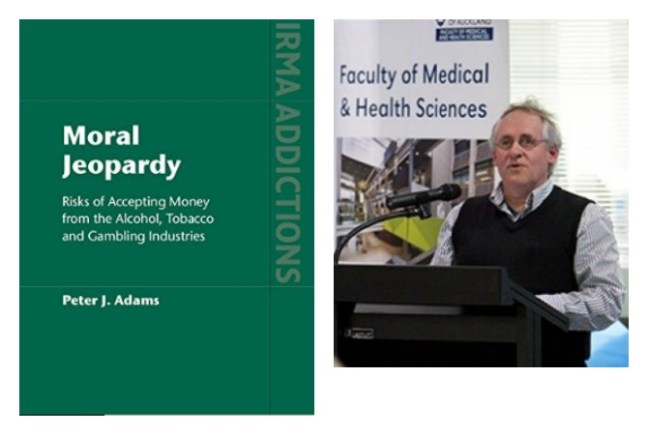
In his new book, Moral Jeopardy: Risks of Accepting Money from the Alcohol, Tobacco and Gambling Industries (Cambridge University Press, 2016), Peter Adams examines the ethical issues that arise when people and organizations accept money from tobacco, alcohol and gambling corporations. Adams is professor and deputy head of the School of Population Health at the University of Auckland in New Zealand and an associate director of its Centre for Addiction Research. Corporations and Health Watch’s Nick Freudenberg conducted this e-mail interview of Adams. Continue reading Moral Jeopardy: What are the risks of accepting money from the alcohol, tobacco and gambling industries?
Philip Morris gets its ash kicked in Uruguay; where will it next blow smoke?
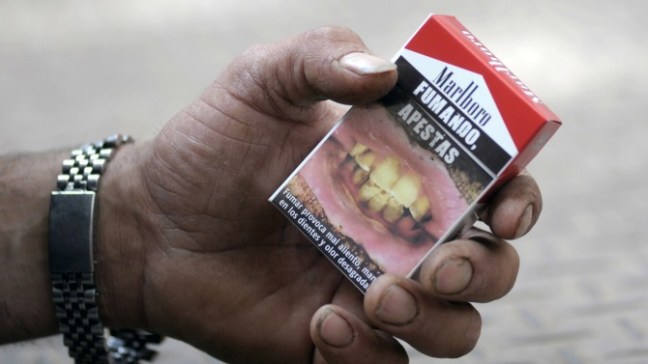
Philip Morris International just lost a six-year battle to block Uruguay’s strong cigarette warning labels, which cover 80 percent of the front and back of cigarette packs, including graphic photos of the damages of smoking, write Eric Crosbie and Stanton Glanz in The Conversation. Continue reading Philip Morris gets its ash kicked in Uruguay; where will it next blow smoke?
Public Opinion Regarding Whether Speaking With Patients about Firearms Is Appropriate: Results of a National Survey
Health care providers have been encouraged to discuss firearms with patients; whether patients view these discussions as appropriate is unclear. In an online survey of U.S. adults, researchers found that two thirds of non–firearm owners and more than one half of firearm owners in the United States believe that health care provider discussions about firearms are at least sometimes appropriate.
Citation: Betz ME, Azrael D, Barber C, Miller M. Public Opinion Regarding Whether Speaking With Patients About Firearms Is Appropriate: Results of a National Survey. Ann Intern Med. [Epub ahead of print 26 July 2016] doi:10.7326/M16-0739
Welcome to Brazil, Where a Food Revolution Is Changing the Way People Eat
Over the last 30 years, big transnational food companies have aggressively expanded into Latin America. Taking advantage of economic reforms that opened markets, they’ve courted a consumer class that has grown in size due to generally increasing prosperity and antipoverty efforts. In recent years, Brazil has inscribed the right to food in its Constitution and reformed its federal school-lunch program to broaden its reach while bolstering local farms. And in 2014, the Ministry of Health released new dietary guidelines that emphasized unprocessed food. Read more from Bridget Huber’s report on food developments in Brazil in The Nation.
In hard-hitting ad campaign, Philly targets tobacco industry marketing practices
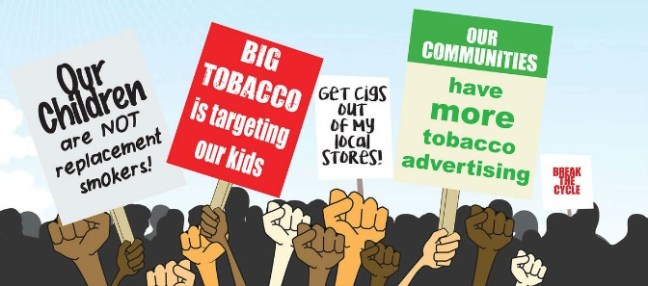
“Our children are not replacement smokers!” a protest leader cries in a radio spot, reports the Philadelphia Inquirer. “We have the power!” the crowd responds – which is exactly the point of this unusually aggressive new campaign targeting the tobacco industry’s heavy marketing in low-income and African American neighborhoods. On ads inside SEPTA buses and subway cars, a giant, cuff-link-adorned hand representing the tobacco industry plucks a black teenager from a line of friends, leaving the chalk outline of the teen’s body behind.
When Will Food Issues Be on Politicians’ Plates?
Even though the cultural conversation around food and agriculture seems to grow louder every day, the American food system was on the sidelines at the Republican Convention in Cleveland last week, and at the Democratic National Convention in Philadelphia this week, writes Kim Severson in The New York Times. Even among those most likely to push for it, food isn’t getting much attention as a political issue. “What people think is cool about food and what people think is cool about politics are different,” said Matt Birong, a Democratic delegate from Vermont who continues to support Senator Bernie Sanders.
 Corporations and Health Watch