Soda and Fast Food Lobbyists Push State Preemption Laws to Prevent Local Regulation

Credit

When the city council of Santa Fe, New Mexico, placed a measure on the local ballot to tax sugary drinks earlier this year, writes Rob Waters in Forbes, the soda industry responded quickly, pouring $1.3 million into the anti-tax campaign. To cover their bases, industry lobbyists also pursued a back-up plan: they backed a bill in the state legislature to strip local governments of the power to levy such taxes. In the end, the state language was added to another bill that sailed through the New Mexico House before dying in a Senate committee, shortly before Santa Fe voters defeated the local soda tax. But as a growing number of cities consider and increasingly pass soda taxes and other measures designed to combat obesity and promote healthy eating, the food industry has turned to preemption, a strategy used extensively by the tobacco and gun lobbies.

Canadian drug makers assailed for lack of transparency over payments

Ten of Canada’s largest pharmaceutical companies, reports Toronto’s Globe and Mail, have revealed that together they spent at least $48.3-million on payments to physicians and health-care organizations last year, a voluntary disclosure that critics of Big Pharma say falls well short of genuine transparency.  The figures provided a peek into how drug makers compensate Canada’s physicians for consulting, delivering speeches, sitting on advisory boards and traveling to international medical conferences. But the companies did not name any of the doctors, nor did they reveal the total number of physicians they paid or the amounts they provided to doctors for running clinical trials.

Cutting alcohol consumption in Scotland

A new Health Scotland report, Monitoring and Evaluating Scotland’s Alcohol Strategy: Monitoring Report 2017, shows that in 2016, 10.5 litres of pure alcohol were sold per adult in Scotland, equivalent to 20.2 units per adult per week.  This means that enough alcohol was sold last year in Scotland for every adult to exceed the weekly guideline limit (of 14 units per week on a regular basis) every week.  “Alcohol has become more affordable in recent years as disposable income has increased,” said Lucy Giles, the report’s lead author. BMA Scotland council chair Peter Bennie said wide-ranging action was needed. ‘In particular, minimum-unit pricing – a policy that big alcohol producers have spent the last five years delaying, and trying to prevent – would have a significant impact on reducing alcohol harms and must be implemented as swiftly as possible.

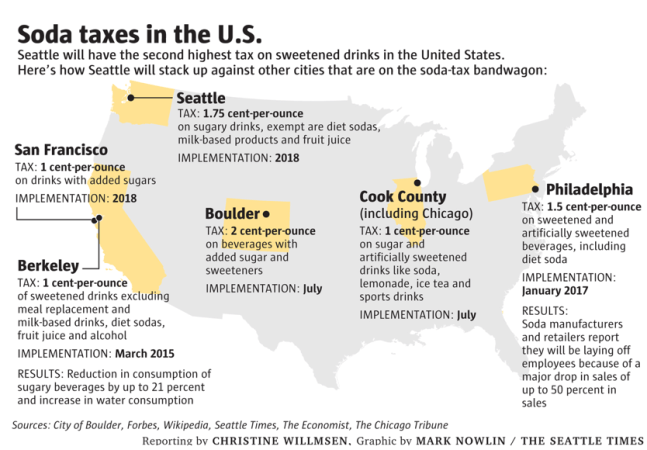
Can U.S. local soda taxes continue to spread?

Credit: http://www.seattletimes.com/seattle-news/politics/seattle-city-council-says-yes-to-soda-tax/

Taxes to reduce the consumption of sugar-sweetened beverages (SSBs) such as soda drinks have been endorsed by the World Health Organization and are now in place in France, Hungary, and Mexico, and scheduled for Portugal, South Africa, and Great Britain. Such taxes have so far been impossible to enact in the United States at the state or federal level, but since 2014 seven local jurisdictions have put them in place. Three necessary conditions for local political enactment emerge from this recent experience: Democratic Party dominance, external financial support for pro-tax advocates, and a political message appropriate to the process (public health for ballot issues; budget revenue for city council votes). Roughly 40 percent of Americans live within local jurisdictions where the Democratic Party dominates, so room exists for local SSB taxes to continue spreading.

Citation: Paarlberg R, Mozaffarian D, Micha R. Can US local soda taxes continue to spread?. Food Policy. 2017 Aug 31;71:1-7.

What Public Health Practitioners Need to Know About Unhealthy Industry Tactics

If you are working to improve public health and the environment, writes Rob Moodie in the American Journal of Public Health,  you need to know what your opponents are up to. Here is a quick guide to their tactics:

  1. Attack legitimate science
  2. Attack and intimidate the scientists
  3. Create arms-length front organizations
  4. Manufacture false debate and insist on balance
  5. Frame key issues in highly creative ways
  6. Fund industry disinformation campaigns
  7. Influence the political agenda

Citation: Moodie, AR. “What Public Health Practitioners Need to Know About Unhealthy Industry Tactics”, American Journal of Public Health 2017; 107(7): 1047-1049.

Childhood Firearm Injuries in the United States

A study in Pediatrics examines fatal and nonfatal firearm injuries among children aged 0 to 17 in the United States, including intent, demographic characteristics, trends, state-level patterns, and circumstances. Nearly 1300 children die and 5790 are treated for gunshot wounds each year. Boys, older children, and minorities are disproportionately affected. Although unintentional firearm deaths among children declined from 2002 to 2014 and firearm homicides declined from 2007 to 2014, firearm suicides decreased between 2002 and 2007 and then showed a significant upward trend from 2007 to 2014. Rates of firearm homicide among children are higher in many Southern states and parts of the Midwest relative to other parts of the country. Firearm homicides of younger children often occurred in multivictim events and involved intimate partner or family conflict; older children more often died in the context of crime and violence. Firearm injuries are an important public health problem, contributing substantially to premature death and disability of children. Understanding their nature and impact is a first step toward prevention.

Citation: Fowler KA, Dahlberg LL, Haileyesus T, et al.Childhood Firearm Injuries in the United States. Pediatrics. 2017;140(1): e20163486

Conflicts of interest in health care journalism. Who’s watching the watchdogs?

Credit

Many journalists are aware of the drug industry’s attempts to gain positive attention by buying placement within the nation’s health care news.  A few occasionally write or talk about it, as Harder and Rosenthal did publicly. But, writes Gary Schwitzer in Health News Review, we don’t talk often enough about why it matters if health care industry entities are allowed to advertise within, or sponsor, health care journalism content.  Americans spend more than $3 trillion on health care. Conflicts of interest in health care and research are rampant. But who talks about conflicts of interest in health care journalism? There is a great potential harm in journalists – and the audience they serve – becoming numb to the presence of and influence of drug companies and other industry entities in the news and information disseminated to the public.  In a three part series, Health News Review examines this problem. Read Part 1.  Read Part 2.

Nassau County Sues Drugmakers Over Opioid Epidemic

Nassau County on Long Island  filed a lawsuit Monday against several pharmaceutical companies, alleging their prescription painkillers helped fuel the opioid epidemic that costs the county millions of dollars annually to combat, reports the Wall Street Journal. The complaint, filed in Nassau County Supreme Court, targets several companies including Teva Pharmaceutical Industries Ltd., Purdue Pharma LP and Janssen Pharmaceuticals Inc. The defendants also include drug distributors and doctors.

Food Watchdog Groups Sue Trump Administration Over Menu Labeling

The Center for Science in the Public Interest and the National Consumers League, both represented by the nonprofit law firm Earthjustice, filed a lawsuit last week in U.S. District Court for the District of Columbia challenging the U.S. Food and Drug Administration’s decision to delay a rule requiring chain restaurants, supermarkets, convenience stores, and other food retail establishments to post calorie counts for prepared food and beverages. FDA issued the rule requiring disclosure of calorie counts and other nutrition information in 2014 but, one day before industry was due to comply in May 2017, the FDA delayed the compliance deadline for an additional year until May 2018. Without menu labeling, it’s hard for consumers to estimate the calorie content of popular restaurant items.

Leaving the Paris Climate Accord Could Lead to a Public Health Disaster

Credit

Seven million people died prematurely in 2012 from air pollution caused by fossil fuel combustion, according to a 2014 report by the World Health Organization. So President Trump’s decision to halt U.S. compliance with the 2015 Paris climate agreement is a blow not just to climate science and international diplomacy — it’s also a looming disaster for public health, reports Scientific American. A review of dozens of studies published between 2009 and 2014 link climate change to increases in a wide range of health problems, including asthma and other respiratory disorders, heart disease induced by heat stress, infectious diseases, waterborne diseases that can cause dangerous bouts of diarrhea in children, and mental health issues such as depression and PTSD following climate-related natural disasters such as hurricanes.