TPP Caves to the Tobacco Industry, Threatens Public Health

Ellen R. Shaffer, Joseph E. Brenner   Nov. 6, 2015               Cross-posted from CPATH

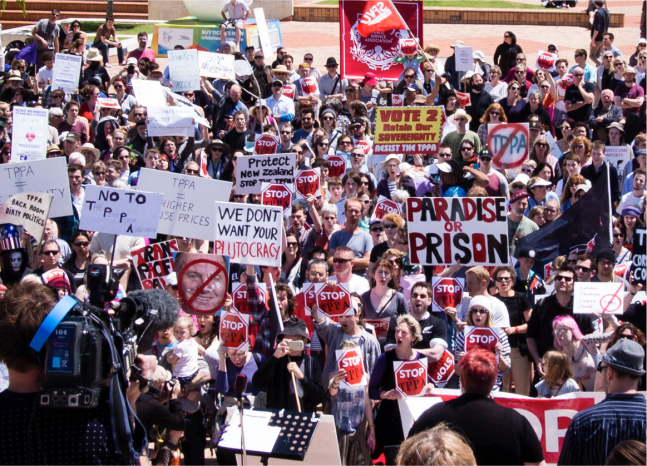
The vacuous “tobacco control” provision in the Trans Pacific Partnership (TPP) virtually capitulates to the demands of multinational tobacco corporations, jeopardizing nations’ health and economic welfare.  Public health and medical advocates in the U.S. and abroad consistently urged negotiators to exclude tobacco control protections from trade challenges under the TPP.  But tobacco industry opposition won the day, bolstered by corporate allies concerned that addressing the uniquely lethal effects of tobacco in trade agreements could set a precedent for reining in their own practices.

Continue reading TPP Caves to the Tobacco Industry, Threatens Public Health
India drug industry says U.S.-led trade deal will raise prices

Reuters reports that leaders of India’s $15 billion pharmaceuticals industry, a major supplier of affordable generics to the world, have joined public health activists in criticizing a new U.S.-led trade deal they say will delay the arrival of new cheap drugs. Industry executives said provisions of the Trans-Pacific Partnership (TPP) deal struck earlier this month between 12 nations that shield new drug data from competitors would hurt their business in those nations.

Corporations improve reporting of political activity — with exceptions

The Center for Political Accountability and the Zicklin Center for Business Ethics Research at the University of Pennsylvania’s Wharton School rated 500 companies on their political activities. The study found  most companies are reporting more of their activities—with some exceptions.

Why VW and Johnson & Johnson Crossed the Line: Towards a Theory of Corporate Law Breaking

By Nicholas Freudenberg, Founder, Corporations and Health Watch

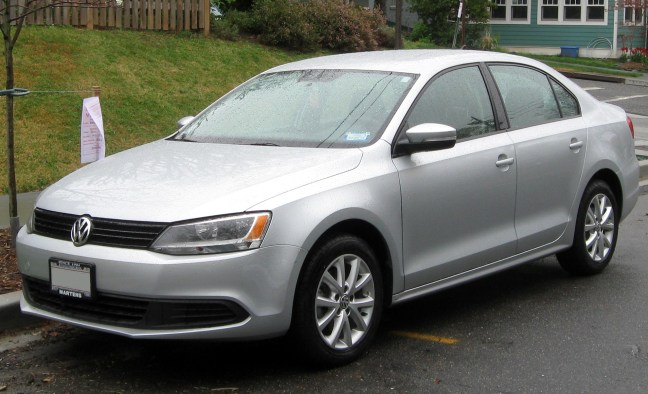
Readers of Corporations and Health Watch are familiar with the argument that the corporate practices that harm health are for the most part perfectly legal. However, recent media coverage of the scandals at Volkswagen and Johnson & Johnson led me to ask why some businesses choose to break the law. In the first, documented thoroughly in Steven Brill’s 15 chapter “docuserial” America’s Most Admired Lawbreaker posted last month on the Huffington Post Highline, the drug and medical device maker Johnson and Johnson (J&J) promoted Risperdal, an antipsychotic drug approved by the FDA for treating schizophrenia to children and older people for a much wider set of indications than those approved by the FDA. In 2013, Johnson & Johnson agreed to pay more than $2.2 billion in criminal and civil fines to settle accusations that it improperly promoted Risperdal.

Risperdal Continue reading Why VW and Johnson & Johnson Crossed the Line: Towards a Theory of Corporate Law Breaking

Health and Trade: what hope for SDG3?

Emma Woodford, Founder and Director, Health and Trade Network (HaT)

Cross posted from Health and Trade Network

“… the forces of power, particularly corporate power, are impatient with what is adequate for a coherent community. Because power gains so little from community in the short run, it does not hesitate to destroy community for the long run.” ― Wes Jackson, Becoming Native to This Place

In case you had been asleep for the last ten days, last week in New York the UN finally ratified the Sustainable Development Goals (SDGs) aiming to end poverty, protect the planet, and ensure prosperity for all.

Continue reading Health and Trade: what hope for SDG3?

Is Exxon the new tobacco?

From the late 1970s to the mid-80s, Exxon scientists worked at the cutting edge of climate change research, documents examined by Inside Climate News show. Exxon documents show that top corporate managers were aware of their scientists’ early conclusions about carbon dioxide’s impact on the climate. They reveal that scientists warned management that policy changes to address climate change might affect profitability.

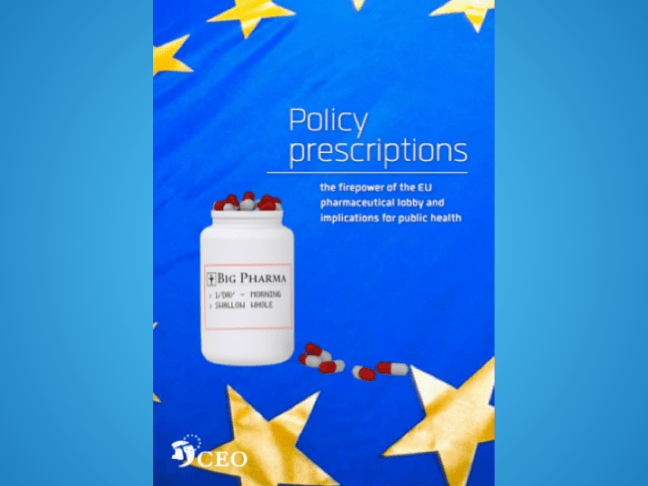
Policy prescriptions: The firepower of the EU pharmaceutical lobby and implications for public health

Corporate Europe Observatory                                                                

Executive summary

The pharmaceutical industry – including companies, associations and the top ten lobby firms they employ – have a declared lobby spend of nearly €40 million. That is around 15 times more than the lobby expenditure of civil society and consumer groups which work on public health or access to medicines. Although many pharma industry actors declare more realistic expenditure in the lobby register than three years ago, the real spending may be much more. Nonetheless, the top ten biggest spending pharmaceutical companies now declare €6 million more than in 2012, whilst the top eight European pharmaceutical industry trade associations declare seven times more. Moreover this powerful lobby has had a staggering number of meetings with European Commission departments and officials. The largest public-private partnership in the EU is with the pharmaceutical industry. Alongside its gargantuan resources and considerable access, the industry has an impressive lobbying arsenal. Its efforts are now focused on ensuring US-EU trade agreement TTIP furthers its profit-motivated agenda, including its property rights and to prevent vital data transparency for big pharma’s clinical trials.

Continue reading Policy prescriptions: The firepower of the EU pharmaceutical lobby and implications for public health

The 100 Largest Governments and Corporations by Revenue

Nicholas Freudenberg

How does the size of governments and corporations compare? To answer this question, I identified one metric often used to measure the size of organizations: annual revenues. I then found a source for annual revenues for governments, The CIA World Fact Book and another for corporations, The Global Fortune 500 List. Both provided data for 2014. The results below show that of the 100 governments and corporations with the highest annual revenues in 2014, 63 are corporations and 37 are governments. Previous analysts have compared corporations to national economies, a different measure. In 2000, Anderson and Cavanagh found that of the 100 largest economies in the world, 51 were global corporations and 49 were countries. In 2012, the economic analyst D. Steven White listed the top 175 “economic entities” in the world for 2011, using GDP for nations and revenues for corporations. Of these, 63% were corporations and 37% were nations.

Continue reading The 100 Largest Governments and Corporations by Revenue

Trans-Pacific Partnership Agreement Must Protect Nations’ Right to Enact Measures to Reduce Tobacco Use

Statement of Matthew L. Myers, President, Campaign for Tobacco-Free Kids

TPP map
The nations of the Trans Pacific Partnership (credit)

As they complete negotiations on the Trans-Pacific Partnership (TPP) trade agreement, the United States and the 11 other countries involved must ensure the final agreement protects the right of participating nations to adopt public health measures to reduce tobacco use and prevents tobacco companies from using the TPP to attack such measures.

Continue reading Trans-Pacific Partnership Agreement Must Protect Nations’ Right to Enact Measures to Reduce Tobacco Use