Nine of the “Big 10” global food and beverage companies have improved their ratings by at least 10 percent in three years since Oxfam began keeping score through its “Behind the Brands” scorecard. Oxfam highlighted the major strides most of them have made to improve their policies on land rights, agricultural greenhouse gas emissions and gender equality in company supply chains. Kellogg (up 30 percent) and Unilever (up 26 percent) made the most progress across all themes since the campaign began.
Globalization, Health and Corporations
What are the positive and negative health consequences of globalization? How do trade pacts influence health? What role do corporations play in shaping the direction of globalization? On April 4, 2016, Ron Labonté, Research Chair in Globalization and Health Equity at the School of Epidemiology, Public Health and Preventive Medicine at the University of Ottawa addressed these and other questions at a talk on “Globalization and the (new) political economy of health” at the City University of New York School of Public Health. View the presentation here.
photo credit: Institute of Population Health, 2007
Houston hospitals under fire for offering fast food
Corporate Accountability International (CAI) reports that two national groups have called on several Houston hospitals to remove fast-food chain restaurants from their grounds. One recent campaign by the Physicians Committee for Responsible Medicine focused on Chik-fil-A. It says about 20 hospitals across the country have the franchise, and it launched an advertising and billboard campaign that parodied Chik-fil-A’s slogan, with white-coated doctors asking people to “Eat More Chickpeas.” Taylor Billings, a Houston organizer for CAI, criticized both Texas Children’s and Ben Taub hospital for having a McDonald’s. “To have two of the leading health institutions in Houston hosting the world’s most recognized junk food brand, it just doesn’t make any sense,” Billings said at a protest March 31 outside the headquarters of the Harris Health System in Houston.
7 Corporate Giants Accused of Evading Billions in Taxes
It’s tax season—and that’s apt for companies who are under the microscope of European tax authorities, writes Fortune. In February, reports emerged that the European Commission is considering a proposal that would force multinationals to reveal their tax bills in 28 European countries. Why? Because corporate tax-dodging costs the EU between $54.5 billion and $76.4 billion a year, according to a study by the European Parliamentary Research Service.
Trading Down: Unemployment, Inequality and Other Risks of the Trans-Pacific Partnership Agreement
Adverse impacts of the Trans Pacific Partnership on public health have been well documented but how might the pact affect regional and global economies? A new report “Trading Down: Unemployment, Inequality and Other Risks of the Trans-Pacific Partnership Agreement,” on the Trans Pacific Partnership by investigators at Tufts University asks that question. It concludes that “the benefits to economic growth are even smaller than those projected with full-employment models, and are negative for Japan and the United States. More important, we find that the TPP will likely lead to losses in employment and increases in inequality.”
Trade groups to top corporations: Resist political disclosure
The Center for Public Integrity reports that three of the nation’s leading trade associations have a message for their member corporations: Resist activists who demand you disclose more details about your politicking than the law requires.
New Report on Dangerous Regulatory Duet
“Regulatory cooperation” is set to be at the heart of the Transatlantic Trade and Investment Partnership (TTIP), which is currently under negotiation between the European Union and the US. A new report from the Corporate Europe Observatory warns that the treaty will allow bureaucrats and big business to attack the public interest. The report looks at cases of regulatory cooperation between the US and the EU that have had a negative impact on regulations in the public interest. It illustrates that TTIP was born out of a dialogue between big business and trade officials, and as a result clearly reflects the enthusiasm of transnational corporations for regulatory issues.
Progress and Problems Government Scientists Report on Scientific Integrity at Four Agencies
Union of Concerned Scientists
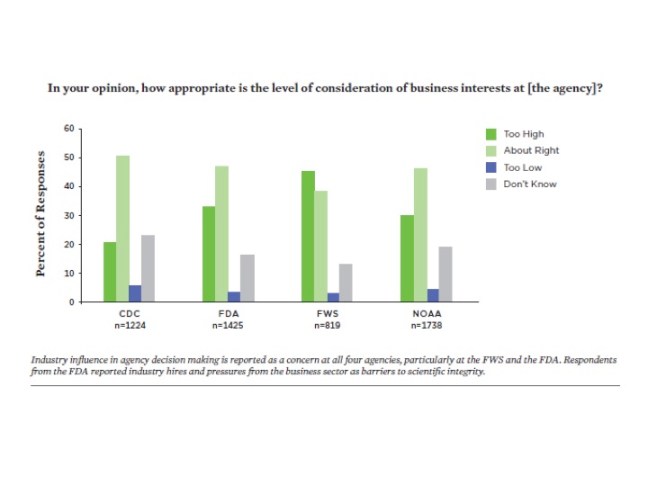
UCS released a new report on scientific integrity at four federal agencies: US Centers for Disease Control and Prevention, Food and Drug Administration, Fish and Wildlife Service, and the National Oceanic and Atmospheric Administration. Almost a third (31%) of the 5,206 scientists who answered the survey reported that they thought business interests played too big a role in agency decisions.
Settling for a Lack of Accountability?

Phineas Baxandall and Michelle Sukra
The United States Public Interest Research Group Education Fund released a report that examines which federal agencies allow companies to write off out-of-court settlements as tax deductions, and which are transparent about it. Here’s the Executive Summary.
How an $84,000 drug got its price
Gilead Sciences executives were acutely aware in 2013 that their plan to charge an exorbitantly high price for a powerful new hepatitis C drug would spark public outrage, reports the Washington Post, but they pursued the profit-driven strategy anyway, according to a Senate Finance Committee investigation report released Tuesday.
 Corporations and Health Watch