After 41 years with McDonald’s, Jim Skinner will be replaced as CEO by Donald Thompson, the company’s current president, reports Time. In a press release, Corporate Accountability International (CAI) reflects on Skinner’s tenure. Child obesity rates have risen in his eight years as CEO, with studies linking fast food and its marketing to the epidemic of diet-related diseases. McDonald’s has dismissed health concerns, fought menu labeling and spent millions on misleading PR. CAI hopes that Thompson will reverse these trends that have sacrificed health to boost profit.
Whistleblower to Maker of Pink Slime: “Quit Harassing Me”
Cross-posted from Appetite for Profit.
This past week, the media woke up to the shocking reality that our meat supply is in fact industrialized. Long gone are the days of your friendly local butcher grinding meat for your kids’ hamburgers. Taking its place is a corporate behemoth you probably never heard of called Beef Products Inc.
BPI now finds itself on the receiving end of consumer outrage over its ammonia-treated ground beef filler a former USDA official coined “pink slime.” Thus far, a petition aimed at getting current USDA officials to stop using the scary stuff in school lunches has garnered more than 200,000 signatures in about a week.
 All the hullaballoo reminded me of a dramatic talk I witnessed about a year ago on this very topic. Last February, I spoke at a conference organized by the Government Accountability Project’s Food Integrity Campaign called “Employee Rights and the Food Safety Modernization Act” in Washington, D.C. The event’s focus was the little-known, but critical aspects of the newly-enacted food safety law that would give whistleblowers added protection.
The show-stopping presentation came from Kit Foshee, a whistleblower fired by Beef Products Inc., the very same company now in the news for pink slime.
So I went back to watch his presentation again, which the conference organizers were kind enough to make available. (But only after Foshee’s attorneys gave their approval – it will soon become apparent why that huddle was needed.)
What made Foshee’s talk so remarkable was its content – he spoke in great detail about BPI’s ammoniated beef process – but also his bravery at confronting his former employers, who just happened to be in the room.
A few minutes into his talk, as Foshee was pointing out the absurdity of BPI’s food safety awards on their website, he dramatically turned to his left to the BPI attorneys and asked if they were there to protect whistleblowers and to support the Food Safety Modernization Act, like the rest of us were?
I stopped taking notes and looked over, as everyone else in the room did. I can’t recall ever being at a conference hearing a whistleblower speak, let alone one that was confronting the company that fired him. The tension in the room was palpable but Foshee plowed ahead, with some nervousness in his voice.
He answered for the BPI reps, who weren’t interested in dialogue:
No, I am going to tell you right now, they’re not here to protect whistleblowers. This is about me. They’re here with their tape recorder because they are going to find a way to shut me up. They’ve got sealed documents, that if I say anything about, they’re going to persecute me. So we’re going to stick with the publicly available information, from their website, to stay safe.
(Foshee was referring to sealed court documents that resulted from his wrongful termination lawsuit against BPI.)
He described the adding of ammonia as “Mr. Clean.” He asked if people would buy hamburgers if they knew BPI used ammonia “to clean it up,” and spoke of the awful smell of the filler material. But “you don’t know that,” he said, and “you should be able to make a choice.”
The main way BPI and the meat industry has defended using ammonia (see this silly website just up – http://pinkslimeisamyth.com) is by claiming the safety benefits in reducing bacteria. This, by the way, was soundly disputed back in 2009 in an award-winning expose by the New York Times.
Foshee (who worked as BPI’s Corporate Quality Assurance Manager for ten years) – disputed the company’s safety claims in great detail. He called claims of reduced levels of the deadly strain of E. coli 0157:H7 “totally misleading.”
He said BPI would manipulate test results in various ways, including raising pH levels and not using the most effective testing methods available for detection. He called BPI’s claims that its testing was the best in the industry “a farce” and that “all they wanted was a test to give a negative result” and move on.
He added, directing his remarks to the BPI attorneys in the audience, “you want to promote that you’re a safe company to further your sales” but (pointing to their webpage) “this is false advertising.”
He noted that BPI is actually a detriment to food safety because many companies eliminated their own testing, relying instead on BPI’s claims of safety. “I don’t blame companies for believing it, because what idiot would claim that?”
In another dramatic moment, he challenged the BPI reps by saying “You want to sue me? Sue me, but quote your own studies correctly. It’s on your website. Quit trying to mislead consumers to thinking that if they buy from a company’s that uses BPI products in its ground beef, it’s safer – that’s absolutely false.”
In keeping with the theme of the conference, he explained why we need to protect whistleblowers: “because companies falsify data. This is still happening. This is real. This is a company is still falsely advertising right now. Their product is in all the ground beef that you’re eating every day.”
He also explained how painful it was to get fired. He divorced because of the toll the experience took on his marriage. “You try to explain to your spouse why you’re giving up $30,000 bonuses.” He had made over $100,000, but no more.
He finished with a challenge directed at the BPI attorneys in the room:
I wonder if there’s something in those sealed documents that they don’t want to know about, that I can’t talk about right now. I challenge BPI: why don’t you come here to promote whistleblowers and instead of to persecute me? Let’s open up these documents and see who’s lying? Let’s get this all out into the open. Why don’t you quit harassing me?
Why indeed. What’s in those documents? What is BPI trying to hide?
Next time you read sorry excuses from BPI like these, check out Foshee’s talk online and ask yourself, is this really a reliable company?
According to Amanda Hitt, director of the Food Integrity Campaign, within hours of Foshee’s talk, BPI removed entire sections of its website. She also disputes BPI’s claims of food safety and says the goal was to offer up cheap filler for hamburgers: “This product was never about safety, it’s about economics.”
Meantime, pink slime is just one of many problems with industrialized meat, so let’s not lose sight of that bigger picture. What to do about it? Demand labeling, buy organic, or just don’t eat ground beef.
Read more about Foshee and the Government Accountability Project’s Food Integrity Campaign. Thanks to brave whistleblowers like Kit Foshee for speaking out and let’s hope the media pays more than just passing attention to these critical issues.
Image Credit:
PepsiCo: Master of Corporate Spin?
Cross-posted from Appetite for Profit.
When I ask people to name the largest food company in America, most don’t realize the answer is PepsiCo. You may just think soft drinks when you hear the name, but PepsiCo actually owns a dizzying array of food and beverage brands across five massive divisions: Pepsi-Cola, Frito-Lay, Gatorade, Tropicana, and Quaker Oats. As I recently told CNBC for their documentary, Pepsi’s Challenge, perhaps the leading maker of sugary drinks and salty snacks should bear some responsibility for America’s bad eating habits.
 To examine the company further, I ask in a lengthy article just published online in the City University of New York Law Review, “PepsiCo and Public Health: Is the Nation’s Largest Food Company a Model of Corporate Responsibility or Master of Public Relations?”
The article describes how PepsiCo utilizes an array of public relations maneuvers to convince Americans to keep buying its products, despite copious health advice to the contrary. Moreover, PepsiCo engages in lobbying and other underhanded behavior that defy its self-proclaimed “Performance with Purpose” image. These tactics include:
- Describing questionable products such as baked chips and diet soda as “better for you” while attempting to engineer healthier junk food with such novelties as “drinkable oats.”
- Exploiting an increasing desire for local food with “farmwashing” ad campaigns for potato chips.
- Hiring respected public health experts and medical doctors to represent the company, creating an illusion of having a health-oriented mission, instead of being driven by profit.
- Continuing to market its unhealthy products to children, despite numerous promises to the contrary, and lobbying to undermine federal policy aimed at reducing junk food marketing to kids.
- Inserting its self-serving public relations message into a respected annual scientific report funded by top health foundations.
- Buying off nonprofits by engaging in a host of philanthropic efforts such as its ubiquitous Pepsi Refresh program, all the name of moving more products.
- Aggressively marching into the developing world to ensure continued growth globally as western markets become saturated with salt, sugar, and fat.
Throughout the article, I show how PepsiCo uses deliberately vague language in its annual report and other documents in which the company claims to be a responsible corporate citizen, thereby making evaluating such claims impossible. We cannot trust PepsiCo or any other food company to “do the right thing” when it comes to fixing the mess they got us into in the first place.
Download the full article, published in Volume 15.1 of the City University of New York Law Review here.
Image Credit:
Can Corporations Provide Sustainable Solutions to Global Food Insecurity?
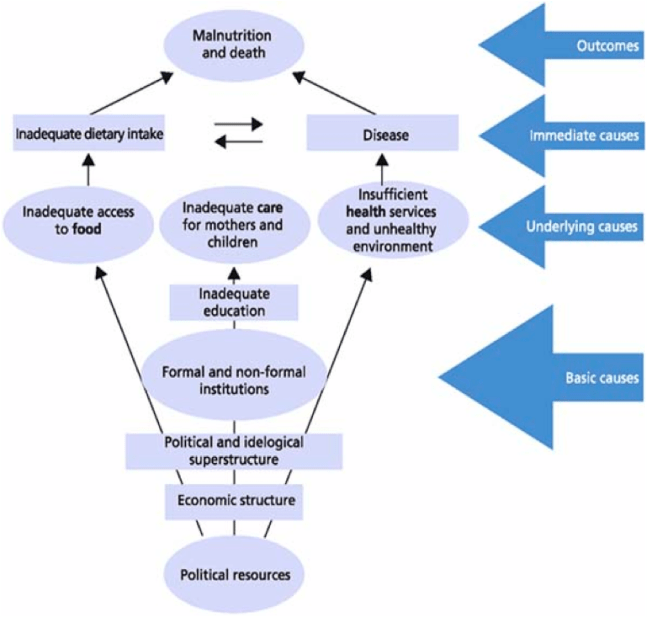
On February 15, Marion Nestle, a public health professor at New York University, spoke on corporate influences on food policy at a meeting of the NGO Working Group on Food and Hunger. Nestle proposed food insecurity as one of the main issues around corporations and food policy for 2012, arguing that the main thing we can do to combat food insecurity is address its root causes. “There’s plenty that can be done at the local level if not at the international level, but work on the root causes, all you public health people,” she urged.

Nestle referred to UNICEF’s conceptual framework for the causes of malnutrition in society (Figure 1) to emphasize that food insecurity stems from social issues, not just from a lack of food. Lack of food is the end problem, but dealing only with that lack does not solve the root causes of food insecurity. According to Nestle, in order for everyone on the planet to be adequately nourished, we must create income equity and political stability, invest in sustainable agriculture and education, empower women, ensure access to clean water and safe food, and promote breastfeeding.
Some food and beverage corporations seek to position themselves as part of the solution to the problem of global food insecurity, marketing fortified food products in developing countries to target under-nutrition.
For example, European consumer-goods corporation Unilever produces food and beverages, among other products. Under “Sustainability” on the Unilever website, you can read about how the corporation’s “brands can play a role in tackling under-nutrition and many of [its] products already make an important contribution to the micronutrient intakes of hundreds of millions of people worldwide.” These products include fortified margarines, instant porridges, powdered drinks and snacks, and instant hot school meals. American food processing company H.J. Heinz is also investing in micronutrients in the name of sustainability. According to its website, Heinz has been a pioneer in supporting the development of micronutrient powders, provided in convenient, “single-serve sachets.”
 While such products do indeed address nutrient deficiencies, according to Nestle, “these efforts are about products, not food.” And in the words of Dr. Alfred Sommer, dean emeritus of the Johns Hopkins Bloomberg School of Public Health, “Nutrition can only be sustainable if people ultimately pay for it. Nutrition could stop being a program when governments change priorities.” So, while fortified foods are important suppliers of emergency nutrients, they come at a price. Rather than addressing root causes of food insecurity, fortified foods are marketable products that must be purchased. People suffering from food insecurity will have to rely on government programs or charitable donations to access fortified foods, instead of benefitting from sustainable solutions to undernourishment.
In a 2010 article in the American Journal of Public Health entitled, “Can the Food Industry Help Tackle the Growing Global Burden of Undernutrition?” Derek Yach et al argue that, yes, food and beverage corporations are ideally positioned to address under-nutrition. According to the authors, corporate business expertise, distribution capacity, and product development capabilities are all vital components of successfully combating problems of food insecurity. (It is, perhaps, important to note that Yach, a former WHO health official, is now a senior vice president at PepsiCo.) True, corporations have resources and expertise that could have a huge impact on food insecurity, but would they be able to use this expertise to address the root causes?

In his 2010 Wall St. Journal article, “The Case Against Corporate Social Responsibility,” business professor Aneel Kanmani corroborates Nestle’s argument: “The fact is that while companies sometimes can do well by doing good, more often they can’t. Because in most cases, doing what’s best for society means sacrificing profits.” In our economic system, a corporation’s end goal is always to make a profit, and profit comes from products. And products, no matter how healthy, can never address the inequality that is the root cause of food insecurity.”The goal of the company is to make a profit. It’s really that simple,” Nestle said in her presentation. And, as she argued with co-author David Ludwig in a 2008 Lancet article, “In a Western-style capitalistic economy, food corporations, like all corporations, must make the financial return to stockholders their first priority. Wall Street places corporations under great pressure not only to be profitable, but also to meet quarterly growth targets… Far greater profits come from highly processed, commodity-derived products.” Nestle sees an irreconcilable conflict between highly processed products and public health, even if these products contain essential nutrients.
Image Credits:
SNAP: the Other Corporate Subsidy in the Farm Bill?
Cross posted from Appetite for Profit.
This week Congress begins hearings on the 2012 farm bill, the massive piece of legislation that gets updated about every five years and undergirds America’s entire food supply, but that few mortals can even understand. As nutrition professor Marion Nestle recently lamented, “no one has any idea what the farm bill is about. It’s too complicated for any mind to grasp.”
 Nestle also called the Supplemental Nutrition Assistance Program (SNAP, formerly known as food stamps) “the huge elephant in the farm bill” because its enormity trumps everything else. This entitlement program (the budget expands as more people enroll) provides modest monthly benefits for food purchases and represents a critical lifeline to many people in need.
In recent years, public health and food policy experts have sounded the alarm about how farm bill programs supporting all the wrong crops (think corn and soy) contribute to America’s epidemic of obesity and diet-related diseases. This is certainly true, along with a host of other economic drivers.
But are we focusing too much on the commodity title and not enough on the nutrition title when it comes to how the farm bill truly subsidizes Big Food? After all, even if the commodity title was completely eliminated, most economists believe it would have minimal impact on healthy food consumption.
SNAP spending dwarfs all farm bill programs
According to federal data, food assistance made up 68 percent of the farm bill budget in 2008 and SNAP accounts for almost that entire amount. (Other food assistance programs such as school meals are funded through other legislation.) In contrast, the next three largest farm bill programs were commodity support (12 percent), crop insurance (10 percent), and conservation (9 percent).
Looking at the dollars and cents, the U.S. Department of Agriculture reported that in fiscal year 2011, taxpayers spent $71.8 billion on SNAP benefits, compared to $64.7 billion in 2010. The total number of enrolled participants was 44.7 million last year compared to 40.3 million in 2010. Obviously these increasing numbers reflect our struggling economy, and SNAP benefits are a crucial component of addressing hunger in the U.S. Sadly, estimates are that about 30 percent of Americans who qualify for SNAP aren’t even enrolled.
So how exactly was close to $72 billion of the taxpayers’ money spent last year? Good question. Unfortunately, we have little clue. We have somewhat better information on commodity payments. See for example, the Environmental Working Group’s handy Farm Subsidy Database. (But EWG also warns of an increasing lack of transparency in farm bill commodity and insurance subsidies.)
Other than broad categories of retailers (e.g., large versus small) we don’t know where SNAP dollars go because USDA does not require retailers to report specific purchase data; rather, all the agency wants to know is the total amount to be reimbursed.
Bill would require retailers to report SNAP receipts
In December, Senator Ron Wyden (D-OR) introduced the FRESH Act (Fresh Regional Eating for Schools and Health), which (in addition to other provisions) aims to “increase accountability” in the SNAP program by requiring corporations receiving more than $1 million a year “to provide taxpayers with an itemized receipt for their share” of the SNAP program.
Sounds pretty reasonable, since any retailer large enough to rake in over a million bucks a year from SNAP is almost certain to have the technology necessary to send an electronic report to USDA on how that money was spent.
Such information is a crucial factor in the debate over restricting benefits, which is once again heating up in states around the country, with Florida being the most recent example. (However, that measure appears to be dead for now.)
In 2010, New York City applied to USDA for a waiver to conduct a 2-year pilot test to exclude unhealthy beverages such as soda from the SNAP-eligible food list. (The feds denied the request, citing complexity.) An unfortunate divide exists between public health experts targeting “sugar-sweetened beverages” as enemy number one and anti-hunger advocates, who vociferously oppose any SNAP restrictions.
But conveniently left on the sidelines of this very public debate, and laughing all the way to the bank, has been the food and beverage industry. Of course, they made their voices heard loud and clear through their usual behind-the-scenes lobbying efforts.
Senator Wyden’s bill should spark a conversation that’s long overdue: exactly how much does Big Soda and Big Food benefit from SNAP funding? Some of my colleagues are concerned that such data could backfire by giving more fodder to certain politicians who will use any excuse to cut benefits for the poor.
Yes, the data is likely to show that SNAP participants’ purchase habits parallel those of other Americans, who are also consuming too many empty calories. But that’s not a valid reason to fear collecting the information. The “personal responsibility” argument – that individuals alone are responsible for how they eat regardless of their environment and shear lack of affordable healthy options – will continue with or without Uncle Sam picking up the tab.
But how will we ever improve and strengthen SNAP if we cannot accurately evaluate it? How else will we truly integrate public health into our food assistance programs? Why should Walmart—probably the single largest beneficiary of SNAP—have access to information that the USDA doesn’t?
Now more than ever we need to ensure the nation’s largest food assistance program is truly helping those in need, instead of just lining the pockets of Corporate America.
Image Credit:
Thomas Hawk via Flickr.
Regulation Works
A Research Letter in last week’s Journal of the American Medical Association reported that blood levels of trans fatty acids, a substance with known adverse metabolic effects, fell 56 percent between 2000 and 2009. The study compared trans fat levels in adult white men in samples from the NHANES studies, a periodic assessment of the heath and well-being of a representative sample of the US population. In 2003, the US Food and Drug Administration required that food companies declare the trans fatty acid content on the nutrition label of foods and dietary supplements. In addition, some community and state health departments have required restaurants to limit TFAs and reductions have been shown in supermarket and restaurant products.
Should Sugar be Regulated like Alcohol?
In a commentary in Nature, Robert Lustig, Laura Schmidt and Claire Brindis make the case that excessive consumption of sugar causes many of the same health problems as alcohol, suggesting that regulation should seek to put similar limits on sugar’s toxic consequences. Charles Baker, the chief scientific officer for the Sugar Association disagrees. “When the full body of science is evaluated during a major review, experts continue to conclude that sugar intake is not a causative factor in any disease, including obesity,” he writes.
Super Bowl Ads: Good for Business, Bad for Health
On Sunday, more than 110 million Americans watched the Super Bowl, some for the football but more than half, according to one survey, as much to watch the ads as the game. This year 36 corporations paid about $3.5 million for each 30 second ad that they hoped would drum up business on American advertisers’ biggest day. Total ad revenue is expected to reach $245 million, the highest ever. To entertain themselves during the game, Americans will spend an estimated $11 billion on snacks, game-related merchandise and apparel.
 This orgy of commercialism provides a lens through which to examine the health of this country and the power of corporations to shape health behavior and health policy in ways that are good for business but bad for the well-being of the American people.
Previews of the ads shown in Sunday’s games reveal some common themes. One analyst noted that based on these ads, it is clear Americans are desperately seeking their inner child, love animals (especially dogs and chimps) and will buy anything if it is linked to sex. The Mad Men who created these ads have settled on appeals to the lowest common denominator, using their neuromarketing brain scans to decide that the precognitive parts of the brain are more susceptible to persuasion than the frontal lobes that might process real information about the product.
Who advertises on Super Bowl? A business newsletter found that six of eight top advertisers in the last 10 years are Anheuser-Busch, now part of the Belgian-Brazilian alcohol conglomerate InBev (spending $246.million on Super Bowl ads), PepsiCo ($209.7 million), General Motors ($135.2 million), Yum! Brands, a fast food corporation, ($67.8 million), Coca Cola ($61 million) and Ford ($36.3 million). Overall, advertisers have spent $2.5 billion on Super Bowl ads in the last 10 years ; the top four categories are autos, film, food — including snacks and fast food — and beverages, both alcohol and soda.
According to public health researchers, poor diet and physical inactivity were the cause of 365,000 deaths in the United States in 2000, alcohol consumption 85,000 deaths, motor vehicle crashes 43,000 and sexual behavior 20,000. A look at the Super Bowl ads shows they overwhelmingly encourage the behaviors and lifestyles that contribute to these deaths: eating too much food high in fat, sugar and salt; youth drinking and drinking as a way of asserting sexuality and adulthood; driving that emphasizes speed and macho rather than safety; and sex that emphasizes body parts rather than intimacy.
When the ads do mention health, it is often in ways designed to ensure irrelevancy. A Super Bowl ad promoting Doritos (8 gms fat, 200 mgs sodium and 140 calories for each 11 Flamas chips) ends with the tagline “Eat Responsibly”– somewhat like thinking that telling a person with major depression to “Have a nice day” is good therapy.
In a Coca Cola ad, a polar bear urges its companion to drink a bottle of Coke (65 gms of high fructose corn syrup and 57 mg of caffeine) to allay its fears about the Super Bowl. The closing message: “Coca Cola: Open Happiness.” Like some evil Mary Poppins, the polar bears encourage viewers to swallow with 15 spoonfuls of sugar the message that consuming products that contribute to obesity, diabetes and other diet-related health conditions is the road to happiness.
 In 1976 and again in 2001, an increasingly pro-corporate US Supreme Court reversed its prior opinions and granted limited First Amendment protection to commercial speech, deciding that advertisements further the societal interest in the free flow of information to allow consumers to make more informed decisions. Viewers of Sunday’s Super Bowl ads would have a hard time finding much information about the products that were advertised. And while the health care industry may benefit from more cases of heart disease, auto accidents and alcohol-related liver disease, it’s tough to imagine the societal interest realized by promoting the chronic diseases and injuries that are overwhelming our health care system and burdening families.
To add insult to injury, corporations can deduct the full cost of the advertisements aired on the Super Bowl – and in all other media — as tax-deductible business expenses. Thus tax payers forego the tax revenue that would come were these expenses not deductible, then pay the heath care costs associated with the consumption these ads encourage.
In today’s economy, it seems churlish, even unpatriotic, to criticize the corporate celebration of consumption represented by Super Bowl ads. But in a country that spends more on health care than any other nation and with poorer results, isn’t it fair to ask whether patriotic businesses would choose to relentlessly promote products associated with premature death and needless suffering? And whether patriotic elected officials would allow food, tobacco, alcohol and auto corporations to become the dominant health educator for the nation, then expect tax payers to foot the bills for the consequences of their messages?
Image Credits:
1. Coca-Cola
Is Walmart’s March into Cities Helping or Hurting?
Cross-posted from Food Safety News.
Having saturated the rural landscape, shuttering local stores in small town America along the way, now, in the wake of stagnant sales and increased competition, Walmart desperately needs to expand into urban markets.
And what better urban market than one full of eight million people? While the big box retailer is eager to enter the Big Apple, challenges loom large. Given the negative reputation Walmart has earned for being hostile to workers among other problems, many New Yorkers are skeptical, to put it mildly.
 To counter the opposition, Walmart is positioning itself as the solution to urban food deserts – areas where finding real food is next to impossible. But as Anna Lappé has eloquently argued, the big box chain isn’t the answer: “Let’s be clear, expanding into so-called food deserts is an expansion strategy for Walmart. It’s not a charitable move.”
Research Shows Walmart Kills Both Jobs and Food Access
Now a report released last month by Manhattan Borough President Scott Stringer concludes that not only would bringing Walmart to Harlem spell disaster for labor, but it could also make an already dire food access problem there even worse.
Based on data from Chicago’s negative experience, the report found that within two years of a Walmart store opening in New York:
– Between 48 and 66 fresh food retailers could go out of business, representing a net loss of between 56,500 to 82,000 square feet of food retail within a one-mile radius;
– Closure of these stores would represent a loss of 50 to 57 percent of the fresh food retail square footage added in recent years by New York City’s incentive program;
– All of this would negate more than $4 million in public finance investment and four years of effort to improve fresh food access in the area.
As Stringer explained, Walmart shouldn’t be undermining city programs to improve fresh food availability: “Walmart would be a bane, not a boon, to the health food economy of Harlem – or any other New York City neighborhood.”
Moreover, previous economic analysis has shown that Walmart’s promise of jobs doesn’t pan out either. In a report from last summer called “The Walmartization of New York City,” researchers at the City University of New York concluded that, “despite Walmart’s promises of jobs and lower prices for the community, the longer term impact is actually the opposite.”
Assuming Walmart opened the 159 stores needed to reach 21 percent grocery market share in New York City (the same proportion the company enjoys nationally), the impact would be a net loss of almost 4,000 jobs, and a loss of more than $453 million in wages per year for all remaining workers.
What about the new Walmart jobs? According to the report, 4,279 new low-wage Walmart workers would have to “rely on social services to make ends meet, costing New York taxpayers over $4 million per year” in health care benefits alone. This, in a city where the mayor has asked for $2 billion in budget cuts.
Current Walmart Locations Confirm Bleak Outlook
 Other areas of the country have already had real world experiences to back up these projected findings. According to New York’s Food for Thought report, of all the employers in Ohio, Walmart has the greatest number of associates and dependents enrolled in Medicaid, which in 2009 cost taxpayers $44.8 million.
Similarly, a 2004 study found that for each of California’s whopping 44,000 Walmart employees, taxpayers had to spend $730 on health care and $1,222 on other forms of state and federal assistance such as (ironically) food stamps.
In 2006, Walmart entered Chicago and recently convinced local officials to approve two additional locations, including (after a long battle) on the city’s South Side. How have things fared so far in the original Chicago location? Not so well.
A three-year study released by Loyola University Chicago in 2010 revealed that Walmart had not enhanced retail activity or even employment opportunities. In fact, “the probability of a local retailer going out of business during the study period was significantly higher for establishments close to Walmart’s location.” Specifically, researchers found that a nearby business had about a 40 percent chance of closing over a two-year period – not very good odds.
If You Can’t Beat Them, Buy Them
Of course Walmart paints an entirely different picture, and is spending a ton of money to hide these sobering facts in a massive PR campaign. According to the Walmartization report, in the first half of 2011 alone, the company spent $2.1 million lobbying in New York, as much as they spent there in the past four years combined. There’s even a dedicated website complete with a “fact-checker” and the heartwarming tagline, “Helping NYC Save Money and Live Better.”
Philanthropy is another time-honored corporate tactic, often used to buy silence from critics, curry favor with community leaders, or, in this case, grease the wheels to gain entry into a reluctant-but-lucrative market.
In December, Walmart announced a combined gift of $250,000 to five various New York City charities, including a home food delivery service and a soup kitchen. Of course $250K is chump change to a company whose net sales topped $405 billion in 2010, but to these five groups it no doubt means a lot. Moreover, in its press release, Walmart made sure to point out the company’s “more than $13 million” in donations in New York City since 2007. (Similarly, Walmart pledged to donate $20 million to Chicago charities.)
But Walmart will need a lot more than a few million dollars in tax-deductible contributions to make up for all the job losses, decrease in available fresh food (and even increased obesity) that could befall New Yorkers.
Other cities should also brace themselves, as the company is opening four stores in Washington, D.C. later this year, with additional area sites planned. Other locations on the agenda include Boston and San Francisco. But mostly the company is keeping quiet about its urban expansion agenda, at least publicly. Last year in Boston, the company was said to be “quietly chatting up city officials” while scouting neighborhoods.
I shudder to think of the consequences to American’s already suffering urban populations if Walmart succeeds in duplicating its rural retail takeover. What to do about it? Support the United Food and Commercial Workers, which has an important campaign called Making Change at Walmart. See also the Big Box Tool Kit, which is chock-full of news and practical resources. Communities can work together to fight back, we just have to act before it’s too late.
———————
© Food Safety News
See reader comments.
Lobbying in Action: PepsiCo Fights Guidelines for Marketing to Kids
In a posting on theatlantic.com, Marion Nestle reports that Pepsi spent millions this year to fight a set of proposed standards that would regulate how products are presented to kids. Lobbyists are supposed to report what they do and how much money they spend doing it, but this information is not easily available to the public. CBS News reports that PepsiCo spent $750,000 to lobby the government last quarter. This comes to roughly $3 million annually, a drop in PepsiCo’s annual $30.6 billion sales in the U.S. – $57.8 billion worldwide.
 Corporations and Health Watch