United Kingdom Proposes Soda Tax in Ongoing Fight against Obesity

Last October, writes Take Part, a “social action platform for the conscious consumer”, British Prime Minister David Cameron addressed the question of a soda tax in the United Kingdom, where more than a quarter of children are overweight or obese. “The Prime Minister thinks there are more effective ways of tackling this issue than putting a tax on sugar,” a spokesman said. On Wednesday, March 17, Cameron’s finance minister, Chancellor of the Exchequer George Osborne, introduced a proposal for a national soda tax. “I am not prepared to look back at my time here in this Parliament, doing this job, and say to my children’s generation, ‘I’m sorry. We knew there was a problem with sugary drinks. We knew it caused disease. But we ducked the difficult decisions and we did nothing,’ ” Osborne told Parliament.

From new Lethal but Legal Afterword: The World That Is Possible

This week Oxford University Press releases a new paperback edition of Lethal but Legal Corporations, Consumption and Protecting Public Health with a new Afterword by the author. An excerpt is below.

Nicholas Freudenberg

New York City, October 2034.

I wrote Lethal but Legal more than 20 years ago because I was worried about humanity’s survival. Growing epidemics of chronic diseases and injuries, escalating environmental damage, increasing concentration of corporate power and wealth, and declining democracy and government protection of health were converging towards a dangerous tipping point. After the book’s release, I had many conversations about these fears with readers, researchers, activists, health professionals and students. What struck me most was that although most agreed that the rise of the corporate consumption complex and its relentless marketing of hyperconsumption threatened public health and democracy, even those persuaded by the book’s arguments were pessimistic that another future was possible. Corporations were too powerful, they said, opposition too weak. Acquiescence was more popular than resistance and any possibility of a real alternative seemed hopelessly naïve.

Continue reading From new Lethal but Legal Afterword: The World That Is Possible

Food companies distort nutrition science. Here’s how to stop them.

In Vox, Julia Belluz writes about Marion Nestle’s compilation of food industry research studies. About a year ago, Marion Nestle finally got sick of the rotten state of nutrition science. Everywhere she looked, she found glaring conflicts of interest. “Without any trouble, I could identify industry-funded nutrition studies by their titles,” says the New York University professor. “It was so obvious.” Nestle kept seeing studies with very specific names, like, “Concord grape juice, cognitive function, and driving performance,” or, “Walnut ingestion in adults at risk for diabetes.” These papers were funded by the food industry — a grape juice maker, walnut growers — and nearly always reached glowing conclusions about the food in question. Her findings so far are remarkable. Of the 152 industry-funded studies she has examined, 140 boast results that favor the funder. That’s more than 90 percent.

Carbonating the World

A new report from the Center for Science in the Public Interest shows how two major global soft-drink producers, Coca-Cola and PepsiCo, have sought to maintain their profits in the face of declining sales in wealthier countries by, like the tobacco industry, investing heavily in low- and middle-income countries. Thus, both companies, as well as other multinational and local beverage producers, are spending several billion dollars a year in such countries as Brazil, China, India, and Mexico to build bottling plants, create distribution networks, and advertise their products to maximize sales.

After being investigated over tainted cookies, food industry giant settles for lack of excess lead warning

The Orange County Register reports that Mondelez International, formerly known as Kraft Foods, has settled a state investigation into claims the food industry giant sold ginger snap cookies in California that contained excess lead without a warning. “The levels of lead found in Nabisco’s Ginger Snap cookies posed a serious public health threat, potentially impacting the brain development of our children,” said California Attorney General Kamala Harris in a statement. “Parents need accurate information to make educated food choices for their children.”

Purchases of sugar-sweetened beverages in Mexico decline after tax

A new study in BMJ assessing the impact of Mexico’s tax on sugar-sweetened beverages found that purchases of taxed beverages decreased by an average of 6% and decreased at an increasing rate up to a 12% decline by December 2014. All three socioeconomic groups reduced purchases of taxed beverages, but reductions were higher among the households of low socioeconomic status, averaging a 9% decline during 2014, and up to a 17% decrease by December 2014 compared with pretax trends. Purchases of untaxed beverages were 4% higher than before 2014 mainly driven by an increase in purchases of bottled plain water.

Slide1[photo: A poster from the campaign for Mexico’s sugar tax. Message says: “With the soda tax, water fountains in schools and public places.”]

Dietary Guidelines Recommend Limiting Added Sugar to Less Than 10% of Calories

The new Dietary Guidelines for Americans say that healthy eating patterns limit added sugars to less than 10 percent of calories per day. This recommendation is a target to help the public achieve a healthy eating pattern, which means meeting nutrient and food group needs through nutrient-dense food and beverage choices and staying within calorie limits. This target is informed by national data on intakes of calories from added sugars, which account on average for almost 270 calories, or more than 13 percent of calories per day in the U.S. population.

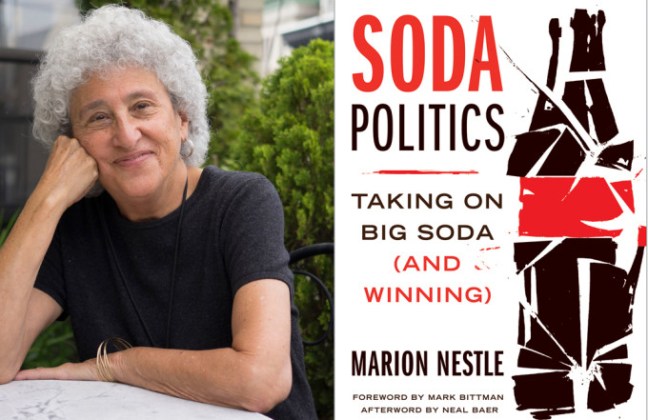
Interview with Marion Nestle, Author of “Soda Politics: Taking on Big Soda (and Winning)”

Marion Nestle’s new book is “Soda Politics: Taking on Big Soda (and Winning)”. She is Paulette Goddard Professor in the Department of Nutrition, Food Studies, and Public Health at New York University. Nestle’s book was recently reviewed in the New York Times. Corporations and Health Watch founder Nick Freudenberg recently asked Professor Nestle some questions about her new book.

Continue reading Interview with Marion Nestle, Author of “Soda Politics: Taking on Big Soda (and Winning)”