Assessing the health impact of transnational corporations: its importance and a framework

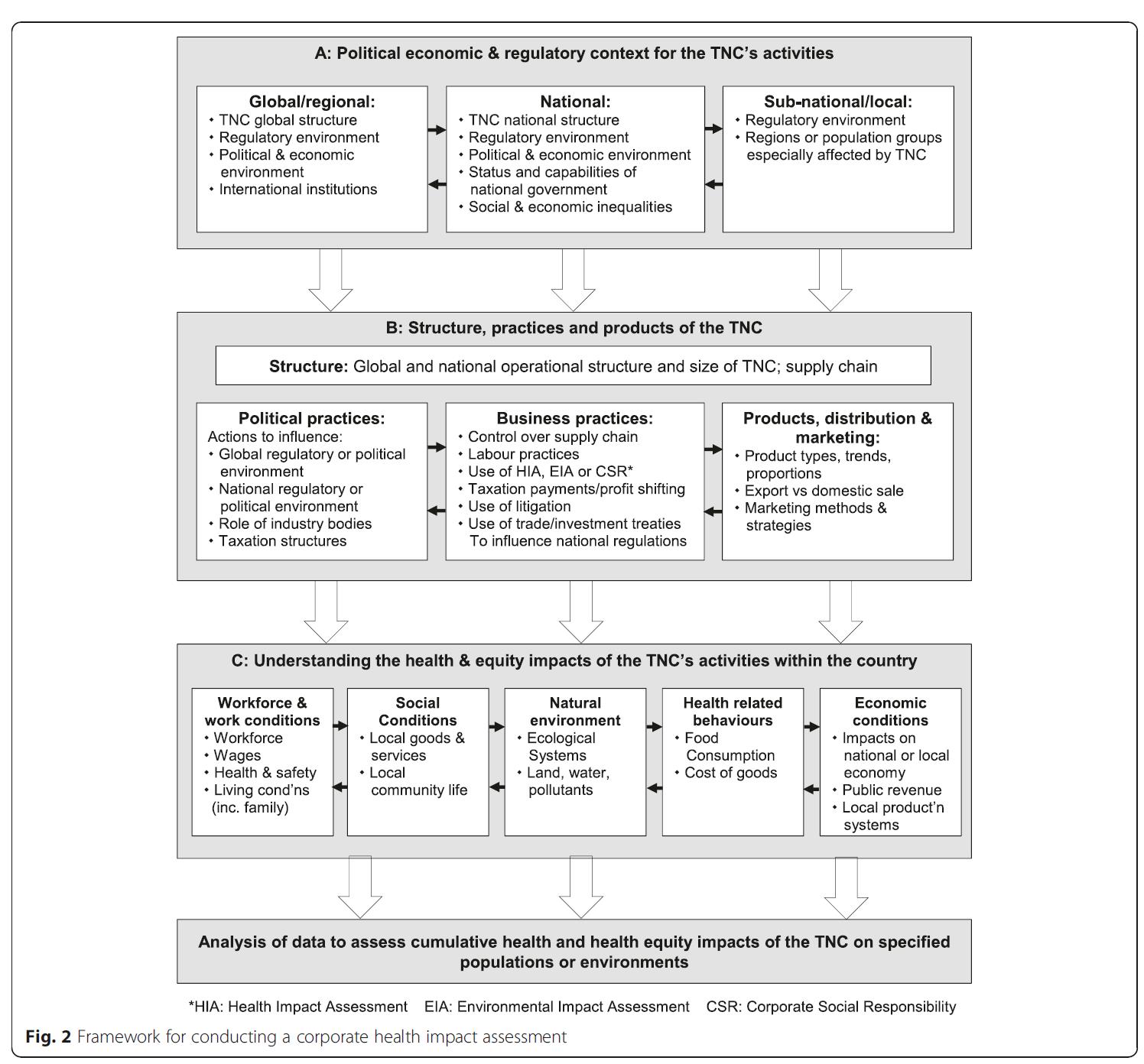
A framework for assessing health impact of transnational corporations. Source.
A framework for assessing health impact of transnational corporations.

The adverse health and equity impacts of transnational corporations’ (TNCs) practices have become central public health concerns as TNCs increasingly dominate global trade and investment and shape national economies. Despite this, methodologies have been lacking with which to study the health equity impacts of individual corporations and thus to inform actions to mitigate or reverse negative and increase positive impacts. A new report in Globalization and Health  describes a framework designed to conduct corporate health impact assessment (CHIA), that was developed at a meeting held at the Rockefeller Foundation Bellagio Center in May 2015.

Continue reading Assessing the health impact of transnational corporations: its importance and a framework

Alcohol Advertising Exposure Among Middle School–Age Youth: An Assessment Across All Media and Venues

The purpose of this study which appears in the Journal of Studies on Alcohol and Drugs was to quantify middle school youth’s exposure to alcohol advertisements across media and venues, determine venues of greatest exposure, and identify characteristics of youth who are most exposed.

Continue reading Alcohol Advertising Exposure Among Middle School–Age Youth: An Assessment Across All Media and Venues

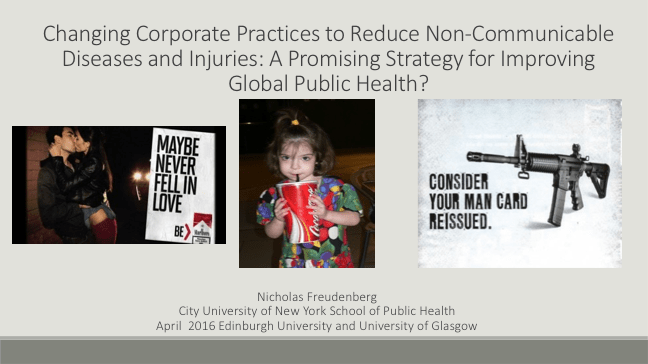
Changing Corporate Practices to Reduce Non-Communicable Diseases and Injuries: A Promising Strategy for Improving Global Public Health?

In presentations on “Changing Corporate Practices to Reduce Non-Communicable Diseases and Injuries: A Promising Strategy for Improving Global Public Health?” at Edinburgh University and University of Glasgow, Nicholas Freudenberg, Distinguished Professor of Public Health at City University of New York School of Public Health, described the role of corporate business and political practices on the growing global burden of non-communicable diseases and injuries. He also analyzed what roles public health professionals can play in countering the adverse health effects of these practices. View the presentation.

Reducing the Role of the Food, Tobacco, and Alcohol Industries in Noncommunicable Disease Risk in South Africa

Noncommunicable diseases (NCDs) impose a growing burden on the health, economy, and development of South Africa. According to the World Health Organization, four risk factors, tobacco use, alcohol consumption, unhealthy diets, and physical inactivity, account for a significant proportion of major NCDs. We analyze the role of tobacco, alcohol, and food corporations in promoting NCD risk and unhealthy lifestyles in South Africa and in exacerbating inequities in NCD distribution among populations. Through their business practices such as product design, marketing, retail distribution, and pricing and their business practices such as lobbying, public relations, philanthropy, and sponsored research, national and transnational corporations in South Africa shape the social and physical environments that structure opportunities for NCD risk behavior.

Continue reading Reducing the Role of the Food, Tobacco, and Alcohol Industries in Noncommunicable Disease Risk in South Africa

From new Lethal but Legal Afterword: The World That Is Possible

This week Oxford University Press releases a new paperback edition of Lethal but Legal Corporations, Consumption and Protecting Public Health with a new Afterword by the author. An excerpt is below.

Nicholas Freudenberg

New York City, October 2034.

I wrote Lethal but Legal more than 20 years ago because I was worried about humanity’s survival. Growing epidemics of chronic diseases and injuries, escalating environmental damage, increasing concentration of corporate power and wealth, and declining democracy and government protection of health were converging towards a dangerous tipping point. After the book’s release, I had many conversations about these fears with readers, researchers, activists, health professionals and students. What struck me most was that although most agreed that the rise of the corporate consumption complex and its relentless marketing of hyperconsumption threatened public health and democracy, even those persuaded by the book’s arguments were pessimistic that another future was possible. Corporations were too powerful, they said, opposition too weak. Acquiescence was more popular than resistance and any possibility of a real alternative seemed hopelessly naïve.

Continue reading From new Lethal but Legal Afterword: The World That Is Possible

The Potential Impact of a “No-Buy” List on Youth Exposure to Alcohol Advertising on Cable Television.

This article by CS Ross , RD Brewer and DH Jernigan appears in the January 2016 issue of the Journal of Studies on Alcohol and Drugs.

OBJECTIVE: The purpose of this study was to outline a method to improve alcohol industry compliance with its self-regulatory advertising placement guidelines on television with the goal of reducing youth exposure to noncompliant advertisements.

METHOD: Data were sourced from Nielsen (The Nielsen Company, New York, NY) for all alcohol advertisements on television in the United States for 2005-2012. A “no-buy” list, that is a list of cable television programs and networks to be avoided when purchasing alcohol advertising, was devised using three criteria: avoid placements on programs that were noncompliant in the past (serially noncompliant), avoid placements on networks at times of day when youth make up a high proportion of the audience (high-risk network dayparts), and use a “guardbanded” (or more restrictive) composition guideline when placing ads on low-rated programs (low rated).

RESULTS: Youth were exposed to 15.1 billion noncompliant advertising impressions from 2005 to 2012, mostly on cable television. Together, the three no-buy list criteria accounted for 99% of 12.9 billion noncompliant advertising exposures on cable television for youth ages 2-20 years. When we evaluated the no-buy list criteria sequentially and mutually exclusively, serially noncompliant ads accounted for 67% of noncompliant exposure, high-risk network-daypart ads accounted for 26%, and low-rated ads accounted for 7%.

CONCLUSIONS: These findings suggest that the prospective use of the no-buy list criteria when purchasing alcohol advertising could eliminate most noncompliant advertising exposures and could be incorporated into standard post-audit procedures that are widely used by the alcohol industry in assessing exposure to television advertising.

Cut drinking to reduce risk of cancer, says new guidance from United Kingdom

BMJ reports that new guidelines from all four UK chief medical officers warn that drinking any level of alcohol raises the risk of a range of cancers. An expert advisory group examined the evidence from 44 systematic reviews and meta-analyses published since a 1995 report and concluded that there was strong evidence that the risk of a range of cancers, particularly breast cancer, increased directly in line with consumption of any amount of alcohol. Another recent report from the UK Committee on Carcinogenicity said that between 4% and 6% of all new cancers in the UK in 2013 were caused by alcohol consumption.

Tobacco, alcohol and processed food industries – Why are they viewed so differently?

Katherine Smith           November 18, 2015

Cross-posted from Policy and Politics Blog

One of the few indisputable truths in life is that we will all, eventually, die but what we will die of, and at what age, is changing across the world, with non-communicable diseases (NCDs) increasingly accounting for excessive morbidity and mortality burdens. The growing prevalence of NCDs is triggering substantial policy concern, evident, for example, in the 2011 UN high level meeting on NCDs. Yet, it is clear there are very different ways of thinking about this ‘epidemiological transition’: it has been framed, on the one hand, as a consequence of the choices that individuals make and, on the other, as a consequence of the strategies that corporations pursue.

Continue reading Tobacco, alcohol and processed food industries – Why are they viewed so differently?

Alcohol Ads Linked to Teen Alcohol Brand Choices

A new report in the American Journal of Drug and Alcohol Abuse found that overall exposure to brand-specific alcohol advertising is a significant predictor of underage youth alcohol brand consumption, with youth ages 13 to 20 more than five times more likely to consume brands that advertise on national television and 36 percent more likely to consume brands that advertise in national magazines compared to brands that don’t advertise in these media.

Alcohol sales get higher after weed legalization contrary to industry fears

As an increasing number of states look to join the four states and Washington DC in legalizing recreational marijuana, many in the alcohol industry have feared that legalized weed will cut into their existing profits, reports The Guardian. But a few years into Colorado legalization, alcohol sales are up in the state, and those in the alcohol business have embraced their fellow industry.