New Resource: Beating Goliath Examines Successful Campaigns Against Corporations

In a recent report called ‘Beating Goliath’, The Democracy Center gathers case studies from previous successful campaigns against corporations, looking at how they won and what we can learn from them. It provides links to many useful resources for activists, and highlights current campaigns engaged in the fight against climate change through targeting corporations. The Democracy Center works globally to help citizens become effective advocates on environmental and social justice issues.

In its Introduction, the authors of ‘Beating Goliath’ explain its purposes:

All across the world people are engaged in urgent battles: on worker rights, protection of the environment, trade, health, and a range of other issues that shape our lives and our futures. In many of these struggles we face a powerful adversary – the corporation. National laws and international trade agreements are drafted under the influence of corporate power. Corporate interests form the donor base of major political parties, and often have bigger balance sheets than the countries they operate in. Waves of deregulation and privatization have eroded limits to corporate accumulation of profit and power. In this hostile environment, groups have had to become more and more sophisticated in how they confront companies in their workplaces and communities.

Struggles to win concessions from corporate power are not new. As the influence and reach of the corporation has grown, so has resistance to it. From early worker struggles for better wages and conditions, to the late 1990s campaign that targeted Shell’s bright yellow logo to stop it sinking an old drilling platform in the North Sea, confronting corporate interests has long been part of the struggle for social and environmental justice.

Groups confronting corporations have a range of politics and use a range of tactics. They include Christian shareholder groups that talk about increasing ‘corporate responsibility’, direct action campaigners that see capitalism itself as the root cause of climate change, well-funded NGOs and confederations of neighbourhood organizations. The Democracy Center designed this resource to be useful for both newcomers to this kind of campaigning and old hands, no matter where they lie on the political or tactical spectrum.

This resource opens with some background on corporate campaigning, and why we think it’s important to take on corporate power through individual campaigns. We then look at a series of wins from corporate targets, with a focus on what we can learn from them as we put together new campaigns. This is followed by introductions to tools and more detailed resources for campaigners fighting corporations – including organizing, research, strategy, communications, coalition building, direct action, shareholder and financier strategies, legal strategies, and consumer strategies. Finally, we’ve included six profiles of climate justice campaigns against corporations that are happening right now, with brief outlines of what they’re campaigning for and how they’re going about it.

And for additional ideas on corporate campaigns, the Spring 2012 issue of Yes! Magazine describes 9 strategies to end corporate rule. They are:

  1. Amend the constitution to end corporate personhood.
  2. Dive into grassroots campaigns.
  3. Hold corporations accountable to our laws.
  4. Get past the propaganda.
  5. Support independent media and keep the Internet free.
  6. Protect the Commons.
  7. Vote. Protect our democracy.
  8. Make your dollars matter.
  9. Get creative to raise awareness.


Image Credit:

1. The Democracy Center
Corporations Transfer Environmental Costs to Society

A new report by KPMG, the international the audit, tax and advisory firm, calculated that if companies had to pay for the full environmental costs of their production, they would lose 41 cents for every US$1 in earnings on average. The report, “Expect the Unexpected: Building Business Value in a Changing World,” explores issues such as climate change, energy and fuel volatility, water availability and cost and resource availability, as well as population growth spawning new urban centers.

China National Tobacco Reports Higher Profit than Wal-Mart’s

China National Tobacco Corp., that nation’s cigarette monopoly, may be larger by annual profit than Wal-Mart Stores Inc. according to a rare release of the company’s financial data, reports Bloomberg News. The state-owned tobacco company had net income of 117.7 billion yuan ($18.7 billion) in 2010 on sales of 770.4 billion yuan. Industrial Bank Co. released the figures in a statement last week because China National Tobacco is buying a 5.2 billion yuan stake in the Shanghai-listed lender. China National Tobacco made more in profit in 2010 than the combined total for Philip Morris International Inc. (PM), British American Tobacco Plc (BATS), and Altria Group, Inc., the world’s three- biggest listed tobacco companies, according to the figures.

PepsiCo: Master of Corporate Spin?

Cross-posted from Appetite for Profit.

When I ask people to name the largest food company in America, most don’t realize the answer is PepsiCo. You may just think soft drinks when you hear the name, but PepsiCo actually owns a dizzying array of food and beverage brands across five massive divisions: Pepsi-Cola, Frito-Lay, Gatorade, Tropicana, and Quaker Oats. As I recently told CNBC for their documentary, Pepsi’s Challenge, perhaps the leading maker of sugary drinks and salty snacks should bear some responsibility for America’s bad eating habits.

To examine the company further, I ask in a lengthy article just published online in the City University of New York Law Review, “PepsiCo and Public Health: Is the Nation’s Largest Food Company a Model of Corporate Responsibility or Master of Public Relations?”

The article describes how PepsiCo utilizes an array of public relations maneuvers to convince Americans to keep buying its products, despite copious health advice to the contrary. Moreover, PepsiCo engages in lobbying and other underhanded behavior that defy its self-proclaimed “Performance with Purpose” image. These tactics include:

  • Describing questionable products such as baked chips and diet soda as “better for you” while attempting to engineer healthier junk food with such novelties as “drinkable oats.”
  • Exploiting an increasing desire for local food with “farmwashing” ad campaigns for potato chips.
  • Hiring respected public health experts and medical doctors to represent the company, creating an illusion of having a health-oriented mission, instead of being driven by profit.
  • Continuing to market its unhealthy products to children, despite numerous promises to the contrary, and lobbying to undermine federal policy aimed at reducing junk food marketing to kids.
  • Inserting its self-serving public relations message into a respected annual scientific report funded by top health foundations.
  • Buying off nonprofits by engaging in a host of philanthropic efforts such as its ubiquitous Pepsi Refresh program, all the name of moving more products.
  • Aggressively marching into the developing world to ensure continued growth globally as western markets become saturated with salt, sugar, and fat.

Throughout the article, I show how PepsiCo uses deliberately vague language in its annual report and other documents in which the company claims to be a responsible corporate citizen, thereby making evaluating such claims impossible. We cannot trust PepsiCo or any other food company to “do the right thing” when it comes to fixing the mess they got us into in the first place.

Download the full article, published in Volume 15.1 of the City University of New York Law Review here.


Image Credit:

Appetite for Profit

Occupy Wall Street Visits Pfizer

Occupy Wall Street protesters marched around midtown Manhattan on Wednesday, February 29, chanting anti-corporate slogans outside banks and the pharmaceutical giant Pfizer, reported the Wall Street Journal.   Protesters awarded Pfizer a prize for “Excellence in Profiteering,” noting the discrepancy between the wealthy pharmaceutical company and the millions of uninsured Americans who cannot afford health care.

Fighting Big Tobacco in Indonesia

Mardiyah Chamim has authored a new book “A Giant Pack of Lies,” that describes the marketing and lobbying practices of Indonesia’s powerful tobacco industry, part of an intensifying campaign to control tobacco use in Indonesia. The author compares that nation’s current attitude toward smoking to that of the United States in the 1930s, arguing that the country is decades behind in raising public awareness of the dangers of tobacco use and forcing the industry to take responsibility for its harmful impact on public health. Earlier this year, Vanguard documentary film maker Chrishof Putzel exposed the ways that Indonesian tobacco marketers target children.

Can Corporations Provide Sustainable Solutions to Global Food Insecurity?

On February 15, Marion Nestle, a public health professor at New York University, spoke on corporate influences on food policy at a meeting of the NGO Working Group on Food and Hunger. Nestle proposed food insecurity as one of the main issues around corporations and food policy for 2012, arguing that the main thing we can do to combat food insecurity is address its root causes. “There’s plenty that can be done at the local level if not at the international level, but work on the root causes, all you public health people,” she urged.

Figure 1

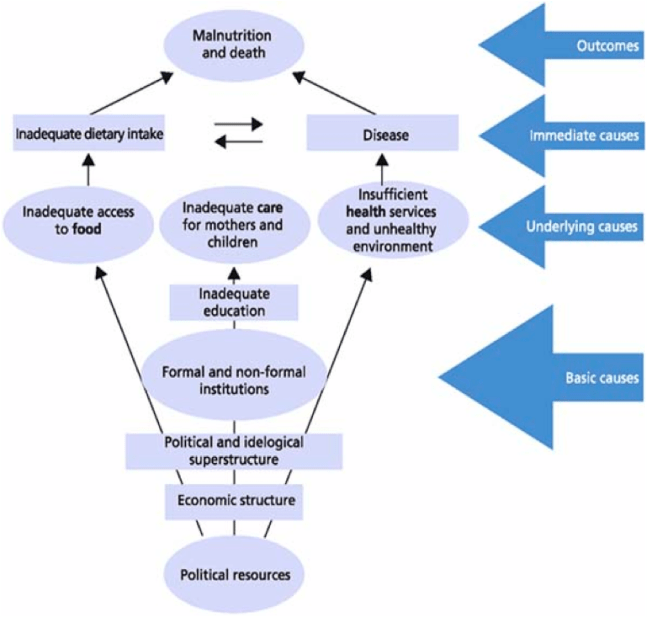
Nestle referred to UNICEF’s conceptual framework for the causes of malnutrition in society (Figure 1) to emphasize that food insecurity stems from social issues, not just from a lack of food. Lack of food is the end problem, but dealing only with that lack does not solve the root causes of food insecurity. According to Nestle, in order for everyone on the planet to be adequately nourished, we must create income equity and political stability, invest in sustainable agriculture and education, empower women, ensure access to clean water and safe food, and promote breastfeeding.

Some food and beverage corporations seek to position themselves as part of the solution to the problem of global food insecurity, marketing fortified food products in developing countries to target under-nutrition.

For example, European consumer-goods corporation Unilever produces food and beverages, among other products. Under “Sustainability” on the Unilever website, you can read about how the corporation’s “brands can play a role in tackling under-nutrition and many of [its] products already make an important contribution to the micronutrient intakes of hundreds of millions of people worldwide.” These products include fortified margarines, instant porridges, powdered drinks and snacks, and instant hot school meals. American food processing company H.J. Heinz is also investing in micronutrients in the name of sustainability. According to its website, Heinz has been a pioneer in supporting the development of micronutrient powders, provided in convenient, “single-serve sachets.”

While such products do indeed address nutrient deficiencies, according to Nestle, “these efforts are about products, not food.” And in the words of Dr. Alfred Sommer, dean emeritus of the Johns Hopkins Bloomberg School of Public Health, “Nutrition can only be sustainable if people ultimately pay for it. Nutrition could stop being a program when governments change priorities.” So, while fortified foods are important suppliers of emergency nutrients, they come at a price. Rather than addressing root causes of food insecurity, fortified foods are marketable products that must be purchased. People suffering from food insecurity will have to rely on government programs or charitable donations to access fortified foods, instead of benefitting from sustainable solutions to undernourishment.

In a 2010 article in the American Journal of Public Health entitled, “Can the Food Industry Help Tackle the Growing Global Burden of Undernutrition?” Derek Yach et al argue that, yes, food and beverage corporations are ideally positioned to address under-nutrition. According to the authors, corporate business expertise, distribution capacity, and product development capabilities are all vital components of successfully combating problems of food insecurity. (It is, perhaps, important to note that Yach, a former WHO health official, is now a senior vice president at PepsiCo.) True, corporations have resources and expertise that could have a huge impact on food insecurity, but would they be able to use this expertise to address the root causes?

Marion Nestle

In his 2010 Wall St. Journal article, “The Case Against Corporate Social Responsibility,” business professor Aneel Kanmani corroborates Nestle’s argument: “The fact is that while companies sometimes can do well by doing good, more often they can’t. Because in most cases, doing what’s best for society means sacrificing profits.” In our economic system, a corporation’s end goal is always to make a profit, and profit comes from products. And products, no matter how healthy, can never address the inequality that is the root cause of food insecurity.”The goal of the company is to make a profit. It’s really that simple,” Nestle said in her presentation. And, as she argued with co-author David Ludwig in a 2008 Lancet article, “In a Western-style capitalistic economy, food corporations, like all corporations, must make the financial return to stockholders their first priority. Wall Street places corporations under great pressure not only to be profitable, but also to meet quarterly growth targets… Far greater profits come from highly processed, commodity-derived products.” Nestle sees an irreconcilable conflict between highly processed products and public health, even if these products contain essential nutrients.
Image Credits:


1.     Food Politics

2.     Kintampo Health Research Centre

Patients Say FDA Lets Big Pharma Create Artificial Drug Shortages

Two dozen people suffering from life-threatening Fabry disease, a rare condition caused by deficiencies in an enzyme needed to metabolize lipids, say the U.S. Food and Drug Administration and the Department of Health and Human Services give drug manufacturers carte blanche to create drug shortages that deny them the medicine that keeps them alive, reports Courthouse News. Twenty-five people sued the agencies in Federal Court on constitutional claims. Most of the plaintiffs say they are being denied interstate access to Fabrazyme, a drug that treats Fabry disease, due to a shortage created by Genzyme, the drug’s manufacturer, but not a party to the case. They seek an injunction ordering the government to take the enforcement actions and they want the drug companies to disgorge profits unjustly created by drug shortages and fined for creating shortages.

Alcohol Industry Reaching for New Markets in Asia

As the European market decreases, big alcohol companies are searching for new Asian markets. Unregulated markets and  big populations promise new opportunities for growth. Bloomberg Businessweek describes how Carlsberg, “the world’s fourth- biggest brewer, is seeking acquisition opportunities in Asia, including China, amid slowing growth in Europe.”

Campaign Against Retail Marketing of Tobacco to Youth

The New York chapter of the American Lung Association has launched a campaign to reduce aggressive retail marketing of tobacco to youth in New York City. A video shows local youth from Queens leading decision makers and the media on a tour of the rampant tobacco advertising they encounter. In New York State, the tobacco industry spends $1 million every day to market its products.