In an editorial in Addiction, David Jernigan explains that South Africa’s proposed ban on alcohol advertising in Africa is a bellwether for the continent, whose populations are already among the most adversely affected by alcohol use in the world. An advertising ban may give the public health community a chance to keep the abstainers abstaining, and to convince the heavy drinkers that there are better ways to live—and die.
PROTECT CHILDREN NOT GUNS 2013
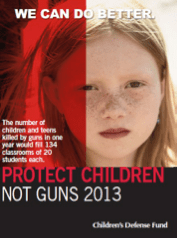
Last month, the Children’s Defense Fund released a new report, PROTECT CHILDREN NOT GUNS 2013. An overview and action steps are below. The full report is here.

Overview
2,694 children and teens died from guns in the United States in 2010.
The Children’s Defense Fund’s publication, Protect Children, Not Guns 2013, analyzes the latest fatal and nonfatal gun injury data from the U.S. Centers for Disease Control and Prevention for children and teens ages 0-19.
The U.S. has as many guns as people.
- The U.S. accounts for less than 5 percent of the global population, but owns an estimated
35 to 50 percent of all civilian-owned guns in the world.
- The most recent estimate of U.S. civilian gun ownership is as high as 310 million, about one gun per person. In contrast, U.S. military and law enforcement agencies possess 4 million guns.
- American companies manufacture enough bullets each year to fire 31 rounds into every one of our citizens.
A gun in the home increases the risk of homicide, suicide and accidental death.
- A gun in the home makes the likelihood of homicide three times higher, suicide three to five times higher, and accidental death four times higher. For every time a gun in the home injures or kills in self-defense, there are 11 completed and attempted gun suicides, seven criminal assaults and homicides with a gun, and four unintentional shooting deaths or injuries.
- More than half of youth who committed suicide with a gun obtained the gun from their home, usually a parent’s gun.
U.S. children and teens are 17 times more likely to die from a gun than their peers in 25 other high-income countries combined.
- U.S. children and teens made up 43 percent of all children and teens in these 26 countries but were 93 percent of all children and teens killed by guns.
- In 2010, children and teen gun death rates in the U.S. were over four times higher than in Canada, the country with the next highest rate, nearly seven times higher than in Israel, and nearly 65 times higher than in the United Kingdom.
- U.S. children and teens were 32 times more likely to die from a gun homicide and 10 times more likely to die from a gun suicide or a gun accident than all their peers in the other high-income countries combined.
A child or teen dies or is injured from guns every 30 minutes.
- 18,270 children and teens died or were injured from guns in 2010.
- 1 child or teen died or was injured every 30 minutes.
- 50 children and teens died or were injured every day.
- 351 children and teens died or were injured every week.
More children and teens die from guns every three days than died in the Newtown massacre.
- 2,694 children and teens died from guns in 2010.
- 1 child or teen died every 3 hours and 15 minutes.
- 7 children and teens died every day, more than 20 every three days.
- 51 children and teens died every week.
- The children and teens who died from guns in 2010 would fill 134 classrooms of 20 children
Guns are the second leading cause of death among children and teens ages 1-19 and the number one cause among Black children and teens.
- Only motor vehicle accidents kill more children and teens every year.
- White and Asian/Pacific Islander children and teens were nearly three times more likely, American Indian/Alaska Native children and teens more than two times as likely, and Hispanic children and teens one-and-a-half times more likely to be killed in a car accident than by a gun.
- In contrast, Black children and teens were twice as likely to be killed by a gun than to be killed in a car accident.
Although total gun deaths dropped in 2010 for the fourth consecutive year, gun death rates remained higher than in the early 1960s.
- In 2010, the rate of gun deaths in children and teens was 30 percent higher than in 1963, when data were first collected from all states.
- While Black children and teens have experienced the highest rates of gun deaths, the largest number of deaths has been among White children and teens. Out of the estimated 166,600 children and teens who have died from guns between 1963 and 2010, 53 percent were among White children and teens, and 36 percent were among Black children and teens.
- Between 1963 and 2010, 59,265 Black children and teens were killed by guns—more than 17 times the recorded lynchings of Black people of all ages in the 86 years from 1882 to 1968.
Since 1963, three times more children and teens died from guns on American soil than U.S. soldiers killed in action in wars abroad.
- 166,500 children and teens died from guns on American soil between 1963 and 2010, while 52,183 U.S. soldiers were killed in action in the Vietnam, Afghanistan, and Iraq wars combined during that same period.
- On average 3,470 children and teens were killed by guns every year from 1963 to 2010, or 174 classrooms of 20 children every year.
Nearly three times more children and teens were injured by guns in 2010 than the number of U.S. soldiers wounded in action that year in the war in Afghanistan.
- An estimated 15,576 children and teens were injured by guns in 2010.
- 1 child or teen was injured every 34 minutes.
- 43 children and teens were injured every day.
- 300 children and teens were injured every week.
- 5,247 U.S. soldiers were injured in the war in Afghanistan in 2010.
Children and teens die from gun violence in all states.
- Every state lost children to gun violence between 2000 and 2010. The number of deaths varied from 15 in Hawaii to 4,668 in California.
- The deadliest state was Alaska with 8.7 gun deaths for every 100,000 children and teens each year, more than twice the nationwide rate of 3.6. Alaska was 21 times more deadly for children and teens than Hawaii, the safest state.
Guns kill more children under 5 than law enforcement officers in the line of duty.
- 82 children under 5 died from guns in 2010, compared to 55 law enforcement officers killed by guns in the line of duty.
Children are more likely to be exposed to violence than adults.
- The 2008 National Survey of Children’s Exposure to Violence found that nearly two-thirds of children and youth had been victims or witnesses of violence within the past year.
- Nearly 1 in 10 children and 1 in 5 14-17 year-olds had witnessed a shooting at some point in their lives.
Black, Hispanic, American Indian and Alaska Native children and teens are disproportionately more likely to die or be injured by guns.
- In 2010, 45 percent of gun deaths and 46 percent of gun injuries were among Black children and teens, although they comprised only 15 percent of all children and teens.
- Black children and teens were 4.7 times more likely to die from guns than White children the same age, and 8.5 times more likely to be injured. American Indian or Alaska Native children and teens were 2.4 times more likely to die from guns, and Hispanic children were 3.3 times |more likely to be injured from guns than White children and teens.
- Black children and teens were 17 times more likely to die from a gun homicide than White children the same age.
- American Indian or Alaska Native children and teens had the highest rate of gun suicides, nearly twice as high as White children and teens.
Homicide is the leading manner of gun death among children and teens and assault the leading manner of gun injury.
- Children and teen gun deaths were most likely to be homicides; adult gun deaths were most likely to be suicides.
- Two out of three child and teen gun deaths were homicides; a little over one out of four were suicides.
- Among nonfatal gun injuries, a little over three out of four resulted from assaults while nearly one out of five was accidental.
Older teenagers are most at risk from gun violence, Black male teens are most at risk
- Eighty-six percent of gun deaths and 89 percent of gun injuries in 2010 occurred in 15-19 year-olds.
- Black males ages 15-19 were nearly 30 times more likely to die in a gun homicide than White males and more than three times more likely to die in a gun homicide than Hispanic males of the same age.
Total gun deaths and injuries in 2010 cost the U.S. $174.1 billion, or 1.15 percent of our gross domestic product.
- The 105,177 gun deaths and injuries to children, teens and adults that occurred in 2010 cost the nation $8.4 billion in medical and other direct costs, $52.5 billion in lost productivity and lost wages, and $113.3 billion in lost enjoyment of life.
Stand Up and Take Action
1. Urge your members of Congress to protect children from gun violence. Support commonsense gun safety and gun violence prevention measures for the nation including:
- Universal background checks;
- Limits on assault weapons and high-capacity ammunition magazines;
- Consumer safety standards, childproof safety features, and authorized-user identification technology for all guns;
- Better preventive and therapeutic services for children and families facing violence in their homes and communities and for children with unmet mental health needs;
- Adequate funding for gun violence prevention research and programs; and
- Resources and authority for the federal Bureau of Alcohol, Tobacco, Firearms and Explosives (ATF) and law enforcement agencies to properly enforce gun laws.
2. Urge state and local governments to protect children from guns. Urge your state legislators and local officials to:
- Support laws to prevent child access to guns including childproofing and keeping all guns secured from unsupervised children;
- Support universal background checks;
- Support limits on assault weapons and high-capacity ammunition magazines; and
- Oppose efforts to limit the ability of schools, physicians and others to warn parents and students about the dangers of guns.
3. Parents, remove guns from your home and be vigilant about where your children play.
4. Boycott businesses and products that glamorize and normalize violence.
5. Bring attention to the number of children killed and injured by gun violence and the truth about guns.
6. Offer parents, children and teens the resources, support and tools to survive and combat the culture of violence.
The Impact of Initiatives to Limit the Advertising of Food and Beverage Products to Children: A Systematic Review
In recent years, many governments and food companies have introduced new codes on food advertising to children. A report in Obesity Reviews presents findings from a systematic review of evidence on levels of exposure of children to the advertising of less healthy foods since the introduction of these codes. Scientific, peer-reviewed papers show that high levels of such advertising of less healthy foods continue to be found in several different countries worldwide. In contrast, the evidence provided in industry-sponsored reports indicates a remarkably high adherence to voluntary codes. We conclude that adherence to voluntary codes may not sufficiently reduce the advertising of foods which undermine healthy diets, or reduce children’s exposure to this advertising.
Indonesia to Seek Compensation from US in Tobacco Trade Fight
Indonesia will seek compensation from the United States for pulling its clove cigarettes from shelves despite a World Trade Organization (WTO) ruling that deemed the ban discriminatory, reports the Jakarta Globe. Indonesia’s trade ministry said it had lost between $200 million and $300 million annually from the 2009 ban, aimed at helping prevent youths from taking up smoking. The WTO found that the US had flouted trade rules in its health act — under which cinnamon, coffee, grape and strawberry-flavored cigarettes were also banned — because it allowed menthol-laced tobacco to stay on the market.
Industry Lawyers Tell Big Food How Not to Get Sued

Cross-posted from Eat, Drink Politics

Earlier this month I attended a conference in Washington DC with the lofty title: “3rd Advanced Regulatory and Compliance Summit on Food & Beverage Marketing & Advertising.” The event’s main sponsor was the law firm of Faegre Baker Daniels, whose numerous mega-corporate food clients include Cargill, Dean Foods, and Nestlé. In addition, the firm represents (under the heading of “crop protection“) Big Biotech players such as Bayer, Dow, and DuPont. The presenters were almost all industry lawyers, with a few government types. Not one member of the plaintiffs bar or anyone from a public interest organization was a speaker, and it seemed most of the audience was also from industry.
In all fairness, I think it’s a good thing for defense lawyers to share information and best practices about how food companies can and should comply with the law. Adhering to laws and regulations, as feeble as those rules can be, is a good thing and corporations should strive for it. And I am happy to report that’s what most of this meeting was about: to help food companies (in legalese) “mitigate risk,” as opposed to how to get away with skirting the law.
For example, in a session called “Minimizing the Risk of Deceptive Health Claims Post-POM Wonderful” an attorney with the Federal Trade Commission tried to explain what sort of “substantiation” a food company would need to back up any health claims. (POM Wonderful has been embroiled in quite a fight with the feds over its exaggerated claims.)
A similar presentation was called “How to Use Clinical Studies, Data, and Results without Violating FTC Regulations: A Case Study on Omega-3 Claims.” You see, the feds are OK with making certain types of health claims on food products as long as you can back it up with actual science. Just how strong the research needs to be however, was never made very clear. When I tried to ask one government lawyer, What if the science is funded by industry?, the answer was also unsatisfactory: that might be considered as a factor but not a disqualifying one. Generally the feds like to consider these matters on a case by case basis.
The most unbalanced and frustrating panel was called: “Maintaining the Delicate Balance of Marketing to Children‚ Obesity and the Integrity of your Product.” The main speaker was Elaine Kolish, director of the Children’s Food & Beverage Advertising Initiative, a fancy name for the food industry’s sad excuse for voluntary self-regulation. Numerous groups have criticized CFBAI for its ridiculously generous nutrition guidelines and self-serving loopholes.
But to hear Kolish tell it, CFBAI was the best way to protect children, far better than government regulation. She claimed that all by itself, industry “has created robust rules, and changed them twice” and that “in a five-year period, self-regulation has done more than government.” Of course it has, because that same industry lobbied like hell to stop government from doing its job in setting better guidelines. Throughout her presentation, which at times bordered on shrill, Kolish showed her utter disdain for the feds, along with numerous public interest groups. She disparaged Center for Science in the Public Interest, saying they engaged in “litigation by press release.” She also attacked other groups including the Campaign for a Commercial-Free Childhood and Berkeley Media Studies Group for daring to complain about food industry exploitation of children.
Now reasonable people can disagree on this controversial topic and I realize I was attending an industry-friendly meeting, but Kolish said several things that should not have gone unchallenged. For example, she misrepresented the current science on how marketing to children is deceptive. If someone from the other side had been on that panel, the audience would have heard a far more balanced take. It was in fact a disservice to the industry representatives in the room to downplay the issue. I had this feeling at numerous other times during the event: that including a public interest perspective would have allowed for a more nuanced and stimulating discussion.
Another notable presentation was called “Update on State Food Labeling Laws: How GMO Labeling Initiatives Impact your Business Strategies.” Obviously industry is very concerned about the growing movement to label genetically-engineered foods. This panel was a good overview of current efforts, and mentioned several advocacy groups, including Food Democracy Now! for its role in the state bills. (Unlike Ms. Kolish, the speakers on this panel – both with the sponsoring law firm – were factual and respectful.) It was interesting, though not surprising, to see how much industry lawyers were staying on top of advocacy efforts.
Finally, as would be expected, there were several presentations on the current threat of private class action litigation over deceptive food marketing claims, some offering tips on how to defend against such lawsuits. (I recently wrote about this trend in class actions.) The “natural” cases were clearly a huge concern. One attorney in the audience suggested food makers stop using natural labeling at all, which was very sound advice and refreshing to hear. Also discussed was emerging case law in which judges are deferring to FDA ruling on whether or not “natural” labels should be allowed on products containing genetically-engineered ingredients. But no one in the room expected FDA to do so anytime soon.
Over the three-day event, I had several constructive conversations with food industry attorneys who really don’t want their clients to get into legal trouble. But it was also clear that their good advice can sometimes come into conflict with the marketing department. So next time you see a food product making a deceptive claim, it’s probably either because the company received bad legal advice, or the marketers overruled the lawyers.
Federal Trade Commission Plans Pay-For-Delay Crackdown in Wake of Supreme Court Ruling
Now that the Supreme Court has ruled on FTC v. Actavis, the Federal Trade Commission is ramping up scrutiny of pay-for-delay deals and will pursue antitrust charges not only for new cases, but also those that “still have delay in effect”. In a hearing at the Senate Subcommittee on Antitrust, Competition and Consumer Rights, FTC Chairwoman Edith Ramirez called the pay-for-delay issue “one of the Commission’s top priorities” and said the Commission “remains united today in its determination to end these illegal pay-for-delay agreements.”
Car Industry Chiefs Urged to Give Latin America Safer Vehicles
The Global New Car Assessment Programme (Global NCAP) is a newly established non-profit organization which aims to encourage the worldwide availability of independent consumer information about the safety of motor vehicles. Its chairman Max Mosley has urged CEOs at Renault-Nissan, General Motors and Suzuki to apply the UN’s minimum crash safety standards to their global passenger car production. New crash test results have indicated that popular cars sold by the manufacturers in Latin America pose an unacceptably high risk of death or injury in the event of a crash.
A Bagful of Cash: How the U.S. Chamber of Commerce Orchestrated a Corporate Takeover of Government
Cross posted from shutthechamber.org

A new report by Shut the Chamber, a group leading a campaign to educate and organize communities across the country to fight the Chamber of Commerce on a national and state-by-state level describes the history and goals of the Chamber:
The US Chamber of Commerce– a 101 year-old organization formed as corporations’ first union—is the chief agent behind Congress’ kowtowing to corporate interests, the Supreme Court’s favorability to corporations in its rulings, and presidents of both parties’ insistence on accommodating the wishes of multinational corporations at the expense of working-class people all over the world. This report outlines how the Chamber first formed, their blueprint for ultimate success as revealed in the confidential Powell Memo, how that blueprint has been realized in the 40 years since its writing, and the devastating effects of that agenda on small business. Despite the US Chamber purporting to be pro-jobs, pro-small business, and pro-growth, they have consistently lobbied for policies that kill jobs, stall economic growth, and take competitive advantages away from small businesses to enrich their corporate members. The Chamber of Commerce’s unchecked power over government will only continue to worsen unless the American people build a movement to mobilize against them.
Minimum Unit Price for Alcohol Proposal Shelved
Health groups have strongly condemned the government for last week’s decision to shelve minimum unit pricing for alcohol and substitute a series of measures to curb excessive drinking that they say will not work. They warn that more lives will now be lost, reports the Guardian. The Alcohol Health Alliance (AHA) accused the government of buckling to pressure from the drink industry, which has fiercely opposed minimum pricing – a measure which is supported by doctors, children’s charities, pub landlords and the police.
Bain Capital Buys British Blood Bank
Bain Capital, the private equity firm branded a “job destroyer” in the US presidential elections, has bought a majority stake in the state-owned blood products firm Plasma Resources UK, reports the Guardian. Lord Owen, a former Labour health minister in the 1970s, who created a service to make the UK self-sufficient in blood supplies, said it was “hard to conceive of a worse outcome” than the £200m sale of an 80% stake in the Hertfordshire-based company to private equity. The Department of Health will retain a 20% share in the business.
 Corporations and Health Watch