The Legal Intelligencer reports that drug companies may face product liability claims in Pennsylvania for defectively designed drugs, the state Supreme Court has ruled. The 4-2 ruling stems from a case involving the fatal use of a diet drug made by a Pfizer subsidiary that was later taken off the market. The majority rejected the argument that manufacturing defects and inadequate warnings are the only viable product liability claims against pharmaceutical companies, and the court allowed claims to go forward alleging the drug company negligently designed and marketed the diet pill.
The Cigarette Industry Running Out of Puff
In an analysis of the future of the tobacco industry, The Economist warns that U.S. Surgeon-General Boris Lushniak’s goal of “end-game strategies” to stamp out cigarettes could put America’s three big tobacco firms, Altria, Reynolds and Lorillard, out of business and endanger the viability of Philip Morris International (PMI), which along with Altria makes Marlboro, the top-selling global brand; Japan Tobacco; and British American Tobacco and Imperial Tobacco of Britain.
Top Lessons from 50 Years of Fighting the Tobacco Industry

Cross-posted from The Guardian

This month’s 50th anniversary of the First Surgeon General’s Report on Smoking and Health provides a bittersweet reminder of the promise and the limitations of public health activism to curb corporate promotion of behaviors and lifestyles associated with premature death and preventable illness and injury. In the half century since the report was released, the proportion of Americans who smoke has been cut in half. A new report in the Journal of the American Medical Association estimates that tobacco control efforts in the United States have prevented 8 million premature deaths and extended the average lifespan by on average almost 20 years of life for the people who did not take up smoking because of prevention campaigns, higher tobacco taxes or smoking bans. Overall, the success in reducing tobacco use has added 2.3 years to the life of the average American man and 1.6 years to the average American woman.
But this progress could have been achieved in far less time had not every preventive policy been opposed by the tobacco industry and had politicians beholden to the tobacco lobby severed these ties more quickly. These delays doomed many more to tobacco-related illnesses. And despite the progress in this country, the estimated toll from tobacco in this century is 1 billion premature deaths, more than 10 times the toll for the 20th century. The main reason so many more people will fall ill and die painful, early tobacco-related deaths is that the tobacco industry has adapted the lessons on marketing and undermining regulation that it learned in the United States to emerging markets in Asia, Africa and Latin America.
Sadly, the tobacco industry is not alone in contributing to America’s poor health standing among developed nations. In 2010, guns took the lives of 31,076 Americans in homicides, suicides and unintentional shootings, the equivalent of more than 85 deaths each day. Another 73,505 Americans were treated in hospital emergency departments for non-fatal gunshot wounds. While the scientific knowledge and technology to significantly reduce this toll are available, like the tobacco industry, the gun industry and its allies in the National Rifle Association have steadfastly blocked any progress to make guns less accessible or safer.
Similarly, the alcohol industry contributes to alcohol related injuries and illnesses by aggressive marketing, expanding the density of alcohol outlets, and designing products such as wine coolers and malt liquors to appeal to young drinkers. A recent study found that between 2001 and 2009, youth exposure to television alcohol advertising increased by 71%. Excess alcohol consumption accounts for about 4,700 annual deaths among underage drinkers. Another study estimated that the combined market value for the alcohol industry of illegal underage drinking and adult problem drinking accounted for between 37.5 and 48.8% of consumer expenditures for alcohol.
How has it come to pass that corporations now have a stronger influence on the health of Americans than public health officials, doctors or hospitals? How have corporations succeeded in convincing so many officials in the White House, Congress and the supreme court that protecting profits is a higher national priority than protecting public health?
In the last decades, a corporate consumption complex has solidified its influence on American politics and the economy. This web of consumer corporations, the bankers and hedge funds that lend them money, the trade associations that lobby for them, and the global ad agencies that market their products has been able to use its campaign contributions, lobbying and lawsuits to achieve its business goals even when the majority of Americans disagree with these. Like the military industrial complex that Dwight Eisenhower warned about before he left public office, the corporate consumption complex threatens our democracy as well as our health and environment.
Are there lessons from our partial successes in cutting tobacco use that could be applied to reducing the power of the corporate consumption complex and its brand of hyperconsumption? I suggest three.
1. Efforts to reduce tobacco use succeeded when Americans came to believe that the right to breathe clean air trumped the tobacco’s industry’s right to promote its products without public oversight. Today, we need to mobilize parents to demand our children’s right not to be shot and not to be targeted by marketing of fast food, sugary beverages and snacks that have contributed to a 176% increase in the prevalence of diabetes between 1980 and 2011.
2. Part of the success in reducing smoking came from forcing Big Tobacco to reimburse state governments for the costs of caring for people with tobacco-related illnesses. Enacting policies that would require processed food producers to reimburse taxpayers and victims of the diet-related diseases exacerbated by their promotion of high fat, sugar and salt diets and alcohol producers for those injured or killed by the binge drinking.
3. Fund independent hard-hitting prevention campaigns designed to undo the deceptive advertising Big Tobacco had sponsored. We can do the same thing by counterbalancing the media and ad campaigns today targeting young people to eat bad foods and glamorize guns.
In 1964, most observers thought it was politically impossible to defeat the tobacco industry and to bring about significant reductions in tobacco use. Today, changing the practices of the firearms, alcohol and processed food industries seems a similarly daunting task. But if we can apply the lessons from tobacco to accelerate changes in harmful business practices, perhaps we won’t need to wait another 50 years to prevent the deaths, illnesses, injuries and rising healthcare costs that today’s science could avert.
Post script: 219 Guardian readers commented on this column in the week since it was posted. A review of these comments provides a good overview of public debates about individual and corporate responsibility –as well as the occasional nuttiness of online commentary.
Grocery Goliaths: How Food Monopolies Impact Consumers
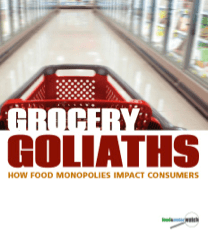
Last month, Food and Water Watch, a group that seeks to ensure that the food, water and fish we consume is safe, accessible and sustainably produced, released a report on concentration in the food industry. The Executive Summary is posted below. The full report is available here.

Groceries are big business, with Americans spending $603 billion on grocery products in 2012. Big-box food retailers like Walmart and national grocery store chains now dominate the grocery industry. These mega-retailers are the biggest buyers of grocery products, and they exert tremendous power over food companies and ultimately farmers. This has led to a handful of food companies producing the majority of the products in the supermarket.
This growing consolidation of the food supply is severe at every step of the food chain, from farm to fork. And it impacts not only farmers and food manufacturers, but also consumers in the form of reduced consumer choices and higher grocery prices. Since the Great Recession started, grocery food prices rose more quickly than inflation and wages — twice as fast between 2010 and 2012. At the same time, the largest food, beverage and grocery retail companies pocketed $77 billion in profits in 2012. Nationally, the growing size and market power of the top grocery retailers has had tremendous ripple effects across the food chain. Food & Water Watch examined 100 types of grocery products and found that the top few companies dominated the sales of each grocery item in recent years.
Key Findings:
- In 2012, more than half of the money that Americans spent on groceries (53.6 percent) went to the four largest retailers: Walmart, Kroger, Target and Safeway. Walmart alone sold nearly a third (28.8 percent) of all groceries in 2012.
- The top companies controlled an average of 63.3 percent of the sales of 100 types of groceries (known as categories in industry jargon). In 32 of the grocery categories, four or fewer companies controlled at least 75 percent of the sales. In six categories, the top companies had more than 90 percent of the sales, including baby formula and microwave dinners.
- Many firms sell multiple brands of the same product, which leads consumers to believe that they are choosing among competitors when they are actually just choosing among products made by the same firm that may have been made at the same factory. This is true across the board, including organic and healthful brands typically seen as independent, but which are being bought up by large food companies unbeknownst to consumers.
- Supermarkets engage in a host of strategies to manipulate the shopping experience, encouraging consumers to make impulse and more expensive purchases that are unknown to consumers.
- Regulators have largely left mega-retailers to operate unchecked as they invented new ways to extract value from consumers and even large food processors. It is time for regulators to step in to protect consumers and restore some semblance of competition for consumers in grocery stores, providing a chance for innovative, small or local food companies to get on store shelves.
Surgeon General: Smoking to Kill 5.6 Million Kids if We Don’t Act Now
CBS reports that the U.S. Surgeon General’s latest smoking report warns that unless current tobacco use rates fall, another 5.6 million U.S. kids might die prematurely. The Surgeon General’s 2014 report, the first in more than a decade, found that smoking has killed more than 20 million Americans prematurely in the last half century.
Father of Australian Victim of Alcohol Violence Pushes for Ban on Alcohol Industry Donations
The Sydney Morning Herald reports that the father of Australian assault victim Michael McEwen, who was left fighting for his life after being hit and having his head stomped by drunken assailants, has called on the New South Wales and federal governments to consider a six-point plan to address alcohol-related violence. Among the measures championed by Robert McEwen are a federal ban on political donations from the alcohol industry and mandatory drug and alcohol testing of perpetrators of violent attacks in NSW.
Big Data + Big Pharma = Big Money
Need another reminder of how much drugmakers spend to discover what doctors are prescribing? asks Charles Ornstein on Pro Publica. Look no further than new documents from the leading keeper of such data. IMS Health Holdings Inc. says it pulled in nearly $2 billion in the first nine months of 2013, much of it from sweeping up data from pharmacies and selling it to pharmaceutical and biotech companies. The firm’s revenues in 2012 reached $2.4 billion, about 60 percent of it from selling such information.
Sugar Health Risk Cannot Be Compared to Smoking, Says Former UK Health Secretary Andrew Lansley
Health experts are wrong to claim that sugar is as dangerous as smoking, the former health secretary Andrew Lansley has said as he clashed with one of his old advisers on obesity, Professor Simon Capewell, reports the Guardian. Lansley, a senior Conservative and now leader of the house, said people would not accept a rapid reduction in the sugar content of familiar foods, as he rejected calls from the Action on Sugar group for a 20% to 30% drop in the amount added to products. “Sugar is the new tobacco. Everywhere, sugary drinks and junk foods are now pressed on unsuspecting parents and children by a cynical industry focused on profit not health,” Capewell said.
Camp-Baucus Bill Would Revive Controversial 2002 Fast Track Mechanism

Cross-posted from Public Citizen

The Camp-Baucus Fast Track bill replicates the procedures included in the 2002 grant of Fast Track that expired in 2007:
- The president would be empowered to unilaterally select trade negotiating partners and commence negotiations. Like the 2002 Fast Track, in the Camp-Baucus bill this authority is conditioned only on pro forma consultations and 90 calendar days’ notice being given to Congress before negotiations begin. The Camp-Baucus bill provides no mechanism for Congress to veto a president’s decision to enter into negotiations on a trade pact that would be subject to expedited floor procedures, nor any role in selecting with which countries such pacts are initiated. (Sec. 5(a))
- The president would be empowered to unilaterally control the contents of an agreement. As with the 2002 Fast Track, congressional negotiating objectives in the Camp-Baucus bill are not enforceable. Whether or not U.S. negotiators obtain the listed negotiating objectives, the Camp-Baucus bill would empower the president to sign a trade pact before Congress votes on it, with a guarantee that the executive branch could write legislation to implement the pact and obtain House and Senate votes within 90 days, with all amendments forbidden and a maximum of 20 hours of debate permitted. (Sec. 3(b)(3))
- Democratic and GOP presidents alike have historically ignored negotiating objectives included in Fast Track. The 1988 Fast Track used for the North American Free Trade Agreement (NAFTA) and the establishment of the World Trade Organization (WTO) included a negotiating objective on labor standards, but neither pact included such terms. The 2002 Fast Track listed as a priority the establishment of mechanisms to counter currency manipulation, but none of the pacts established under that authority included such terms.
- The president would be authorized to sign and enter into an agreement subject to expedited consideration conditioned only on pro forma consultations and providing Congress 90 calendar days’ notice prior to doing so. (Sec. 6(a)(1)) The executive branch alone would determine when negotiations are “complete.” The congressional “consultation” mechanisms in the Camp-Baucus bill do not provide Congress with any authority or mechanism to formally dispute whether negotiations have indeed met Congress’ goals and thus are complete, much less any means for Congress to certify that its objectives were met before an agreement may be signed.
- The president would be authorized to write expansive implementing legislation and submit it for consideration. (Sec. 6(a)(1)(C)) As with the 2002 Fast Track, such legislation would not be subject to congressional committee markup and amendment. The 2002 Fast Track states that this legislation can include any changes to U.S. law that the president deems “necessary or appropriate to implement such trade agreement or agreements.” (19 USC 3803(b)(3)(B)(ii)) Inclusion of the term “appropriate” in this section of past Fast Track authorities has been controversial, because it provides enormous discretion for the executive branch to include changes to existing U.S. law that Congress may or may not deem necessary to implement an agreement. Indeed, inclusion of the term “appropriate” has enabled Democratic and GOP administrations alike to insert extraneous changes to U.S. law into legislation that skirts committee mark up and is not subject to floor amendment. Rather than remove the term “appropriate,” the Camp-Baucus bill merely adds the superfluous modifier “strictly” in front of the same “necessary or appropriate” language found in the 2002 Fast Track. (Sec. 3(b)(3(B)ii)) As with the 2002 Fast Track, there is no point of order or other mechanism to challenge inclusion of overreaching provisions in the implementing bill.
- Like the 2002 Fast Track, the Camp-Baucus bill would require the House to vote on such legislation within 60 session days, with the Senate having an additional 30 days to vote thereafter. (Sec. 3(b)(3))
- Like the 2002 Fast Track, the Camp-Baucus bill would forbid all amendments and permit only 20 hours of debate on such legislation in the House and Senate. Voting, including in the Senate, would be by simple majority. (Sec. 3(b)(3))
- The Camp-Baucus bill replicates the 2002 Fast Track with respect to limitations that could be placed on the application of the Fast Track process to a specific trade agreement. While the factsheet on the bill released by the Finance Committee suggests that it includes a “strong, comprehensive” disapproval process, in fact it replicates the 2002 Fast Track’s limited grounds for which a resolution to disapprove Fast Track can be offered. The Camp-Baucus bill also replicates the 2002 Fast Track’s procedures for consideration of such a resolution, which curtail the prospect that such a resolution would ever receive a vote. To obtain floor action, a resolution would have to be approved by the Ways and Means and Finance committees, and then the House and Senate would have to both pass the resolution within a 60-day period. (Sec. 6(b))
The Camp-Baucus bill includes several negotiating objectives not found in the 2002 Fast Track. However, the Fast Track process that this legislation would reestablish ensures that these objectives are entirely unenforceable:
- In addition, some of the Camp-Baucus bill negotiating objectives advertised as “new” are in fact referenced in the 2002 Fast Track. For example, the 2002 Fast Track included currency measures: “seek to establish consultative mechanisms among parties to trade agreements to examine the trade consequences of significant and unanticipated currency movements and to scrutinize whether a foreign government engaged in a pattern of manipulating its currency to promote a competitive advantage in international trade.” (19 USC 3802(c)(12)) The so-called “new” text in the Camp-Baucus bill is: “The principal negotiating objective of the United States with respect to currency practices is that parties to a trade agreement with the United States avoid manipulating exchange rates in order to prevent effective balance of payments adjustment or to gain an unfair competitive advantage over other parties to the agreement, such as through cooperative mechanisms, enforceable rules, reporting, monitoring, transparency, or other means, as appropriate.” (Sec. 2(b)(11))
What is touted as “enhanced coordination with Congress” is actually the mere renaming of the Congressional Oversight Group from the 2002 Fast Track as “Congressional Advisory Groups on Negotiations,” while provisions ostensibly improving transparency merely formalize past practice:
- The 2002 Fast Track established a Congressional Oversight Group (COG) comprised of members of Congress appointed by congressional leaders who were to obtain special briefings from the U.S. Trade Representative’s (USTR) office on the status of negotiations and to attend negotiations on an advisory basis. The Camp-Baucus bill renames the COG – delineating a “House Advisory Group on Negotiations” and a “Senate Advisory Group on Negotiations” and describing joint activities of the two – but includes the same appointment process and limited role for congressional trade advisory groups as found in the 2002 Fast Track. (Sec. 4(c))
- The Camp-Baucus bill instructs USTR to write guidelines for its consultations with Congress, the public and private sector advisory groups. In effect, this provision merely requires USTR to put into writing how it will (or will not) relate to these interested parties. (e.g. Sec. 4(a)(3) and Sec. 4(d)(1))
- The Camp-Baucus bill simply formalizes the past practices of USTR by requiring that any member of Congress be provided access to trade agreement documents. For instance, during NAFTA negotiations, members of Congress had open access to the full draft NAFTA texts with a new version placed into a secure reading room in the U.S. Capitol after each round of negotiations. In the summer of 2013, the Obama administration finally responded to growing pressure by members of Congress for access to draft TPP texts by bringing requested specific chapters to members’ offices for review when a member asked for such access. Rather than specifying that USTR must resume the practice of providing standing access for members of Congress to full draft trade agreement texts, the Camp-Baucus bill leaves to the discretion of USTR how it will provide text access to members of Congress if a member requests access. (Sec. 4(a)(1)(B))
- The Camp-Baucus bill also replicates the problematic language of the 2002 Fast Track that limits access to confidential trade agreement proposals and draft texts for congressional staff with the necessary security clearances to only committee staff, excluding personal staff with clearances. (Sec. 4(a)(3)(B)(ii))
The Camp-Baucus bill faces long odds for approval in the 113th Congress:
- With a large bloc of House Democrats and Republicans already having announced opposition to the old Fast Track process at the heart of Camp-Baucus bill, the prospects are limited for the Obama administration to secure passage in the first half of 2014 before lawmakers’ attention turns to midterm elections.
- A letter sent to President Obama in November by 151 Democrats opposed Fast Track authority and called for the creation of a new mechanism for trade agreement negotiations and approval.
- Twenty-seven Republicans have also announced their opposition to Fast Track in two letters to Obama.
- Most Democratic Ways and Means Committee members joined an additional letter in November noting that the old Fast Track process enjoys little support.
- Even after repeated delays in introduction, the Camp-Baucus Fast Track bill failed to gain a House Democratic cosponsor. Ways and Means Ranking Member Sandy Levin (D-Mich.) has announced that he does not support the Camp-Baucus bill. Levin’s demands for changes to the 2002 Fast Track procedure to enhance Congress’ role in determining the contents of trade pacts were rebuffed by Ways and Means Committee Chair Dave Camp (R-Mich.), Finance Committee Chair Max Baucus (D-Mont.) and Finance Committee Ranking Member Orrin Hatch (R-Utah).
- The Camp-Baucus Fast Track grandfathers in the Trans-Pacific Partnership (TPP) and U.S.-EU Trans-Atlantic Free Trade Agreement (TAFTA) negotiations. (Sec. 7) Fast Track for the TPP and TAFTA is especially controversial because these pacts would include chapters on patents, copyright, financial regulation, energy policy, procurement, food safety and more, constraining the policies that Congress and state legislatures could maintain or establish on these sensitive non-trade matters. Fast Track was designed in the 1970s when trade negotiations were narrowly focused on cutting tariffs and quotas, not the sweeping range of non-trade policies implicated by today’s pacts.
Fast Track is an anomaly. It has only been in effect for five of the past 19 years:
- Both Democratic and GOP presidents have struggled to convince Congress to delegate its constitutional trade authority via the Nixon-era Fast Track scheme. Fast Track has been in effect for only five years (2002-2007) of the 19 years since passage of NAFTA and the agreement that created the WTO.
- A two-year effort by President Bill Clinton to obtain Fast Track trade authority during his second term in office was voted down on the House floor in 1998 when 171 Democrats were joined by 71 GOP members who bucked then-Speaker Newt Gingrich. Clinton did not have Fast Track for six of his eight years in office, but still implemented more than 130 trade agreements.
- President George W. Bush spent two years and extraordinary political capital to obtain the 2002-2007 Fast Track grant, which passed a Republican-controlled House by one vote, and expired in 2007.
Nader Recommends New Book Lethal but Legal to Provoke Conversation in 2014


In a column in the Huffington Post, Ralph Nader, author of Unsafe at Any Speed (1965) and other corporate exposes, includes Lethal but Legal Corporations, Consumption and Protecting Public Health, a new book by published by Oxford University Press and written by CHW founder Nicholas Freudenberg, as one of 10 Books to Provoke Conversation in the New Year. He writes that “Freudenberg gives readers an absorbing aggregation of corporate crimes and abuses that destroy or damage every day the health, safety and economic well-being of the people. Then he aggregates the past civic/political victories over market fundamentalism and its corporate outlaws for framing future reform initiatives.”
The ten are:
1. Think Like a Commoner: A Short Introduction to the Life of the Commons by David Bollier (New Society Publishers)
David Bollier is a leading writer and advocate for all those real-life commons — what we own, from the public lands, public airwaves, online information and local civic assets. He calls the commons a “parallel economy and social order that…. affirms that another world is possible. And more: we can build it ourselves, now.”
2. All the President’s Bankers: The Hidden Alliances that Drive American Power by Nomi Prins (Nation Books)
All the President’s Bankers is about the hidden alliances between big bankers and the government leaders they have controlled for the past 100 years. A gripping history that reflects the words of the famed Louis B. Brandeis (later to become Supreme Court Justice Brandeis) who wrote: “We must break the Money Trust or the Money Trust will break us.” Prins was a former Goldman Sachs director. She knows this world.
3. How Can You Represent Those People? Edited by Abbe Smith and Monroe H. Freedman (Palgrave Macmillan)
How many times have criminal defense attorneys been asked this question when they represent unpopular, unsavory, or horrific accused defendants? Fifteen criminal defense lawyers write short but educational replies in both personal and professional terms. You’ll learn a lot about our legal system.
4. The Truth in Small Doses: Why We’re Losing the War on Cancer and How to Win It by Clifton Leaf (Simon & Schuster)
The Truth in Small Doses is a detailed, sober myth-busting report. Leaf concludes the “war on cancer” is a failure due to a dysfunctional “cancer culture” – “a groupthink that pushes tens of thousands of physicians and scientists toward the goal of finding the tiniest improvements in treatment rather than genuine breakthroughs; that fosters isolated and redundant problem-solving instead of cooperation; and rewards academic achievement and publication above all else.” He shows why “the public’s immense investment in research has been badly misspent.”
5. The American Way of Poverty: How the Other Half Still Lives by Sasha Abramsky (Nation Books)
The American Way of Poverty is a worthy successor to Michael Harrington’s The Other America which came out in 1962 and helped spark a war on poverty. Abramsky puts many faces of poverty into a broader context which sparks reader indignation that statistics alone can’t provoke.
6. The Firm: The Story of McKinsey and Its Influence on American Business by Duff McDonald (Simon and Shuster)
The Firm portrays a finishing school for the plutocracy both as an early recruiter of future power brokers in business and government and as a “prestigious” provider of dated business management advice often of dubious value.
7. Censored 2014: Fearless Speech in Fateful Times by Mickey Huff and Andy Lee Roth with Project Censored (Seven Stories Press)
Censored 2014 is an annual open window to censorship of the big and routine kind. It is always a must read. This volume describes the top censored stories with media analysis of 2012-2013. What a shocking commentary on the so-called free press!
8. Lethal but Legal: Corporations, Consumption and Protecting Public Health by Nicholas Freudenberg (Oxford University Press)
Aggregation is a key strategy for justice movements. Author Freudenberg gives readers an absorbing aggregation of corporate crimes and abuses that destroy or damage every day the health, safety and economic well-being of the people. Then he aggregates the past civic/political victories over market fundamentalism and its corporate outlaws for framing future reform initiatives.
(Read more about Lethal but Legal)
9. Front Porch Politics: The Forgotten Heyday of American Activism in the 1970s and 1980s by Michael Stewart Foley (Hill and Wang)
Decades are stereotyped and often exaggerated. Foley counters the conventional take that there was a sharp and sudden letdown in civic activism after the sixties. Maybe the impression was conveyed by the media’s lessened coverage. Good antidote for those still demoralized by decennial mythologies.
10. The Capitalism Papers: Fatal Flaws of an Obsolete System by Jerry Mander (Counterpoint)
The Capitalism Papers is a fundamental critique of the intrinsic problems of the capitalist system that the author believes are inherent to its structure and unreformable. A former celebrated advertising executive, Mander goes deeper into the perverse incentives of corporate capitalism than almost anyone writing today. And man, can he write. Too bad top Wall Streeters won’t debate him.
Years ago books mattered more in provoking change. It is up to readers today not to be overwhelmed by information overload, to be selective and make books matter again.
 Corporations and Health Watch