Taxing for health

Credit

Taxing products that harm health has long been part of the public health’s armamentarium to reduce the impact of harmful corporate practices. As the global economic crisis continues and the austerity mentality feeds government hunger for new sources of support, politicians look for   streams of   revenue that can win public support.    Recent media coverage of several political debates about taxes designed to promote health illustrate the potential and pitfalls of this strategy.


In France, the new socialist government has proposed a new tax on beer that would increase the price of a half pint of beer by six cents.  According to the New York Times, the government offers a public health rationale for the beer tax. There has been an “excessive alcoholization, in particular of youth, with beer more than with wine,” said Jérôme Cahuzac, the budget minister. French beer taxes are among the lowest in the 27-state European Union, he noted, and the scheduled increase would leave them only the 10th highest, lower than in Britain, Spain and the Netherlands.


The Socialist government has also said it will increase the value-added tax, a type of consumption tax, in several sectors of the food industry, including restaurant meals, to 10 percent from 7 percent, partly reversing a reduction made by the previous center-right government.  In addition, France’s social security budget, which is in the final stages of the legislative process, also includes heavier taxes on tobacco and new ones on energy drinks. Proposed new taxes total about $30 billion; the increase in the beer tax is expected to generate an additional $625 million.


Not surprisingly, bar owners oppose the new tax, fearing it will cut their business.  Others complain that the tax increase is just on beer, not wine, an important sector of the national economy. One supporter of the bill, Even Gérard Bapt, a Socialist legislator, expressed the opinion that the “increase would have to be much more significant to have a real moderating effect on consumption.”


While the socialist government in France is proposing new consumption taxes,  Danish lawmakers from the center-right party  earlier this month have killed a controversial “fat tax” one year after its implementation, reports the Wall Street Journal.  They acted after deciding its negative effect on the economy and the strain it has put on small businesses outweighed the health benefits.


The new tax led to increases of up to 9 percent on products such as butter, oil, sausage, cheese and cream. “What made consumers upset was probably that an extra tax was put on a natural ingredient,” Sinne Smed, a professor at the Institute of Food and Resource Economics in Copenhagen, told the Journal.


The fat tax brought an estimated $216 million in 2012 in new revenue.  To make up for the lost revenue, Danish lawmakers will raise income taxes slightly and reduce personal tax deductions. The lawmakers also reversed an earlier decision to create a sugar tax. The fat tax was created in 2011 to address Denmark’s rising obesity rates and relatively low life expectancy. There is little evidence the tax impacted consumers financially, reports the Journal,  but it did spark a shift in consumer habits. Many Danes have bought lower-cost alternatives, or in some cases hopped the border to Germany, where prices are roughly 20% lower, or to Sweden.


In a commentary in the New Scientist on the repeal of Denmark’s fat tax Marion Nestle, the New York University nutritionist, disputed the contention that Denmark’s decision was based on health:


Nobody likes taxes, and the fat tax was especially unpopular among Danish consumers, who resented having to pay more for butter, dairy products and meats – foods naturally high in fat. But the real reason for the repeal was to appease business interests. The ministry of taxation’s rationale was that the levy on fatty foods raised the costs of doing business, put Danish jobs at risk and drove customers to buy food in Sweden and Germany…. Governments must decide whether they want to bear the political consequences of putting health before business interests. The Danish government cast a clear vote for business.  At some point, governments will need to find ways to make food firms responsible for the health problems their products cause. When they do, we are likely to see immediate improvements in food quality and health. Let’s hope this happens soon.


Credit


Another approach to public health taxes has been suggested by outgoing Ohio Congressman Dennis Kucinich. He has proposed a bill HR 4310 End The Childhood Obesity Subsidy Act that would prohibit any company from claiming a tax deduction for the expense of marketing that is directed at children “to promote the consumption of food at fast food restaurants or of food of poor nutritional quality.”  In a November press release and video, Kucinich argues:


According to the Institute of Medicine, ‘Aggressive marketing of high-calorie foods to children and adolescents has been identified as one of the major contributors to childhood obesity.’ We can end this tax break, improve our kids’ health and reduce our nation’s debt all at the same time. It’s time to stop subsidizing the childhood obesity epidemic.


Under current law, the federal tax code allows companies to deduct “reasonable and necessary” expenses of marketing and advertising from their income taxes. Fast food marketers get the same break that other businesses do.


So what do these three recent stories from different parts of the world tell us about the use of taxation to promote health and end harmful corporate practices?


First, taxes on products that harm health will always generate intense opposition from a variety of business interests, from local retailers to the world’s largest corporations.  Advocates who propose such taxes better expect such opposition and be ready to counter it. 


Second, finding the balance between a level of taxation that will actually discourage use and one that is politically feasible in a particular context requires scientific analysis of the available literature and political analysis of the opportunities and constraints.  A May 2012 review in the British Medical Journal concluded that


Taxes on unhealthy food and drinks would need to be at least 20% to have a significant effect on diet-related conditions such as obesity and heart disease. Ideally, this should be combined with subsidies on healthy foods such as fruit and vegetables, they add.


Advocates need to assess the potential for achieving health goals with a proposed tax and consider the pros and cons of a variety of alternative strategies before deciding to pursue the tax route.


Finally, as Kucinich’s proposal suggests, changing the tax code to promote health is not limited to taxes that lead to direct increases in consumer prices.   Dozens of corporate subsidies enable low prices for unhealthy products and supporting changes in taxation that limit these subsidies may offer promoting political opportunities for discouraging harmful corporate practices.  Given the key role that marketing plays in promoting unhealthy behaviors, environments and lifestyles, a closer analysis of tax subsidies for advertising that harms health seems warranted. 
  

To achieve NCD Targets, WHO should monitor tobacco, alcohol and food industry practices

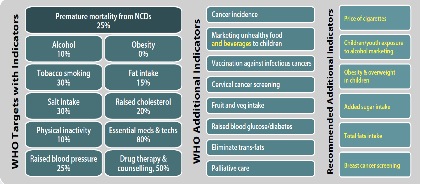
This week the member states of the World Health Organization are meeting in Geneva to agree on a Global Monitoring Framework  for noncommunicable diseases (NCDs).   Meeting participants discussed indicators and targets that could be used to assess progress towards achieving the goal of reducing preventable deaths from NCDs by 25 percent by 2025.  Also participating in the meeting was the NCD Alliance, a network of more than 2,000 civil society organizations from more than 170 countries.  The Global Action Plan and the Global Monitoring Framework on NCDs are a result of the United Nations High-Level Meeting of the General Assembly on NCDs held in New York City in September 2011. 


The discussions at the meeting in Geneva focused on what to measure.  As shown below, WHO has set 2025 targets as shown in the column on the left and then proposed additional indicators as shown in the middle column.  The NCD Alliance has recommended some additional indicators, shown in the column on the right.


These targets and indicators mark an important step forward in controlling NCDs. As Cary Adams, the Chair of the NCD Alliance noted in Geneva , the “commitment to measuring our progress and setting realistic and achievable goals, supported by the investment required, will…make a real difference to those of us who have or will develop NCDs in our lifetime. “


But monitoring changes in health status and health behavior related to NCDs and government NCD prevention policies may not be enough to achieve the stated goals.  As several experts have acknowledged, the business and political practices of the alcohol, tobacco and food industries play a critical role in the development of NCDs.[i][ii][iii] Without changes in these practices, it will be difficult to reduce premature deaths.  To encourage the discussion of indicators and targets for such monitoring, I suggest some provocative goals for the monitoring of corporate practices.


  1. Reduce expenditures on marketing alcohol, tobacco and unhealthy foods by the top 10(or 20 or 50) global producers of each of these products by a fixed percentage each year. The alcohol, tobacco and food industries are heavily concentrated with the top firms controlling a significant portion of market share.[iv][v][vi]  Since research evidence shows that more marketing leads to more consumption of these products associated with NCDs,[vii] less marketing could reduce exposure to this negative influence.
  2. Reduce corporate expenditures on lobbying and campaigns contributions for the top 10(or 20 or 50) global producers of alcohol, tobacco and unhealthy food by a fixed percentage each year. Tobacco, alcohol and food corporations have used their political and economic clout to undermine public health protections and to create an environment that allows them to promote behaviors and lifestyles associated with NCDs. [viii][ix][x] Restricting their ability to externalize the costs of the NCDs associated with their products and to thwart the democratic principles of one person one vote could help to prevent premature deaths, reduce government expenditures on health care and restore more democratic processes.
  3. Require tobacco, alcohol and food companies to commission an independent health impact assessment of any new product or practice and to make the assessment publicly available.


Each year, these companies introduce thousands of new products and practices. Often, however,  the adverse health impact is not recognized for years.  Requiring companies to hire independent researchers to complete health impact assessments according to uniform standards prior to exposing the population to such practices or products and to make such reports public could discourage companies from releasing into the market inadequately tested products. 


How could such targets be monitored?  The World Health Organization and other global bodies, the NCD Alliance and its network of NGO partners, national governments and other bodies could each play a role in setting targets and monitoring this indicator.  Global organizations could limit participation in international forums to those organizations who achieved targets.  Institutional investors could invest in companies that met targets and disinvest from those that did not.   National governments could favor companies meeting targets for procurement contracts and penalize those that failed to meet the targets.  They could also offer subsidies or tax breaks to companies that achieved targets. Some nations may choose to make these guidelines mandatory, especially for practices implicitly or explicitly designed to increase consumption of unhealthy products by children and young people.  


In the current political climate, these proposals will of course elicit intense opposition from corporations and their allies.  But 50 years ago the current measures in place to control tobacco use would have been unthinkable.  Effective public health officials need to compromise but before they compromise, they have to be able to articulate public health goals that are based on the evidence and have the potential to fulfill the mandate to protect population health.    Unless public health professionals,  researchers and advocates begin discussing now how to take action to end the corporate practices that contribute to the preventable illnesses and premature mortality  that  NCDs impose, 50 years from now we’ll still be lamenting the steady increase in the health burden and economic costs imposed by NCDs. 


[i] Beaglehole R, Bonita R, Horton R, et al., and the NCD Alliance. Priority actions for the non-communicable disease crisis. Lancet. 2011;377(9775):1438-47.

[ii] Magnusson RS. Rethinking global health challenges: towards a ‘global compact’ for reducing the burden of chronic disease. Public Health. 2009;123(3):265-74.

[iii] Lien G, DeLand K. Translating the WHO Framework Convention on Tobacco Control (FCTC): can we use tobacco control as a model for other non-communicable disease control? Public Health;125(12):847-53.

[iv] Jernigan DH. The global alcohol industry: an overview. Addiction. 2009 Feb;104 Suppl 1:6-12.

[v]    Eriksen M, Mackay J, Ross H.  Chapter 18 Tobacco Companies in The Tobacco Atlas 4th Edition  pp. 56-57

[vi] Stuckler D, Nestle M. Big food, food systems, and global health. PLoS Med.2012;9(6):e1001242.

[vii] Stuckler D, McKee M, Ebrahim S, Basu S (2012) Manufacturing Epidemics: The Role of Global Producers in Increased Consumption of Unhealthy Commodities Including Processed Foods, Alcohol, and Tobacco. PLoS Med 9(6):e1001235.

[viii] Brownell KD (2012) Thinking Forward: The Quicksand of Appeasing the Food Industry. PLoS Med 9(7):e1001254.

[ix] Freudenberg N. The manufacture of lifestyle: the role of corporations in unhealthy living. J Public Health Policy. 2012 May;33(2):244-56.

[x] Gilmore AB, Savell E, Collin J. Public health, corporations and the new responsibility deal: promoting partnerships with vectors of disease? J PublicHealth (Oxf). 2011;33(1):2-4.

Corporations and Health at the 2012 APHA Meeting in San Francisco

The American Public Health Association will meet from October 27 -31 in San Francisco, California, drawing about 13,000 health professionals and advocates from around the country and the world.  Several sessions, some listed below, listed below, take up questions on the health impact of corporations.  Presentations given by CHW writers are marked below with *.  The session links provide additional details and the APHA Annual Meeting Program lists other sessions on corporations and health in a searchable program. 


APHA Meeting Sites
Credit


Session 255412:  “The Big Why”: A tobacco product manufacturer’s failed search for corporate social value   

Tuesday, October 30, 2012 : 10:30 AM – 10:50 AM

Participants: Ruth Malone,Patricia McDaniel

Tobacco company corporate social responsibility (CSR) initiatives function as tobacco marketing, inhibit effective tobacco control, and constitute efforts to normalize tobacco companies. When even tobacco executives struggle to define their company’s social value, it signals a social shift: an opening to advocate for supply-side changes appropriate to the scale of the tobacco disease epidemic and consistent with authentic social value.


Session 260757: Corporate shaping of basic public health definitions including disease entities and primary prevention  

Tuesday, October 30, 2012 : 4:50 PM – 5:10 PM

Participant:  Beatrice Manning

This presentation uses existing research on relatively new diseases, such as osteopenia and hypercholesteremia, to document how the web of corporate interests shapes the most basic definitions of health, illness and primary prevention. It will then explicate how these definitional strategies are used by the three major corporate sectors (big pharma, medical equipment companies and private health insurers) within health care to leverage public payment programs to the maximum.


Session 2609.17: How the news media frames the debate over alcohol taxes  

Monday, October 29, 2012

Participants:  Samantha Cukier, Rebecca Reynolds-Ramirez, Katherine Clegg Smith, David H. Jernigan*

The news media play a powerful role in framing public debate over alcohol policies. We report the findings of a content analysis of press coverage of successful efforts to increase alcohol taxes in three states between 2009 and 2011: Illinois, Maryland and Massachusetts. From a purposive sample of six key newspapers in each state, the research team collected more than 600 relevant articles, letters to the editor and editorials that appeared over a two-year period surrounding the passage of the tax increase. We coded each article on 32 different variables, including mentions of public health research in support of the increase, and key arguments utilized and values conveyed by both proponents and opponents. We will summarize the findings of these content analyses, elucidating how competing frames were constructed in public discussions about alcohol taxes, and drawing out implications for public health practice in the specific arena of alcohol taxation as well as more generally in public health applications of the principles and techniques of media advocacy.


Session 262296: Trading Away Health: The Case of Global Tobacco Control

Tuesday, October 30, 2012 : 4:34 PM – 4:48 PM

Participants: Sohil R. Sud, Joseph E. Brenner, Ellen R. Shaffer

Tobacco corporations are suing governments around the world, claiming that regulations on tobacco marketing practices are violations of international trade agreements. Little is known within the healthcare community about these lawsuits and their potential to derail efforts to reduce tobacco consumption.


Session 270317: Global Trade and Health Activism: A Report from the People’s Health Assembly Monday, October 29, 2012 : 3:16 PM – 3:30 PM

Participants:  Shelley K. White, Jonathan White

The third People’s Health Assembly in July 2012, brought together health activists from around the world  to discuss trade and health. This paper provides a brief history of global trade and health activism, highlighting traditional obstacles facing such transnational health-based social movements. It will then report on the trade-focused activities of the PHA3 meeting, and will outline the common organizing principles and goals identified for coordinating global trade and health activism.


Session 270558: Tobacco industry, regional trade agreements and tobacco control in Sub-Saharan Africa Tuesday, October 30, 2012 : 5:16 PM – 5:30 PM

Participants:  Hadii M. Mamudu, Eric Crosbie, Sreenivas P. Veeranki,

Over 80% of estimated global deaths from tobacco-induced diseases by 2030 are expected to occur in low- and medium-income countries, where tobacco industry has aggressively penetrated new markets. We used mixed-methods approach to assess the impact of regional trade agreements (RTAs) in Africa on cigarette sales and analyze how tobacco industry used these RTAs to expand operations and undermine tobacco control.


Session 3167.0: Snack Food and Beverage Industry and Global Non-communicable Chronic Disease  Monday, October 29, 2012: 10:30 – 12:00

Participants: William H. Wiist*, Sanjay Basu, Marion Nestle, Michele Simon*, Jennifer L. Pomeranz*

Worldwide more than 30 million people die each year from chronic disease. By 2030, chronic disease will cause 59% of deaths (more than 37 million deaths per year). The major behavioral risk factors are tobacco, unhealthful diet, physical inactivity and alcohol. The choices people make to eat poorly, drink dangerously, and not exercise are shaped by the world around them. Those choices are strongly influenced by the vested interests of corporations that lobby for policies to support unhealthful products, and develop, promote and sell unhealthful products. Marketing and sale of these products are increasingly promoted around the world in poor countries where chronic disease rates are increasing faster than in rich countries. This session will focus on the “fast food” food and beverage industry which produces and markets processed foods containing ingredients shown by research to be unhealthful.


Session 3205.0: Public Health Harms from Legal Products: Challenges of Countering Industry Influence in Alcohol, Tobacco, Prescription Drugs, and Food in the US 

Monday, October 29, 2012: 12:30 -2:00

Participants: Linda M. Bosma, Michele Simon*, Sarah Mart, Ruth Malone

Numerous legal products available in the United States are associated with public health problems and costs. Tobacco, alcohol, prescription drugs, and food all are available legally, but also have significant costs associated with health and public health harms. These substances are well represented in US regulatory and law-making systems, often to a much greater degree than public health advocates or researchers are able to be. This session will look at current challenges faced by the public health field, examine issues related to regulation and the legal environment, and present solutions that some local governments are exploring. Common issues and strategies across these products will be presented. The opportunity for discussion will help enrich the presentation.


Session 3312.0: The Epidemiologic Cascade: Identifying Multiple Sites for Policy Intervention Monday, October 29, 2012: 2:30 PM – 4:00 PM

Participants:  René I. Jahiel, William Wiist

Epidemiologic cascade: Concept and application to industrial corporations; Defining drinking problems in the UK as a corporation-induced disorder: Theoretical and public health implications


Session 3379.0:  Public Health Strategies to Address Trade and Trade Policy

Monday, October 29, 2012: 2:30 PM – 4:00 PM

Participants:  Peter Maybarduk, Burcu Kilic, Donald Zeigler, Joshua Yang, Shelley K. White, Jonathan White, Timothy Mackey

This session focuses on public health strategies to protect public health within trade and trade agreements.


Session 5181.0: Food, Fairness and Health II: Occupy Agriculture – Corporate Power, Equity and the Food System

Wednesday, October 31, 2012: 12:30 -2:00

Participants:  Steve Wing, Lisa Bero, Elena O. Linga, Tyrone Hayes, Michele Simon*

To equip public health professionals with an awareness of the fact of corporate influence, as well as the specific strategies employed by corporations, so as to better inform public health practice and advocacy around healthy food and just food systems. Public health depends in part on healthy food, and clean air and water in the environments where agriculture occurs. Science and public policies supporting these preconditions for public health, can run directly contrary to the aims of corporations mandated by their corporate charters to maximize profits and shareholder return — and not to promote public health. As a nation, we do enjoy environmental health and safety regulations on the books that exist to protect the public’s health interests. Agribusiness influence on these processes, however, can weaken regulation and enforcement. Compounding the problem of regulatory capture is the fact that corporations also influence research universities and non-profit organizations relied upon to create the scientific bases for public health policy can also be influenced by corporations. Corporate power and influence often lie on the other side of that unhealthy divide from communities of color. Cooptation of the public health profession by a corporate-government alliance undermines our ability to contribute to the basic goals of public health. To change this, public health must develop closer ties to movements for environmental justice and for food justice.

Vote with our forks, feet or ballots? What directions for the US food movement?

Credit

In an article in last week’s New York Times Magazine, food writer Michael Pollan asks whether the US food movement is ready to take on Big Food. He writes:


One of the more interesting things we will learn on Nov. 6 is whether or not there is a “food movement” in America worthy of the name — that is, an organized force in our politics capable of demanding change in the food system. People like me throw the term around loosely, partly because we sense the gathering of such a force, and partly (to be honest) to help wish it into being by sheer dint of repetition. Clearly there is growing sentiment in favor of reforming American agriculture and interest in questions about where our food comes from and how it was produced. And certainly we can see an alternative food economy rising around us: local and organic agriculture is growing far faster than the food market as a whole. But a market and a sentiment are not quite the same thing as a political movement — something capable of frightening politicians and propelling its concerns onto the national agenda.


His November 6th test is “California’s Proposition 37, which would require that genetically modified (G.M.) foods carry a label”.  The proposition, he writes, “has the potential to do just that — to change the politics of food not just in California but nationally too.”


To get another test of the pulse of the US food movement, I conducted my own mini-study of the events listed for second annual Food Day, sponsored by the Center for Science in the Public Interest and hundreds of other organizations around the country.  I wanted to understand the diversity of issues that motivated people to organize and list events so I reviewed a sample of 200 events of the 1,749 listed as of October 14 on the Food Day website.  Here’s what I found:


Of these 200 events, 25 (12.5%) had an explicitly political focus, which I defined by whether the listing mentioned policy, protest or food system change.  Another 20 events (10%) didn’t include enough information to determine whether there was political content or not.  The remaining 155 events (78%) were celebrations of healthy food, cooking events or harvest festivals.  Below is a listing of selected events with a more explicitly political focus.   The list shows the geographic and topical diversity of these activities. It gives an overview of some of the issues and tactics that motivate the more political arm of the food movement.   (CHW readers who want to sign up for upcoming events –or conduct their own studies of Food Day activities– can visit the Events page on Food Day website.)


Like its predecessor and inspiration, Earth Day, founded in 1970, also provoked debate within the movement.  On the one hand, events like Earth and Food Days bring thousands of people to events, link the many issues that inspire activism, and provide multiple opportunities for dialogue and debate.  On the other hand, by lumping together celebration of a Harvest Festival and forcing Monsanto to label its products, the movement risks dissipating its focus and priorities, and allowing people to think individuals can change the food system simply by shopping more wisely. It also invites cooptation:  many food companies jump on the bandwagon of encouraging healthier food choices by, for example, labeling vitamin-fortified Fruit Loops as a healthy choice.  To succeed, movements need to define the source of the problem they combat.  If every organization is a potential partner, then none are the target of change.


To be clear, Food Day is a terrific event. Anyone concerned about food justice should support it.    It will raise consciousness about food issues for tens of thousands of people.  But as we celebrate Food Day events on October 24—and in the weeks before and after, let’s make sure we learn how we can best use Food Day this year and next to build a movement that can truly change our food system.

Credit


Some 2012 Food Day Events with a Political Focus


Seeds of Deception and Genetic Roulette – An Author Presentation     Project Rogue Valley and Ashland Food Coop co-host a presentation by Jeffrey M. Smith, author of the book Seeds of Deception and Genetic Roulette. The presentation supports the efforts of GMO-Free Jackson County. http://jclac.org  Thursday, October 11, 2012 at 07:30 PM – 09:00 PM  Central Medford High Auditorium in Medford, OR.


World Food Day Asheville 2012    World Food Day Rally & Gathering for our Right2Know
Prichard Park in Downtown Asheville, NC.   IN SOLIDARITY WITH SEED FREEDOM’S FORTNIGHT OF ACTION SATURDAY, OCTOBER 13th, 2-5pm.  RAISING AWARENESS OF GENETICALLY MODIFIED ORGANISMS.  SPEAKERS, MUSIC, AND MORE! Sow True Seed…and Grow Wise! & Millions Against Monsanto: Carolinas. For more information, visit:http://www.facebook.com/WorldFoodDayAsheville)Saturday, October 13, 2012 at 02:00 PM – 05:00 PM  Pritchard Park in Asheville, NC.


CUESA Prop 37 Volunteer Training  At each Ferry Plaza Farmers Market (Tuesday, Thursday and Saturday) till November 6, there will be a Proposition 37 Info area where we’ll need volunteers to talk to market-goers and send them home with info about the proposition. Whether you’ve just heard of the prop and you’re ready to learn more, or you’re already feeling strongly about GMO labeling and you’re ready to take action – I invite you to our volunteer orientation this Saturday the 13th from 2-3 pm.  If you are unable to make it on Saturday I’ll host an alternative orientation on Monday evening from 6-7 pm.  At the volunteer training we’ll go over the basics of the proposition, cover talking points to share with market-goers, and role-play possible conversations as they might play out at a market.  I’ll also have Prop 37 information to send home with you to share and plenty of time during and after the orientation to answer questions. Thank you for your hard work.  I look forward to working with you. Saturday, October 13, 2012 at 02:00 PM – 03:00 PM  Ferry Building in San Francisco, CA.


Truth About GMOs with Frances Moore Lappe and Jeffery Smith Speaking Out for Healthier Food: The Truth about GMOs  Dynamic talks about health risks of genetically modified (GMO) food by investigative writer and educator Jeffrey Smith and how this affects us and our environment by Frances Moore Lappe. Find out the truth about GMOs before you vote in November! Key Note Speakers:  Frances Moore Lappe  World visionary and author or co-author of 18 books including the three-million copy Diet for a Small Planet and EcoMind: Changing the Way We Think to Create the World We Want. She is the cofounder of three organizations, including Food First: The Institute for Food and Development Policy and the Small Planet Institute. Jeffrey Smith  Executive Director, Institute for Responsible Technology, author of the best-selling book Genetic Roulette newly released as a documentary film. Sponsored by:  Slow Food San Francisco http://www.slowfoodsanfrancisco.org; Food Policy Fund of the Institute for Responsible Technology; For more info on GMOs:  http://www.responsibletechnology.org  Sunday, October 14, 2012 at 01:00 PM – 04:00 PM · San Francisco, CA.


World Food Day 2012 Philadelphia  Presented by the UN Association of Greater Philadelphia, join us for a celebration of Food Day and World Food Day!  We’ll discuss the agriculture pressures of feeding the world, population pressure and global food needs, and local solutions for global problems. Speakers: Dr. Alan Kelly (UPenn): “Urban Food Security in the Developing World”; Bob Pierson (Philadelphia Common Market):“Local Food Cooperatives and Partnerships”; Dr. Alison Buttenheim (UPenn):
“Farmer’s Markets Expanding Access to Healthy Foods”. Sunday, October 14, 2012 at 02:00 PM – 05:00 PM Hopkinson House Solarium in Philadelphia, PA.


Good Food Economy, Growing Food Justice for Food Servers Forum  Who is serving the food we enjoy at events, at restaurants, and institutions? Is there a living wage, and under what conditions? Sunday, October 14, 2012 at 01:00 PM – 02:30 PM · First Unitarian Church, Eliot Chapel in Portland, OR.


Unmasking Halloween: Harvest, Health, and Hunger  High-fructose corn syrup. Palm Oil. Chocolate. Candy corns. How much candy should I let my child eat?  What kind of candy should I give out to other kids? No other holiday tests our ideas of healthy eating more than Halloween. Join registered dietitian Aaron Flores for a discussion on how you can make peace with the candy and help your family enjoy a healthy Halloween. Sunday, October 14, 2012 at 08:00 PM – 10:00 PM.   University Synagogue in Los Angeles, CA.


Reel Eats: What’s On Your Plate  This is the first screening in the monthly People’s Coop Film Series “REEL EATS.” People’s members get discounted admission. Only $2. Opportunity for discussion following the film. WHAT’S ON YOUR PLATE? is a witty and provocative documentary about kids and food politics. Over the course of one year, the film follows two eleven-year-old multiracial friends from NYC as they explore their place in the food chain. Sadie and Safiyah talk to food activists, farmers, and storekeepers as they address questions regarding the origin of the food they eat, how it’s cultivated, and how many miles it travels from farm to fork. Sadie and Safiyah formulate sophisticated and compassionate opinions about urban sustainability, and by doing so inspire hope and active engagement in others.$6, reg; $4 students & seniors 55+; $2 People’s Coop members Monday, October 15, 2012 at 07:00 PM – 10:00 PM Clinton Street Theater in Portland, OR.


Lecture: Animal Welfare and Factory Farms    Lecture by School of Law Professor Verne Smith on Animal Welfare and Factory Farms with healthy Halloween treats provided by the School of Hospitality Management students – University Center Webb Room, Main Campus. Wednesday, October 31, 2012 at 12:00 PM – 01:00 PM Widener University, University Center Webb Room in Chester, PA.


SWAGG Snacks Video Challenge  Opportunity for Rhode Island Youth!   Want a chance to WIN $500??  Enter the SWAGG Snacks Video Challenge.  ECO Youth is calling on all Rhode Island youth to create a 1-5 minute video about the challenges you, your family, or your friends face trying to eat healthful foods, how you try to overcome these challenges, and why it’s important to you. Submit videos online (include your name, phone, email, and school name in the post): www.facebook.com/groups/swaggsnacks  Wednesday, October 31, 2012 at 12:00 AM – 11:00 PM Environmental Justice League of Rhode Island in Providence, RI.


Webinar: Sharing the Harvest – Growing Fresh Food for Those Who Most Need It This event is virtual. Click here to register: http://www.nccendpoverty.org/hunger/SharingHarvestWebinarOct172012.php  Space is limited, so please register early! One in every seven households in the United States experienced food insecurity last year. While food banks and pantries serve as an important safety net, the majority of food they provide is highly-processed and full of excess fats, salts, and sugars. These food banks are hungry for fresh, nutritious, wholesome produce. Churches across the country are beginning to respond to this need by planting vegetable gardens and donating the produce to their local food banks.   Join us on Wednesday, Oct 17th at 1:00pm EST to learn how your church can have a real impact on your community through a food bank garden. Our keynote presenter is Gary Oppenheimer, founder of AmpleHarvest.org, an organization that bridges the gap between backyard gardeners and local food banks. Also joining us are members of congregations involved in gardening and food bank projects. Please register early, as space is limited, and share this opportunity with friends! Wednesday, October 17, 2012 at 01:00 PM – 02:00 PM · http://www.nccendpoverty.org/hunger/SharingHarvestWebinarOct172012.php in Washington, DC.


“Forks Over Knives” screening by Montclair’s Environmental Affairs and Community Green  Montclair Environmental Affairs office and Community Green present another eye-opening environmental movie – Forks Over Knives – examining the profound claim that most, if not all, of the degenerative diseases that afflict us can be controlled, or even reversed, by rejecting animal-based and processed foods. http://www.meetup.com/nj-green/events/85371352/  Thursday, October 18, 2012 at 06:30 PM – 09:00 PM. Montclair Public Library in Montclair, NJ


Food Justice Fundraiser: Food at what cost?  The Interfaith Food and Farm Partnership in conjunction with Ecumenical Ministries of Oregon will host a fundraiser to continue the conversation about where our food comes from as we follow the true path from farm to table. Featuring Traci McMillan, author of The American Way of Eating. McMillan is an investigative journalist who went undercover working various jobs in the food industry. Her book documents these experiences and discusses the relationship between food and class. The event will also include: Food Justice Voices panel; Highlights of IFFP projects; and Dinner featuring seasonal produce. The event also celebrates Food Day 2012 on Oct. 24.  Funds raised will go towards Interfaith Food & Farms Partnership‘s (IFFP) work in creating a just and sustainable food system for everyone. Cost: $45 per person; $350 for a table of eight. A limited number of work scholarships are available; for more information, call (503) 221-1054  Thursday, October 18, 2012 at 05:00 PM – 07:00 PM · $45.00 USD First Christian Church in Portland, OR

Protecting Public Health from Risky Corporate Practices

Photo Credit: British American Tobacco

Two current news stories illustrate the challenges the US government faces in protecting the public from corporations that manufacture dangerous products.  A  Huffington Post report posted on October 9th describes how in 1993, Bain and Co., the Boston consulting company where Mitt Romney was CEO, received a $3.9 million contract from the US government to help the Russian government privatize its economy.  At the same time, Bain also had a contract with British American Tobacco (BAT), a conglomerate that produced Kool, Lucky Strike and Pall Mall cigarettes.   In 1992, the Russian government’s monopoly on tobacco production ended.  Bain used its government contract to develop a privatization strategy for Russia, then helped BAT executives to maximize the company’s growth opportunities in this new environment.    


Bain also worked for Philip Morris, another Big Tobacco company that was expanding its business in Russia.  In an earlier investigation, the Center for Public Integrity has shown how the marketing and pricing strategies of multinational tobacco companies – and their sweetheart deals with Russian officials – helped increase the rate of smoking among Russian women from 7 % in 1992 to 22% by 2009.  Russian men continue to have among the highest smoking rates in the world.   In Bain’s US work with Philip Morris, reports the Huffington Post, the

consulting company helped Philip Morris  to develop a “coordinated long term approach to legal/regulatory/public

opinion opportunities and challenges to maximize shareholder wealth.” 


In another story, The New York Times reports that 11 people have died and 119 have become sick in a national meningitis outbreak linked to injections of a contaminated drug .  All of them had been injected with a pain drug shipped around the country by a compounding pharmacy in Massachusetts. Compounding pharmacies are small to midsize businesses that have emerged to exploit gaps in the regulations of the pharmaceutical industry. 


Photo Credit: US Food and Drug Administration

“This incident raises serious concerns about the scope of the practice of pharmacy compounding in the US and the current patchwork of federal and state laws,” said a statement by Representative Henry A. Waxman, Democrat of California, and two other Democrats on the House Energy and Commerce Committee, Diana DeGette of Colorado and Frank Pallone Jr. of New Jersey. The committee has jurisdiction over the Food and Drug Administration.


Gary Dykstra, a professor at the University of Georgia College of Pharmacy who was the F.D.A.’s deputy associate commissioner for regulatory affairs in the 1990s and retired in 2007, told the Times that Federal drug regulators have tried to crack down on the larger compounding pharmacies with limited success. “They were pushing the limits of pharmacy practice. We were seeing some very clever entrepreneurs that were trying to get a foothold in what they saw as a need but taking it to extremes.” However, inspection proved difficult. They were politically adept, he said, using lobbyists. “They were making a lot of money so they fought us pretty hard,” Mr. Dykstra

said.  “They argued this was a doctor-patient relationship and the F.D.A. couldn’t interfere…We would put a lot of

work into an investigation but our recommendations would find little support.”  The F.D.A. has said it knows of 200

“adverse events,” involving 71 compounded products since 1990.

The Public Health Consequences of Externalities

 In economics, an externality is defined as an indirect consequence of production or consumption that affects not the producer or consumer but a third party — society as a whole or some sub-population.  Because the costs and benefits of externalities are not included in the price of the product, externalities have the potential to distort markets, where prices are theorized to reflect the “real” value.  Positive externalities bring benefits to the third party; negative externalities impose costs.  Below are some examples of positive and negative externalities.

Positive Corporate Externalities

  • A workplace vaccination program reduces absenteeism for the company but also benefits society as a whole by slowing spread of infectious diseases. 
  • Insurance discounts for those who complete driver education programs can reduce payouts for company, costs and accidents for drivers, and motor vehicle injury rate for society.
  • Voluntary installation of pollution control systems can win a manufacturer a tax break, benefit nearby residents by lowering pollution and benefit society as a whole by lowering pollution-related costs. 

Negative Corporate Externalities

  • Air pollution from industrial manufacturing contributes to respiratory and cardiovascular diseases and cancer, agricultural damage and climate change.
  • Tobacco use leads to increased hospitalizations and lost productivity, the costs of which are borne by tax payers and government. 
  • Industrial production of meat led to farms that were easier to run, with fewer and often less-skilled employees, and a greater output of uniform animal products. Social costs include contributing to the increase in the pool of antibiotic-resistant bacteria because of the overuse of antibiotics; air quality problems; the contamination of rivers, streams, and coastal waters with concentrated animal waste; animal welfare problems, mainly as a result of the extremely close quarters in which the animals are housed.


One important reason that corporations contribute to premature death and preventable illnesses and injuries is that they are able to externalize, i.e., shift to consumers, taxpayers, or society as a whole, the real costs of production or consumption of the products they manufacture.  In this commentary, I explain how corporate externalities contribute to public health problems.  In a later post, I will explore a few proposals to improve population health by requiring corporations to “internalize” these external costs back into the price, thus reducing socially subsidized use.  My larger purpose is to encourage public health professionals and researchers to focus more closely on public health externalities and the development of strategies to promote positive and reduce negative externalities. 


Because manufacturers of goods (or services) that impose negative externalities are not required to pay these costs, the public subsidy increases profits for the maker.  Companies therefore tend to produce more of that product, which in turn magnifies the adverse impact on population health.  In effect, negative externalities initiate a vicious circle of more sales, more profits, more subsidies and more disease.  Examples include the dramatic expansion of the production and marketing of cigarettes, alcoholic beverages and unhealthy food such as fast food, sugary beverages and processed snacks in the second half of the twentieth century. 


Since the overall cost and benefit to society is defined as the sum of the economic benefits and costs for all parties involved, the cost accounting that looks only at producers and consumers misses the externalities. Unlike those who “decide” to produce or consume goods, those who suffer from external costs do so involuntarily, creating an additional moral and political problem. In free market economic theory, an efficient market finds the ideal price for a good or service, defined as the price that best promotes the general welfare of society given the supply and demand. In reality, however, most transactions include some unforeseen externalities that confer costs or benefits on society at large and disrupt this theoretical efficiency. This tendency is amplified because in general neither corporations nor consumers account for such externalities when they make their transactions.  What fast food outlet or customer considers who is going to pay for the diabetes treatment services that are attributable to aggressive marketing of unhealthy food?  In some cases, this oversight results from the difficulties of determining the scope and costs of such externalities in the context of an individual transaction.


In other cases, however, corporations hide information that would allow consumers to make more informed choices.  The tobacco industry’s comprehensive knowledge of the social costs of tobacco use revealed by the tobacco documents released as part of various court settlements illustrates this non-disclosure dramatically.  Other industries have also hidden such information.  In this way, market practice again departs from classical economic theory, in which both consumers and producers have equal access to relevant information.  The problem of asymmetrical access to information further compounds the problem of negative externalities.  The public that ends up paying the cost of these externalities e.g., tobacco, alcohol or unhealthy food-related diseases, does not even know they are being stuck with the tab. 


To correct these problems, governments can seek to force companies to internalize externality costs.  This means that if a company’s pollution creates economic costs (for example, the medical bill of a patient who gets sick from pollution), and then the government will force the company to pay that cost.  In this way, the company can more accurately compare revenues and expenses and decide whether production is indeed profitable.  In a future post, I’ll describe some of the proposals to achieve this goal. 


For more on externalities and public health: 

Biglan A. Corporate externalities: a challenge to the further success of prevention science. Prev Sci. 2011;12(1):1-11.

Carande-Kulis VG, Getzen TE, Thacker SB. Public goods and externalities: a research agenda for public health economics. J Public Health Manag Pract. 2007;13(2):227-32.

Global Diet and Sustainability Assessing the negative externalities of animal agriculture: A conference in New York City, October 12, 2012

Lustig RH, Schmidt LA, Brindis CD. Public health: The toxic truth about sugar. Nature. 2012; 482(7383):27-9.


Bringing Corporations and Health into the Public Health Curriculum

As public health students and faculty head back to school this week, Corporations and Health Watch continues its tradition of starting the academic year with a commentary on teaching about corporations and health. Our argument for including teaching about the impact of corporations on health in public health and related academic programs is based on the following premises:


  • Corporations are the dominant economic and political institution of the 21st century and thus have a profound influence on global well-being.
  • The business and political practices of corporations are a modifiable social determinant of health and thus a promising target for public health interventions.
  • To achieve local, national and global public health goals of reducing premature mortality, shrinking inequalities in health,  and controlling non-communicable diseases and injuries  will require making changing corporate behavior as important a public health priority as changing individual behavior.
  • Few public health academic programs adequately prepare their students to investigate, analyze or contribute to modifying the corporate policies and practices that harm health.


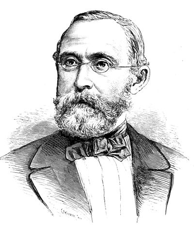
Professor Rudolph Virchow
Photo credit

To be effective in fulfilling their responsibility to prevent illness, promote health and reduce health inequalities, public health professionals should be able to demonstrate the following competencies:


  1. Identify corporate business and political practices that affect health.
  2. Develop public health strategies to encourage health-promoting corporate practices and discourage or end health-damaging ones.
  3. Analyze the public health advantages and disadvantages of various government/market relationships
  4. Create alliances with consumer, environmental, labor  and health organizations and movements that seek to  change harmful corporate practices and policies
  5. Describe the roles of public health professionals and researchers in modifying harmful corporate practices or policies.


These competencies can be developed in several ways.  Core public health courses can includes sessions on these topics as they relate to, for example, epidemiology, health policy, environmental health, or health education.  Some programs have developed specialized courses on the topic, allowing interested students to pursue this interest.  (To see a  syllabus for a doctoral course Interdisciplinary Perspectives on Corporations and Health 1900-2012 at City University of New York  click here to request a copy.)  Or a student-faculty interest group can bring together those who want to pursue research, advocacy or practice on the corporate impact on public health. 


Front entrance to the Bloomberg School of Public Health
Photo credit


For the time being, you’re more likely to find a corporate name on the front of a school of public health than to have corporate practices discussed in the classroom.  Fortunately, however, a growing number of resources are available to faculty who want to teach about this topic and students who want to learn more or write papers on corporations and health.  I offer here a short list of such sources.


10 Sources on Corporations and Health for Use in Basic Public Health Classes

(with suggestions for use in Epidemiology (EPI), Health Policy & Management (HPM), Social and Behavioral Health (SBH), or Environmental & Occupational Health (EOH) Core Courses)


Biglan A. Corporate Externalities: A Challenge to the Further Success of Prevention Science.  Prev Sci. 2011; 12(1): 1–11. (HPM, SBH)

Brandt AM.  Inventing conflicts of interest: a history of tobacco industry tactics. Am J Public Health. 2012;102(1):63-71.(EPI, SBH, HPM)

Freudenberg N, Galea S. The impact of corporate practices on health: implications for health policy. J Public Health Policy. 2008;29(1):86-104 (SBH,HPM)

Hastings G. Why corporate power is a public health priority. BMJ. 2012;345:e5124.(EPI, HPM, SBH)

Huff, J. 2007. Industry influence on occupational and environmental public health. International Journal of Occupational and Environmental Health 13.1: 107–117. (EPI, EOH)

Labonté R, Mohindra KS, Lencucha R.  Framing international trade and chronic disease.  Global Health. 2011 Jul 4;7(1):21.(EPI, SBH,HPM)

Ludwig DS, Nestle M. Can the food industry play a constructive role in the obesity epidemic? JAMA. 2008 Oct 15;300(15):1808-11.(SBH,HPM)

Stuckler D, McKee M, Ebrahim S, Basu S Manufacturing Epidemics: The Role of Global Producers in Increased Consumption of Unhealthy Commodities Including Processed Foods, Alcohol, and Tobacco. PLoS Med 2012;  9(6): e1001235. (EPI, SBH, HPM)

Wiist, W.H. (Ed). Bottom Line or Public Health. Tactics Corporations Use to Influence Health and Health Policy, and What We Can Do to Counter Them. NY: Oxford University Press, 2010. (relevant chapters for all 4 courses)

Woodcock J, Aldred R. Cars, Corporations, and Commodities: Consequences for the Social Determinants of Health. Emerging Themes in Epidemiology. 2008 Feb 21;5:4.  (EPI, EOH, SBH)


In addition to these selected resources, a bibliographic essay on Business and Corporate Practices can be found in the Public Health section of Oxford Online Bibliographies.


Finally, several Corporations and Health Watch contributing writers have websites or blogs that include additional timely material.  Check out these sites:  David Jernigan, Michele Simon, Bill Wiist.


Previous CHW Posts on Teaching about Corporations and Health


10 Ways to Bring the Health Impact of Business Practices into the Classroom  September 2011

Teaching about Corporations and Health  June 2010

Teaching about Corporations and Health: Bringing Corporate Practices into Public Health Classrooms  December 2007

MCDONALD’S, COCA COLA SEEK GOLD IN LONDON OLYMPICS

Credit: e-basak

As the London Olympic Games draw to a close, let’s take a closer look at the performance of the biggest, best-funded and most highly trained team to compete in this year’s Olympics: representatives of multinational corporations. 

A few statistics illustrate the scope of the corporate investment in the Olympics:

  • The 11 biggest corporate sponsors paid nearly $1 billion for the rights to flaunt the Olympic seal during the London Games and 2010’s Winter Games in Vancouver.
  • Corporate valuation specialist Brand Finance valued the Olympic brand as being worth just over $47.5 billion That leaves it behind only Apple ($70.6 billion) and above the corporate world’s next biggest brand, Google ($47.4 billion), although valuation of an event such as the Olympics is difficult.
  • Proctor and Gamble, an Olympic sponsor, expects its 2012 Olympic sponsorship to result in $500 million in additional sales, while NBC, the Olympic broadcaster expect to net an additional $1 billion in revenue from the Olympics. 

For most corporate sponsors, however, the take-home rewards are not the green, gold or silver that flows into their bank accounts but the opportunity to shape their image.  Coca Cola, an Olympic sponsor since the 1928 games in Amsterdam, expects to reach 1.5 billion people worldwide via its create-your-own-beat social-media and mobile campaign. The Coke promo begins with the sounds of six athletes set to a musical track, then asks consumers to add their own sounds to the track — and share it. Wendy Clark, Coca Cola’s senior vice president of integrated marketing, says this campaign provides “share-worthy” content that gives young adults “cred” in their social-media circles. “We don’t spend this amount of time on things that don’t work,” she said.


McDonald’s, another corporate sponsor, has built the world’s largest McDonald’s in London’s Olympic Village. It seats up to 1,500 people and is expected to serve 14,000 people a day during the games and offer free Olympic-themed Happy Meals to children.  “Many athletes tell us we are their favorite place to eat,” says a McDonald’s spokeswoman. Mickey D expects to make £3 million selling fast food during the Games, after  which  the Olympic Golden Arches  will be bull-dozed to the ground.


Heineken UK, the beer maker, is an Olympic supplier.  It has erected digital outdoor screens throughout London underground and rail stations that display near-live content that directly feeds from the Heineken® Fanhub. The public screens include a daily calendar of events, Heineken pubs nearby, relevant Olympic and Paralympic facts and details of medals celebrations – “all updated regularly to drive consumer intrigue and interest.”

Credit: Heineken UK


The outsized corporate presence at the Olympics has drawn some criticism. The Associated Press reported: A protest last week, the largest so far against the games, drew a mix of left-wing and green activists who decry the Olympics as a corporate juggernaut rolling over residents and their civil rights. They marched peacefully, chanting against what they called the “Corpolympics,” watched by police officers on foot and motorcycle. The protesters contend that the often-cited Olympic boost to traditionally gritty, working-class east  London is an illusion, whereas major corporate sponsors such as McDonald’s and Coca-Cola gain from the 9.3 billion pound ($14 billion) games. They said the mass arrests at the cycling demonstration, and limits on corporate branding designed to protect sponsors, show that the games are a threat to civil liberties.


An editorial on the Games called “Chariot of Fries”  in Lancet, the British medical journal, noted:  Health campaigners have rightly been dismayed. On June 20, the London Assembly (an elected body that scrutinizes the work of the Mayor of London) passed a motion urging the International Olympic Committee (IOC) to adopt strict sponsorship criteria that exclude food and drinks companies strongly associated with high calorie brands and  products linked to childhood obesity. Meanwhile, the UK’s Academy of Medical Royal Colleges has said that the presence of McDonald’s and Coca-Cola at the 2012 Games sends out the wrong message to children.  Indeed, their presence is hardly subtle… Cadbury’s has joined forces with McDonald’s to  offer what it states on its website will    be the “perfect snack” to enjoy whilst watching the Games—a chocolate bar-ice cream concoction with a whopping 395 calories per serving.  Coca-Cola, meanwhile, has raised its profile considerably by branding the Olympic torch relay.


As the Olympics finish in London and planning begins for the 2016 Rio Games, Michael Jacobsen from Center for Science in the Public Interest asks:  Brazilians are one of the world’s biggest consumers of soda (fueled by Coca-Cola’s  billion-dollars-a-year investments), and host to over 650 McDonald’s outlets. Experts predict that Brazil’s bulging waistlines may grab the world record from the United States by 2022. Will junk-food marketers get an Olympic carte blanche again?


In his recent book What Money Can’t Buy The Moral Limits of Markets, Harvard political scientist Michael Sandel warns that the most fateful change of the last three decades has been “the expansion of markets, and of market  values, into spheres of life where they don’t belong.”  In the distant past, the Olympic Games provided a celebration of fitness, athletic discipline, fair play and internationalism.  Now they have become one more place for multinational corporations to promote the patterns of hyper-consumption that contribute to premature mortality and preventable illness. 

Farm Bill Debates Show Agribusiness Lobby’s Clout

Food and Water Watch Report

The legislative process of Congress serves as a lens to magnify the ways that corporate power and money shape policy. As the U.S. House of Representatives considers the Farm Bill passed by the Senate last month, several new reports provide details of how corporations ensure that their needs take precedence over the well-being of the American people.


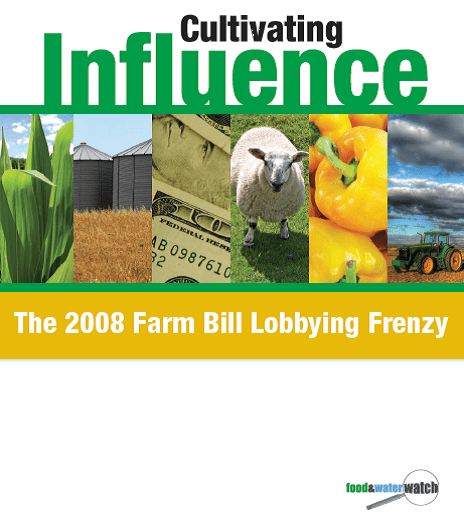
Cultivating Influence The 2008 Farm Bill Lobbying Frenzy released earlier this month by Food and Water Watch, a non-profit group that works to ensure that the food, water and fish we consume is safe, accessible and sustainable, documents the scope of lobbing for the 2008 Farm Bill, the last re-authorization Congress approved.  The found that:

More than 1,000 companies, trade associations and other groups spent an estimated $173.5 million lobbying on just the 2008 Farm Bill. As shown in Table 1, almost half was spent on farm policy…. During every day that the 100th Congress was in session in 2007 and 2008, special interests spent on average $539,000 lobbying on issues covered by the Farm Bill.

The 2008 Farm Bill generated more than $300 billion in federal spending over five years.  The report shows that some corporations got generous payoff for their lobbying.  Weyerhaeuser, the timber company, for example, spent $1 million to lobby successfully for a tax benefit that netted them $180 million. 

The 2013 re-authorization of the Farm Bill is attracting no les corporate interest.  A report from Reuters documents the role Monsanto and Dow Chemical are playing to win new benefits for biotech seed companies.  If successful, reports Reuters, their efforts “would severely limit U.S. oversight of genetically modified crops.”  One proposed measure that the House will vote on soon would allow biotech crops to be planted even if courts rule that they were approved illegally.


Earlier in July, 40 food businesses, retailers, family farmers and other group send a protest letter to leaders of the House Agriculture Committee calling on them to remove this and other provisions that limited government oversight.  The letter, sent by the National Family Farm Coalition, the Union of Concerned Scientists, the Center for Environmental Health and other groups noted that “The Farm Bill riders together would eliminate the much needed review of these novel crops, forcing hasty approvals in advancing the chemical industry’s interest in selling their products.”


Another letter, sent in June to all members of Congress and signed by more than 70 public health, nutrition, food  and environmental scientists and activists  identified other concerns with the proposals now being considered by the House:


We are deeply concerned that [the proposed bill] would continue to give away subsidies worth tens of billions of taxpayer dollars to the largest commodity crop growers, insurance companies, and agribusinesses even as it drastically underfunds programs to promote the health and food security of all Americans, invest in beginning and disadvantaged farmers, revitalize local food economies and protect natural resources. We strongly object to any cuts in food assistance during such dire times for so many Americans. …When it is your turn to vote, we urge you to stand up for local and healthy food and nutrition programs and to support equitable and fiscally responsible amendments that will protect and enhance public health and the environment while maintaining a reasonable safety net for the farmers who grow our food. More than ever before, the public demands this. Come November, they will be giving their votes to members of Congress who supported a healthy food and farm bill that puts the interests of taxpayers, citizens and the vast majority of America’s farmers first and foremost.”


What’s likely to happen next?  According to Tom Philpott, a food policy journalist and farmer,

“The bill is now stalled in the House, in danger of being buried by right-wing backbenchers intent on even deeper food-aid cuts. If the House doesn’t vote on it before the August recess, the most likely outcome is an extension of the 2008 bill—and the 2013 Congress will have to start the farm bill process from scratch. Let’s be blunt: If that scenario plays out, no matter how the November elections go, we’re quite likely to see an equally or more dismal bill emerge next year.”

Can a New United Nations Arms Trade Treaty Reduce Gun Deaths?

Source: Arms Trade Treaty Monitor

This month, representatives from more than 100 governments and 100 Non-Governmental Organizations (NGOs) are meeting at the United Nations in New York to work out a new global arms trade treaty by a July 27 deadline. The goal is to establish common standards for the import, export, and transfer of conventional arms and ammunition, a business worth about $55 billion a year.  A report by the British government estimates that at least 400,000 people are killed by illegal small arms and light weapons each year while armed violence is responsible for more than 740,000 deaths annually.  Many more people are injured.  A recent  report  by the International Action Network on Small Arms and Amnesty International concluded  that the “use of firearms in non-conflict settings is the most prevalent form of armed violence and the form that results in the most deaths and injuries. This fact underscores the importance of adopting an approach to addressing armed violence that will encompass violence outside of armed conflict settings.”


The UN meeting, three years in the works, has the opportunity to reduce this death toll by moving the illegal gun trade into the open with verifiable international standards that are enforced by national governments. 


Several obstacles could block a successful outcome.  First, a few governments and some powerful NGOs like the National Rifle Association (NRA) oppose the inclusion of small arms.  On July 11, NRA CEO Wayne LaPierre told the UN meeting, “The only way to address NRA’s objections is to simply and completely remove civilian firearms from the scope of the treaty. That is the only solution. On that, there will be no compromise.”


And in the usual NRA-gun industry tag team, Richard Patterson, the managing director of The Sporting Arms and Ammunition Manufacturers’ Institute, one of the NGOs participating in the deliberations, testified “that hundreds of millions of citizens regularly use firearms for the greater good” and that a “treaty that does not support the positive use of firearms is doomed to cause more harm than good.”


In an alliance that show that guns make strange bedfellows , several states, including China, Egypt, Ethiopia, Venezuela, and Iran also oppose inclusion of small arms in the treaty.  In a statement released last week at the UN meeting, the government of Iran echoed Wayne La Pierre: 

NRA CEO Wayne LaPierre speaking at a meeting in Florida last year.

In our view, a well-defined and universally accepted scope for a potential Arms Trade Treaty would be a determining factor in the acceptance of its provision.  In this regard, we are not in favor of the inclusion of missiles, Small Arms and Light Weapons and ammunition in the scope of the treaty.


According to The Hill, proponents of the treaty say the NRA’s concerns are unfounded since the treaty has no impact on the domestic gun trade and leaves national governments with the power to enforce the treaty.  These treaty supporters assert that the exclusion of civilian weapons would gut the effort to keep deadly arms out of the hands of terrorists, criminals and rogue regimes.


Another conflict is about the role that NGOs can play in the meeting.  For many governments, national security concerns may trump reducing deaths from illegal guns.  Thus, keeping the meeting open can help to keep the spotlight on health and human rights.  Yet last week, treaty organizers moved to close half the sessions to all but government delegates. Anna MacDonald, the Head of Control Arms Campaign for Oxfam explained the objections: 

The arms trade is often a shadowy business with arms deals being conducted in isolation, behind closed doors. The Arms Trade Treaty is attempting to shed some light over this trade and ensure that we have transparent and robust laws to prevent arms ending up in the wrong hands. Thanks to a tiny minority of countries it now seems like negotiations on the Arms Trade treaty will also become secretive.


This secrecy may make it harder to keep the focus on reducing deaths from the illegal arms trade. As  Frank Jannuz, from Amnesty International USA and  Daryl G. Kimball of the Arms Control Association  argued in a recent op ed in The Christian Science Monitor:

To succeed, the assembled ambassadors must put sons over guns and daughters over slaughter. At a minimum, the new treaty should require states to withhold approval for the international transfer of arms in contravention of UN embargoes or when there is a substantial risk the items will be used to commit serious violations of human rights. Despite its strong, pro-human rights rhetoric, the Obama administration has not yet endorsed such a formula.


If the UN members at the meeting agree on a final document by July 27, the treaty would still need to win a two-thirds majority in the Senate to be binding on the United States.  The NRA has vowed to prevent that.