Review: Killer Coke

Re-posted from The American Interest

credit
credit: W.W. Norton

Citizen Coke: The Making of Coca-Cola Capitalism by Bartow J. Elmore, W.W. Norton & Co, 2014, 432 pp., $27.95


Which Coca-Cola is the real “Real Thing”? Is it Citizen Coke, the responsible corporation that promotes local economic development and brings happiness and the American way of life to millions around the world? Or is it Killer Coke, a company that exploits public water, transportation, and waste systems to profit at the public’s expense, relentlessly promotes products to children that contribute to premature death, despoils the environment with its waste, underpays and mistreats the workers who produce its ingredients, and lobbies to defeat laws that protect public health?


In Citizen Coke: The Making of Coca-Cola Capitalism, Bartow J. Elmore, an environmental historian at the University of Alabama, tells us that the answer isn’t “either/or.” Citizen Coke and Killer Coke are conjoined twins, each providing the other with essential life support.


To read the whole review, visit The American Interest

How Wealthy Individuals and Corporations Protect their Interests

Two new reports shed light on how big corporations and the wealthy elites who control them use their riches to advance their policy agenda. A new report by Oxfam, Wealth: Having it All and Wanting More describes the increasing concentration of global wealth.


credit: Oxfam
credit: Oxfam

Richest 10 billionaires (ranked in 2013) who have made (at least part of) their fortunes from activities related to the pharmaceutical and healthcare sectors, and their increase in wealth between March 2013 and March 2014.


A few highlights from this report:


  • In 2014, the richest 1% of the people in the world owned 48% of the global wealth., leaving just 52% to be shared among the others 99% of the adults on the planet.
  • Wealth of the 80 richest people in the world has doubled in nominal terms between 2009 and 2014, while the wealth of the bottom 50% is lower in 2014 than it was in 2009
  • In the last two years, billionaires listed as having interests and activities in the pharmaceutical and health care sectors saw the biggest increase in their collective wealth. Their collective wealth increased from $170 billion to $250 billion, a 47% increase and the largest increase in wealth of the different sectors on the Forbes list.
  • In 2013, the pharmaceutical and health care sectors spent more than $487 million on lobbying in the United States alone, more than any other US sectors and representing 15% of total lobbying in 2013. In 2012, this sector spent $260 million on campaign contributions. The pharmaceutical and health care industry spent another $50 million on lobbying in the European Union.


Who Needs Lobbyists?

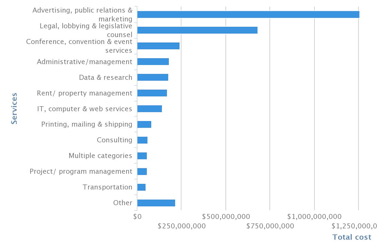
A second report Who needs lobbyists? See what big business spends to win American minds by the Center on Public Integrity analyzed how much US trade associations spent on advertising and public relations, a much higher expenditure than lobbing. Some highlights:


  • Spending on public relations faces far less disclosure requirements, making transparency more difficult than for lobbying.
  • By industry sector, the biggest clients of PR services are energy and natural resources associations.
  • All five of the U.S. Chamber of Commerce’s top contractors in 2010 and 2012 were advertising agencies.
  • PR giant Edelman collected $346.8 million from trade groups from 2008-2012, way more than any other communications firm.
  • Industries relying most on PR campaigns are usually those facing the heaviest regulation


lobbyists
credit: Center for Public Integrity


From 2008 through 2012, the most politically active trade groups spent a total of $3.4 billion on their top contractors, according to a Center for Public Integrity analysis of annual tax filings. This graph shows where their money went.

2014 Stories on Health Impact of Corporations-Part II

Last week, I wrote about some of the 2014 news stories that revealed how the auto, pharmaceutical and alcohol industries had harmed health. In this post, I turn to some of the top stories in last year’s coverage of the other industries Corporations and Health Watch follows: food and beverages, firearms and tobacco.


Coca-Cola Sales Go Flat

CC
credit

Early this month, the New York Times reported that Coca-Cola says it will cut between 1,600 and 1,800 jobs in coming months to trim costs. These moves are part of an ongoing restructuring to reflect declining sales of Coca Cola in the United States—and in many other parts of the world. In October, Coca-Cola announced it hoped to cut costs by $3 billion a year through a variety of measures. The savings would be used to pay for more marketing to drive up beverage sales.


But throughout the year, business analysts have been questioning Coke’s strategy. For example, Bloomberg BusinessWeek carried a story called Coke Confronts Its Big Fat Problem. It concluded:


Americans may not have figured out the answer to the obesity epidemic, but for years they’ve pointed to Coca-Cola and other soda as one of the causes. Coke has tried fighting against this. It’s tried ignoring it. Now it accepts this as a reality… (The company) has to persuade people to drink Coca-Cola again, even if they don’t guzzle it like water the way they did before.


Fortune published Coca-Cola’s Problems Reflect a Giant Losing Relevance. Its harsh assessment is that Coca Cola has failed in:


recognizing that the big problem is the leadership team’s fixation with defending its Coke brand, rather than finding new growth businesses as the market moves away from carbonated soft drinks.  This problem requires the CEO and his entire management team to step up their strategy efforts, not just fire the leader who has been updating the branding mechanisms.


For public health, Coke’s failures are our success. The continuing decline in soda consumption is in part a reflection of the health policy and education campaigns that have changed the image of soda that Coke has tried to market.   Declining sales at Coke now hold the promise of less diabetes and diet-related diseases in the future. Key questions for the coming years are will Coke’s fizzed up advertising be able to delay the shift in tastes and to what extent will the company apply tobacco industry response to flat sales in the US by stepping up marketing in Asia, Africa and Latin America.


Big Tobacco Takes Up Vaping

vaping
credit

When e-cigarettes were introduced a few years ago, it wasn’t clear if the makers of this product would take business away from the tobacco industry or become a subsidiary of the nicotine delivery business. Last year, most of the world’s largest tobacco companies expanded their e-cigarette business, suggesting the emergence of an integrated Big Nicotine business. For example, according to Bloomberg Businessweek, R.J. Reynolds in 2014 scaled up marketing of its Vuse brand of e-cigarettes from four states to a national market. Lorillard sells Blu eCigs and controls about 40 percent of the current market. Altria Group owns two e-cig brands and plans to expand nationally as well. While some public health advocates continue to argue that e-cigarettes have the potential to reduce tobacco use, others make the case that the increasing control of the e-cigarette market by transnational tobacco companies does not bode well for this product being used to advance public health or reduce the demand for nicotine products. As public health advocates debate our positions on e-cigarettes, we need to keep our eyes not just on the theoretical potential of a new technology but on the actual practices of the industry that makes and markets the product.


Gun Fight Turns to the States

credit
credit

Just as policy battles on abortion and gay marriage have bounced between state and federal levels over the last decade, the fight on gun safety, long played out on the federal level, has now bounced back to the state level. Earlier this month, the New York Times noted that,


“the gun control movement, blocked in Congress and facing mounting losses in federal elections, is tweaking its name, refining its goals and using the same-sex marriage movement as a model to take the fight to voters on the state level.”


Last November, Washington state voters approved a ballot measure that will require broader background checks on gun buyers and gun safety advocates are looking to add ballot measures in 2016 in Nevada, Arizona, Maine and Oregon.


At the same time, gun rights advocates are using state legislatures to seek to overturn federal guns laws. According to one report, eight states have recently passed laws voiding federal firearms regulations and in the last decade more than 200 such bills have been considered by states.


A recent report by the Law Center to Prevent Gun Violence found that states with stronger gun regulation have lower gun death rates, and the states with weaker regulation have higher gun death rates. As gun safety advocates study the successes of the gay marriage movement in using state level successes to win national victories, they’ll need to devise strategies that choose the settings and the messages that can ultimately lead to national successes in reducing gun violence.

Roundup of 2014 Stories on Health Impact of Corporations

For observers of how corporations find ways to profit at the expense of public health, the news coverage of 2014 provides a wealth of evidence. Here are three stories that caught my eye last year. Next week I’ll present stories about the food, firearms and tobacco industries, the other sectors that Corporations and Health Watch follows.


Auto Recalls at General Motors, Chrysler, Ford, Toyota, Honda and Others Set New Record


credit
credit

Last year, reported the New York Times, more than 60 million vehicles have been recalled in the United States, double the previous annual record in 2004. In all, there have been about 700 recall announcements — an average of two a day — affecting the equivalent of one in five vehicles on the road. The eight largest automakers have each recalled more vehicles in the United States this year than they have on average since 1966, when data collection began, with G.M., Honda, and Chrysler each setting corporate records, the review by The Times found.


GMs failed ignition switches on Chevy Cobalts and several other models were one source for the recalls. Another was airbags manufactured by Takata, a Japanese parts maker, that occasionally exploded injuring or killing passengers or drivers. According to Consumer Reports, 7.8 million vehicles, made by 10 different automakers, have been recalled to replace frontal air bags on the driver’s, passenger’s sides or both. An ominous lesson from the Takata recalls is that globalization of the auto industry and the concentration of parts makers into a few giant companies can result in many manufacturers relying on the same few parts suppliers. If these parts fail, the population impact can be enormous.


AstraZeneca, Eli Lilly, GlaxoSmithKline, Merck and Other Drug Makers Pay Doctors and Hospitals Billions to Promote their Drugs


credit
credit


According to the Centers for Medicare & Medicaid Services, as of December 19, 2014,  drug makers paid at least 366,000 U.S. doctors and 900 teaching hospitals $3.7 billion for gifts, meals, travel, speaking about their products, or attending promotional events.


In a series of stories called Dollars for Docs: How Industry Dollars Reach Your Doctors, Pro Publica describes the many ways that drug companies pay doctors—often physicians who have been previously sanctioned for unethical or illegal practices– to promote their products. Pro Publica also provides a database that allows readers to look up what companies have paid which doctors. This information is now available thanks to the Physician Payment Sunshine Act, a part of the Affordable Care Act that went into effect in 2014.  Would requiring other companies in other sectors to report who they paid to promote their products help consumers to make more informed judgments on products?


Alcohol Makers Market Powdered Alcohol


credit
credit


Powdered alcohol hasn’t even arrived in stores yet, but some states already are moving to ban the product touted by its inventor as an easy way to mix a drink on the go. The UK-based Daily Mail reports that Colorado is the latest state considering prohibiting ‘Palcohol’ amid concern it will increase underage drinking. The product is marketed as an ounce of rum or vodka in powdered form, which is then added to water. Each serving is the equivalent of a shot of liquor, according to Lipsmark, the company that owns Palcohol. The company awaits labeling approval from the Alcohol and Tobacco Tax and Trade Bureau. The Food and Drug Administration said it does not have a legal basis to block the product after examining the non-alcoholic ingredients in the powder. Will this product make it to market in 2015? Stay tuned.

In May 2014, David H. Jernigan, Director of the Center on Alcohol Marketing and Youth at the Johns Hopkins Bloomberg School of Public Health noted:


“Based on our experience with jello shots, alcoholic energy drinks, and other “cutting  edge” alcohol products, we anticipate that allowing powdered alcohol onto the market  will have grave consequences for our nation’s young people. Youth is a time of risk-taking and experimentation, and these types of products have proven most popular among the heaviest drinking and more risk-prone youth. Powdered alcohol is also highly concealable, making it all too easy for youth to access and consume. Currently 4300 young people under age 21 die each year from alcohol-related causes; our efforts should be focused on making alcoholic products less, not more, available to our nation’s youth.”

Exposed: Decades of Denial on Poisons

Last week, The Center for Public Integrity announced that it was joining with Columbia University and City University of New York to make public some 20,000 pages of benzene documents — the inaugural collection in Exposed: Decades of denial on poisons, an archive of previously secret oil and chemical industry memoranda, emails, letters, presentations and meeting minutes. Hundreds of thousands of additional documents on different chemicals will be added in 2015 and beyond. To find out more about Exposed, Corporations and Health Watch director Nicholas Freudenberg interviewed one of its founders, Gerald Markowitz, CUNY Distinguished Professor of History and Public Health.


Gerry Markowitz
Gerald Markowitz

CHW: What led you and your colleagues to create this new resource for scholars, journalists and activists?


GM: Over the past 20 to 25 years David Rosner (Ronald Lauterstein Professor of History at Columbia’s Mailman School of Public Health) and I have been using the private records of corporations that have been obtained through discovery procedures in legal cases. These include hundreds of thousands of documents from the chemical industry, the lead industry, the silica industry among others, which we have used in our books and articles. For many years we have worked with Merlin Chowkwanyun, currently a Robert Wood Johnson Foundation Health & Society Scholar at the University of Wisconsin-Madison, who will be an assistant professor of sociomedical sciences at Columbia next year. In addition to his extraordinary talents as a scholar, Chowkwanyun is knowledgeable about how to make masses of documents available and searchable for researchers. Together we realized that these documents could be used to tell multiple stories and thus they could be a tremendous resource for scholars, journalists, students and activists.


CHW: How do you think a resource like this can contribute to a better understanding of the impact of corporations on health?


GM: These are internal corporate documents that often hold information found nowhere else. This is an opportunity for people to understand not only the effects of corporate actions on health, but also the thinking within corporations about how and why they take the actions they do. It also provides us with the opportunity to examine secret studies that corporations have conducted on a variety of products and substances as well as their attempts to influence government activities and public perceptions of their products.


CHW: Why did you decide to partner with the Center on Public Integrity, an investigative journalism organization?


GM: It is crucial that information that is in these documents gets to as broad a public and scholarly community as possible. CPI has a rich and distinguished history of examining and analyzing a wide range of public health, occupational and environmental issues and has been very successful in getting its stories into the public arena.


CHW: How can students in public health, history and other disciplines use this resource?


GM: This resource is open to the public and we hope that it will provide the basis of many masters theses, PhD dissertations, and articles.


CHW: What future do you see for this database? Are you hoping that it will include documents from other industries?


GM: We are just at the beginning of developing this database. As time goes on we will be expanding and refining the search engine so that users will be able to make use of it in many creative and productive ways. In addition, although right now we only have the benzene documents on line, in the coming months we will be adding a wide range of other industry documents, including those of the chemical industry, the asbestos industry, the silica industry and the lead industry among others.


Benzene
Benzene


See the following CPI reports based on documents in Exposed:


Benzene and worker cancers: ‘An American tragedy’

A dozen dirty documents

Internal documents reveal industry ‘pattern of behavior’ on toxic chemicals

New battlefront for petrochemical industry: benzene and childhood leukemia


The rise of electronic cigarettes and their impact on public health

Cross-posted from OUP Blog

Oxford Dictionaries has selected vape as Word of the Year 2014 and I wrote the following commentary for the OUP Blog.

An e-cigarette starter kit photo credit

A new report from the US Centers of Disease Control and Prevention shows that use of e-cigarettes among high schools students has tripled in two years. The finding raises the question is vaping—the use of tobacco-free electronic cigarettes—an important tool for helping smokers quit or a ploy by Big Tobacco to addict another generation of young people to nicotine? Public health experts are poring over the modest evidence on the health consequences of e-cigarettes to find guidance for policy.


What is clear is that vaping—inhaling and exhaling vaporized nicotine liquid produced by an electronic cigarette—is on the rise not only in the United States but elsewhere. In the United Kingdom, the percent of current smokers had ever tried electronic cigarettes rose from 8.2 in 2010 to 50.6 in 2014.


Big Tobacco has jumped into the e-cigarette business with gusto. By the end of 2013, British American Tobacco, Lorillard, Philip Morris International and Reynolds—key players in the multinational tobacco business—had each bought e-cigarettes companies. While e-cigarettes still constitute a fraction of the tobacco business, their market share has grown rapidly. Retail sales value of e-cigarettes worldwide for 2013 was $2.5 billion and Wells Fargo estimates sales will top $10 billion by 2017.


Supporters of e-cigarettes argue that by satisfying the craving for nicotine these devices can wean smokers from tobacco, reducing the harm from inhaling more than 5,000 chemicals—many of them carcinogenic. Some studies have found that e-cigarettes were modestly effective at helping tobacco smokers to quit. Proponents believe that some tobacco use is inevitable for the foreseeable future so making e-cigarettes available helps reduce the world’s main cause of premature death. They compare e-cigarettes to offering injecting drug users free clean needles, a policy demonstrated to reduce HIV transmission.


Critics reject these arguments. They point to evidence that vaping exposes users to dangerous toxics, including cancer-causing formaldehyde. Of greatest concern, opponents fear that vaping will addict new users to nicotine, serving as a gateway to tobacco use. Some preliminary evidence supports this view. They also worry that e-cigarettes will re-glamorize smoking, undermining the changing social norms that have led to sharp declines in tobacco use.


Table credit: MMWR
Table credit: MMWR

The inconclusive evidence raises some basic questions. How do we make policy decisions in the face of uncertainty? In setting e-cigarette policy, what are appropriate roles for the market and government? Finally, in a political system where corporate interests have shown a growing capacity to manipulate the rules to achieve their goals, how can the public interest be best protected?


Over the past century, two warring principles have guided policy on consumer rights. The first, caveat emptor, let the buyer beware, says consumers have the obligation to find out what they can about the products they choose to consume. The more recent precautionary principle argues instead that producers should introduce only goods that are proved safe. For e-cigarettes, this would put the onus on manufacturers to demonstrate in advance of widespread marketing that the alleged benefits of vaping outweigh its potential costs. Few researchers believe that such evidence now exists.


The history of Big Tobacco suggest that no industry is less qualified to set public health policy than the corporations that are buying up e-cigarette companies. In her 2006 decision in the United States racketeering trial against the tobacco industry, Judge Gladys Kessler wrote that the tobacco industry “survives, and profits from selling a highly addictive product which causes diseases that lead to … an immeasurable amount of human suffering and economic loss, and a profound burden on our national health care system. Defendants have known many of these facts for at least 50 years or more. Despite that knowledge, they have consistently, repeatedly and with enormous skill and sophistication, denied these facts to the public, the Government, and to the public health community.”


Already the industry’s e-cigarette practices raise concerns. For example, companies have marketed products in flavors like cherry, vanilla, and cookies and cream milkshake. Their advertising has used the same sexual and risk-taking imagery employed to market tobacco to young people. Significantly, manufacturers decided not to promote their products primarily as smoking cessation devices, an approach that would have emphasized public health benefits, but instead as a glamorous, sophisticated new product. This strategy increases the likelihood that the product will create new generations of nicotine addicts rather than help smokers to quit.


Leaving e-cigarette policy in the hands of industry invites Big Tobacco to continue its deceptive practices and use its political resources to undermine public policy. The 2009 Family Smoking Prevention and Tobacco Control Act gave the US Food and Drug Administration the authority to regulate tobacco. In 2014, the FDA proposed new rules to regulate e-cigarettes. These rules would set the minimum age of 18 to use e-cigarettes, prohibit most sales in vending machines, mandate warning labels, and ban free samples. As these rules work their way through the system, advocates have suggested the need for additional rules including a ban on flavored e-cigarettes, limits on marketing, and strict oversight of the truthfulness of health claims.


Lax public health protection from lethal but legal products such as tobacco, foods high in sugar and fat, alcohol, firearms, and automobiles has produced a growing burden of premature deaths and preventable injuries and illnesses. Around the world, chronic diseases and injuries are now the main killers and impose the highest costs on health systems and tax payers. Allowing Big Tobacco to use e-cigarettes to write a new chapter in this sorry history would be a step in the wrong direction.

Five Questions for the Food Movement after Berkeley Approves a Soda Tax

Photo credit:  Berkeley vs Big Soda
Photo credit: Berkeley vs Big Soda

On Election Day November 4th, Berkeley voters made their town the first in the United States to approve a soda tax, endorsing Measure D to levy a penny-an-ounce tax on soda  by a 3 to 1 margin , 76% for and 24% against.  The victory came despite the fact that Big Soda poured $2.3 million dollars into the campaign, about $409 per voter that sided with the industry position.  For the food justice movement, the win demands a careful analysis of the lessons learned.  I raise 5 questions to get us started in this analysis. 


1.  Everybody knows that Berkeley is the capital of the Left Coast but the town has set important national trends before.  What are the characteristics of Berkeley and the campaign that may be generalizeable to other places in the US?


“We fully expect other communities to take on the soda industry and succeed,” said  Yes on D Co-Chair Dr. Vicki Alexander after the victory.  “Berkeley has a proud history of setting nationwide trends, such as nonsmoking sections in restaurants and bars, curb cuts for wheelchairs, curbside recycling, and public school food policies. But many communities have the same ingredients that made Measure D possible in Berkeley: proactive parents and community leaders who care about the health of their kids.”   Yes on D built a broad, diverse and inclusive community coalition.


A report in the Contra Costa Times  provided further perspectives on  Berkeley’s role as trend setter rather than outlier.   Tom Lochner wrote:


Harold Goldstein, executive director of the California Center for Public Health Advocacy, is among those who believe the No on D camp is mistaken to view Berkeley as a stand-alone oddity. Rather, Goldstein describes Berkeley as “a pretty significant trendsetter for what happens in California and what happens in the country, on the progressive side.” “If you think about the Free Speech Movement, care and attention to people with disabilities, curb cuts for wheelchairs, indoor smoking ordinances, fast-food packaging — major environmental, social justice and public health movements have begun in Berkeley, and often, when they began, people saw them as radical,” Goldstein said. “But because they focused on justice and protecting people and the environment, those movements caught on, and spread across the country quite quickly.”


Dozens of local, statewide and national organizations supported Yes on D. We need to understand how the Coalition attracted this support and what other communities can do to replicate this success.


2.  What can we learn about framing public health messages that counter Big Soda from the Berkeley campaign? 


The Coalition, learning in part from the tobacco movement, painted Big Soda as the opponent.  And obligingly, Big Soda did everything possible to live up to its stereotype—spending millions, suing the city, and distorting science.  What will Big Soda learn from this defeat?  Their public message is that no other town in America would ever follow Berkeley down this path but we can expect that they will vary their tactics on the next battle to incorporate what they learned here.  Anticipating Big Soda’s next steps will help the food moment to get ready for the next campaigns.


3.  In other places—like San Francisco – and on other issues—like GMO labeling—health advocates lost elections.  What accounted for these losses?


In San Francisco, the soda tax measure also won majority support but to pass it required two-thirds approval in order to levy a tax that would be dedicated to health.  To win in multiple settings, advocates will need to better understanding the ways  that business and political elites set ground rules that thwart popularly supported measures and also to choose battles where the terms are most favorable.  As Michele Simon has written, the GMO battles in Oregon and Colorado united four giants of the processed food/agribusiness  industries– Dupont, Monsanto, PepsiCo, and Coca-Cola were the largest donors to these campaigns—as well as to the efforts to defeat soda taxes in California.  As Simon noted, “The good news is that the more we identify these shady lobbying tactics and dirty tricks and expose the moneyed interests behind them, the less effective the industry efforts will be.”


4.  Taxes are one strategy to reduce soda consumption.  What are others? How do we decide on the best portfolio of strategies? 


From the tobacco control movement, we have learned that no single strategy can by itself diminish the toll from corporate promotion of disease.  In tobacco, it was the combination of taxes, clean air laws, counter-advertising, litigation and community mobilization that led to the decline in tobacco use.  Some in the food movement note the limitations of soda taxes but don’t always propose alternatives.  Previously, I have described eight approaches to reducing sugar consumption.  Now is the time to consider how to assemble the most effective portfolio of approaches to enable us to save lives in this generation instead of 40 years in the future.


5.    What’s the potential –and limits—of reducing diet-related disease by taking on one product or one industry? 


Current evidence suggests that no ingredient plays a stronger role in diet-related disease than sugar and no product more consistently delivers dangerous doses of sugar to broad sections of the population than soda and other sugary beverages.  That’s the rationale for targeting soda and sugar for public policy and regulation.  But it is also true that the more fundamental cause of the rise of diet-related diseases is a food production system that values profit over public well-being and  highly processed food over whole food and that promotes the least healthy foods most heavily and the healthier ones almost not at all.  The deepest solution, therefore, is not more regulation for each of the hundreds or thousands of harmful products but instead a transformed food system where making healthy food available to all is the priority.  Charting the paths that can lead from incremental policies like soda taxes to transformational ones that move us away from our disease–inducing diets is the challenge of the  day.


More on Soda Taxes and the California votes 

Berkeley breaks through on soda tax. By Helena Bottemiller Evich in Politico.

Berkeley Wins: What’s Next for Soda Taxes?  By Dana Woldow in BeyondChron the Voice of the Next.

Big Food Uses Dirty Tricks in Ballot Fights over GMO Labeling and Soda Taxes. By Michele Simon  In Al Jazeera America

Yesterday’s elections: plenty of good news for the food movement. Food Politics By Marion Nestle

When Grassroots Protest Rallies Have Corporate Sponsors. Nightline ABC News

True Cost of Diverted Tobacco Payouts Measured in Lives

Cross-posted from The Conversation

smoking
Not enough tobacco company money is going into public health campaigns. REUTERS/Daniel Munoz

The #20 Million Memorial created earlier this month by the United States Centers for Disease Control, is an online tribute to honor the 20 million spouses, mothers, fathers, children, sisters, brothers, and friends who have died of tobacco-related diseases since 1964.


The memorial recognizes the 50th anniversary of the 1964 Surgeon General’s Report on Smoking and Health, the document that alerted Americans to the perils of tobacco.


In some ways, tobacco control demonstrates a public health triumph. Since 1965, the percentage of Americans adults who smoked has fallen from 42.4% to 18%.


Researchers estimate that since the Surgeon’s General’s first report, 8 million tobacco deaths have been averted, giving those who quit or didn’t start on average an added 20 years of life, clear evidence of the benefits of public health investment.


But the dark side of this achievement is our failure to use what we know to prevent millions of more premature deaths.


Settlement funds diverted


Last year marked another tobacco milestone – the 15th anniversary of the Master Settlement Agreement of 1998, an agreement between the Attorneys General of 46 states (four states had settled earlier) and the tobacco industry to change advertising practices and require the industry to pay more than $200 billion to fund tobacco prevention activities in perpetuity.


A recent investigation by ProPublica found that only a fraction of the money the tobacco industry is paying is actually funding tobacco control activities.


Instead, Citigroup, JPMorgan, UBS, Goldman Sachs, Morgan Stanley and now-defunct firms like Bear Stearns, Lehman Brothers and Merrill Lynch — the same financial institutions that helped trigger the 2008 global economic crisis — had convinced many state governments to divert their tobacco settlement funds into a financial instruments called capital appreciation bonds (CABS) in order to borrow money for routine expenses.


ProPublica estimates that bankers and their consultants and lawyers have pocketed more than $500 million in fees for this financial engineering.


The nine states, three territories, District of Columbia and several counties that issued $3 billion in CABS have promised a total of $64 billion to pay them off, a lucrative investment that jeopardizes public health and financial solvency.


20mil
CDC, CC BY-SA


New Jersey spends the least on smoking prevention. Its 2014 revenues from tobacco – taxes and settlement funds—were $947 million, of which none was spent on tobacco control. The story in similar in many other states. For example, in 2013 Massachusetts brought in $815 million in tobacco money of which only about $4.2 million or 0.5% was spent on smoking cessation and prevention programs.


Last year, a tobacco deal got New Jersey Governor Chris Christie $92 million to fill a gap in his budget. Earlier CABs issued by New Jersey threaten additional debt, a problem temporarily solved by signing over the anticipated tobacco money expected from 2017 to 2023 – more than $400 million — to repay the debt early and get more cash from investors in exchange.


According to the CDC, each year 11,800 people in New Jersey die from tobacco-related diseases and the cost of health care for these conditions is $4.06 billion. About 60,000 high school students in New Jersey smoke cigarettes.


Nationally, according to ProPublica’s analysis, about 44%, or nearly one in every two dollars the tobacco companies pay out each year, goes to investors rather than governments. Between 1998 and 2010, reports the CDC, revenues from state taxes and the MSA settlement almost tripled, from $8.8 billion to $24 billion.


In this same period, the percentage of tobacco revenues dedicated to tobacco control fell by 10%. This year, says the Campaign for Tobacco Free Kids, states are appropriating only 1.9% of their state tobacco revenues to tobacco control.


The true cost of diverting the money


Diverting revenues from tobacco to other purposes causes three problems. First, it costs lives. The CDC has estimated that fully implementing known tobacco control measures between 1998 and 2010 would have cost about $29 billion.


In this period,the federal and state governments spent about $8 billion on tobacco control, about 27% of the recommendation. More troubling, the proportion of the recommended funding allocated has fallen alarmingly, from 51% in 2002, the high year, to 17% in 2010, the last year for which data are available.


As a result of these decisions, millions of smokers and potential smokers who could have joined the 8 million whose lives were extended as a result of tobacco control activities ended up getting sick or dying.


In addition, failing to invest in tobacco control costs money. A 2008 study found that when California increased spending on tobacco control, smoking rates declined faster than elsewhere in the nation and health care expenditures on tobacco-related diseases fell by $84 billion in 15 years.


A second problem with diversion is its impact on taxes and public spending. In the short run, politicians justify taking out loans on tobacco revenues as a way to avoid tax increases. Usually that means leaving in place an inequitable tax structure.


In the longer run, turning over public dollars to bankers and financial institutions risks the financial stability of state governments. In an October 6 op ed in the New York Times, Jim Estes, a professor of finance at California State University, San Bernardino, warned that defaults on tobacco CABs could begin in 2026 in the nine states that have already mortgaged their future.


Already New Jersey has had its credit rating downgraded by Wall Street twice this year, an action that will require New Jersey tax payers to cover for Christie’s gamble.


Who’s protecting public health?


Most troubling, elected officials’ willingness to speculate with tobacco revenues shows how far we need to come to restore public health protection as a government priority.


If we can’t trust our public officials to take action to save lives from tobacco, the world’s best-studied toxic exposure, when they have the funds to do so, what can we expect from them when regulating legal but potentially lethal industries like alcohol, firearms, automobiles, processed foods and pharmaceuticals?


A growing body of scientific evidence shows that the products and practices of these industries are the world’s leading causes of death through chronic diseases and injuries.


Nicholas Freudenberg is author of Lethal but Legal Corporations, Consumption and Protecting Public Health.


The Conversation is a collaboration between editors and academics to provide informed news analysis and commentary that’s free to read and republish.
 

Public Policies and the Risk Factors for NCDs in Brazil

Todosjuntos


At the Todo Juntos Contra O Cancer (Together Against Cancer) conference in Sao Paulo, Brazil last week, several presenters explored the role of the food, alcohol and tobacco industries in non-communicable diseases in Brazil and elsewhere. The moderator of the panel was Claudia Collucci, a reporter for Folha de Sao Paulo, a major Brazilian newspaper. The panel at this session included:


Professor Carlos A. Monteiro, Department of Nutrition, School of Public Health, University of Sao Paulo, who spoke on Ultra-processed foods and health, exploring the need for public policies to reduce the proportion of calories derived from ultra-processed foods;


Dr. Maristela Monteiro, Senior Advisor for Alcohol and Substance Abuse at the Pan American Health Organization, who spoke on Alcohol as a risk factor for public health in the Americas , an overview of the burden of disease imposed by alcohol and the policies used to reduce this burden.


Paula Johns, Executive Director, ACT – Alliance for the Control of Tobacco Use, Brazil, who spoke on Success and challenges in tobacco control, a look at the challenges faced and strategies employed to curb smoking prevalence in Brazil.


Nicholas Freudenberg, Distinguished Professor of Public Health at City University of New York, who spoke on Changing the Practices of the Tobacco, Alcohol, Automotive, and Food Industries to Prevent Noncommunicable Diseases, an examination of the role of corporate business and political practices on NCDs.

Climate Change, Food and Health: Taking Action to Address Root Causes

ClimateTree

The “good” news is that three of the world’s most serious threats —human-induced climate change, accelerating epidemics of chronic diseases, and growing food insecurity — have common causes and therefore potentially common solutions. The 2014 Climate Summit at the United Nations later this month provides an opportunity for scientists, government leaders, activists and concerned citizens from around the world to examine these common causes and identify the actions we can take to modify the underlying causes of these intersecting crises.


What are these common roots?   Our economy’s continued dependence on fossil fuels ensures that carbon continues to accumulate, accelerating rising global temperatures and their impact on weather, climate and human well-being. The global energy industry from Exxon to BP to Gazprom uses its economic and political power to thwart widespread implementation of alternatives. Evidence shows that coal plays an especially important role in climate change yet countries like China, the United States and others continue to support coal production. According to Greenpeace, the fossil fuel industry is planning 14 massive coal, oil and gas projects that would produce as much new carbon dioxide emissions in 2020 as the entire US, and delay action on climate change for more than a decade.


Hyperconsumption describes lifestyles and health behaviors that put people at risk of premature death and preventable chronic illnesses. Each year the tobacco, alcohol and processed food industries spend billions of dollars aggressively promoting their products around the world, despite the World Health Organization’s finding that increased consumption of tobacco, alcohol and unhealthy food are primary drivers of growing rates of chronic diseases, today’s leading global killers. The production and distribution practices of the food, alcohol and tobacco industries contribute to global warming and also magnify global health inequalities.


Autocentrism is the irrational promotion of automobiles as the main mode of human transportation. Despite growing evidence that active transportation like walking and bicycling and mass transitcontribute to more physical activity, better health, fewer emissions of carbon and other pollutants, and people-friendlier cities and towns, the automobile industry and the governments that support it resist pursuing alternatives at a scale that can achieve their benefits.


Industrial agriculture describes the transformation of food production from small and medium size farmers and manufacturers to a system where giant multinational corporations like Monsanto, Cargill, Coca Cola, McDonald’s, Nestle and Walmart control every stage of our food system from patented seeds, monoculture farming, and integrated distribution to global marketing and retail outlets. Industrial agriculture insists that the bottom line is their profit, not human need. Its practices on fertilizers, transportation, meat production and global trade contribute to carbon emissions, diet-related diseases and food insecurity.


One reason that climate change, chronic disease and food insecurity have worsened in recent decades is that the industries involved and business and international trade associations they have created have coordinated a massive effort to roll back regulations that protect public health and the environment and discredit the science that documents the dangers the world faces.


Underlying these trends has been the growing concentration of wealth and power in the hands of corporations and the moneyed interests that own and control them. The synergistic impact of these developments has been a rise in inequality and declines in democracy, developments that make it harder to propose and mobilize public support for alternative policies.


Some who agree on the magnitude of the threats and the evidence on common causes of climate change, premature deaths from chronic diseases and growing food insecurity are reluctant to act because they believe the problems are too big and complex and the perpetrators too powerful to make change possible. But the acceleration of each of these problems results from human decisions made over the course of the last few decades. And what people decide in one time, they can change in another.


To the chorus of the powerful that there is no alternative to the status quo the response of the majority must be that another world is possible. By encouraging public discussion of the common roots of climate change, chronic diseases and food insecurity, we can begin to shine a light on the actions that will lead us to that other world.


Every generation is judged by the world we leave our children and grandchildren. The decisions we make in the years to come will determine whether our legacy is shortened lifespans, growing hunger, and further deterioration of the environment that supports life. Or we can decide that our gift will be better health, food security and a more sustainable planet. The choice is ours.


Another World is Possible

ClimateTreeHealthy


For more information, read the recent Lancet summary on climate change and health and Chapter 7 on food security and Chapter 11 on Human Health from the Intergovernmental Panel on Climate Change, 2014.