Science helps keep us safe and healthy. The public safeguards that keep our drinking water clean and our children’s toys safe rely on independent science and a transparent policymaking process. And we all rely on scientific information to make informed choices about everything from what we eat to what consumer products we buy for our families. But the results of independent science don’t always shine a favorable light on corporate products and practices. In response, some corporations manipulate science and scientists to distort the truth about the dangers of their products, using a set of tactics made famous decades ago by the tobacco industry. In a new guide called The Disinformation Playbook, the Union of Concerned Scientists describes five of the most widely used “plays” and some of the many cases where they have been used to block regulations or minimize corporate liability, often with frightening effectiveness—and disastrous repercussions on public health and safety.
Taking the Overseas Blinders Off Corporate Governance

In its annual Good Governance report, writes Fair Observer, the Institute of Directors assesses the United Kingdom’s largest listed companies against indicators that include board effectiveness, audit and risk accountability, remuneration, shareholder relations and stakeholder relations. Ironically, the IoD index’s top performers often come from the alcohol and tobacco industries. This year’s report gave pride of place to the distiller Diageo and the 2016 winner was British American Tobacco (BAT). The IoD’s standards may be appropriate for how these companies behave in London. In Kinshasa, Kampala and Juba, though, the praise of BAT surely raises eyebrows. As the rest of the world has learned over the intervening months, above-board corporate behavior in the UK does not guarantee ethical conduct elsewhere. Over the summer, The Guardian revealed in a series of explosive investigative pieces that BAT (as well as other multinational tobacco firms) has been ruthless in staking out market share and seeing off health regulations in African markets. BAT and its allies have threatened governments in some eight African countries to counteract policies that have underpinned public health initiatives in Western markets.
Too Big to Feed
Mega-mergers are sparking unprecedented consolidation across food systems, and new data technologies represent a powerful new driver. For decades, firms in the agri-food sector have pursued mergers and acquisitions and other forms of consolidation as part of their growth strategies. However, the recent spate of mega-mergers takes this logic to a new scale. Since 2015, the “biggest year ever for mergers and acquisitions”, a number of high-profile deals have come onto the table in a range of agri-food sectors – often with a view to linking different nodes in the chain. These include the $130 billion merger between US agro-chemical giants,
Dow and DuPont, Bayer’s $66 billion buyout of Monsanto, ChemChina’s acquisition of Syngenta for $43 billion and its planned merger with Sinochem in 2018. These deals alone will place as much as 70% of the agrochemical industry in the hands of only three merged companies. A new report Too Big to Feed Exploring the impacts of mega-mergers, consolidation and concentration of power in the agri-food sector from the International Panel of Experts on Sustainable Food Systems analyzes this issue.
How Big Business Got Brazil Hooked on Junk Food

Nestlé candies from Brazil. Credit.
A New York Times examination of corporate records, epidemiological studies and government reports — as well as interviews with scores of nutritionists and health experts around the world — reveals a sea change in the way food is produced, distributed and advertised across much of the globe. The shift is contributing to a new epidemic of diabetes and heart disease, chronic illnesses that are fed by soaring rates of obesity in places that struggled with hunger and malnutrition just a generation ago. “What we have is a war between two food systems, a traditional diet of real food once produced by the farmers around you and the producers of ultra-processed food designed to be over-consumed and which in some cases are addictive,” said Carlos A. Monteiro, a professor of nutrition and public health at the University of São Paulo. “It’s a war,” he said, “but one food system has disproportionately more power than the other.” Watch a Times video of the story.
The shift in framing of food and beverage product reformulation in the United States from 1980 to 2015
Food and beverage product reformulation is a public health nutrition policy of recent prominence; it is a so-called ‘win-win’ policy, as unlike other nutrition policies, it has the potential to also benefit the food and beverage industry. This study investigates how and why reformulation became a public health initiative by conducting a framing analysis on 278 US newspaper articles from 1980 to 2015. Three primary frames of reformulation were identified: business, health, and political. The political frame of reformulation grew in importance after 2001, to describe reformulations occurring in response to public health policy initiatives aimed at obesity and noncommunicable diseases. The increasing use of a political frame suggests that voluntary reformulation followed a growing threat of policy change and litigation facing the industry, a finding that provides important context to debates about voluntary reformulation initiatives.
Scott C, Nixon L. The shift in framing of food and beverage product reformulation in the United States from 1980 to 2015. Critical Public Health. 2017 Jun 7:1-3.
Exploring the complex policy formulation process of the draft Control of Marketing of Alcoholic Beverages Bill in South Africa
This study by Adam Bertscher, posted on Open UCT explores the complex policy formulation process in South Africa, using the draft Control of Marketing of Alcoholic Beverages Bill as a tracer case and focused on the alcohol industry, as a central actor, to understand how it – together with other actors – may influence this process. The study concludes that networks of actors with financial interest use diverse strategies to influence policy formulation processes to contest proposed regulation. The implications are that measures to insulate policy development are needed to prevent industry influence potentially undermining public health goals, such as: government to moderate certain consultations with industry; industry to declare conflict of interest; guidelines for bureaucrats and policymakers to advise on whose evidence to consider; and guidelines for bureaucrats and policymakers to assess quality of evidence.
Fueling an Epidemic
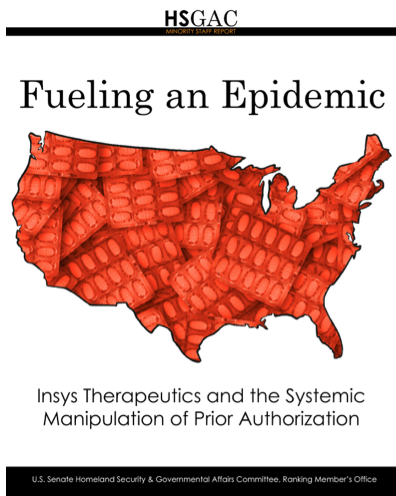
A report released by the minority members of the US. Senate Homeland Security and Governmental Affairs Committee provides new information regarding the significant efforts the pharmaceutical company Insys has undertaken to reduce barriers to the prescription of Subsys, its powerful fentanyl product. These efforts include actions to mislead pharmacy benefit managers (PBMs) about the role of Insys in the prior authorization process and the presence of breakthrough cancer pain in potential Subsys patients. An internal Insys document suggests Insys apparently lacked even basic measures to prevent its employees from manipulating the prior authorization process and received clear notice of these deficiencies.
Don’t let pharma take down a new Maryland price gouging law
In May, Maryland became the first state to take action against the alarming trend of price gouging of off-patent brand-name and generic drugs, writes Jeremy Greene in an op-ed in The Washington Post. The state’s concise new law, which permits the attorney general to argue in front of a court when the price of an older essential medication increases so precipitously as to “shock the conscience,” passed with overwhelming bipartisan votes and broad popular support. The generic pharmaceutical industry would prefer to see it overturned. While the problem of pharmaceutical pricing is felt most keenly in newer specialty drugs that can cost more than $30,000 a year, interpretations of federal patent law limit the ability of states to protect residents from price increases in these newer drugs whose monopolies are protected by patents.
Novo Nordisk Reaches USD 58.65 million Settlement with US Department of Justice over Allegedly Illegal Marketing for Victoza
Novo Nordisk (Denmark) has agreed to pay $58.65 million to end a federal investigation by the US Department of Justice (DoJ) related to the company’s diabetes medication marketing practices, reports Bloomberg News. The investigation was launched in February 2011 into sales and marketing activities concerning Novo Nordisk’s leading type 2 diabetes drug Victoza. The financial terms of the agreement mean that Novo Nordisk will pay about $46.5 million as settlement to the federal government and to US states responsible for reimbursing Victoza under the Medicaid program. Furthermore, Novo Nordisk has agreed to pay $12.15 million to resolve complaints lodged by the US administration on behalf of the FDA. The alleged off-label marketing unnecessarily increased the costs for government healthcare programs while allegedly endangering patients, according to the whistleblower complaints and the government.
EU starts in-depth probe of Bayer, Monsanto deal

Reuters reports that the European Commission has started an in-depth investigation of Bayer’s planned $66 billion takeover of U.S. seeds group Monsanto, saying it was worried about competition in various pesticide and seeds markets. The deal would create the world’s largest integrated pesticides and seeds company, the Commission said, adding this limited the number of competitors selling herbicides and seeds in Europe. If the deal goes through, the newly merged company will be one of the largest agrochemical firms in the world and could put 90 percent of the world’s food supply in the hands of only four multinational corporations.
 Corporations and Health Watch