A new study in the New England Journal of Medicine found that steep decline in air pollution in Southern California since the mid-1990s is strongly associated with “statistically and clinically significant improvements” in children’s lung function and growth. The study provides the strongest evidence yet that years of government regulations to reduce air pollution in California and across the nation are paying off with measurable improvements in children’s health.
Two New Reports on Alcohol Policy in United Kingdom
Two new reports released by Alcohol Research UK examine alcohol problems and policy in the United Kingdom. The first, Understanding the Alcohol Harm Paradox , why people with low individual or neighborhood socioeconomic status show a greater susceptibility to the harmful effects of alcohol. The second, A Measure of Change, finds that the devolution of public health responsibilities to local authorities had led to significant cuts in spending on alcohol services.
Judge Suspends City Gun Laws
A Dauphin County (Pennsylvania) judge has ordered Harrisburg to stop enforcing three of its gun-control ordinances, reports The Burg, a community magazine in Harrisburg. Judge Andrew H. Dowling found that the three ordinances—prohibiting gun possession in a park, by a minor and in a mayor-declared state of emergency—violate the state’s Uniform Firearms Act, which forbids municipalities from regulating the “lawful ownership, possession, transfer or transportation” of guns and ammunition for purposes that are not considered illegal under state law.
Judge Strikes Down Maine Law for Importing Prescription Medicines
In a blow to advocates who want to import medicines, a federal judge has invalidated a controversial Maine law that allows residents to buy prescription drugs from some foreign pharmacies, reports the Wall Street Journal. The Maine Pharmacy Act was enacted two years ago in response to the growing cost of prescription medicines.
Negotiating healthy trade in Australia: Health impact assessment of the proposed Trans-Pacific Partnership Agreement
The Centre for Health Equity, Training Research and Evaluation at the University of New South Wales in Australia has released a report assessing the health impact of the Trans Pacific Partnership. The executive summary is below. Read the full report.
EXECUTIVE SUMMARY
The Trans-Pacific Partnership is Continue reading Negotiating healthy trade in Australia: Health impact assessment of the proposed Trans-Pacific Partnership Agreement
U.S. Agency Sets Fines for Maker of Airbags
In an escalating standoff with Takata, writes the New York Times, federal regulators said on Friday that they would begin to fine the Japanese auto supplier $14,000 a day, saying it had not fully cooperated in an investigation into defective airbags. Takata has failed to respond “fully or truthfully” to two orders that it turn over documents and information related to the defect, the National Highway Traffic Safety Administration wrote in a letter to the company.
E.P.A. Issues Stiffer Rules on Vehicle Fuel Ratings
After two years of imposing increasingly stiff penalties on automakers that overstate their fuel economy ratings, federal regulators on Monday said they would tighten guidelines used in determining the mileage advertised to consumers, reports the New York Times. Next year, automakers will face stricter rules for testing fuel economy and higher potential penalties. The rules for the test had not been updated in over 10 years.
How to accelerate declines in sugar consumption

To translate the recent U.S. Dietary Guidelines Recommendation to reduce sugar intake into practice, advocates might learn more by reading the business news than nutrition journals. Consider the following:
- Coca Cola said its fourth quarter profit in 2014 fell 55% from the previous year based on reduced demand for sugary and diet soft drinks; Pepsi reported a 24% decline in the same period
- Kellogg, the world’s largest maker of breakfast cereals said persistent declines in products like Frosted Flakes and Pop-Tarts contributed to a 7.7% drop in the last quarter of 2014 compared to the previous year.
- Mondelez International, the maker of Oreo Cookies and Cadbury chocolate, reported a $149 million hit to fourth quarter earnings.
Of course single quarter results have multiple causes, including recent currency fluctuations but the trends are long term. Carbonated soft drink sales in the United States have declined for 10 consecutive years as consumers continue to give up sugary sodas. And while Big Soda continues to market heavily in nations like China, Brazil and India, even there problems are emerging. “In China we are seeing probably the weakest food-and-beverage market in 10 years,” Ahmet Bozer, president of Coca-Cola International told reporters on a conference call earlier this month. And in Mexico, another big market, the recent 7 cents per liter soda tax has already reduced sales.
Of course, food companies respond to these declines with new efforts to restore profitability including more marketing and new product development. But even some of these strategies, such as charging higher per-ounce prices on the new mini-cans Pepsi and Coke are selling, do not end up claiming a bigger stomach share for sugary beverages, the previous solution to any drop in sales. Overall, according to recent food availability data from the United States Department of Agriculture, estimated consumption of sweeteners is nearly 14% lower than it was at its peak in 1999, when the average American took in almost 422 calories per day in sugar and other sweeteners.
Of course many Americans, especially teenage boys, still consume too much sugar. As Marlene Schwartz, director of the Rudd Center for Food Policy and Obesity, told US News and World Report, “It’s a little bit like having only a foot and a half of snow instead of 2 feet.”
But the steady declines in sugar consumption should encourage health professionals and activists to consider what we are doing right –and what to do more of. Here are three suggestions:
1. Push on every front for new public health protections on added sugar.
Some observers suggest that falling sugar consumption demonstrates the success of market forces. The opposite argument is more compelling: every industry effort to reduce sugar in its products, label more fully and engage in more public activities to take sugary products out of schools is a direct result of pressure from health professionals and a food movement. More pressure will lead to greater responses.
Some researchers think now is the time for more study of the relative benefits of sugar taxes, calorie listing or warning labels. However, the experience from tobacco suggests the more the better. Tobacco use declined as more taxes, smoking bans, and hard-hitting educational campaigns were implemented So bring on the policies and let’s evaluate them in real world settings. Every public debate about sugar policy helps to educate people about the health dangers of added sugar and encourages industry to further reduce sugar , thus contributing to lower sugar consumption, whether the policy is passed or not.
2. Take on Big Sugar.
In a moral economy, heavily marketing to children and young people the products most associated with the rising burden of diet-related diseases like would not be considered an ethical business model. When the American public lost faith in the credibility of the tobacco industry as a participant in shaping public health policy, significant health advances were achieved. If snapping a can of Coke open becomes associated not with bringing happiness but more diabetes for our children, the capacity of Coke and other producers of high sugar products to undermine public health policy will be diminished. Counter-marketing campaigns like the truth campaign on tobacco can accelerate the declining respect for food companies that depend on sickening products for profitability.
Another way to take on Big Sugar is to sever the links between these industries and health care, professional and educational institutions. Professional organizations like the American Academy of Nutrition and Dietetics, the American Academy of Family Physicians and others continue to take money from Coca Cola and other manufacturers of high sugar products. Many educational and health organizations (including my own, I am sorry to say) continue to have pouring rights contracts with Coke or Pepsi. Few hospitals or universities have considered divesting from companies that depend on products that contribute to diet-related diseases. Taking on these links can provoke further discussion about the role of sugar in our diet and the consequences of promoting sugary products.
3. Create environments that make alternative to sugary products easy choices.
In many institutions, vending machines and soda fountains in cafeterias make soda the most available drink. For institutional leaders, vending machines are a revenue stream while the alternative, water fountains, are a revenue drain. That equation needs to change. Mobilizing parents, students, health professionals and workers to ensure that water fountains are more available than soda and that they are adequately maintained will help to make it easier for millions of people to choose water over soda.
In the long run, creating healthier food environments will require changing a food system that has made the needs of a handful of increasingly concentrated multinational food companies a higher priority than promoting the health and reducing food insecurity for the world’s population. But in today’s world, the continuing declines in sugar consumption—and the new Dietary Guidelines recommendation to cut back more on sugar– provide health professionals and the food movement with an opportunity to accelerate a trend that can prevent premature deaths and avoidable illnesses.
And Now a Word from our (Australian) Sponsors
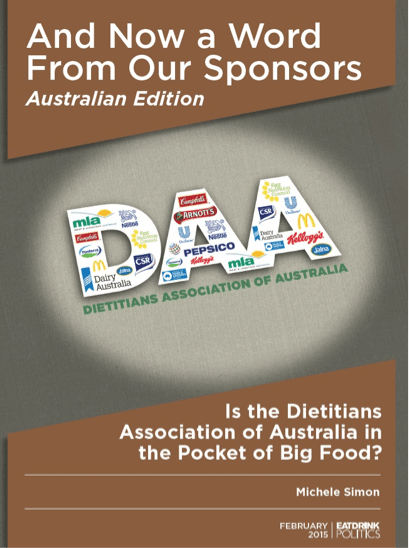
Reposted from Eat Drink Politics
 Just as most western nations do, Australia suffers significantly from diet- related chronic diseases. Heart disease is the leading cause of death, killing one Australian every 12 minutes. Diabetes is also a serious health concern and has been on the rise in recent years, according to the Australian government.Three out of five people who suffer from diabetes also suffer from heart disease. Especially troubling is how the indigenous population of Australia suffers from diabetes at three times the rate of the general population. Given these serious public health problems, all preventable through healthy eating, it behooves the nation’s leading nutrition professionals to be honest with the Australian people.
The 2013 report, “And Now a Word from Our Sponsors,” also from Eat Drink Politics, found that the Academy of Nutrition and Dietetics in the United States has a serious credibility problem due to its myriad conflicts with the junk food industry. For example, dietitians can earn continuing education credits from Coca-Cola and PepsiCo, and at their annual meeting, attend sponsored sessions by Nestlé and lobbyists for high fructose corn syrup. This sort of cozy relationship with the same companies that are contributing to the very problems dietitians are supposed to help prevent seriously undermines that profession’s credibility.
Sadly, a very similar situation exists within Australia’s dietetic profession. The Dietitians Association of Australia (DAA), representing more than 5,000 members, claims to be “the leader in nutrition for better food, better health and well-being for all.” But that can’t be true when the organization is compromised by serious conflicts of interest, which cast doubt on the organizations’ dietary recommendations and policy positions.
Read the full report.
Cereal offenders: why do sugar levels keep rising in our breakfast choices?
The sugar on our collective breakfast tables is piling up at an alarming rate, reports The Guardian. Despite a barrage of health warnings on the white stuff, a report last month from Action on Sugar showed that one in five cereals now contains more sugar than three years ago, and some are 18% sweeter. And there’s a bitter new chapter to this sorry tale. As we collectively spend less on cereals a new generation of on-the-run alternatives – breakfast drinks and biscuits – is taking sugary snacks to new levels.
 Corporations and Health Watch