Federal regulations require drug manufacturers to report previously unknown side effects and complications of their products to the Food and Drug Administration (FDA) within 15 days of receiving reports of patient injury or death. But a new study by researchers at the University of Minnesota showed that between 2000 and 2014, drug manufacturers didn’t disclose more than 160,000 serious adverse events within the 15-day time frame.
A Common-Sense Public Health Approach to Gun Violence
Every year, wrote Tim Burgess, the Seattle City Council president, in Capitol Hill Times, taxpayers in Seattle pay for millions of dollars of emergency medical care for people who have been shot. It’s time for the gun industry to chip in to help defray these costs. The City Council will soon consider two gun-safety measures to address these issues in our continuing effort to reduce gun violence in Seattle.
Beach Reads on Corporate Skullduggery
August is a time for vacations and reading on the beach—or in an air-conditioned library. For those dedicated Corporations and Health Watch readers who can’t resist an opportunity to find out more about how corporations influence well-being, here are a few recent novels that provide additional insights into this process. For those who worry about the quality of the scientific evidence in these accounts, remember it was the public outrage generated by Upton Sinclair’s novel The Jungle that played a key role in creating the United State Food and Drug Administration in 1906.
Experts support call for lower cancer drug prices
Reuters reports that a group of 118 leading cancer experts have developed a list of proposals designed to reduce the cost of cancer drugs, and support a grassroots patient protest movement to pressure drug companies to charge what they deem a fair value for treatments.
Taxes on tobacco, alcohol and sugar sweetened beverages: Linkages and lessons learned
A review of taxes on tobacco, alcohol and sugary beverages in Social Sciences and Medicine concludes that while “specific taxes based on the volume of beverages are likely to reduce the demand for SSBs, policy makers should also consider taxes on alcohol and SSBs that tax the dose of the alcohol and calories in order to create supply-side incentives for producers to lower alcohol and calorie levels in existing products or promote products with lower levels of alcohol and calories.”
U.S. Senate weighs highway bill with modest safety reforms
According to Automotive News, a six-year highway funding bill being considered by the U.S. Senate would provide a path for auto safety regulators to impose bigger fines on automakers that violate the law and take limited steps to address loopholes in the nation’s auto recall system, but it would stop short of some of the stricter measures sought by Democratic lawmakers.
Nestlé/Gerber again caught conning parents
Nestlé has been sued in California state court for shenanigans involving products of its Gerber division, reports Consumer Law and Policy Blog. Nestlé wants to grab the same parents who fed Gerber infant foods to their kids—and tap into their desire for healthier food. However, because it’s cheaper and easier to use fake fruits instead of real ones, Nestlé tarts up flour and sugar with flavors that taste like fruit but which provide none of their nutritional benefits.
The end of chicken?

by Michele Simon @MicheleRSimon and Jamie Berger @jamiecberger July 20th, 2015
Cross posted from Eat Drink Politics and Al Jazeera
While the western United States is suffering from crippling drought, the Midwest is reeling from an unprecedented outbreak of avian flu, mostly among egg-laying chickens and other forms of poultry.
The numbers are staggering. According to the U.S. Department of Agriculture, 223 outbreaks in 15 states have been identified over the past six months, affecting more than 48 million birds, with more cases expected. The hardest-hit states, all of which have declared states of emergency, are Iowa, Minnesota, Nebraska and Wisconsin. About 11 percent of the nation’s egg-laying hens have been slaughtered out of fear that they might be infected.
Interactive Map Documents Rising Tide of State Preemption
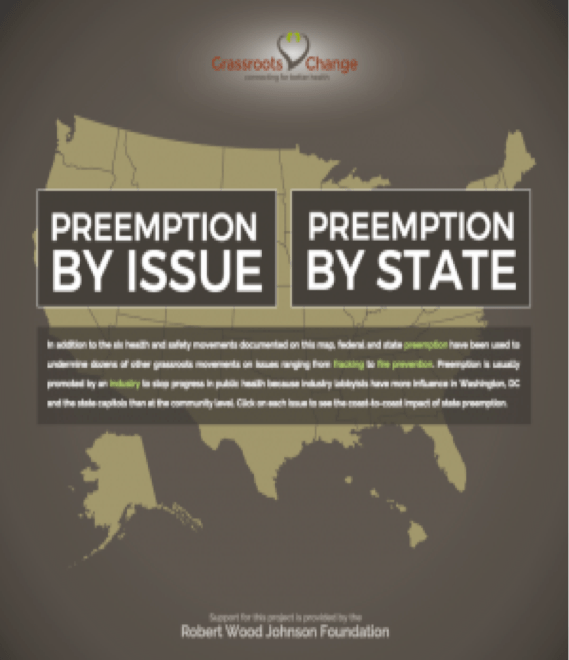
Since the 1980s, preemption has been used to undermine grassroots movements across public health issues including tobacco, nutrition, housing and gun violence. But over the last few years, opponents of public health have dramatically accelerated the use of preemption to hinder public health. From e-cigarettes to paid sick days, more and more communities are threatened with losing their ability to protect their own residents. This not only affects the community health and safety, but it can kill effective grassroots movements before they even start.
Continue reading Interactive Map Documents Rising Tide of State Preemption
Pharmaceutical Companies which Underreported Prices Paid by Medicaid Reach Settlement with DOJ
Whistleblower, a blog for attorneys, reports that AstraZeneca and Cephalon have both reached settlements with the US Department of Justice totaling $54 million. The companies were accused of deliberately underreporting Average Manufacturer Prices to public health programs. The government accused the companies of underpaying rebates owed to the states that caused the United States to be overcharged for its payments to the states for the Medicaid program.
 Corporations and Health Watch