The Brady Center to Prevent Gun Violence announced that the family of Kirsten Englund is filing a lawsuit against World Pawn Exchange for transferring multiple firearms to a straw purchaser, which were then used by her mentally ill son, to murder Kirsten Englund and carjack and kidnap another victim during a crime spree stretching from Oregon to California. The suit also seeks to hold Diane Boyce and J&G Sales, the company which originally sold the guns online, accountable. The suit was filed in the Multnomah County Circuit Court by Cohen Milstein Sellers & Toll, PLLC, the Brady Center to Prevent Gun Violence’s Legal Action Project, and the D’Amore Law Group, P.C.
Purchases of sugar-sweetened beverages in Mexico decline after tax

A new study in BMJ assessing the impact of Mexico’s tax on sugar-sweetened beverages found that purchases of taxed beverages decreased by an average of 6% and decreased at an increasing rate up to a 12% decline by December 2014. All three socioeconomic groups reduced purchases of taxed beverages, but reductions were higher among the households of low socioeconomic status, averaging a 9% decline during 2014, and up to a 17% decrease by December 2014 compared with pretax trends. Purchases of untaxed beverages were 4% higher than before 2014 mainly driven by an increase in purchases of bottled plain water.
 [photo: A poster from the campaign for Mexico’s sugar tax. Message says: “With the soda tax, water fountains in schools and public places.”]
Dietary Guidelines Recommend Limiting Added Sugar to Less Than 10% of Calories
The new Dietary Guidelines for Americans say that healthy eating patterns limit added sugars to less than 10 percent of calories per day. This recommendation is a target to help the public achieve a healthy eating pattern, which means meeting nutrient and food group needs through nutrient-dense food and beverage choices and staying within calorie limits. This target is informed by national data on intakes of calories from added sugars, which account on average for almost 270 calories, or more than 13 percent of calories per day in the U.S. population.
House Takes Fairness in Class Act Litigation Act
US PIRG reports that the House is taking action on HR 1927, The Fairness in Class Action Litigation Act of 2015. The bill would in effect wipe out the class action mechanism by requiring all victims to suffer the exact same injury or harm in “type and scope.” For example, if a VW “Defeat Device” reduces the value of a 2011 diesel by $2000 but a 2010 diesel by only $1000, the two owners couldn’t join the same class, even though class actions are really the only way to hold VW accountable to its customers. As Joanne Doroshow of New York Law School’s Center for Justice and Democracy states: “Classes inherently include a range of affected individuals, and virtually never does every member of the class suffer the same scope of injury even from the same wrongdoing. H.R. 1927 will wipe out one of the most important tools for justice in America.” Read PIRGs 70-group letter of opposition sent to the House.
Interview with Marion Nestle, Author of “Soda Politics: Taking on Big Soda (and Winning)”
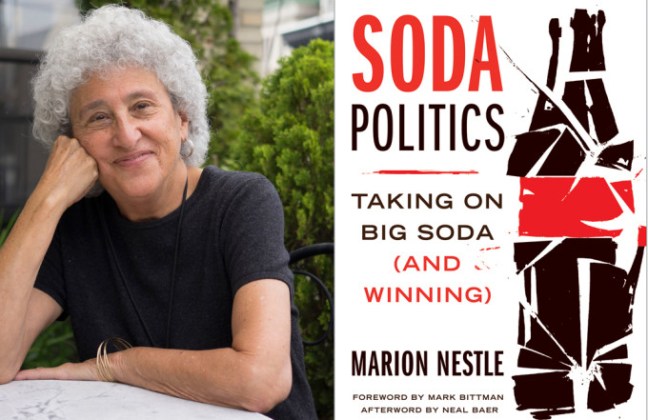
Marion Nestle’s new book is “Soda Politics: Taking on Big Soda (and Winning)”. She is Paulette Goddard Professor in the Department of Nutrition, Food Studies, and Public Health at New York University. Nestle’s book was recently reviewed in the New York Times. Corporations and Health Watch founder Nick Freudenberg recently asked Professor Nestle some questions about her new book.
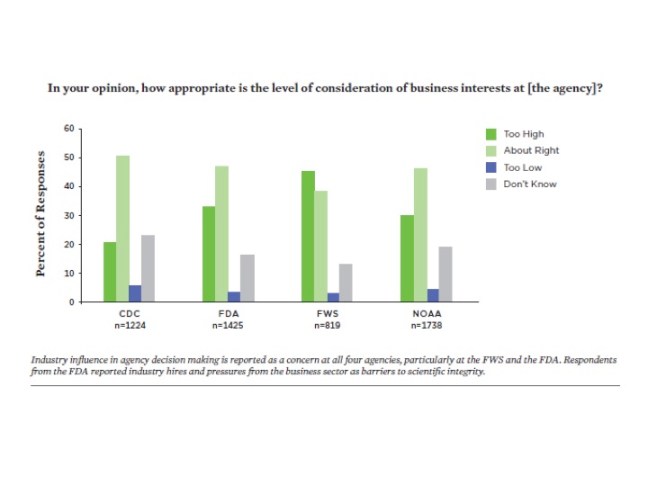
Progress and Problems Government Scientists Report on Scientific Integrity at Four Agencies
Union of Concerned Scientists
UCS released a new report on scientific integrity at four federal agencies: US Centers for Disease Control and Prevention, Food and Drug Administration, Fish and Wildlife Service, and the National Oceanic and Atmospheric Administration. Almost a third (31%) of the 5,206 scientists who answered the survey reported that they thought business interests played too big a role in agency decisions.
Soda Scandal: Journalists Fail to Reveal Sources Funded by Coca-Cola
During the investigation and subsequent subsequent collapse of the Coca-Cola Global Energy Balance Network, the New York Times and Associated Press discovered that prominent university professors working on obesity issues had been funded by The Coca-Cola Company. This is not just a public health scandal. It is a journalistic one as well, writes Gary Ruskin on Alternet.
Regulation of the pharmaceutical industry: promoting health or protecting wealth?
Government has long had conflicting aims with regard to regulating the pharmaceutical industry. An essay in the in the Journal of the Royal Society of Medicine asks how the National Health Service in the United Kingdom is balancing its public health and economic mandates.
Settling for a Lack of Accountability?

Phineas Baxandall and Michelle Sukra
The United States Public Interest Research Group Education Fund released a report that examines which federal agencies allow companies to write off out-of-court settlements as tax deductions, and which are transparent about it. Here’s the Executive Summary.
How an $84,000 drug got its price
Gilead Sciences executives were acutely aware in 2013 that their plan to charge an exorbitantly high price for a powerful new hepatitis C drug would spark public outrage, reports the Washington Post, but they pursued the profit-driven strategy anyway, according to a Senate Finance Committee investigation report released Tuesday.
 Corporations and Health Watch