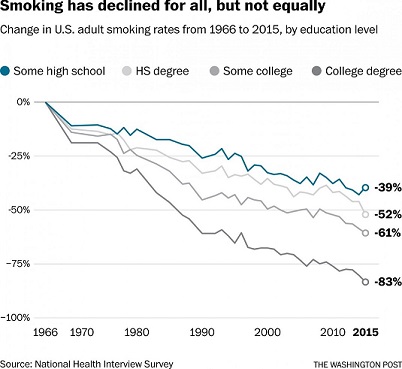
After decades of lawsuits, public campaigns and painful struggles, Americans have finally done what once seemed impossible: Most of the country has quit smoking, saving millions of lives and leading to massive reductions in cancer. Unless, reports The Washington Post, those Americans are poor, uneducated or live in a rural area. Hidden among the steady declines in recent years is the stark reality that cigarettes are becoming a habit of the poor. The national smoking rate has fallen to historic lows, with just 15 percent of adults still smoking. But the socioeconomic gap has never been bigger. Cigarette companies are focusing their marketing on lower income communities to retain their customer base, researchers say. “Poorer people don’t smoke because anything’s different or wrong about them,” said Robin Koval, president of Truth Initiative, a leading tobacco-control nonprofit group. “Their communities are not protected like others are. They don’t have access to good health care and cessation programs. If you have a bull’s eye painted on your back, it’s harder to get away.” Tobacco companies have also invested considerable resources in recent years lobbying against smoking restrictions and taxes, especially in poorer, rural and often Southern states, where smoking remains highest.
The Company We Keep: Lobbyists in the Trump Administration
President Trump promised to “drain the swamp” when he got to Washington. Yet his appointments have included not just former lobbyists, but dozens of lobbyists whose governmental responsibilities fall into the same specific issue areas that they lobbied within the last two years — an apparent violation of Trump’s own executive order on ethics. In a new report, Public Citizen identifies 37 recent hires with lobbying conflicts stemming from activity within the last two years, only four of whom have received ethics waivers.
What Public Health Practitioners Need to Know About Unhealthy Industry Tactics
If you are working to improve public health and the environment, writes Rob Moodie in the American Journal of Public Health, you need to know what your opponents are up to. Here is a quick guide to their tactics:
- Attack legitimate science
- Attack and intimidate the scientists
- Create arms-length front organizations
- Manufacture false debate and insist on balance
- Frame key issues in highly creative ways
- Fund industry disinformation campaigns
- Influence the political agenda
Citation: Moodie, AR. “What Public Health Practitioners Need to Know About Unhealthy Industry Tactics”, American Journal of Public Health 2017; 107(7): 1047-1049.
Conflicts of interest in health care journalism. Who’s watching the watchdogs?
Many journalists are aware of the drug industry’s attempts to gain positive attention by buying placement within the nation’s health care news. A few occasionally write or talk about it, as Harder and Rosenthal did publicly. But, writes Gary Schwitzer in Health News Review, we don’t talk often enough about why it matters if health care industry entities are allowed to advertise within, or sponsor, health care journalism content. Americans spend more than $3 trillion on health care. Conflicts of interest in health care and research are rampant. But who talks about conflicts of interest in health care journalism? There is a great potential harm in journalists – and the audience they serve – becoming numb to the presence of and influence of drug companies and other industry entities in the news and information disseminated to the public. In a three part series, Health News Review examines this problem. Read Part 1. Read Part 2.
Leaving the Paris Climate Accord Could Lead to a Public Health Disaster
Seven million people died prematurely in 2012 from air pollution caused by fossil fuel combustion, according to a 2014 report by the World Health Organization. So President Trump’s decision to halt U.S. compliance with the 2015 Paris climate agreement is a blow not just to climate science and international diplomacy — it’s also a looming disaster for public health, reports Scientific American. A review of dozens of studies published between 2009 and 2014 link climate change to increases in a wide range of health problems, including asthma and other respiratory disorders, heart disease induced by heat stress, infectious diseases, waterborne diseases that can cause dangerous bouts of diarrhea in children, and mental health issues such as depression and PTSD following climate-related natural disasters such as hurricanes.
The role of industry lobbies in the climate negotiations
BINGO, for Business and Industry NGO, is, in French, “non-governmental organizations in business and industry,” writes Simon Ross in Le Monde. With such an acronym, it’s no wonder some voices are wondering about the jackpot that could benefit the economic players present in the climate negotiations! The issue of the presence of lobbyists is in any case taken very seriously by the delegates of the UN Framework Convention on Climate Change (UNFCCC) meeting in Bonn, Germany this week. “Hundreds of trade associations have access to climate negotiations, and many of them are funded by some of the world’s largest polluters and climate skeptics,” said Tamar Lawrence-Samuel, from the US-based NGO Corporate Accountability International(CAI). “They represent the main obstacle to raising the level of ambition of action against global warming.” A new report by CAI called Inside Job: Big Polluters’ lobbyists on the inside at the UNFCCC documents the role of these business organizations.
The Powerful Corporations Pushing to Unravel Protections for Consumers, Public Health, and the Environment
In mid-May, writes the Center for American Progress, the Senate Homeland Security and Governmental Affairs Committee is scheduled to consider the Regulatory Accountability Act, or RAA, a dangerous piece of legislation that will make it harder—if not impossible—for federal agencies to do their jobs to protect consumers from unscrupulous business practices; protect the environment from pollution; and protect public health from exposure to toxic chemicals and unsafe food. Although the Senate sponsors are working to position the bill as moderate relative to its House companion, it is far from reasonable and will open new doors for powerful corporations to block federal agencies trying to serve the public interest. During the first three months of 2017, most of the largest trade associations in the country walked the halls of Congress pushing for the RAA. If this bill were to become law, the biggest winners would be the powerful corporations that have lobbied to pass it.
Environmental pollution with antimicrobial agents from bulk drug manufacturing industries in Hyderabad, South India
High antibiotic and antifungal concentrations in wastewater from anti-infective drug production may exert selection pressure for multidrug-resistant (MDR) pathogens. This study investigated the environmental presence of active pharmaceutical ingredients and their association with MDR bacteria in Hyderabad, South India, a major production area for the global bulk drug market.
Water samples were collected from the direct environment of bulk drug manufacturing facilities. Samples were analyzed for 25 anti-infective pharmaceuticals. All environmental specimens from 28 different sampling sites were contaminated with antimicrobials.
High concentrations of moxifloxacin, voriconazole, and fluconazole as well as increased concentrations of eight other antibiotics were found in sewers. Corresponding analyses revealed an extensive presence of enterobacteria. Insufficient wastewater management by bulk drug manufacturing facilities leads to unprecedented contamination of water resources with antimicrobial pharmaceuticals, which seems to be associated with the selection and dissemination of pathogens. The development and global spread of antimicrobial resistance present a major challenge for pharmaceutical producers and regulatory agencies.
Citation: Lübbert, C., Baars, C., Dayakar, A. et al. Environmental pollution with antimicrobial agents from bulk drug manufacturing industries in Hyderabad, South India, is associated with dissemination of extended-spectrum beta-lactamase and carbapenemase-producing pathogens Infection (2017). Published online on April 26,2017.
Big tax cuts for the rich leave less for the poor
A group of conservative think tanks wants the nation’s tax system to look more like North Carolina’s, writes the Center for Public Integrity. In Washington, D.C., the Trump administration and Congressional Republicans have been considering a similar approach — lower federal income-tax brackets and a tax on imports — that some tax experts say would have comparable outcomes. Some of the same conservative groups that convinced states to change their tax systems have advised the Trump administration on economic and tax policy. But so far, for the working poor, that hasn’t been a great deal. While Congress prepares for the tax debate, single-parents in Asheville worry that the proposed federal tax changes would only make life harder, as North Carolina’s tax reforms did. “They’re going to come for every little penny that you have,” said one. “Where is the help when we need it?”
Public Universities Get an Education in Private Industry
At the University of California, Davis, researchers are regularly invited to attend on-campus meet-and-greets with potential corporate funders to discuss possible sponsorship opportunities. Handshakes and business cards are routinely exchanged—so are nondisclosure agreements, writes Molly McCluskey in The Atlantic. Jonathan Eisen, an evolutionary biologist at U.C. Davis, says such meetings and the attendant nondisclosure agreements are commonplace and that it’s university administrators—rather than the corporations themselves—who encourage their professors and researchers to attend. I spent a year poring over documents and talking to universities, companies, lawyers, and researchers to figure out what kind of role corporate funding plays in public-university studies across the United States. Nearly all of the people I spoke with talked about the increasing ease with which corporate representatives have access to researchers, although some were more comfortable with the arrangement than others.

