The New York Times reports that the commissioner of the Food and Drug Administration on called on Congress to empower the agency to better police compounding pharmacies like the one at the center of a national meningitis outbreak. But Republican lawmakers pushed back, arguing that the agency has enough authority, leaving it unclear whether the House would support efforts to increase oversight. The Times had previously disclosed that despite two decades of dire health warnings, the industry has until now fought off tougher federal oversight with the help of powerful allies in Congress.
To achieve NCD Targets, WHO should monitor tobacco, alcohol and food industry practices
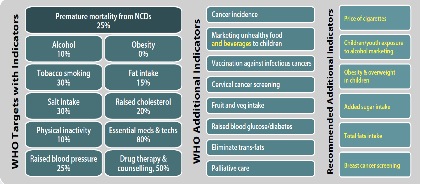
This week the member states of the World Health Organization are meeting in Geneva to agree on a Global Monitoring Framework for noncommunicable diseases (NCDs). Meeting participants discussed indicators and targets that could be used to assess progress towards achieving the goal of reducing preventable deaths from NCDs by 25 percent by 2025. Also participating in the meeting was the NCD Alliance, a network of more than 2,000 civil society organizations from more than 170 countries. The Global Action Plan and the Global Monitoring Framework on NCDs are a result of the United Nations High-Level Meeting of the General Assembly on NCDs held in New York City in September 2011.
The discussions at the meeting in Geneva focused on what to measure. As shown below, WHO has set 2025 targets as shown in the column on the left and then proposed additional indicators as shown in the middle column. The NCD Alliance has recommended some additional indicators, shown in the column on the right.

These targets and indicators mark an important step forward in controlling NCDs. As Cary Adams, the Chair of the NCD Alliance noted in Geneva , the “commitment to measuring our progress and setting realistic and achievable goals, supported by the investment required, will…make a real difference to those of us who have or will develop NCDs in our lifetime. “
But monitoring changes in health status and health behavior related to NCDs and government NCD prevention policies may not be enough to achieve the stated goals. As several experts have acknowledged, the business and political practices of the alcohol, tobacco and food industries play a critical role in the development of NCDs.[i][ii][iii] Without changes in these practices, it will be difficult to reduce premature deaths. To encourage the discussion of indicators and targets for such monitoring, I suggest some provocative goals for the monitoring of corporate practices.
- Reduce expenditures on marketing alcohol, tobacco and unhealthy foods by the top 10(or 20 or 50) global producers of each of these products by a fixed percentage each year. The alcohol, tobacco and food industries are heavily concentrated with the top firms controlling a significant portion of market share.[iv][v][vi] Since research evidence shows that more marketing leads to more consumption of these products associated with NCDs,[vii] less marketing could reduce exposure to this negative influence.
- Reduce corporate expenditures on lobbying and campaigns contributions for the top 10(or 20 or 50) global producers of alcohol, tobacco and unhealthy food by a fixed percentage each year. Tobacco, alcohol and food corporations have used their political and economic clout to undermine public health protections and to create an environment that allows them to promote behaviors and lifestyles associated with NCDs. [viii][ix][x] Restricting their ability to externalize the costs of the NCDs associated with their products and to thwart the democratic principles of one person one vote could help to prevent premature deaths, reduce government expenditures on health care and restore more democratic processes.
- Require tobacco, alcohol and food companies to commission an independent health impact assessment of any new product or practice and to make the assessment publicly available.
Each year, these companies introduce thousands of new products and practices. Often, however, the adverse health impact is not recognized for years. Requiring companies to hire independent researchers to complete health impact assessments according to uniform standards prior to exposing the population to such practices or products and to make such reports public could discourage companies from releasing into the market inadequately tested products.
How could such targets be monitored? The World Health Organization and other global bodies, the NCD Alliance and its network of NGO partners, national governments and other bodies could each play a role in setting targets and monitoring this indicator. Global organizations could limit participation in international forums to those organizations who achieved targets. Institutional investors could invest in companies that met targets and disinvest from those that did not. National governments could favor companies meeting targets for procurement contracts and penalize those that failed to meet the targets. They could also offer subsidies or tax breaks to companies that achieved targets. Some nations may choose to make these guidelines mandatory, especially for practices implicitly or explicitly designed to increase consumption of unhealthy products by children and young people.
In the current political climate, these proposals will of course elicit intense opposition from corporations and their allies. But 50 years ago the current measures in place to control tobacco use would have been unthinkable. Effective public health officials need to compromise but before they compromise, they have to be able to articulate public health goals that are based on the evidence and have the potential to fulfill the mandate to protect population health. Unless public health professionals, researchers and advocates begin discussing now how to take action to end the corporate practices that contribute to the preventable illnesses and premature mortality that NCDs impose, 50 years from now we’ll still be lamenting the steady increase in the health burden and economic costs imposed by NCDs.
[i] Beaglehole R, Bonita R, Horton R, et al., and the NCD Alliance. Priority actions for the non-communicable disease crisis. Lancet. 2011;377(9775):1438-47.
[ii] Magnusson RS. Rethinking global health challenges: towards a ‘global compact’ for reducing the burden of chronic disease. Public Health. 2009;123(3):265-74.
[iii] Lien G, DeLand K. Translating the WHO Framework Convention on Tobacco Control (FCTC): can we use tobacco control as a model for other non-communicable disease control? Public Health;125(12):847-53.
[iv] Jernigan DH. The global alcohol industry: an overview. Addiction. 2009 Feb;104 Suppl 1:6-12.
[v] Eriksen M, Mackay J, Ross H. Chapter 18 Tobacco Companies in The Tobacco Atlas 4th Edition pp. 56-57
[vi] Stuckler D, Nestle M. Big food, food systems, and global health. PLoS Med.2012;9(6):e1001242.
[vii] Stuckler D, McKee M, Ebrahim S, Basu S (2012) Manufacturing Epidemics: The Role of Global Producers in Increased Consumption of Unhealthy Commodities Including Processed Foods, Alcohol, and Tobacco. PLoS Med 9(6):e1001235.
[viii] Brownell KD (2012) Thinking Forward: The Quicksand of Appeasing the Food Industry. PLoS Med 9(7):e1001254.
[ix] Freudenberg N. The manufacture of lifestyle: the role of corporations in unhealthy living. J Public Health Policy. 2012 May;33(2):244-56.
[x] Gilmore AB, Savell E, Collin J. Public health, corporations and the new responsibility deal: promoting partnerships with vectors of disease? J PublicHealth (Oxf). 2011;33(1):2-4.
NY appeal court: Shooting victim may sue gun maker
The Wall Street Journal reported last month that a former high school athlete, who was shot in 2003, may sue the companies that made and distributed the handgun used in the crime. The suit brought an appellate court ruling that gun control advocates say will keep irresponsible gun makers and sellers from taking advantage of a federal law shielding them from lawsuits. The ruling by the Appellate Division of the New York State Supreme Court reversed a lower court’s 2011 dismissal of victim Daniel Williams’ complaint, which accused Ohio gun maker Hi-Point and distributor MKS Supply Inc. of Ohio of intentionally supplying handguns to irresponsible dealers because they profited from sales to the criminal gun market.
Corporations and Health at the 2012 APHA Meeting in San Francisco

The American Public Health Association will meet from October 27 -31 in San Francisco, California, drawing about 13,000 health professionals and advocates from around the country and the world. Several sessions, some listed below, listed below, take up questions on the health impact of corporations. Presentations given by CHW writers are marked below with *. The session links provide additional details and the APHA Annual Meeting Program lists other sessions on corporations and health in a searchable program.

Credit
Session 255412: “The Big Why”: A tobacco product manufacturer’s failed search for corporate social value
Tuesday, October 30, 2012 : 10:30 AM – 10:50 AM
Participants: Ruth Malone,Patricia McDaniel
Tobacco company corporate social responsibility (CSR) initiatives function as tobacco marketing, inhibit effective tobacco control, and constitute efforts to normalize tobacco companies. When even tobacco executives struggle to define their company’s social value, it signals a social shift: an opening to advocate for supply-side changes appropriate to the scale of the tobacco disease epidemic and consistent with authentic social value.
Session 260757: Corporate shaping of basic public health definitions including disease entities and primary prevention
Tuesday, October 30, 2012 : 4:50 PM – 5:10 PM
Participant: Beatrice Manning
This presentation uses existing research on relatively new diseases, such as osteopenia and hypercholesteremia, to document how the web of corporate interests shapes the most basic definitions of health, illness and primary prevention. It will then explicate how these definitional strategies are used by the three major corporate sectors (big pharma, medical equipment companies and private health insurers) within health care to leverage public payment programs to the maximum.
Session 2609.17: How the news media frames the debate over alcohol taxes
Monday, October 29, 2012
Participants: Samantha Cukier, Rebecca Reynolds-Ramirez, Katherine Clegg Smith, David H. Jernigan*
The news media play a powerful role in framing public debate over alcohol policies. We report the findings of a content analysis of press coverage of successful efforts to increase alcohol taxes in three states between 2009 and 2011: Illinois, Maryland and Massachusetts. From a purposive sample of six key newspapers in each state, the research team collected more than 600 relevant articles, letters to the editor and editorials that appeared over a two-year period surrounding the passage of the tax increase. We coded each article on 32 different variables, including mentions of public health research in support of the increase, and key arguments utilized and values conveyed by both proponents and opponents. We will summarize the findings of these content analyses, elucidating how competing frames were constructed in public discussions about alcohol taxes, and drawing out implications for public health practice in the specific arena of alcohol taxation as well as more generally in public health applications of the principles and techniques of media advocacy.
Session 262296: Trading Away Health: The Case of Global Tobacco Control
Tuesday, October 30, 2012 : 4:34 PM – 4:48 PM
Participants: Sohil R. Sud, Joseph E. Brenner, Ellen R. Shaffer
Tobacco corporations are suing governments around the world, claiming that regulations on tobacco marketing practices are violations of international trade agreements. Little is known within the healthcare community about these lawsuits and their potential to derail efforts to reduce tobacco consumption.
Session 270317: Global Trade and Health Activism: A Report from the People’s Health Assembly Monday, October 29, 2012 : 3:16 PM – 3:30 PM
Participants: Shelley K. White, Jonathan White
The third People’s Health Assembly in July 2012, brought together health activists from around the world to discuss trade and health. This paper provides a brief history of global trade and health activism, highlighting traditional obstacles facing such transnational health-based social movements. It will then report on the trade-focused activities of the PHA3 meeting, and will outline the common organizing principles and goals identified for coordinating global trade and health activism.
Session 270558: Tobacco industry, regional trade agreements and tobacco control in Sub-Saharan Africa Tuesday, October 30, 2012 : 5:16 PM – 5:30 PM
Participants: Hadii M. Mamudu, Eric Crosbie, Sreenivas P. Veeranki,
Over 80% of estimated global deaths from tobacco-induced diseases by 2030 are expected to occur in low- and medium-income countries, where tobacco industry has aggressively penetrated new markets. We used mixed-methods approach to assess the impact of regional trade agreements (RTAs) in Africa on cigarette sales and analyze how tobacco industry used these RTAs to expand operations and undermine tobacco control.
Session 3167.0: Snack Food and Beverage Industry and Global Non-communicable Chronic Disease Monday, October 29, 2012: 10:30 – 12:00
Participants: William H. Wiist*, Sanjay Basu, Marion Nestle, Michele Simon*, Jennifer L. Pomeranz*
Worldwide more than 30 million people die each year from chronic disease. By 2030, chronic disease will cause 59% of deaths (more than 37 million deaths per year). The major behavioral risk factors are tobacco, unhealthful diet, physical inactivity and alcohol. The choices people make to eat poorly, drink dangerously, and not exercise are shaped by the world around them. Those choices are strongly influenced by the vested interests of corporations that lobby for policies to support unhealthful products, and develop, promote and sell unhealthful products. Marketing and sale of these products are increasingly promoted around the world in poor countries where chronic disease rates are increasing faster than in rich countries. This session will focus on the “fast food” food and beverage industry which produces and markets processed foods containing ingredients shown by research to be unhealthful.
Session 3205.0: Public Health Harms from Legal Products: Challenges of Countering Industry Influence in Alcohol, Tobacco, Prescription Drugs, and Food in the US
Monday, October 29, 2012: 12:30 -2:00
Participants: Linda M. Bosma, Michele Simon*, Sarah Mart, Ruth Malone
Numerous legal products available in the United States are associated with public health problems and costs. Tobacco, alcohol, prescription drugs, and food all are available legally, but also have significant costs associated with health and public health harms. These substances are well represented in US regulatory and law-making systems, often to a much greater degree than public health advocates or researchers are able to be. This session will look at current challenges faced by the public health field, examine issues related to regulation and the legal environment, and present solutions that some local governments are exploring. Common issues and strategies across these products will be presented. The opportunity for discussion will help enrich the presentation.
Session 3312.0: The Epidemiologic Cascade: Identifying Multiple Sites for Policy Intervention Monday, October 29, 2012: 2:30 PM – 4:00 PM
Participants: René I. Jahiel, William Wiist
Epidemiologic cascade: Concept and application to industrial corporations; Defining drinking problems in the UK as a corporation-induced disorder: Theoretical and public health implications
Session 3379.0: Public Health Strategies to Address Trade and Trade Policy
Monday, October 29, 2012: 2:30 PM – 4:00 PM
Participants: Peter Maybarduk, Burcu Kilic, Donald Zeigler, Joshua Yang, Shelley K. White, Jonathan White, Timothy Mackey
This session focuses on public health strategies to protect public health within trade and trade agreements.
Session 5181.0: Food, Fairness and Health II: Occupy Agriculture – Corporate Power, Equity and the Food System
Wednesday, October 31, 2012: 12:30 -2:00
Participants: Steve Wing, Lisa Bero, Elena O. Linga, Tyrone Hayes, Michele Simon*
To equip public health professionals with an awareness of the fact of corporate influence, as well as the specific strategies employed by corporations, so as to better inform public health practice and advocacy around healthy food and just food systems. Public health depends in part on healthy food, and clean air and water in the environments where agriculture occurs. Science and public policies supporting these preconditions for public health, can run directly contrary to the aims of corporations mandated by their corporate charters to maximize profits and shareholder return — and not to promote public health. As a nation, we do enjoy environmental health and safety regulations on the books that exist to protect the public’s health interests. Agribusiness influence on these processes, however, can weaken regulation and enforcement. Compounding the problem of regulatory capture is the fact that corporations also influence research universities and non-profit organizations relied upon to create the scientific bases for public health policy can also be influenced by corporations. Corporate power and influence often lie on the other side of that unhealthy divide from communities of color. Cooptation of the public health profession by a corporate-government alliance undermines our ability to contribute to the basic goals of public health. To change this, public health must develop closer ties to movements for environmental justice and for food justice.
African-American Youth Exposed to More Magazine and Television Alcohol Advertising than Youth in General

By Center on Alcohol Marketing to Youth

African-American youth ages 12-20 are seeing more advertisements for alcohol in magazines and on TV compared with all youth ages 12-20, according to a new report from the Center on Alcohol Marketing and Youth (CAMY) at the Johns Hopkins Bloomberg School of Public Health. The report is available on CAMY’s website, www.camy.org.
The report analyzes alcohol exposure by type and brand among African-American youth in comparison to all youth. It also assesses exposure of African-American youth to alcohol advertising relative to African-American adults across various media venues using the most recent year(s) of data available.
Alcohol is the most widely used drug among African-American youth, and is associated with violence, motor vehicle crashes and the spread of sexually transmitted diseases. At least 14 studies have found that the more young people are exposed to alcohol advertising and marketing, the more likely they are to drink, or if they are already drinking, to drink more.
“The report’s central finding—that African-American youth are being over-exposed to alcohol advertising—is a result of two key phenomena,” said author David Jernigan, PhD, the director of CAMY. “First, brands are specifically targeting African-American audiences and, secondly, African-American media habits make them more vulnerable to alcohol advertising in general because of higher levels of media consumption. As a result, there should be a commitment from alcohol marketers to cut exposure to this high-risk population.”
The report finds certain brands, channels and formats overexpose African-American youth to alcohol advertisements:
- Magazines: African-American youth saw 32 percent more alcohol advertising than all youth in national magazines during 2008. Five publications with high African-American youth readership generated at least twice as much exposure to African-American youth compared to all youth: Jet (440 percent more), Essence (435 percent more), Ebony (426 percent more), Black Enterprise (421 percent more), and Vibe (328 percent more ). Five brands of alcohol overexposed African-American youth compared to all youth and to African-American adults: Seagram’s Twisted Gin, Seagram’s Extra Dry Gin, Jacques Cardin Cognac, 1800 Silver Tequila, and Hennessey Cognacs.
- Television: African-American youth were exposed to 17 percent more advertising per capita than all youth in 2009, including 20 percent more exposure to distilled spirits advertising. Several networks generated at least twice as much African-American youth exposure to alcohol advertising than all youth: TV One (453 percent more), BET (344 percent more), SoapNet (299 percent more), CNN (130 percent more) and TNT (122 percent more).
- Radio: African-American youth heard 26 percent less advertising in 2009 for alcohol than all youth on stations with the most advanced measurement data available; however, they heard 32 percent more radio advertising for distilled spirits. In these markets, four station formats delivered more alcohol advertising exposure to African-American youth than to African-American adults: Contemporary Hit/Rhythmic (104 percent more), Contemporary Hit/Pop (14 percent more), Urban (13 percent more) and Hot Adult Contemporary (43 percent more).
“Alcohol products and imagery continue to pervade African-American youth culture, despite the well known negative health consequences,” said Denise Herd, PhD, an associate professor with the University of California Berkeley School of Public Health who reviewed the report. “The findings of this report make clear immediate action is needed to protect the health and well-being of young African Americans.”
According to the U.S. Centers for Disease Control and Prevention’s Youth Risk Behavior Survey, about one in three African-American high school students in the U.S. are current drinkers, and about 40 percent of those who drink report binge drinking. While alcohol use and binge drinking tend to be less common among African-American adults than among other racial and ethnic groups, African-American adults who binge drink tend to do so more frequently and with higher intensity than non-African Americans.
In 2003, trade groups for beer and distilled spirits committed to placing alcohol ads in media venues only when underage youth comprise 30 percent of the audience or less. Since that time, a number of groups and officials, including the National Research Council, the Institute of Medicine and 24 state attorneys general, have called upon the alcohol industry to strengthen its standard and meet a “proportional” 15 percent placement standard, given that the group most at risk for underage drinking—12 to 20 year-olds—is less than 15 percent of the U.S. population.
University of California at Davis Reports Make Dubious Claims on Prop 37

Cross posted from Appetite for Profit


Last week I wrote about how the No on 37 campaign – the California ballot initiative that would require labeling of GMOs foods – is relying on experts with questionable credentials to do its bidding. Over the past few weeks, two expert reports have emerged from the No campaign that also warrant closer scrutiny.
The first, entitled “California’s Proposition 37: Effects of Mandatory Labeling of GM Food,” was co-authored by University of California at Davis professor Colin Carter and published in the newsletter of the University of California Giannini Foundation of Agricultural Economics. It’s not clear if the report was funded by the No campaign since the article doesn’t say one way or the other.
Regardless of the financial support, the article contains at least one glaring error that’s big enough to call into question the entire piece, along with the authors’ credibility. And right in the first paragraph: “The California initiative would implement a zero-tolerance policy for accidental presence of small amounts of GM substances.” In fact, Prop 37 specifically focuses on the deliberate use of GMO ingredients and exempts accidental occurrences. (This can happen due to drifting of GMO seeds to organic or non-GMO crops.)
To be clear, Prop 37 does not require labels on foods that were unintentionally and/or unknowingly contaminated by genetically engineered seed or food. If you don’t believe me, read the language yourself.
Much of the article is based on this erroneous assertion. For example, the authors complain about how farmers could not adhere to this standard; that the standard is higher than that of other nations, and even higher than the U.S. organic standard. But none of this is true, which makes reading the entire article very confusing.
Parke Wilde, a professor at the Friedman School of Nutrition Science and Policy at Tufts University, recently blogged about Carter’s error and how the Oakland Tribune picked up on it, furthering the confusion about what initiative requires.
In his post entitled, “Incorrect reports say that California’s Prop 37 has zero tolerance for accidental GMO content,” Wilde says that even when he emailed Carter about the matter, he “didn’t really back up this claim that the initiative takes a zero-tolerance position on accidental contamination.” So a University of California professor gets the basic facts wrong and then when asked about it by a colleague, evades the question. Not exactly a trustworthy source.

The article comes to other exaggerated conclusions such as “certified non-GM processed food products will virtually disappear from food stores” but without any actual analysis or scientific basis for such a dramatic claim. The article contains no citations; presumably this is the format of the publication, but it makes understanding the basis for the authors’ conclusions almost impossible.
A second report also from University of California at Davis professors makes similarly unsubstantiated claims about how non-GMO foods would just disappear from the market, along with wild predictions about increased food costs.
That article, entitled, “Proposition 37 – California Food Labeling Initiative: Economic Implications for Farmers and the Food Industry if the Proposed Initiative were Adopted,” is co-authored by UC Davis professors Julian Alston and Daniel Sumner. According to the report, “The work for this project was undertaken with partial funding support from No on 37.” The Los Angeles Times reported that the No campaign paid the authors “at least $30,000.”
Alston has previous ties to Monsanto, according to this Sacramento Bee article from 2004, which explains the relationship:
In July 2002, UC Davis farm economics professor Julian Alston found a patron in the private sector: Monsanto, one of the world’s five largest crop biotechnology firms. The official announcement came in the form of a letter. “Dear Dr. Alston,” it read. “Please find enclosed a check for $40,000 that represents an unrestricted gift in support of your research program.”
That same in-depth story (well worth the long read) paints UC Davis as a research incubator for Big Biotech: “You name it, and biotechnology companies help pay for it at UC Davis: laboratory studies, scholarships, post-doctoral students’ salaries, professors’ travel expenses, even the campus utility bill.”
The No on 37 campaign released the recent report with this dramatic headline: “UC Davis Professors of Agricultural Economics Release New Report that Shows Proposition 37 Will Increase Costs for California Farmers and Food Processors by $1.2 Billion.” The report makes a number of other claims, mostly based on questionable assumptions. As for the $1.2 billion in increased food costs, the figure assumes food makers would substitute non-GMO ingredients, which the authors base upon what happened in Europe upon mandatory labeling. However, there is no evidence to suggest the food industry will respond the same way here. The European Union has a much longer history of opposing GMOs then we do in the U.S. so it’s really not a fair comparison. At the very least, we just don’t know. Proposition 37 only requires labeling, not reformulation.
Once again, most of the authors’ additional conclusions are based on this one faulty assumption. For example, they claim that passage of Prop 37 and the ensuing “complete switch to GE varieties” would cause harm to farmers and the environment, result in high compliance costs for industry, as well as place California agriculture at a competitive disadvantage. But these are just the authors’ speculative opinions, based on faulty assumptions.
Moreover, this report is not published in a peer-reviewed publication; in fact, it’s not published anywhere, except on the No on 37 website. And while the No campaign made sure we knew the two authors are UC Davis professors (it’s mentioned several times on this page) apparently the authors needed to include this disclaimer next to their bios: “Titles are for identification only. The report is the authors’ independent work and not a product of the University of California.”
So both the authors and the No on 37 campaign gets to have it both ways. They can claim the University of California affiliation without making their work a product of UC. Whatever the affiliation or funding source, both of these reports should be dismissed as merely the unsubstantiated opinions of a few academics, as opposed to reliable scientific analysis backed up by peer review.
The Public Health Consequences of Externalities

 In economics, an externality is defined as an indirect consequence of production or consumption that affects not the producer or consumer but a third party — society as a whole or some sub-population. Because the costs and benefits of externalities are not included in the price of the product, externalities have the potential to distort markets, where prices are theorized to reflect the “real” value. Positive externalities bring benefits to the third party; negative externalities impose costs. Below are some examples of positive and negative externalities.
Positive Corporate Externalities
- A workplace vaccination program reduces absenteeism for the company but also benefits society as a whole by slowing spread of infectious diseases.
- Insurance discounts for those who complete driver education programs can reduce payouts for company, costs and accidents for drivers, and motor vehicle injury rate for society.
- Voluntary installation of pollution control systems can win a manufacturer a tax break, benefit nearby residents by lowering pollution and benefit society as a whole by lowering pollution-related costs.
Negative Corporate Externalities
- Air pollution from industrial manufacturing contributes to respiratory and cardiovascular diseases and cancer, agricultural damage and climate change.
- Tobacco use leads to increased hospitalizations and lost productivity, the costs of which are borne by tax payers and government.
- Industrial production of meat led to farms that were easier to run, with fewer and often less-skilled employees, and a greater output of uniform animal products. Social costs include contributing to the increase in the pool of antibiotic-resistant bacteria because of the overuse of antibiotics; air quality problems; the contamination of rivers, streams, and coastal waters with concentrated animal waste; animal welfare problems, mainly as a result of the extremely close quarters in which the animals are housed.
One important reason that corporations contribute to premature death and preventable illnesses and injuries is that they are able to externalize, i.e., shift to consumers, taxpayers, or society as a whole, the real costs of production or consumption of the products they manufacture. In this commentary, I explain how corporate externalities contribute to public health problems. In a later post, I will explore a few proposals to improve population health by requiring corporations to “internalize” these external costs back into the price, thus reducing socially subsidized use. My larger purpose is to encourage public health professionals and researchers to focus more closely on public health externalities and the development of strategies to promote positive and reduce negative externalities.
Because manufacturers of goods (or services) that impose negative externalities are not required to pay these costs, the public subsidy increases profits for the maker. Companies therefore tend to produce more of that product, which in turn magnifies the adverse impact on population health. In effect, negative externalities initiate a vicious circle of more sales, more profits, more subsidies and more disease. Examples include the dramatic expansion of the production and marketing of cigarettes, alcoholic beverages and unhealthy food such as fast food, sugary beverages and processed snacks in the second half of the twentieth century.
Since the overall cost and benefit to society is defined as the sum of the economic benefits and costs for all parties involved, the cost accounting that looks only at producers and consumers misses the externalities. Unlike those who “decide” to produce or consume goods, those who suffer from external costs do so involuntarily, creating an additional moral and political problem. In free market economic theory, an efficient market finds the ideal price for a good or service, defined as the price that best promotes the general welfare of society given the supply and demand. In reality, however, most transactions include some unforeseen externalities that confer costs or benefits on society at large and disrupt this theoretical efficiency. This tendency is amplified because in general neither corporations nor consumers account for such externalities when they make their transactions. What fast food outlet or customer considers who is going to pay for the diabetes treatment services that are attributable to aggressive marketing of unhealthy food? In some cases, this oversight results from the difficulties of determining the scope and costs of such externalities in the context of an individual transaction.
In other cases, however, corporations hide information that would allow consumers to make more informed choices. The tobacco industry’s comprehensive knowledge of the social costs of tobacco use revealed by the tobacco documents released as part of various court settlements illustrates this non-disclosure dramatically. Other industries have also hidden such information. In this way, market practice again departs from classical economic theory, in which both consumers and producers have equal access to relevant information. The problem of asymmetrical access to information further compounds the problem of negative externalities. The public that ends up paying the cost of these externalities e.g., tobacco, alcohol or unhealthy food-related diseases, does not even know they are being stuck with the tab.
To correct these problems, governments can seek to force companies to internalize externality costs. This means that if a company’s pollution creates economic costs (for example, the medical bill of a patient who gets sick from pollution), and then the government will force the company to pay that cost. In this way, the company can more accurately compare revenues and expenses and decide whether production is indeed profitable. In a future post, I’ll describe some of the proposals to achieve this goal.
For more on externalities and public health:
Biglan A. Corporate externalities: a challenge to the further success of prevention science. Prev Sci. 2011;12(1):1-11.
Carande-Kulis VG, Getzen TE, Thacker SB. Public goods and externalities: a research agenda for public health economics. J Public Health Manag Pract. 2007;13(2):227-32.
Global Diet and Sustainability Assessing the negative externalities of animal agriculture: A conference in New York City, October 12, 2012
Lustig RH, Schmidt LA, Brindis CD. Public health: The toxic truth about sugar. Nature. 2012; 482(7383):27-9.
Corporations and Health Watch: A Resource for Those Seeking to Reduce Corporate Harms to Health

This week Corporations and Health Watch introduces its redesigned website, created to help health researchers, professionals, activists and students to learn more and exchange information about the role of corporations in premature death and preventable illnesses and injuries.
The new design enables readers to email posts to friends or colleagues and share CHW news on Twitter, Facebook, Reddit, and other social network sites. We also improved our site search function and re-organized our archives.
Corporations and Health Watch started five years ago with the goal of creating a space for those concerned about the role of corporations in producing health and disease today. Its focus is on six industries –alcohol, automobiles, firearms, food and beverages, pharmaceuticals and tobacco—that play a central and growing role in global morbidity and mortality and contribute to health inequalities. We selected these six because of their well-documented public health significance, the centrality of these industries to the global consumer economy – and because each has sparked resistance from individuals, organizations, government, and social movements. We understand that other industries, e.g., energy, military, finance, and health care, also play an important role in health but choose to focus on those whose primary harm is through exposure of consumers to their products and practices.
CHW is based on several basic principles:
- The products and the business and political practices of corporations are an important social determinant of health, especially of chronic diseases and injuries, two growing threats to health.
- Modifying corporate practices that harm health holds promise as an effective strategy to reduce the world’s most serious health problems.
- Individuals and organizations seeking to change the practices of a single industry (e.g., tobacco, food and beverages, firearms) can learn from analyzing the successes and failures of those working to change practices of other industries.
- Although corporations are only one part of our current free market economy, their decisions have a major influence on health. Expanding the public health paradigm to include changing the behavior of corporations and their allies as well as individuals has the potential to enhance our effectiveness.
- Analyzing the pathways and mechanisms by which specific corporate practices influence health and the comparative effectiveness of various strategies to reduce harmful practices are major public health scientific priorities.
Each week, CHW posts an essay analyzing current developments and a few short news items. Every month, we distribute electronically a free newsletter summarizing our stories of the past month. To subscribe, click here. Our writers are public health researchers and activists based at universities, research institutes, or advocacy organizations.
We ask readers to share this resource with interested colleagues, students and friends. We look forward to your comments, questions and contributions.
ALEC Takes on AGs
Pop Tort, a blog of the Center for Justice and Democracy at New York Law School, describes a new tactic of the American Legislative Exchange Council (ALEC) to defund state attorneys general who have been acting to protect consumers against fraudulent or dangerous corporate practices. Funded by many of America’s largest corporations, ALEC has been lobbying for bills in Mississippi, Montana and elsewhere that seek to strip AGs of the resources needed to fulfill this function.
More on Slowing Down Fast Food: A Guide to Fighting Fast Food in Your Own Back Yard
Cross posted from Appetite for Profit.
It’s hard not to get depressed over the politics of food these days, given the massive power of the food industry to influence everything from the farm bill to childhood obesity.
So a new report, Slowing Down Fast Food: A policy guide for healthier kids and families, on how we can fight back couldn’t come at a better time. A joint project of Corporate Accountability International and Dr. Nicholas Freudenberg and Monica Gagnon of The City University of New York, the guide focuses on four local policy approaches: school policy, “healthy” zoning, curbing kid-focused marketing, and redirecting subsidies to healthier businesses. (Full disclosure: I am a consultant for Corporate Accountability.)

While it’s true that things in Washington are pretty hopeless, many viable policy options exists at the local level and this report offers case studies and tips for success, plus a whole lot of inspiration.
For example, St. Paul Public Schools (Minnesota’s second largest school district with 64 schools) formed a wellness committee and got a strong policy passed that (among other provisions) prohibits marketing of brands promoting low-nutrition foods and beverages. Advocates brought in researchers from the nearby university, who helped make the connection between food and academic achievement. The policy has been so successful that a nearby hospital has expressed interest in following the school district’s lead. That’s how good local policy ideas can spread.
The guide’s section on zoning restrictions provides several examples of local policies that have been enacted across the country. For example, restrictions on chain restaurants (either outright bans or limits on the number permissible) exist in several California cities, as well as cities in Massachusetts and Maine. An ordinance dating back to 1978 in Detroit prohibits fast food outlets within 500 feet of schools, thus reducing children’s exposure to harmful marketing messages.
In my own neighborhood in Oakland, California in 2004, I was part of a successful effort to keep McDonald’s from moving in directly across the street from my beloved Grand Lake farmers market. It just took a few dedicated leaders to organize to stop the fast food monster, along with supportive policymakers. I spoke to an overflow crowd at the local church and was never more proud of my community. (I also worried about what other neighborhood that franchisee probably went to instead.)
In another inspiring success story, in 2008, the city of Los Angeles placed a one-year moratorium on new fast food outlets in south and east L.A, two particularly poor areas with a high density of fast food. Steps that helped get the job done included surveys and other data gathering, finding a champion in the city council, speaking out at council meetings, and of course, a ton of organizing and coalition building. This was the first time a government placed a moratorium on fast food for health reasons. Last year, the city council extended the moratorium indefinitely.
Another success story I wrote about in 2010, when San Francisco enacted a law to place nutrition standards on kids’ meals that include a toy incentive. Of course, the fast food industry, especially McDonald’s, fought the effort vociferously. But a broad coalition of Bay Area groups, working in coordination with Corporate Accountability International, was able to overcome the lobbying onslaught through true grassroots mobilization.
The specific tactics that the fast food industry deployed in this fight are instructive and included:
1) Stakeholder status. McDonald’s attempted to insert itself into the policy-making process, proposing changes to the bill that would have gutted it;
2) Scare tactics. Once they realized that wouldn’t work, McDonald’s and friends shifted to threatening the city with legal action, regardless of how baseless their claims were;
3) Distractions with PR. McDonald’s hired a PR firm, which (among other tactics) tried to convince ordinance author Supervisor Eric Mar that voluntary standards would work.
Despite the hard-won victory, as I wrote about last December, McDonald’s cynically found a way around complying with the law. However, much was gained in the process, including bringing greater awareness to the issue. Also, soon after the bill’s passage, Jack in the Box pulled toys from its kids’ meals.
Another promising local approach is ending public subsidies such as tax incentives and zoning breaks. Some cities offer small business subsidies to fast food franchises, which seems rather ironic for multinational corporations like Subway and KFC. As Manhattan Borough President Scott Stringer has noted, “There is no defensible policy rationale for subsidizing fast food restaurants.”
The guide also lists numerous other ideas, including restrictions on marketing to children, menu labeling, taxation, and counter-marketing strategies. The authors conclude while no one community can do every action, “everyone can do something that will help to create food environments that will guarantee the health of our children and our communities.”
Also included is a handy Action Guide, with specific steps for how to get your community engaged such as, assessing the political landscape, framing and messaging, and most importantly, building community support.
There has never been a better time to get active and take a stand against the infiltration of fast food in your neighborhood. We certainly cannot wait for policymakers in Washington to protect the people. Download Slowing Down Fast Food and start mobilizing your community. I guarantee it will be a challenging yet rewarding experience.
Then be sure to tell me how it goes, so I can write about your success story next.
 Corporations and Health Watch