New Report on Point-of-Sale Tobacco Retail and Policy Landscape

The Center for Public Health System Science at Washington University recently published a report on tobacco point-of-sale promotion. The executive summary is below. Full report is here.

pointofsale

Tobacco companies promote their brands through advertising, product placement, and price promotions. Advertising and promotions at the POS increase impulse purchases and normalize the presence of tobacco products in everyday life.(1) Tobacco product exposure and price promotions at the POS encourage initiation and discourage cessation.(2-4)


It is important for professionals looking to advance POS work to understand the current retail and legal landscape, as well as potential policy options. This report provides data on the tobacco retail environment, tangible next steps and resources to get started in the POS area, and important evidence to help guide the tobacco control policy debate.


FINDINGS


What does the tobacco retail environment look like?


In the U.S. only 36 states mandate tobacco retailer licensing. Without a nationwide mandatory licensing system for tobacco retailers, it is impossible to know how many tobacco retailers operate in the U.S. We estimate that there are 374,584 retailers in the contiguous U.S. Relative to consumer demand for tobacco products, the number of tobacco retailers is excessive.


We found that tobacco retailer density is highly correlated with population density and tobacco retailers are frequently clustered together. The majority of tobacco is sold at convenience stores. In the U.S. supermarkets are another top seller of tobacco products. Other common tobacco retailers include: liquor stores, pharmacies, and tobacco shops. The high number of retailers correlates to a vast amount of POS advertising and marketing in the retail environment.


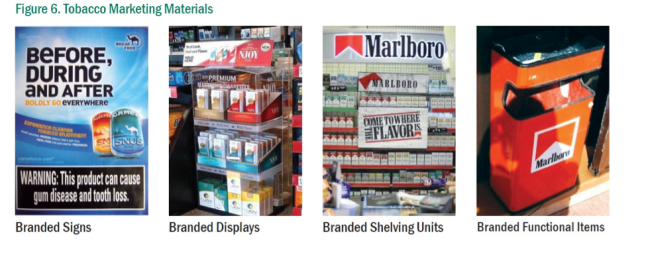
The tobacco industry spends most of its marketing budget at the POS.5 The tobacco industry uses the strategic placement of products, price promotions and price discounts, signage and functional items containing product logos, and the products themselves to advertise and market tobacco products. Marketing and advertising in the POS is ever-present, yet policies to restrict advertising and promotions at the POS are largely underused in the U.S.


What policy activity is occurring across the nation?


The majority of states perceive POS policies as important to their state tobacco control programs. However, most states and communities are underusing POS policies. Policy activity was reported in all six policy areas surveyed, including policies that: address licensing and density, utilize non-tax approaches to raise tobacco prices, restrict product placement, restrict advertising at the POS, require health warnings, and ‘Other POS’ policies. The majority of states surveyed reported state-level activity in at least one area. California reported the greatest amount of POS policy activity, yet its policy activity was low when compared to the total number of policy options examine in this study.

Overall, the two most common of the six policy areas were the Licensing and Density area and the Non-tax Approaches area. The most common activity reported within the Licensing and Density area was to establish or increase tobacco licensing fees. Still, most states either have no licensing fee provision or require just a small fee (less than $75 annually) for licenses. The most common activity reported in the Non- tax Approaches area was implementing cigarette minimum price laws.


What are the barriers to policy implementation?


Given that POS is still an emerging area and that policy activity is low, we asked states what barriers they have experienced when trying to plan or implement POS policies. The most common barriers reported include:


• Lack of background knowledge;
• Lack of funding; and
• Competing priorities.


What resources would help advance POS policy work?


States were also asked to describe resources that have been helpful in advancing POS efforts and to identify what resources are needed to advance POS work in the future.


The most helpful resources reported include:


• Relationships with national organizations;
• Legal and policy support; and
• Learning from successful campaigns in other communities.


The most needed resources reported include:


• Funding and
• Model case studies.


tobacco

RECOMMENDATIONS


Given the national tobacco retail and policy environment, states and communities should consider POS policies as a core strategy of tobacco control. States that have already achieved levels of success with strong smoke-free air policies and higher than average excise taxes could consider expanding their efforts into the POS policy area. States at other stages of tobacco control policy success may also benefit from incorporating POS policies into their current tobacco control programs. Tobacco control advocates in the planning stages of POS policy adoption should take the following steps:


#1: Assess the retail environment
Map and visit retailers. Find out what products are being sold, survey where advertising and products are situated inside and outside stores, and monitor prices and price promotions.


#2: Examine public opinion and assess the policy and legal landscape
Survey the public and conduct interviews with key leaders and decision makers. Work with legal counsel to understand what agency has administrative authority in the state or community and to understand if and how preemption and other legal concerns will affect policy development.

 
#3: Strategize and design the campaign
Build support by understanding the target audience and use appropriate messages that reflect their interests and concerns. Include strategies that will garner support from decision makers. Seek guidance from states and communities that have implemented similar policies.


#4: Implement the policy and evaluate the process
Raise both retailer and public awareness about provisions of the policy to aid in compliance and enforcement. Highlight successes by demonstrating the positive effects the implemented policy is having in the community or state.


References

1. Campaign for Tobacco-Free Kids. Deadly Alliance: How Big Tobacco and Convenience Stores Partner to Market Tobacco Products and Fight Life-Saving Policies. 2012.

2. Paynter J, Edwards R. The impact of tobacco promotion at the point of sale: A systematic review. Nicotine Tob Res. Jan 2009;11(1):25-35.

3. Slater SJ, Chaloupka FJ, Wakefield M, Johnston LD, O’Malley PM. The impact of retail cigarette marketing practices on youth smoking uptake. Arch Pediatr Adolesc Med. May 2007;161(5):440-445.

4. Wakefield M, Germain D, Henriksen L. The effect of retail cigarette pack displays on impulse purchase. Addiction. Feb 2008;103(2):322-328.

5. Federal Trade Commission. Cigarette Report for 2011. 2013. http://1.usa.gov/1n69LX6 . Accessed June 16, 2014.

Advancing Science and Policy in the Retail Environment (ASPiRE) is funded by the National Cancer Institute’s (NCI) State and Community Tobacco Control (SCTC) Research Initiative. ASPiRE is a consortium of researchers from the Center for Public Health Systems Science (CPHSS) at Washington University in St. Louis, the Stanford Prevention Research Center, and the University of North Carolina Gillings School of Global Public Health. In 2011, ASPiRE received a five-year grant from SCTC to conduct research on how to maximize state and local policies to restrict tobacco marketing in the point of sale (POS) and in the broader retail environment.

Corporate Accountability International Goes to Mickey D and Philip Morris Shareholder Meetings

Image from Brendan McDermid/Reuters

Corporate Accountability International brought six powerful moms and health advocates to Chicago to call on the burger giant to stop spending billions on marketing to kids, co-opting athletes and targeting communities of color while paying poverty wages to their workers. As mom and community health advocate Rosa Perea said, “McDonald’s exploits the massive appeal of athletes like LeBron to target kids and make the brand seem healthier than it really is — yet communities like mine are left footing the bill.” Stories in the Chicago Tribune, the AP and CBS brought news of the event to millions of people, and put the burger giant under additional pressure to change its abusive ways. Read more


CAI has also launched a campaign to counter Philip Morris International’s Be Marlboro campaign,   the latest tactic employed by the corporation to hook kids on tobacco, the world’s No. 1 preventable cause of death. CAI teamed up with Campaign for Tobacco-Free Kids to show up at PMI shareholders’ meeting where the activists made clear PMI can’t get away with   such abuses. During the meeting, thousands of CAI   members bombarded Leo Burnett, the ad agency in charge of the ad campaign, with emails and tweets taking the company to task. Read more…

Origins of Personal Responsibility Rhetoric in News Coverage of the Tobacco Industry

By the mid 1980s, the personal responsibility frame dominated the tobacco industry’s public arguments. In a new article in the American Journal of Public Health, Pamela Mejia and colleagues analyze news coverage of the tobacco industry from 1966 to 1991. They conclude that the tobacco industry’s use of personal responsibility rhetoric in public preceded the ascension of personal responsibility rhetoric commonly associated with the Reagan Administration in the 1980s.

Public Health Advocacy Institute Files Amicus Brief Comparing Gambling and Tobacco Industries

cross-posted by Public Health Advocacy Institute

A 1912 panel from a restaurant in Germany that shows drinking, smoking gamblers.  Credit
A 1912 panel from a restaurant in Germany that shows drinking, smoking gamblers. Credit

The Public Health Advocacy Institute has filed an amicus curiae brief in an appeal pending before the Massachusetts Supreme Judicial Court.  The Plaintiff/Appellants are seeking to reverse a decision of the attorney general and get a question certified for inclusion on the 2014 ballot to repeal a law legalizing casino gambling in Massachusetts.  The case is Steven P. Abdow et al., v. Attorney General, et al., No. SJC-11641.


Legalized casino gambling causes devastating effects on the public’s health, including not only the gambler but also their families, neighbors, communities and others with whom they interact. Massachusetts voters should not be denied the opportunity to be heard directly on the question of whether to invite a predatory and toxic industry to do business in the Commonwealth.


The harm caused by the tobacco industry’s products has been the archetype of a commercial threat to public health, and in considering the introduction of gambling industry casinos into Massachusetts, much can be learned from the object lesson of considering the tobacco industry as a disease vector. The predatory gambling industry shares much in common with the tobacco industry.


Some examples of the similarities are:


  • Casinos employ electronic gambling machines that are designed to addict their customers in a way that is similar to how the tobacco industry formulates its cigarettes to be addictive by manipulating their nicotine levels and other ingredients.


  • Mirroring the tobacco industry’s strategy of creating scientific doubt where none truly exists, the casino industry has co-opted and corrupted scholarship on the effects of gambling through the use of front groups that funnel money to beholden scientists who are able to sanitize its origin.


  • Borrowing another tobacco industry technique of shaping the debate around its products, by creating a misleading lexicon and using euphemisms, the casino industry has tried to influence debate, deflect criticism and mislead the public about its role as a disease vector.


  • By employing personal and corporate responsibility rhetoric honed by the tobacco industry, the casino industry hopes to gain and maintain social acceptability and stave off litigation, regulation and citizen-driven activism.


Both the tobacco and casino industries profit from preying upon society’s most vulnerable members, acting as disease vectors which adversely affect the physical, emotional and social health of the individual users and the communities where use of the products is prevalent.


The brief declares that the voters of the Commonwealth should be allowed to act on their own behalf in expressing an opinion of this type of predatory behavior. The power of the citizen ballot initiative is the ultimate in personal responsibility, agency and self-determination. Therefore, PHAI asks the court to compel the attorney general to certify the Plaintiffs’/Appellants’ petition and allow the repeal measure to be included on the 2014 ballot.


The full brief can be downloaded here.


Court-Ordered Tobacco Ads Will Include Black Media

ABC News reports that the nation’s tobacco companies and the Justice Department are including media outlets that target more of the black community in court-ordered advertisements that say the cigarette makers lied about the dangers of smoking, according to a brief filed in U.S. District Court in Washington on Wednesday. The advertisements are part of a case the government brought in 1999 under the Racketeer Influenced and Corrupt Organizations.

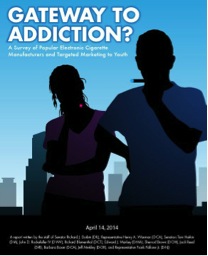
Gateway to Addiction? A Survey of Popular Electronic Cigarette Manufacturers and Targeted Marketing to Youth

Below are the Executive Summary and Key Findings from this report


Gateway to addiction

Electronic cigarettes, also known as e-cigarettes, are battery-operated products designed to deliver nicotine, flavor and other chemicals.(1) They contain cartridges filled with flavors and chemicals, including the highly addictive substance nicotine, which are vaporized into an aerosol that is inhaled by the user. Many e-cigarettes are manufactured to look like conventional cigarettes and mimic the act of smoking.(2)


According to the Centers for Disease Control and Prevention (CDC), e-cigarette use is growing rapidly.(3) However, these products are currently not subject to federal laws and regulations that apply to traditional cigarettes. For example, federal laws and regulations prohibit traditional cigarettes from being sold to persons younger than 18 years of age, distributed as free samples, advertised on television and radio, and having characterizing candy and fruit flavors that appeal to children. There is no federal ban on the use of such tactics by e-cigarette manufacturers. In the absence of federal regulation, some e-cigarette manufacturers appear to be using marketing tactics similar to those previously used by the tobacco industry to sell their products to minors. To address growing questions over e-cigarettes and the marketing of these products, on September 26, 2013, Senator Richard J. Durbin (D-IL), Representative Henry A. Waxman (DCA), Senator Tom Harkin (D-IA), Senator John D. Rockefeller IV (D-WV), along with Senators Richard Blumenthal (D-CT), Edward J. Markey (D-MA), Sherrod Brown (D-OH), Jack Reed(D-RI), Barbara Boxer (D-CA), Heidi Heitkamp (D-ND), Jeff Merkley (D-OR), and Representative Frank Pallone Jr. (D-NJ) launched an investigation into the practices of nine commonly sold e-cigarette brands. This report draws from written responses provided by the companies in response to this investigation. In instances where companies did not provide complete responses or simply did not respond to a question, supplemental information was gathered from company websites and through reviewing other publically available information.


Findings in Brief

The findings of this analysis demonstrate the need for the Food and Drug Administration (FDA) to act quickly to issue e-cigarette regulations.


Major findings:

  • All surveyed companies appear to use various marketing practices that appeal to youth.

For instance:

  • Eight e-cigarette companies promote their products through sponsored or sampling events, many of which appear to be youth-oriented. In 2012 and 2013 alone, six of the surveyed companies sponsored or provided free samples at 348 events.(4)
  • Seven e-cigarette companies air television and radio advertisements during events and programs, including those with youth viewership. Blu’s commercials “have aired thousands of times at various times of the day and night on 48 networks,” and NJOY has advertised during programs including the Super Bowl, an event that reaches a substantial audience of youth under age 18.
  • Six e-cigarette companies market e-cigarettes in flavors that could appeal to children and teens. For example, e-cigarette manufacturers are marketing flavors like Cherry Crush, Chocolate Treat, Peachy Keen, and Grape Mint.
  • E-cigarette manufacturers have significantly increased marketing spending, more than doubling expenditures between 2012 and 2013. In total, six e-cigarette companies spent $59.3 million in 2013 to market e-cigarettes.


Additional findings:

  • There is wide variation in e-cigarette industry point-of-sale practices. One e-cigarette company reported that it does not maintain any policy barring sales to minors. Other companies have policies barring such sales, but these vary in scope and the level of company oversight.
  • Four e-cigarette companies use celebrity spokespeople to market their products and depict e-cigarette smoking as glamorous. For example, celebrities have appeared in advertisements and at a prominent music festival.
  • Seven e-cigarette companies utilize social media to promote their products. While some companies impose age restrictions to prevent youth access to their Facebook, Twitter, and YouTube content, three companies – Eonsmoke, VMR, and Lead by Sales – do not utilize any age restriction options for social media accounts.
  • E-cigarette product warning labels lack uniformity and may confuse consumers. While some manufacturers’ warning labels are succinct, make clear that e-cigarettes don’t offer health benefits, and detail the health risks associated with nicotine, others do not.
  • Six e-cigarette companies support some form of regulation, such as restrictions on the sale and marketing of e-cigarettes to children and teenagers, a ban of the usage of television to market e-cigarettes, a prohibition on characterizing flavors, restricting online sales, and regulation of e-cigarettes at the point-of-sale.


References

1. fda.gov/newsevents/publichealthfocus/ucm172906.htm).

2.   Legacy Foundation, E-cigarette policy: the FDA should promptly exercise regulatory authority over ecigarettes (January 2014).

3.  Centers for Disease Control and Prevention, Notes from the Field: Electronic Cigarette Use Among Middle and High School Students – United States, 2011-2012 (Sept. 6, 2013) (online at http://www.cdc.gov/mmwr/preview/mmwrhtml/mm6235a6.htm).

4. Altria has held sampling events but declined to provide an itemized list; R.J. Reynolds provided a list of all locations where sampling events were held through October 31, 2013. The total number of events in 2012 and 2013 is based on the conservative assumption that one event was held at each of the R.J. Reynolds’ sampling locations.


33 Leading Public Health Groups Urge FDA to Regulate Tobacco More Vigorously

In response to the Surgeon General’s latest report on the health consequences of smoking, thirty-three leading public health and medical organizations are urging the U.S. Food and Drug Administration to make it a priority to regulate how cigarettes are manufactured and stop tobacco industry practices that have made cigarettes even more deadly and addictive than they were 50 years ago.

Selling a Poison by the Barrel: Liquid Nicotine for E-Cigarettes

A dangerous new form of a powerful stimulant is hitting markets nationwide, for sale by the vial, the gallon and even the barrel, reports the New York Times.  The drug is nicotine, in its potent, liquid form — extracted from tobacco and tinctured with a cocktail of flavorings, colorings and assorted chemicals to feed the fast-growing electronic cigarette industry.