In the latest skirmish in the federal government’s long-running racketeering case against the tobacco industry, reports the Wall Street Journal, the U.S. Court of Appeals for the District of Columbia Circuit last week rejected the tobacco industry’s argument that Judge Gladys Kessler’s restrictions should be set aside because Congress in 2009 passed a law that imposed other restrictions on the industry and gave the Food and Drug Administration the authority to regulate tobacco products. The appeals court said Judge Kessler acted reasonably when she decided last year to move forward with the earlier restrictions.
Tobacco Companies Manipulate Czech Policies on Excise Tax and Advertising
A new article in PLoS Medicine examines how transnational tobacco companies sought to influence tobacco policy in the Czech Republic, a nation with one of the poorest tobacco control records in Europe. The authors focus on efforts to shape excise tax policies, one of the most effective means of reducing tobacco consumption, and an important determinant of tobacco companies’ competitiveness.
PLoS Medicine on Manufacturing Epidemics
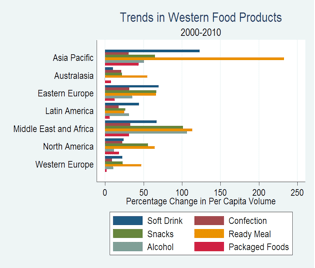
In a new report in the PLoS Medicine series on Big Food, David Stuckler, Martin McKee, Shah Ebrahim and Sanjay Basu describe the role of the alcohol, tobacco, and food and beverage industries in rising rates of consumption of unhealthy commodities, especially in low- and middle income countries. They write:
Unhealthy commodities are highly profitable because of their low production cost, long shelf-life, and high retail value. These market characteristics create perverse incentives for industries to market and sell more of these commodities. Coca-Cola’s net profit margins, for example, are about one-quarter of the retail price, making soft drink production, alongside tobacco production, among the most profitable industrial activities in the world. Indeed, transnational corporations that manufacture and market unhealthy food and beverage commodities, including Coca-Cola, PepsiCo, and Cadbury Schweppes, are among the leading vectors for the global spread of NCD risks. Increasingly, they target developing countries’ markets as a major area for expansion.
Unweighted Trends in Unhealthy Commodities, by Geographic Region,
2000-2010 and 2010-2015. Source: PLoS Medicine

Their article examines two main questions:
(1) Where is the consumption of unhealthy commodities rising most rapidly?
(2) What determines the pace and scale of these increases?
Based on analysis of market data on commodity sales in 80 countries, they offer five observations:
Observation 1. Growth of snacks, soft drinks and processed foods is fastest in LMICs (i.e. GDP≤USD12,500). Little or no growth is expected in HICs in the next 5 years.
Observation 2. The pace of increase in consumption of unhealthy commodities in several LMIC is projected to occur at a faster rate than historically in HICs.
Observation 3. Multinational companies have already entered food systems of middle-income countries to a similar degree observed in HICs.
Observation 4. Tobacco and alcohol are joint risks with unhealthy food commodities.
Observation 5. Substantial increases in consumption of unhealthy commodities are not an inevitable consequence of economic growth.
Observation 6. Foreign direct investment increases risks of rising unhealthy commodities among LMICs.
Trends in Tobacco and Alcohol Commodities, 1997-2010 and projected to 2016
Source: PLoS Medicine

The authors conclude that:
NCDs are the current and future leading causes of global ill health; unhealthy commodities, their producers, and the markets that power them, are their leading risk factors. Until health practitioners, researchers, and politicians are able to understand and identify feasible ways to address the social, economic, and political conditions that lead to the spread of unhealthy food, beverage, and tobacco commodities, progress in areas of prevention and control of NCDs will remain elusive.
For related posts on the role of the alcohol, tobacco and food industries in the production of NCDs , see here and here and here.
Rio +20: Aligning Campaigns against Global Warming and Rise of Non-Communicable Diseases
This week, 50,000 delegates will gather in Rio de Janiero for the United Nations Conference on Sustainable Development. While the slogan is ambitious — “the future we want,” in comparison to the first Earth Summit held in Rio in 1992, the goals of this twentieth anniversary celebration are modest. As Andrea Correa de Lago, Brazil’s head of environment at the Ministry of Foreign Affairs and chief negotiator on climate change, said last February, “It is not an idealistic conference, we are not going to say we are saving the planet through goals and measures that we know are not going to be taken seriously.”
Rather, the opportunity for this meeting is to create a framework for longer term discussion about how best to promote a sustainability agenda. One difference for this year’s conference compared to 1992 will be the active participation of city governments, NGOs, and the private sector. As a result, said Rodrigo Rosa, Rio+20 coordinator at Rio de Janeiro’s Mayor’s Office, “Rio+20’s strength will not be inside the offices, but in the movement. This year we’ll have a great amount of parallel events that didn’t happen in 1992. Politicians are reactive, they take decisions after there’s will in civil society. I think Rio+20 will contribute to that.”
For public health activists seeking to build a movement for sustainability, Rio+20 provides an opportunity to consider the causes and solutions to two of the gravest threats to global sustainability: human-induced climate change and the rise of non-communicable diseases (NCDs) such as cardiovascular disease, diabetes, cancer and respiratory conditions. A recent report in Lancet summarizes the connections between climate change and NCDs, arguing that many of the world’s “development goals have not been achieved partly because social (including health), economic, and environmental priorities have not been addressed in an integrated manner.”
As Manish Bapna, Acting President and Executive Vice President & Managing Director of the World Resources Institute recently observed, developing effective strategies to achieve more sustainable economic growth requires addressing two related trends:
- The rise of the multinational corporations. Having grown dramatically in size, reach, and number in recent decades, global corporations wield increasing influence over the environment and society. Global supply chains only magnify their role. Today, what happens in a factory in China, South Africa, or Thailand can reverberate around the planet.
- The expansion of the global middle class. Exploding growth in the developing world has created a vast new middle class, which could near five billion by 2030, of whom 66 percent will live in Asia. That is a lot of new consumers. How will they live, eat, shop, and get to work? Will they emulate the worst habits of the developed world, or will they embrace a role as better stewards of the planet?
In fact, the rise of both NCDs and global warming in the last few decades can be explained in significant part by the efforts of multinational corporations in the automobile, energy, food and beverage, tobacco, alcohol, pharmaceutical and other industries to target these emerging middle classes in China, India, Brazil, Indonesia and elsewhere for their brand of hyper consumption. As markets become saturated in developed nations, these new markets are the corporations’ hope for profitability in this century. But the lifestyle that corporations promote to achieve their business goals is itself a fundamental cause of unsustainable energy use and chronic diseases. Its remedy requires changing not individual behavior but corporate practices. As the Third World Network, an NGO in Malaysia, put it in their Rio+20 briefing paper, “If governments want to enable sustainable development, then they must regulate transnational corporations who are drivers of unsustainable development.”
In past global meetings, much of the focus has been on what governments can and should do, an important and appropriate topic of discussion. But it is equally important to ask what corporations cannot do if sustainable growth is to be achieved. A Lancet editorial hopes that in the future, Rio+20 “is looked upon as launching a new era for human wellbeing, one that is rooted in principles of equity, social justice, and sustainability.” Achieving that goal will require a willingness to reconsider the role of multinational corporations in today’s world. Rio+ 20 will be judged on its progress in this critical task.
England’s Government Councils Investments in Tobacco Companies Pose Potential Conflict
A new report from the BBC finds the government councils that will have responsibility for leading local efforts to reduce the burden of death and disease from smoking beginning in 2013 have substantial investments in the tobacco industry, presenting potential conflict of interest. BBC reports that Councils across the east of England that are to take a lead role in NHS anti-smoking campaigns have invested more than £167m (US$ 259 million) in tobacco firms.
Big Tobacco Money Wins California Referendum
While most media attention in last week’s primary focused on the Wisconsin recall election, another important outcome came in California. Voters rejected a $1 a pack increase on cigarette taxes by a margin of 50.8% to 49.2%, a difference of about 60,000 votes out of the almost 4 million votes cast. A statewide poll in March 2012 suggested the measure would pass with two-thirds approval but a $47 million ad campaign by the tobacco industry helped to turn the tide. According to an Associated Press report, the ads scarcely mentioned the word “tobacco” — showing that cigarette makers are shifting away from arguing about their product and looking for other ways to attack tax initiatives.
WHO Calls on World Leaders to Say No to Tobacco Industry
On World No Tobacco Day (31 May), the World Health Organization called on national leaders to be extra vigilant against the increasingly aggressive attacks by the industry which undermine policies that protect people from the harms of tobacco. Tobacco kills almost 6 million people every year and is one of the leading preventable causes of illness and death around the world. “In recent years, multinational tobacco companies have been shamelessly fueling a series of legal actions against governments that have been at the forefront of the war against tobacco. The industry is now stepping out of the shadows and into court rooms,” says WHO Director-General Dr Margaret Chan. “We must now stand together with these governments that have had the courage to do the right thing to protect their citizens.”
Cigarette Companies and Their Underhanded Tactics
“As a former cigarette company employee, I have no sympathy for their attempts to challenge the Federal Government’s plain packaging” writes David Donovan, a former tobacco company employee, in an op ed in Independent Australia in response to the Australian tobacco industry’s efforts to reverse new packaging rules. “Cigarette companies have bribed and subverted the political process for too long. I know this, because for three years in the mid-1990s, I worked for a cigarette company in Brisbane, where I saw this company blatantly try to ensure employees, including myself, were hooked on nicotine, as well as their bribery of politicians and public officials.”
Are Cola Companies Behaving Like Cigarette Companies In The U.S.?
As soda consumption declines in the United States, asks Forbes, are soda companies following the tobacco industry by promoting its products in developing nations? In these countries, consumption per capita is low, regulations are lax and there isn’t enough consumer awareness regarding health repercussions due to excessive soda consumption. So, there is plenty of scope to expand in terms of cola consumption.
WTO Dents U.S. Ban on Clove Cigarettes
The World Trade Organization on Wednesday dealt a blow to a U.S. law barring the sale of clove-flavored cigarettes to discourage children from smoking, saying it was unfair to Indonesia because menthol cigarettes can still be sold in the United States. Reuters reported that Nkenge Harmon, a spokeswoman for the U.S. Trade Representative’s Office, observed that, “The United States is very disappointed with the outcome of this dispute. The ban on cigarettes with flavors is part of landmark U.S. legislation to combat the public health crisis caused by tobacco products.” Indonesia, the world’s top producer of clove cigarettes and the source of the vast majority of those smoked in the United States, brought the World Trade Organization case in April 2010.
 Corporations and Health Watch