Big Tobacco: Role Model or Pariah for the Pharmaceutical Industry?

By Nicholas Freudenberg for the Symposium of the Geneesmiddelenbulletin on June 30th 2016 in Leiden ’Science and Economy’. It was also translated and published in the Bulletin.

In the last two decades, the public health community has generally agreed that the tobacco industry has no role in setting health policy or sponsoring research on tobacco. The Framework Convention on Tobacco Control bans industry participation in policy deliberations on Tobacco, most major global public health organizations and national health departments have sharply limited their interactions with representatives of the tobacco industry, and many universities and some journals no longer accept or publish research supported by the tobacco industry.

However, no such agreement has been reached on the appropriate role for corporations and trade associations in other sectors such as pharmaceuticals, food and beverages, and alcohol. Some health and business analysts emphasize that the different roles that the products of the tobacco, medicines, food and alcohol industries play in patterns of health and disease make any judgments inappropriate and misguided, especially in the case of the drug industry. “Such comparisons (between the tobacco and pharmaceutical industries) are not just absurd, they are irresponsible as they contribute to patients not taking prescribed medicines that can clearly benefit them”, wrote one former drug industry executive.  Read more

Corporations and Health Under Trump

Credit.

The election of Donald Trump is expected to bring about significant changes in how the federal government regulates corporations to protect public health and the environment.  It will take some time to analyze what changes are likely and how public health advocates can respond most effectively.  To begin that analysis, Corporations and Health Watch highlights some of the first such assessments.

What President Donald Trump Will Mean for U.S. Food Policy

President-elect Donald Trump made a few issues central to his platform: immigration, taxes, and healthcare among them. Food policy has gone largely ignored, though Trump’s statements on other issues will certainly inform the way food policy will look for the next four years — and possibly beyond that, writes Virginia Chambee for Eater.  Trump has been especially vocal about immigration. His plan to build a wall on the southern border of the U.S. will likely hit the agricultural and restaurant industry hard. He has called climate change a “hoax,” which means it likely won’t be high on his list of priorities; this could be devastating for farmers. When it comes to minimum wage, Trump believes it’s an issue best left up to states (so don’t expect a higher federal minimum any time soon). And on employee benefits, Trump wants to repeal President Obama’s Affordable Care Act, but is seemingly in favor of paid maternity leave (though it’s unclear if that plan will cover single mothers). Chamlee takes a closer look at where Trump stands on policies related to food safety, agriculture, and workers’ rights.

Trump Expected to Seek Deep Cuts in Business Regulations

Hours after Donald J. Trump won the race for the White House, scores of regulations that have reshaped corporate America in the last eight years suddenly seemed vulnerable, writes The New York Times. While many questions remain about how Mr. Trump will govern, a consensus emerged Wednesday in many circles in Washington and on Wall Street about at least one aspect of his impending presidency: Mr. Trump is likely to seek vast cuts in regulations across the banking, health care and energy industries.  “This is going to be a president who will be the biggest regulatory reformer since Ronald Reagan,” Stephen Moore, one of Mr. Trump’s economic advisers said in an interview on Wednesday. “There are just so many regulations that could be eased.”

Get Used To High Drug Prices As Big Pharma Emerges From Election Stronger Than Ever

On the campaign trail, Hillary Clinton, Bernie Sanders, and Donald Trump agreed on at least one thing: the need to control America’s spiraling costs of prescription drugs, writes Buzz Feed News.  But after Tuesday’s election, the likelihood of drug pricing reform seems small. In California, Big Pharma spent more than $100 million to help defeat a ballot measure that would have pegged the state’s drug purchases to the discount rates currently offered to the Veterans Administration (VA).

That’s not to say that Big Pharma is thrilled with president-elect Trump, who has suggested that the huge Medicare program, which provides health insurance for senior citizens, should be able to negotiate prices with drug companies — something that’s currently prohibited by law. But with both houses of Congress remaining firmly under GOP control, legislation to shake up drug pricing seems unlikely. And specific plans proposed by Clinton, including fines for companies that jacked up prices without clear justification, are now off the table.
Investigation: The DEA slowed enforcement while the opioid epidemic grew out of control

Credit

A decade ago, according to a new series of articles in The Washington Post, the Drug Enforcement Administration launched an aggressive campaign to curb a rising opioid epidemic that was claiming thousands of American lives each year. The DEA began to target wholesale companies that distributed hundreds of millions of highly addictive pills to the corrupt pharmacies and pill mills that illegally sold the drugs for street use.

Leading the campaign was the agency’s Office of Diversion Control, whose investigators around the country began filing civil cases against the distributors, issuing orders to immediately suspend the flow of drugs and generating large fines.

But the industry fought back. Former DEA and Justice Department officials hired by drug companies began pressing for a softer approach. In early 2012, the deputy attorney general summoned the DEA’s diversion chief to an unusual meeting over a case against two major drug companies.  Read more.

Advocates debate Prop. 61, which seeks to regulate CA drug prices

Advocates debated Proposition 61 — a California state ballot measure that aims to standardize drug prices — at a panel last week at University of California Berkeley, reports The Daily Californian.  If passed, Proposition 61 would tie prescription drug prices paid by certain state agencies to the discounted price that the U.S. Department of Veterans Affairs pays. While Dan Johnston, research director for the California Nurses Association, argued that Proposition 61 addresses a pressing need for bold action to reduce drug prices, Kathy Fairbanks, a spokesperson for the “No On Prop 61” campaign said passing the measure could have unintended consequences for veterans and could result in higher drug prices for California or reduce access to medicine. The language of the initiative would restrict state agencies from entering into purchasing contracts with drug manufacturers where the price is higher than the price the VA pays. The VA gets a 24 percent discount on drugs, per a federal mandate.

Furor Over Drug Prices Puts Patient Advocacy Groups in Bind

Public anger over the cost of drugs has burned hot for a year, writes The New York Times, coursing through social media, popping up on the presidential campaign, and erupting in a series of congressional hearings, including one last week over the rising price of the allergy treatment EpiPen. But one set of voices has been oddly muted — the nation’s biggest patient advocacy groups. The groups wield multimillion-dollar budgets and influence on Capitol Hill, but they have been largely absent in the public debate over pricing.  But critics say that by avoiding the debate over cost, they are failing in their patient-advocacy duties. “It is a conflict of interest, because the interests of the pharmaceutical industry, from whom they are getting support, may be different from the interests of the patients,” said Dr. Michael Carome, the director of the Health Research Group at Public Citizen, a consumer advocacy group.

Pharma lobbying held deep influence over opioid policies

photo credit

A two-part series by the Associated Press and the Center for Public Integrity investigated the influence of pharmaceutical companies on state and federal policies regarding opioids, the powerful painkillers that have claimed the lives of 165,000 people in the U.S. since 2000. Reporters tracked proposed laws on the subject and analyzed data on how the companies and their allies deployed lobbyists and contributed to political campaigns.

Continue reading Pharma lobbying held deep influence over opioid policies

Disgusted With Sky-High Drug Prices, California Voters Take on Big Pharma

Enormous public frustration with the skyrocketing prices of essential medicines in the US has not yet led to any meaningful reform, writes Fran Quigley in Truthout. But a historic initiative on the November ballot in California, championed by health care and consumer advocates and fiercely opposed by multinational drug corporations, may finally rein in Big Pharma. Continue reading Disgusted With Sky-High Drug Prices, California Voters Take on Big Pharma

New Book on Corporations and Global Health Governance

Case Studies on Corporations & Global Health Governance, edited by Nora Kenworthy, Ross MacKenzie and Kelley Lee, presents interdisciplinary case studies on how corporations influence global health governance and how they could be held more accountable.  The empirical studies examine several industries across high, low and middle income countries and explore the impact of corporations and their allies on the governance processes that shape population health.

Pharmaceutical Industry–Sponsored Meals and Physician Prescribing Patterns for Medicare Beneficiaries

A study of the impact of free meals offered by pharmaceutical companies to physicians attending industry-sponsored continuing education found that receipt of industry-sponsored meals was associated with an increased rate of prescribing the brand-name medication that was being promoted. The findings represent an association, not a cause-and-effect relationship. The findings were published in JAMA Internal Medicine.

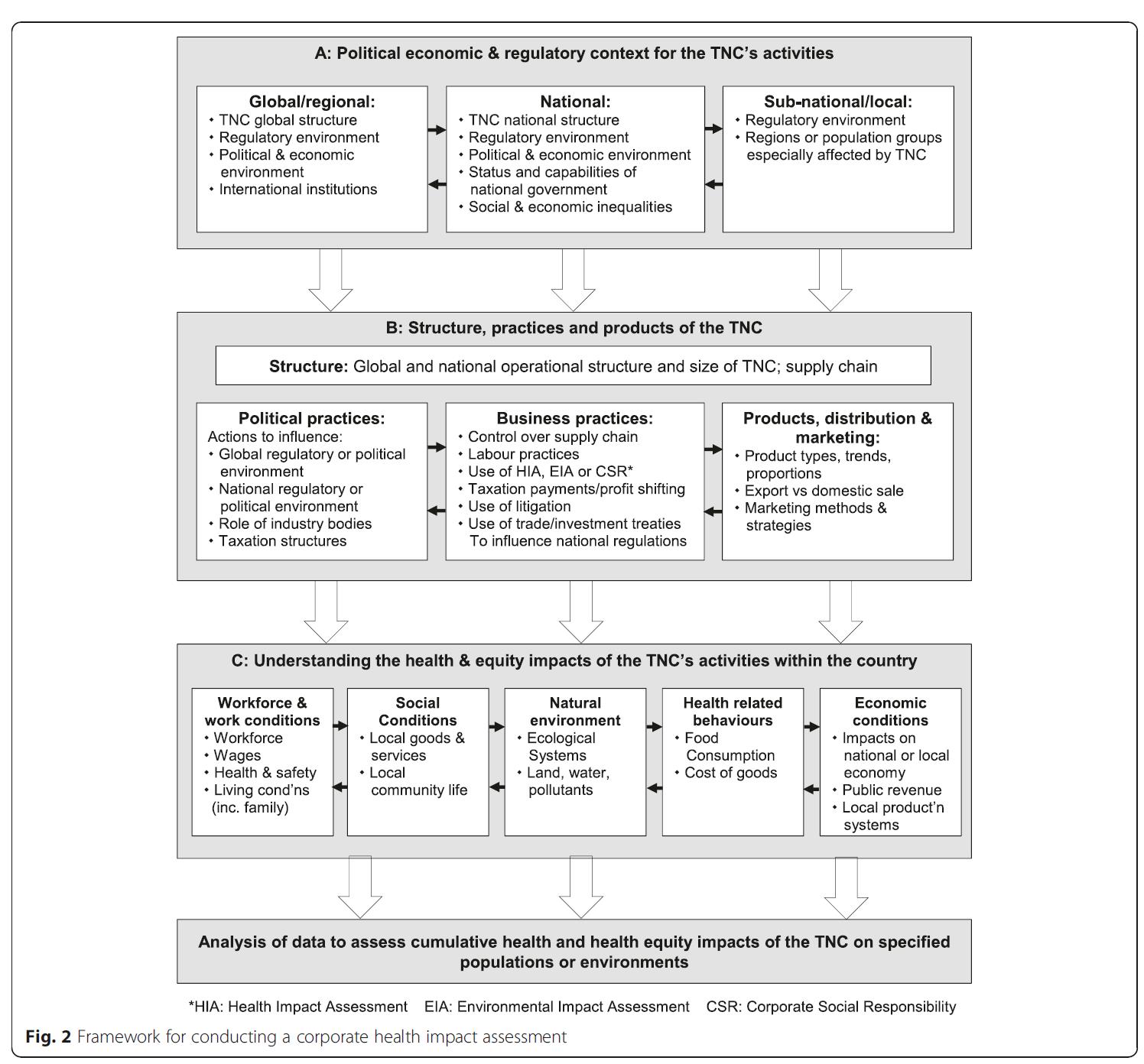
Assessing the health impact of transnational corporations: its importance and a framework

A framework for assessing health impact of transnational corporations. Source.
A framework for assessing health impact of transnational corporations.

The adverse health and equity impacts of transnational corporations’ (TNCs) practices have become central public health concerns as TNCs increasingly dominate global trade and investment and shape national economies. Despite this, methodologies have been lacking with which to study the health equity impacts of individual corporations and thus to inform actions to mitigate or reverse negative and increase positive impacts. A new report in Globalization and Health  describes a framework designed to conduct corporate health impact assessment (CHIA), that was developed at a meeting held at the Rockefeller Foundation Bellagio Center in May 2015.

Continue reading Assessing the health impact of transnational corporations: its importance and a framework