Governing the (un)healthy child-consumer in the age of the childhood obesity crisis

In recent years, multinational food and drink corporations and their marketing practices have been blamed for the global childhood obesity ‘crisis’. Unsurprisingly, these corporations have been quick to refute these claims and now position themselves as ‘part of the solution’ to childhood obesity. Corporations’ anxieties about being blamed for childhood obesity are fused with technologies of ‘healthy consumption’: the consumption of corporate products, corporate philanthropy, the corporate brand and corporate ‘education’.

Citation: Powell D. Governing the (un) healthy child-consumer in the age of the childhood obesity crisis. Sport, Education and Society. 2016; 4:1-4.

Popular Music Celebrity Endorsements in Food and Nonalcoholic Beverage Marketing

Image credits: will.i.am, Maroon5, and Baauer

Food and beverage marketing has been associated with childhood obesity. In a descriptive study published in Pediatrics, the authors quantified the number and type of food or beverage brands promoted by music celebrities, assessed the nutritional quality of the products, and examined Teen Choice Award data to assess the celebrities’ popularity among adolescents.

Continue reading Popular Music Celebrity Endorsements in Food and Nonalcoholic Beverage Marketing

FDA Looks to Cut Salt Content in Food

A fight at the dining table is escalating between regulators and the food industry, this time over government proposals to cut Americans’ average salt intake by almost one-third, reports The Wall Street Journal. The Food and Drug Administration issued long-awaited proposed guidelines targeting the packaged food and restaurant meals that contain the bulk of American’s daily sodium intake. The voluntary proposals are the Obama administration’s latest effort to push the food industry toward reducing the amount of ingredients such as sugar and some fats in an effort to improve consumer health and reduce medical costs.

Analysis of the corporate political activity of major food industry actors in Fiji

Non-communicable diseases (NCDs) are the leading cause of mortality in Fiji, a middle-income country in the Pacific. Some food products processed sold and marketed by the food industry are major contributors to the NCD epidemic, and the food industry is widely identified as having strong economic and political power. However, little research has been undertaken on the attempts by the food industry to influence public health-related policies and programs in its favour. The “corporate political activity” (CPA) of the food industry includes six strategies (information and messaging; financial incentives; constituency building; legal strategies; policy substitution; opposition fragmentation and destabilisation). For this study, we aimed to gain a detailed understanding of the CPA strategies and practices of major food industry actors in Fiji, interpreted through a public health lens.  Full reference: Mialon M, Swinburn B, Wate J, Tukana I, Sacks G. Analysis of the corporate political activity of major food industry actors in Fiji. Globalization and Health 2016; 12:18 DOI: 10.1186/s12992-016-0158-8

What Bernie Gets Wrong About the Soda Tax

“It stunned many progressives to hear Sanders attack Philadelphia’s plan to tax sugary drinks; he called soda taxes regressive and came out swinging”, writes Anne Lappé in Mother Jones. “Like health advocates across the country, I think Sanders got it wrong: These taxes in fact reflect the progressive values he holds dear. It’s the very communities Sanders says he’s trying to protect that have been at the beating heart of campaigns for soda taxes. As a resident of Berkeley, California, the first city in the United States that has passed a tax of this kind, and as someone who has been working to sound the alarm on the epidemic of diet-related illnesses for years, I have had a ringside seat at the battle against Big Soda. And I think that if Sanders had firsthand knowledge of the fight, he too might be moved to see these taxes differently.”

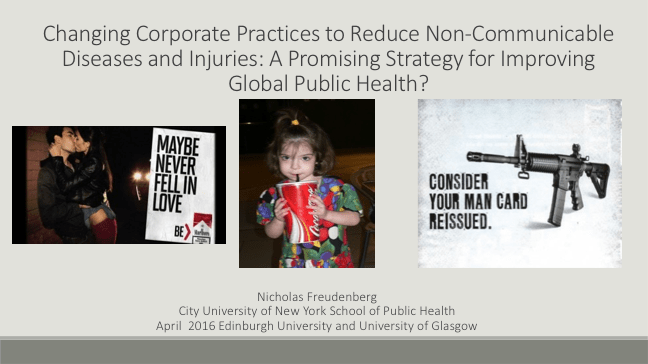
Changing Corporate Practices to Reduce Non-Communicable Diseases and Injuries: A Promising Strategy for Improving Global Public Health?

In presentations on “Changing Corporate Practices to Reduce Non-Communicable Diseases and Injuries: A Promising Strategy for Improving Global Public Health?” at Edinburgh University and University of Glasgow, Nicholas Freudenberg, Distinguished Professor of Public Health at City University of New York School of Public Health, described the role of corporate business and political practices on the growing global burden of non-communicable diseases and injuries. He also analyzed what roles public health professionals can play in countering the adverse health effects of these practices. View the presentation.

Ten of the world’s biggest food and beverage companies battle to improve their social sustainability through the Behind the Brands campaign

Nine of the “Big 10” global food and beverage companies have improved their ratings by at least 10 percent in three years since Oxfam began keeping score through its “Behind the Brands” scorecard. Oxfam highlighted the major strides most of them have made to improve their policies on land rights, agricultural greenhouse gas emissions and gender equality in company supply chains. Kellogg (up 30 percent) and Unilever (up 26 percent) made the most progress across all themes since the campaign began.

Reducing the Role of the Food, Tobacco, and Alcohol Industries in Noncommunicable Disease Risk in South Africa

Noncommunicable diseases (NCDs) impose a growing burden on the health, economy, and development of South Africa. According to the World Health Organization, four risk factors, tobacco use, alcohol consumption, unhealthy diets, and physical inactivity, account for a significant proportion of major NCDs. We analyze the role of tobacco, alcohol, and food corporations in promoting NCD risk and unhealthy lifestyles in South Africa and in exacerbating inequities in NCD distribution among populations. Through their business practices such as product design, marketing, retail distribution, and pricing and their business practices such as lobbying, public relations, philanthropy, and sponsored research, national and transnational corporations in South Africa shape the social and physical environments that structure opportunities for NCD risk behavior.

Continue reading Reducing the Role of the Food, Tobacco, and Alcohol Industries in Noncommunicable Disease Risk in South Africa

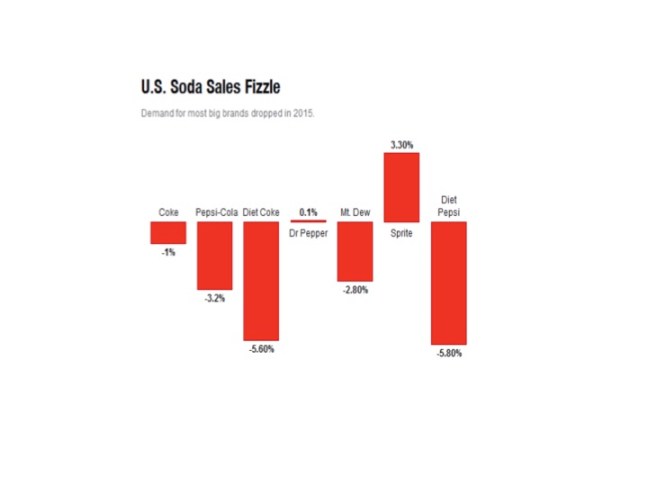
Soda Consumption Falls to 30-Year Low in U.S.

Slumping demand for diet sodas sold by PepsiCo and Coca Cola propelled a decline for the broader industry, as overall sales of carbonated soft drinks dropped for the 11th consecutive year in the U.S., reports Fortune. Total volume declined 1.2% in 2015, an acceleration from 2014’s 0.9% drop, as the biggest three players in the category all reported falling demand, according to a new report from industry tracker Beverage Digest. The group also reported that annual per capita consumption of carbonated soft drinks dropped to about 650 eight-ounce servings in 2015 – the lowest since 1985.

Continue reading Soda Consumption Falls to 30-Year Low in U.S.

The great FLOTUS food fight

In an in-depth assessment of Michelle Obama’s food policy initiatives, Politico make the case that “Obama and her bulldog personal chef engineered and enacted the most aggressive food policy agenda in living memory—a modern example of how a White House spouse can use her unelected platform to wage a genuine Washington policy fight.”