Harnessing adolescent values to motivate healthier eating

A study published in the Proceedings of the National Academy of Sciences asks what can be done to reduce unhealthy eating among adolescents. Researchers hypothesized that aligning healthy eating with important and widely shared adolescent values would produce the needed motivation. A double-blind, randomized, placebo-controlled experiment with eighth graders evaluated the impact of a treatment that framed healthy eating as consistent with the adolescent values of autonomy from adult control and the pursuit of social justice. Healthy eating was suggested as a way to take a stand against manipulative and unfair practices of the food industry, such as engineering junk food to make it addictive and marketing it to young children.

Continue reading Harnessing adolescent values to motivate healthier eating

Countermarketing Unhealthy Food: Lessons from Tobacco

Thirty years of research in tobacco control has shown that countermarketing has been effective in reducing tobacco use, especially among teenagers and young adults. This policy brief by investigators at the City University of New York Urban Food Policy Institute  describes some of the key elements of effective tobacco countermarketing campaigns, and examines the relevance of these evidence-based countermarketing practices to unhealthy food and beverages, defined as processed products high in unhealthy fats, sugar, salt and empty calories

Sugar Industry and Coronary Heart Disease Research: A Historical Analysis of Internal Industry Documents

A study in JAMA Internal Medicine  reports that the sugar industry sponsored a research program in the 1960s and 1970s that successfully cast doubt about the hazards of sucrose while promoting fat as the dietary culprit in CHD. Policymaking committees should consider giving less weight to food industry–funded studies and include mechanistic and animal studies as well as studies appraising the effect of added sugars on multiple CHD biomarkers and disease development. Citation: Kearns CE,  Schmidt LA,Glantz SA. Sugar Industry and Coronary Heart Disease Research: A Historical Analysis of Internal Industry Documents JAMA Intern Med.  2016; Published online September 12, 2016.

New Book on Corporations and Global Health Governance

Case Studies on Corporations & Global Health Governance, edited by Nora Kenworthy, Ross MacKenzie and Kelley Lee, presents interdisciplinary case studies on how corporations influence global health governance and how they could be held more accountable.  The empirical studies examine several industries across high, low and middle income countries and explore the impact of corporations and their allies on the governance processes that shape population health.

Welcome to Brazil, Where a Food Revolution Is Changing the Way People Eat

Over the last 30 years, big transnational food companies have aggressively expanded into Latin America. Taking advantage of economic reforms that opened markets, they’ve courted a consumer class that has grown in size due to generally increasing prosperity and antipoverty efforts. In recent years, Brazil has inscribed the right to food in its Constitution and reformed its federal school-lunch program to broaden its reach while bolstering local farms. And in 2014, the Ministry of Health released new dietary guidelines that emphasized unprocessed food. Read more from Bridget Huber’s report on food developments in Brazil in The Nation.

When Will Food Issues Be on Politicians’ Plates?

Even though the cultural conversation around food and agriculture seems to grow louder every day, the American food system was on the sidelines at the Republican Convention in Cleveland last week, and at the Democratic National Convention in Philadelphia this week, writes Kim Severson in The New York Times. Even among those most likely to push for it, food isn’t getting much attention as a political issue. “What people think is cool about food and what people think is cool about politics are different,” said Matt Birong, a Democratic delegate from Vermont who continues to support Senator Bernie Sanders.

Trends in Television Food Advertising to Young People: 2015

In a new brief on television advertising of food to children, the Rudd Center for Food Policy and Obesity documents trends in food-related TV advertising viewed by children and adolescents from 2002 to 2015, specifically focusing on changes in 2015 compared to 2014. The report also examines changes in categories of foods and beverages advertised since 2007, the year the Children’s Food and Beverage Advertising Initiative (CFBAI) food industry self-regulatory program was implemented. Food, beverage, and restaurant TV advertising to children decreased by 8%, and to adolescents by 14%, from 2014 to 2015. Adults also saw 7% fewer ads in 2015 versus 2014. Compared to 2007, children saw 3% fewer ads and adolescents saw an equal number of ads.

Selling Off the Farm: Corporate Meat’s Takeover Through TTIP

Citizens in both the European Union (EU) and the United States (U.S.) are demanding a healthier, more just and more sustainable food system. As parties negotiate the Transatlantic Trade and Investment Partnership (TTIP), proposed trade rules threaten to undermine the good food and farm movements on both sides of the Atlantic.

Continue reading Selling Off the Farm: Corporate Meat’s Takeover Through TTIP

Food and Water Watch Calls GMO Labeling “Compromise” a Cop-Out

Last week,  over major public opposition, the Senate passed a bill that would nullify Vermont’s GMO labeling law—and any future attempts in other states for mandatory, on-package GMO labeling legislation. For the voters in Vermont, the activists across the country who fought for our right to know what’s in our food, and the vast majority of Americans who support GMO labeling, this news comes as a disappointment. This is a serious setback for our movement – but we’re not giving up yet. Read more

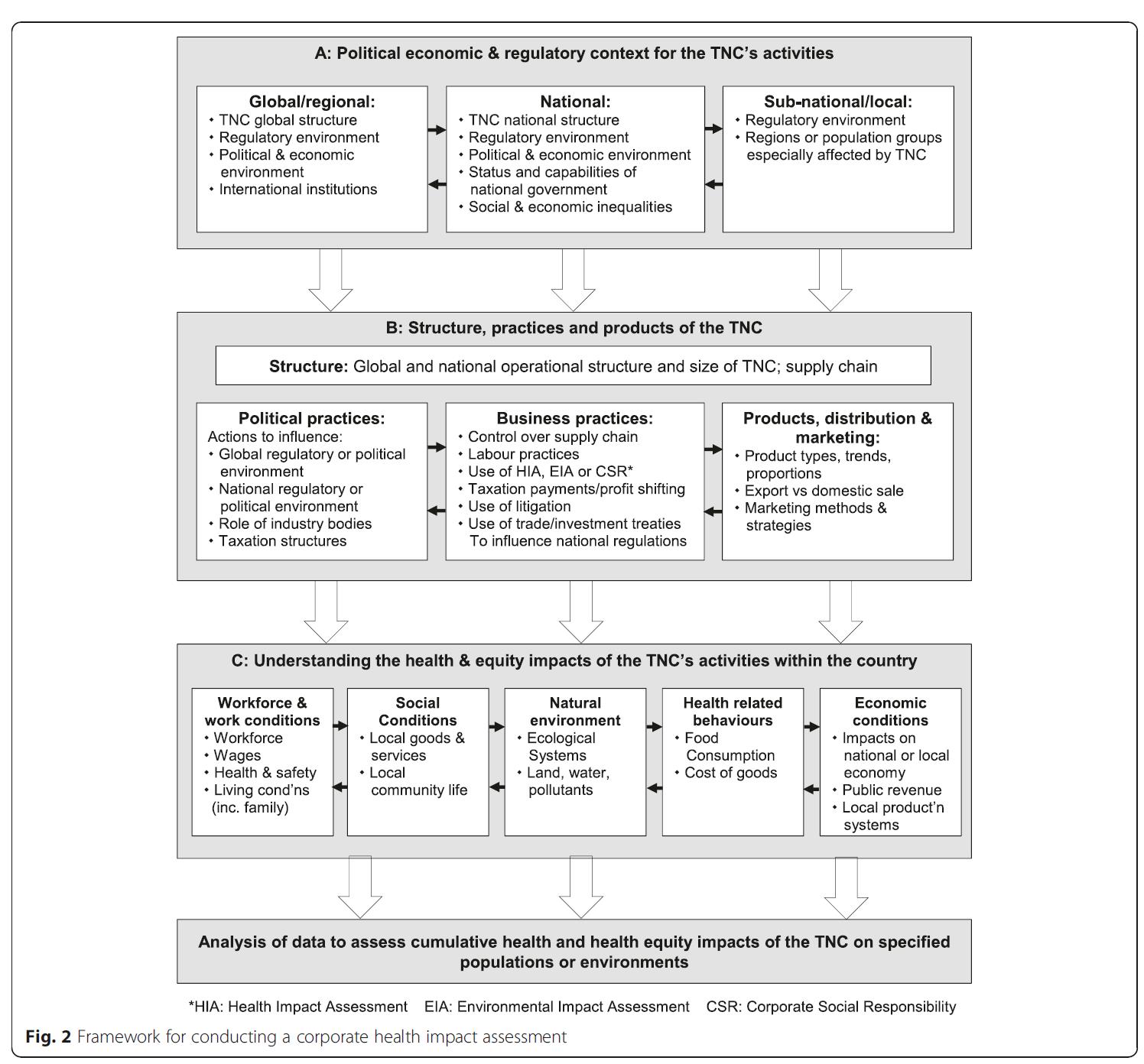
Assessing the health impact of transnational corporations: its importance and a framework

A framework for assessing health impact of transnational corporations. Source.
A framework for assessing health impact of transnational corporations.

The adverse health and equity impacts of transnational corporations’ (TNCs) practices have become central public health concerns as TNCs increasingly dominate global trade and investment and shape national economies. Despite this, methodologies have been lacking with which to study the health equity impacts of individual corporations and thus to inform actions to mitigate or reverse negative and increase positive impacts. A new report in Globalization and Health  describes a framework designed to conduct corporate health impact assessment (CHIA), that was developed at a meeting held at the Rockefeller Foundation Bellagio Center in May 2015.

Continue reading Assessing the health impact of transnational corporations: its importance and a framework