Obesity Prevalence and Costs Rise; House of Representatives and Supreme Court Hamstring Fight Against Obesity

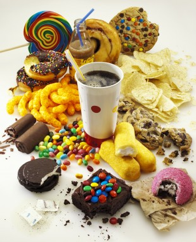
A new report to be published in the American Journal of Preventive Medicine estimates a 33 percent increase in obesity prevalence and a 130 percent increase in severe obesity prevalence over the next two decades. By 2030, according to this forecast, 42 percent of Americans will be obese and 11 percent severely obese. The authors conclude that “if these forecasts prove accurate this will further hinder efforts for healthcare cost containment.” The authors also conclude that if obesity rates stayed at the 2010 levels, the combined savings in medical expenditures by 2030 would be $549.5 billion.

Another new report published in the Journal of Health Care Economics estimated that the total cost of health care associated with U.S. obesity is now $190.2 billion a year, or 20.6 percent of total U.S. health spending – twice as much as previously reported.

Last month, the US House of Representatives voted to eliminate the Prevention and Public Health Fund in order to pay for legislation dealing with student loans. Although the measure is not expected to pass the Senate and President Obama has vowed to veto it, by this vote the House proposed to eliminate one of the few streams of funding to support preventive measures to reduce obesity and other health problems that contribute to diabetes, heart disease and cancer.

Last week Public Citizen and the National Association of Consumer Advocates released a report called Justice Denied One Year Later. The report notes that in the one year since the U.S. Supreme Court’s decision in AT&T Mobility v. Concepcion, consumers have regularly been blocked from pursuing class-action cases. In its Concepcion decision, the court vastly expanded the reach of arbitration by ruling that corporations could block the consumers they force into arbitration from pursuing cases as a class.

According to the report:

Since Concepcion, judges have cited the case in decisions that stopped at least 76 potential class-action lawsuits from going forward. Several judges have expressed frustration that the decision has forced them to stop consumer actions that are best suited to proceed as class actions. Class-action lawsuits historically have provided a means to combat illegal payday lending practices, contest poor business practices and confront discriminatory auto lending. But Concepcion has left many consumers without a means to pursue redress.

In the case of tobacco, public health experts agree that class action lawsuits played a vital role in strengthening public health protection against a tobacco industry determined to make profits even at the expense of their customers’ health.

Whatever the intentions, by seeking to de-fund one of the few federal funding streams for prevention of obesity and other diet-related diseases and by denying consumers a powerful tool to change food industry practices that have been shown to contribute to obesity, the House of Representatives and the Supreme Court have voted to endorse the status quo of rising obesity rates.


Image Credits:

1. allgoodprovisions.com

Obesity Prevalence and Costs Rise: House of Representatives and Supreme Court Hamstring Fight Against Obesity

A new report to be published in the American Journal of Preventive Medicine estimates a 33 percent increase in obesity prevalence and a 130 percent increase in severe obesity prevalence over the next two decades. By 2030, according to this forecast, 42 percent of Americans will be obese and 11 percent severely obese. The authors conclude that “if these forecasts prove accurate this will further hinder efforts for healthcare cost containment.” The authors also conclude that if obesity rates stayed at the 2010 levels, the combined savings in medical expenditures by 2030 would be $549.5 billion.

Another new report published in the Journal of Health Care Economics estimated that the total cost of health care associated with U.S. obesity is now $190.2 billion a year, or 20.6 percent of total U.S. health spending – twice as much as previously reported.

Last month, the US House of Representatives voted to eliminate the Prevention and Public Health Fund in order to pay for legislation dealing with student loans. Although the measure is not expected to pass the Senate and President Obama has vowed to veto it, by this vote the House proposed to eliminate one of the few streams of funding to support preventive measures to reduce obesity and other health problems that contribute to diabetes, heart disease and cancer.

Last week Public Citizen and the National Association of Consumer Advocates released a report called Justice Denied One Year Later. The report notes that in the one year since the U.S. Supreme Court’s decision in AT&T Mobility v. Concepcion, consumers have regularly been blocked from pursuing class-action cases. In its Concepcion decision, the court vastly expanded the reach of arbitration by ruling that corporations could block the consumers they force into arbitration from pursuing cases as a class.

According to the report:

Since Concepcion, judges have cited the case in decisions that stopped at least 76 potential class-action lawsuits from going forward. Several judges have expressed frustration that the decision has forced them to stop consumer actions that are best suited to proceed as class actions. Class-action lawsuits historically have provided a means to combat illegal payday lending practices, contest poor business practices and confront discriminatory auto lending. But Concepcion has left many consumers without a means to pursue redress.

In the case of tobacco, public health experts agree that class action lawsuits played a vital role in strengthening public health protection against a tobacco industry determined to make profits even at the expense of their customers’ health.

Whatever the intentions, by seeking to de-fund one of the few federal funding streams for prevention of obesity and other diet-related diseases and by denying consumers a powerful tool to change food industry practices that have been shown to contribute to obesity, the House of Representatives and the Supreme Court have voted to endorse the status quo of rising obesity rates.


Image Credits:

1. allgoodprovisions.com

New Report on Policies to Slow Down Fast Food


On the heels of a new study in the Journal of Health Economics, which finds that the U.S. spends more than $190 billion a year on medical costs associated with obesity, Corporate Accountability International and Dr. Nicholas Freudenberg and Monica Gagnon of The City University of New York have released a report that will serve as a tool to address the rising epidemic of diet-related disease.

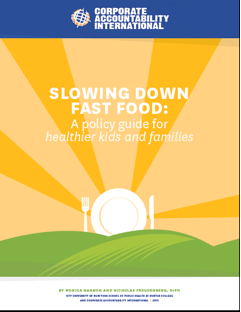
The report, Slowing Down Fast Food: A policy guide for healthier kids and families, documents ways in which city and county policymakers can address the toll that diet-related disease is taking on their municipalities and on their communities’ health.

It offers specific solutions to curb a primary contributor to the problem – the overconsumption of fast food and the ubiquitous marketing of fast food to children.

“Parents and policymakers have long felt at a disadvantage to counter the ubiquity of junk food and its marketing,” said Dr. Freudenberg. “This guide will empower families and communities to create healthier food environments for current and future generations.” Slowing Down Fast Food focuses on four local policy approaches: school policy, “healthy” zoning, curbing kid-focused marketing, and redirecting subsidies to healthier businesses.

As case studies in the report demonstrate, dedicated grassroots initiatives can overcome the food industry’s staunch opposition and build the political will sufficient for the passage of strong public health policies. For example, in San Francisco, the groundbreaking Healthy Meals Incentive Ordinance set basic nutritional standards for kids’ meals that are accompanied by toy giveaways. It was the power of grassroots initiatives involving parents, health professionals, and community leaders that helped secure the passage of this ordinance.

“What we can take from the city’s action is that all cities and towns could pursue and institute like-minded policies,” said San Francisco City Supervisor Eric Mar, the sponsor of the measure. “While no single community or organization can match the political and economic might of the fast food industry, we can make change on the community level that effectively challenges the fast food industry’s negative impact on public health.”

Such policies have positive and direct effects, but also have helped provoke critical changes across the food industry at large. While McDonald’s and its trade association attempted to block the ordinance, ultimately the burger giant and its competitors altered their practices internationally. For example, shortly after the San Francisco ordinance passed, Jack in the Box, the nation’s fifth largest burger chain, pulled the toy giveaways from its kids’ meals.

National media coverage of the San Francisco ordinance also helped foster public discourse and a deeper understanding of the harmful impact of marketing fast food to children. A growing number of studies have found that ending junk food marketing directed at kids could spare the health of millions of children. In June, the American Academy of Pediatrics even urged a ban on junk food advertising to children as part of a new research review published in the Pediatrics journal.

The report also identifies the obstacles to the passage of policies addressing fast food, namely industry opposition, interference, cooption and avoidance of regulation. It documents how fast food corporations use their political and financial clout to advance their interests, even when their products or practices jeopardize health. While this type of pervasive corporate interference has translated into inaction in Congress, local policy solutions have proven an effective means of countering special interests and protecting public health.

“Corporate influence may be drowning out the will of the people in our nation’s capital right now, but it cannot be allowed to remain this way,” said Kelle Louaillier, executive director of Corporate Accountability International. “Change needs to and can start at the local level, and the policies in this report are a critical place to start.”

The report and its companion Action Guide offer specific, practical guidance for putting policy concepts into motion, offering additional resources from a wide range of organizations engaged in protecting our health from the abuses of fast food corporations.

Individuals and policymakers can access and download the report at Slowing Down Fast Food: A policy guide for healthier kids and families.

Corporate Accountability International (formerly Infact) is a membership organization that, for the last 35 years, has successfully advanced campaigns protecting health, the environment and human rights. Value [the] Meal is Corporate Accountability International’s campaign dedicated to reversing the global epidemic of diet-related disease by challenging the fast food industry to curb a range of its practices.

Food Industry Continues to Thwart U.S. Public Health Policy

“After aggressive lobbying, Congress declared pizza a vegetable to protect it from a nutritional overhaul of the school lunch program this year. The White House kept silent last year as Congress killed a plan by four federal agencies to reduce sugar, salt and fat in food marketed to children.” In a special investigative report on food industry lobbying, Duff Wilson and Janet Roberts write for Reuters that “during the past two years, each of the 24 states and five cities that considered “soda taxes” to discourage consumption of sugary drinks has seen the efforts dropped or defeated. At every level of government, the food and beverage industries won fight after fight during the last decade. They have never lost a significant political battle in the United States despite mounting scientific evidence of the role of unhealthy food and children’s marketing in obesity.”

Are Cola Companies Behaving Like Cigarette Companies In The U.S.?

As soda consumption declines in the United States, asks Forbes, are soda companies following the tobacco industry by promoting its products in developing nations?  In these countries, consumption per capita is low, regulations are lax and there isn’t enough consumer awareness regarding health repercussions due to excessive soda consumption. So, there is plenty of scope to expand in terms of cola consumption.

Coke and Pepsi in China: the New Opium Trade?

In 1842, the United Kingdom and the Qing Dynasty of China signed the Treaty of Nanjing to end the first Opium War. A few years earlier, concerned about its trade imbalance with China, Great Britain began to export opium from India to China in order to cover its growing trade deficit generated by British imports of Chinese silk and tea. China resisted by confiscating Britain’s opium. In response, the British navy attacked China in 1839 and three years later China was forced to sign a treaty that required it to allow the importation of opium, an important precedent in global trade and China’s subsequent struggles with opium addiction.

Coke and Pepsi Expand

Last month, Muhtar Kent, Chairman and CEO of The Coca-Cola Company, inaugurated the opening of its 42nd bottling plant located in Yingkou, Liaoning, the largest Coca-Cola production facility in China. The new plant represents a US $160 million (1 billion in Chinese renminbi) investment in China, a small part of a three-year, US $4 billion investment plan announced last year. “China is a vast growth market for Coca-Cola. As we work to double the size of our global business in this decade, China will play a critical role,” said Kent. At its completion, the Liaoning plant is expected to reach an annual production capacity of more than 5 billion servings of sparkling and still beverages, including Coca-Cola, Sprite, Minute Maid and Ice Dew.

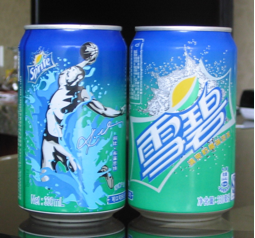
Sprite, one of Coca Cola’s 500 branded products available in China

Coca Cola, the world’s largest beverage company, offers its customers more than 500 sparkling and still brands including Coke, Diet Coke, Fanta, Sprite, Coca-Cola Zero, vitaminwater, Powerade, Minute Maid, Simply, Georgia and Del Valle. These beverages refresh consumers in more than 200 countries who drink more than 1.7 billion servings of its products a day. Coca Cola’s global beverage portfolio includes 15 brands that generate more than one billion dollars annually.

Nor is Coca Cola alone in expanding in China. In March, PepsiCo, Inc., the world’s second-largest food and beverage business (after Nestle) and the owner of 22 billion-dollar-a-year brands, announced a new partnership to create “a strategic beverage alliance” with the Tingyi (Cayman Islands) Holding Corp, one of the leading food and beverage companies in China.  As part of the alliance, a Tingyi subsidiary – Tingyi-Asahi Beverages Holding Co Ltd (TAB), one of China’s leading beverage manufacturers – will become PepsiCo’s franchise bottler in China.

In 2010, PepsiCo announced plans to invest US $2.5 billion in its China business over the next few years. Later this year, Pepsi plans to open its largest research and development center in Asia and a pilot plant in Shanghai, reports China Daily. The research center will employ more than 100 scientists who will develop new food and beverage products for China and the rest of Asia.

“China will soon surpass the United States to become the largest beverage market in the world,” said PepsiCo Chairman and CEO Indra Nooyi. “As a result of this new alliance with Tingyi, PepsiCo is extremely well positioned for long-term growth in China. Tingyi is an outstanding operator with a proven track record of success. By leveraging the complementary strengths of each company, we’ll be able to significantly enhance our beverage business in China, reach millions of new consumers throughout the country, and create value for Tingyi and PepsiCo shareholders.”

Pepsi for sale in a Chinese supermarket

US Soda Sales Go Flat

Together, Coca Cola and PepsiCo accounted for more than one quarter of the global beverages industry in 2010, according to Datamonitor, a global business research group. In the United States, however, reports Beverage Digest, soda consumption is going flat. Throughout most of the 1990s, soda sales in the United States grew about 3 percent annually but started to slow in 1999. Since 2005, sales have been in decline as consumers concerned about health turn to options they see as healthier, such as bottled water, juice and tea. In 2011, US soda consumption fell 1 percent. According to Beverage Digest, the top four sodas — Coke, Diet Coke, Pepsi-Cola and Mountain Dew — all saw declining sales last year. Of those, Coke’s market share was flat, while the other three lost share. In part, then, Coke and Pepsi’s enthusiasm for the China market is a response to this fizzling market for sugary beverages in the United States and Europe.

To boost sales and profits, Coke and Pepsi are aggressively marketing their sugary beverages in China.  Coke hired Knicks basketball superstar Jeremy Lin (actually born in Taiwan) to sell its products both in New York and overseas. In early March,reports Bloomberg News, about 100 million people in China watched the Knicks-Dallas Mavericks game on TV, offering Coke the opportunity of associating its Chinese logo with a rising sports star.  “For a global marketer like Coca-Cola,” Mark O’Brien, an executive with the advertising firm DDB, told a WNYC radio reporter, “you’ve expanded your audience reach from maybe amounts that are in the millions to amounts that are in the tens to hundreds of millions.”

Coke’s new salesman in China: Jeremy Lin

In its agreement with the Chinese company Tingyi, PepsiCo will retain control of branding and marketing its drinks while Tingyi is to oversee manufacturing, sales and distribution in China. As CEO Indra Nooyi said, “The strength of both companies will help make the products available for Chinese consumers in an affordable way.” In other words, PepsiCo’s global advertising savvy will be used to seek to bring a few hundred million Chinese into the Pepsi Generation.

Health Impact of Rising Soda Sales

From one perspective, growing the market for sugary beverages in China makes perfect sense. It offers two leading American companies an opportunity to grow as sales decline in their domestic market. In theory, it offers the United States an opportunity to balance its trade deficit with China, a perennial concern for American businesses and politicians. In practice, however, Coke and Pepsi do not make the drinks they sell in China in the US and in China, they hire mostly Chinese workers. Some portion of the profits does return to the United States and this constitutes a growing share of both companies’ revenues and return on investment.

But from a health perspective, the new trade in sugary beverages constitutes a disaster. In a 2010 article in the New England Journal of Medicine, Yang and colleagues estimated that 92.4 million adults in China have diabetes with an age-standardized prevalence of diagnosed and undiagnosed diabetes of 9.7 percent and of prediabetes, a precursor condition, of 15.5 percent. Moreover, like other countries around the world, China is experiencing rising rates of child obesity. In 2005, the prevalence of child obesity and overweight in big northern coastal cities in China reached 32.5 percent for boys and 17.6 per cent for girls, prevalence rates similar to many developed nations. One recent study concluded, “China is undergoing a remarkable, but undesirable, rapid transition…characterized by high rates of diet-related non-communicable diseases.”

While many factors contribute to rising rates of diabetes and obesity, increased consumption of sugar sweetened beverages (SSBs) plays an especially important role in these conditions and makes a logical target for intervention. A recent literature review by researchers at the Harvard School of Public Health concluded that “higher consumption of sugar-sweetened beverages is associated with development of metabolic syndrome and type 2 diabetes” as well as weight gain. The authors noted that “these data provide empirical evidence that intake of SSBs should be limited to reduce obesity-related risk of chronic metabolic diseases.” To increase production and marketing of sugary beverages in a country struggling with epidemics of overweight and diabetes is like pouring gasoline on a fire.

In assessing the impact of the Opium Wars and the Treaty of Nanjing, the eminent U.S. China scholar John K. Fairbankdescribed the British opium trade as “the most long-continued and systematic international crime of modern times.” Clearly, caffeinated sugary beverages are different from opium, although a new body of research does note the similarity between “hyperpalatable foods” such as fast food and sugary beverages and the neuronal pathways activated by opioid addiction. And clearly Coke and Pepsi’s new agreements with China violate no current laws or international standards of corporate conduct.

But it is also evident that the expanded production and marketing of sugary beverages in a country caught in the throes of epidemics of obesity and diabetes dooms many, many millions of people to premature death and preventable illnesses. Soda marketing will also impose huge burdens on China’s health care system, diverting resources from other national goals such as environmental protection and improved education.

In the 1970s and 1980s, health professionals and public health advocates succeeded in dramatically reducing tobacco use in the United States and other developed nations, preventing millions of deaths. But the unintended consequences of these public health victories were to push the tobacco industry to accelerate its marketing in developing nations. In the twentieth century, 100 million people died prematurely as a result of tobacco use, but in this century it is estimated that tobacco will cause one billion premature deaths, mostly in Asia, Africa and Latin America. Now it looks like Coca Cola, Pepsi and other multinational beverage makers will follow the tobacco play book, building markets in nations that have not yet begun to turn away from sugary beverages. In the next century, will our failure to prevent this assault on health rank as “the most long-continued and systematic international crime” of our times?


Image Credit for photo 3:

Teamstickergiant via Flickr.

A Different Kind of Urban-Rural Linkage

A March presentation on the Farm Bill by Adam Warthesen of the Minnesota Land Stewardship Project started with a pop quiz. Match the projected 10-year farm-program expenditure with its name. The options were as follows:

$771.6 billion A.  Conservation Support
$90.1 billion B.  Crop Insurance
$67.3 billion C.  Nutrition and Food Support
$65.7 billion D.  Commodity Program

When most Americans think about the Farm Bill, they don’t think about crop insurance.  However, the cost of crop insurance to taxpayers has more than doubled in the past decade.  Brian DeVore reports that today it is ($90.1 billion) second only to nutrition and food support programs ($771.6 billion).  The cost of commodity subsidies ($67.3 billion) and conservation support ($65.7 billion) come in a close third and fourth.

While most coverage of the crop insurance issue has focused on rural audiences, those of us living in cities should be concerned that the sources of our food security may be under increasing threat.  Anyone concerned about the social justice and public health implications of rising food prices, diminishing farm yields, climate change, and escalating land speculation should know about how the ever-growing cost of crop insurance for US taxpayers is working against our health and social equity goals.

A Short History of US Crop Insurance

The United States Department of Agriculture’s Risk Management Agency runs the federal crop insurance program.  Started in 1938, the program was the government’s response to the droughts and Dust Bowl of the 1930s.  Its goal was to protect the profitability of farming so that the country could support the population of farmers it needed to grow food and fiber.

The 1990s were a decade of big changes to the US’s federal crop insurance program.  Many of these changes set the stage for the problems farmers identify with the program today.  For example, the USDA stopped requiring that farmers have soil conservation practices in operation before they can collect insurance indemnities.  Also during this period the subsidized percentage of crop insurance premiums started its rise from 25% to today’s subsidy rate of nearly 60%.  This period saw the crop insurance innovation of coverage for revenue aside from crop yield.  Today, crop insurance for farm yield covers only 17% of US farmland.

By 2010, federally subsidized crop insurance covered 255 million acres of land, three-quarters of which were growing corn, cotton, soybeans, and wheat.  As a Congressional Research Service report on this issue explains, “insurance policies are sold and completely serviced through 16 approved private insurance companies.  The insurance companies’ losses are reinsured by USDA, and their administrative and operating costs are reimbursed by the federal government.”  In 2010, the USDA capped subsidies to companies issuing crop insurance at $1.3 billion.  Over 10 years this cap adds up to a $6 billion subsidy reduction, enough to make insurers balk at the proposal, but not enough to damage their profitability, or the profitability of the program.

United States Department of Agriculture

Agricultural Land Grabs

Insurance for farm revenues creates incentives for some of the largest farmers to leverage their size and personal yield histories into insured guarantees on revenue for new land that they rent or purchase.  Our current crop insurance policies allow this, regardless of the suitability of that land for farming.  This incentive to grow has led to a rural land grab where rental rates and land prices have snowballed.  One major effect of this skyrocketing in the cost of farmland is increased pressure for farm consolidation and dramatically increased financial barriers for new farmers.

Climate Change

Unsurprisingly, decoupling soil conservation from crop insurance has also led to a pattern of increases in both environmentally unsustainable farm practices and indemnity payouts resulting from unpredictable droughts and floods.  For example, farmers collected a record high $10 billion in such payments in 2011.  At the same time organic farmers who presumably use more environmentally sustainable food growing practices are currently required to pay a five-percent surcharge on crop insurance and reduced payments in the event of a crop failure.

Moral Hazards  

By decoupling soil conservation from crop insurance, the USDA has also created an agricultural moral hazard, a term used to describe a tendency to take undue risks because the costs are not borne by the party taking the risk.  Land that is not suitable for production can now be profitably farmed, even as a yield failure. Insurance guarantees income regardless of yield.  When the income insurance only costs the farmer 40% of the policy premium because taxpayers subsidize the rest, there are profit incentives to knowingly planting to fail.

The Bottom Line

When food and nutrition advocates think about the farm bill we are accustomed to focusing on increasing funding for nutrition and food support programs and decreasing funding for commodity subsidies.  In reality, the federal crop insurance programs costs significantly more than the commodity program and leads to many of the same problematic food system outcomes – land and business consolidation, support for corporate farming rather than small farmers, high prices for crops we consider food, and environmentally unsustainable farm practices.  The National Corn Growers Association reportedlyexpressed willingness to give up direct payments from commodity subsidies in the farm bill.  They can now hedge their bets on profit with crop insurance and stay profitable.  All while the federal government would appear to be responding to our calls for reduced corn subsidies.

This farm bill season provides both urban and rural taxpayers and eaters with an opportunity to ask elected officials harder questions about crop insurance.  Should taxpayers be subsidizing the insurance of farm profits, not farm yields?  Why should crop insurance policies be based on the historic productivity of the farmer and not the land? Why can’t we return to requiring that insured cropland be conservation compliant?  By raising these and similar questions, food advocates can help to create farm policies that better support the environment, health and democracy.


Kimberly Libman is a doctoral student in environmental psychology at City University of New York and a research fellow at Corporations and Health Watch.  


Image Credits:

1. formalfallacy via Flickr.

2. meironke via Flickr.

The Ag Gag Laws: Hiding Factory Farm Abuses from Public Scrutiny

Cody Carlson, a former investigator for the Humane Society of the United States, writes in The Atlantic that last month, politicians in Iowa bowed to corporate pressure when they passed a law designed to stifle public debate and keep consumers in the dark. Instead of confronting animal cruelty on factory farms, the top egg- and pork-producing state is now in the business of covering it up. HF 589 (PDF), better known as the “Ag Gag” law, criminalizes investigative journalists and animal protection advocates who take entry-level jobs at factory farms in order to document the rampant food safety and animal welfare abuses within. In recent years, these undercover videos have spurred changes in our food system by showing consumers the disturbing truth about where most of today’s meat, eggs, and dairy is produced.

The Supplemental Nutrition Assistance Program and Recent Exceptions for Prepared Foods

In August 2011, the Rhode Island Department of Human Services launched a pilot program in the Providence area that allows some elderly, homeless, and disabled households to buy “hot prepared meals” using Supplemental Nutrition Assistance Program (SNAP) benefits – but only at Subway sandwich shops.[1]

SNAP (formerly known as food stamps) is the largest government nutrition assistance program in the United States, helping one in seven Americans pay for their food.[2]  Each month, approximately 47 million people receive SNAP benefits, and the limits on how recipients can use their benefits are few.[3]

Benefits can be used at any retail establishment that accepts them in order to purchase any brand of food items. The only limitation on eligible food items is that they cannot be “hot foods” or “foods that will be eaten in the store” (i.e., prepared foods).[4]

Recognizing that certain groups of people may find it difficult or impossible to prepare foods for themselves, several states, including Rhode Island, have passed exceptions to the prepared foods restriction.

Now, Rhode Island SNAP recipients who are homeless, disabled, or elderly may use their benefits to purchase prepared foods at federally-approved restaurants in the pilot program. Thus far, however, the only establishments that have been approved are five Subway restaurants.[5]

A chain like Subway probably recognizes the financial advantage of accepting SNAP benefits. The potential revenue from the prepared foods exception is large. Approximately half of the individuals in the U.S. receiving public assistance due to disability (Supplemental Security Income) reside in households receiving SNAP benefits.[6] Add homeless and elderly SNAP recipients to that mix and the magnitude of new customer dollars is substantial.

Given the general lack of restrictions in the SNAP program, some might find it surprising that a state sub-program of SNAP has only approved one restaurant chain to do business with. The decision will potentially funnel a large amount of public funds to one business, which may cause pause in the public policy community. In addition, the pilot program’s options for participating individuals are limited, which may seem counter to the general spirit of SNAP.

But a look at the history of food stamps reveals the program’s long-standing ties to specific food producers and food products.

Unmarketable food surpluses coupled with widespread unemployment in the late 1930s gave birth to the first Food Stamp Program (FSP). In this initial incarnation, recipients would receive an extra 50 cents for each dollar they spent on food. But the fifty cents in benefits could only be used to purchase what the U.S. Department of Agriculture (USDA) determined to be surplus items.[7] Federal funds, via the FSP, went toward supporting farmers who could not sell enough goods.

When the FSP became a permanent program in 1964, its official purposes were “strengthening the agricultural economy and providing improved levels of nutrition among low-income households.”[8] At this time, the main restriction on eligible foods was that they could not be imported – the U.S. food industry, therefore, continued to be supported by the policy. To this day, SNAP is funded through the USDA, which also approves retailers for the program.[9]

It is important to note that SNAP is not the only government nutrition program with ties to specific brands. Women, Infants and Children (WIC) is a federally-funded program that provides supplemental nutrition assistance to low-income pregnant women, new mothers, and children up to age five.[10] WIC is generally more restrictive than SNAP in its categories of eligible foods, but also in that only certain brands of those eligible foods are approved by the program.[11]

For instance, women in New York who would like to use their WIC benefits to purchase breakfast cereals may only purchase cereal from a limited number of brands, including: General Mills, Kellogg’s, Post, Quaker, and Malt-o-Meal.[12]

Given the history of food stamps being used to support American food industries, and given the brand specifications of WIC, the Rhode Island prepared foods exception that uses only the American franchise of Subway Sandwiches might seem less shocking. And, if the state’s pilot program is deemed a success, it’s possible that Rhode Island will add other restaurants to its prepared foods exception.

Of note, Subway is the second largest global restaurant operator in the world, next to YUM! Brands.[13], [14] Interestingly, YUM! Brands has also entered the SNAP arena. In September 2011, the Louisville-based corporation—which owns Taco Bell, KFC, Long John Silver’s, and Pizza Hut—was lobbying to make it easier for SNAP participants to use their benefits at restaurants.[15] Since 2009, Arizona residents who are disabled, elderly, or homeless can use their SNAP benefits to purchase prepared foods from certain fast food restaurants, including YUM! Brands’ Pizza Hut and KFC.[16]

Although ties between the U.S.-based food industry and federal nutrition assistance programs are long-standing, choice of foods has typically been a heavily guarded characteristic of SNAP. For instance, proposed public health interventions to remove sodas from the list of eligible foods under SNAP caused an uproar among anti-hunger advocates (including, among others, the soft-drink industry), who claimed that the government should not “micromanage” how low-income people shop.[17] Soda bans in SNAP have been thus far unsuccessful.

Given the program’s emphasis on choice, it is somewhat surprising that the state-level specific-brand-restricted prepared meals exceptions within SNAP have not received greater attention. They highlight an on-going tension within the SNAP program, between respecting participating individuals’ autonomy relative to food choices and giving preferential treatment to specific food vendors. If prepared foods exceptions within SNAP continue to proliferate, the public health community should be prepared to bring an additional perspective to the debate, namely the need to ensure that healthy (or at least healthier) eating options are available and easily accessible for SNAP recipients. This is the surest way to truly respect the program’s traditional emphases on choice and nutrition for participating individuals.

Sarah O. Rodman is a doctoral student in Health Policy and Management and a pre-doctoral fellow at the Center for a Livable Future at the Johns Hopkins Bloomberg School of Public Health.

References:


[1] Rhode Island Department of Human Services, The Rhode Island Supplemental Nutrition Assistance Program (SNAP) Prepared Meals “Food Access Pilot Project” (Oct. 2011), http://www.dhs.ri.gov/Portals/0/Uploads/Documents/SNAP/Q_and_A.pdf.

[2] Food Research and Action Center, SNAP/Food Participation 2011 (last visited Mar. 14, 2012), http://frac.org/reports-and-resources/snapfood-stamp-monthly-participation-data/.

[3] Food Research and Action Center, SNAP/Food Participation 2011 (last visited Mar. 14, 2012), http://frac.org/reports-and-resources/snapfood-stamp-monthly-participation-data/.

[4] United States Department of Agriculture, Supplemental Nutrition Assistance Program (2012), http://www.fns.usda.gov/snap/retailers/eligible.htm.

[5] Rhode Island Department of Human Services, The Rhode Island Supplemental Nutrition Assistance Program (SNAP) Prepared Meals “Food Access Pilot Project” (Oct. 2011), http://www.dhs.ri.gov/Portals/0/Uploads/Documents/SNAP/Q_and_A.pdf.

[6] Trenkamp B, Wiseman M. The Food Stamp Program and Supplemental Security Income. Soc Secur Bull.  2007;67(4):71–87. Available from: http://www.ncbi.nlm.nih.gov/pubmed/18777670.

[7] United States Department of Agriculture, A Short History of SNAP (2012), http://www.fns.usda.gov/snap/rules/Legislation/about.htm.

[8] United States Department of Agriculture, A Short History of SNAP (2012), http://www.fns.usda.gov/snap/rules/Legislation/about.htm.

[9] United States Department of Agriculture, A Short History of SNAP (2012), http://www.fns.usda.gov/snap/rules/Legislation/about.htm.

[10] New York State Department of Health, Current WIC Acceptable Foods Card (2010), http://www.health.ny.gov/prevention/nutrition/wic/wic_acceptable_foods_card.htm.

[11] New York State Department of Health, Current WIC Acceptable Foods Card (2010), http://www.health.ny.gov/prevention/nutrition/wic/wic_acceptable_foods_card.htm.

[12] New York State Department of Health, Current WIC Acceptable Foods Card (2010), http://www.health.ny.gov/prevention/nutrition/wic/wic_acceptable_foods_card.htm.

[13] Subway (last visited Mar. 14, 2012), http://www.subway.com/subwayroot/default.aspx.

[14] YUM! Brands, Inc. (last visitied Mar. 14, 2012), http://www.hoovers.com/company/YUM!_Brands_Inc/hyssyi-1.html.

[15] Ellis J, Luther M. Restaurants Want a Piece of Food Stamp Pie, USA Today (Sept. 7, 2011), http://www.usatoday.com/money/industries/food/story/2011-09-05/More-restaurants-are-targeting-customers-who-use-food-stamps/50267864/1.

[16] Arizona Department of Economic Security, Arizona Restaurants/Retailers Participating in the USDA/FNS Restaurant Meals Program (2011), https://extranet.azdes.gov/faapolicymanual/FAA1/baggage/MealsProgramRestaurants.pdf.

[17] McGeehan P, U.S. Rejects Mayor’s Plan to Ban Use of Food Stamps to Buy Soda, NY Times (Aug. 19, 2011), http://www.nytimes.com/2011/08/20/nyregion/ban-on-using-food-stamps-to-buy-soda-rejected-by-usda.html.


Image Credits:


1. Supplemental Nutrition Assistance Program

2. NCReedplayer via Flickr.

FDA May Ban Antibiotics in Livestock Feed

The Jurist reports that the U.S. District Court for the Southern District of New York has issued an order to the FDA to continue proceedings, begun in 1977, that could lead to the removal of penicillin and tetracycline from agricultural livestock feed. If companies are unable to demonstrate that these antibiotics are safe, the FDA must prohibit their inclusion in feed. As Gardiner Harris writes in the New York Times, use of antibiotics in livestock feed can lead to the growth of antibiotic-resistant “superbugs,” a significant public health concern.