British Secretary of Health Andrew Lansley is guilty of a “dereliction of duty” for failing to tackle Britain’s growing obesity epidemic, one of his former public health advisers warns. In an interview with The Independent, Professor Simon Capewell, who served on the Health Secretary’s Public Health Commission in opposition, accuses Mr. Lansley of conniving with the food industry and ignoring scientific evidence on obesity.
New York State Attorney General Investigates Energy Beverage Firms’ Marketing
The Wall Street Journal reports that New York State Attorney General Eric Schneiderman is investigating whether the multi-billion dollar energy-drink industry is deceiving consumers with misstatements about the ingredients and health value of its products. Schneiderman issued subpoenas to PepsiCo Inc, the makers of AMP, Monster Beverage Corp, and Living Essentials LLC, maker of 5-hour energy drink. The subpoenas asked for information on the companies’ marketing and advertising practices.
New study shows alcohol advertisers use magazines to target youth


David Jernigan is an Associate Professor and the Director of the Center on Alcohol Marketing to Youth at the Bloomberg School of Public Health at Johns Hopkins University. He has spent many years studying alcohol advertising to youth. In a new article published in The Journal of Adolescent Health, Elizabeth Rhoades, also at Johns Hopkins, and Jernigan reported on their study on alcohol advertising in magazines. Corporations and Health Watch’s Nicholas Freudenberg asked Jernigan some questions about the new study. In addition, David Jernigan’s recent column on state laws to control alcohol marketing to youth “Under the Influence” was recently posted Huff Post Science. To read it, click here.
CHW: How did you do this study?
DJ: We examined 1,261 ads for alcopops, beer, spirits or wine that appeared more than 2,500 times in 11 magazines that are popular among teens. These magazines have youth readerships equaling or exceeding 15 percent. The ads were rated according to a number of factors, such as whether they portrayed over-consumption of alcohol, addiction content, sex-related content, or injury content.
CHW: How common were ads with sexual themes?
DJ: Almost one-fifth of the ads contained sexual connotations or sexual objectification.
CHW: What kinds of alcoholic beverages were being advertised in the magazines you studied?
DJ: We found that in our sample, ads were concentrated across type of alcohol, brand and outlet, with spirits representing about two-thirds of the sample, followed by ads for beer, which comprised almost another 30 percent. The ten most advertised brands, a list comprised solely of spirits and beer brands, accounted for 30 percent of the sample, and seven brands were responsible for more than half of the violations of industry marketing guidelines.
CHW: And what were your conclusions?
DJ: The content of alcohol ads placed in magazines is more likely to be in violation of industry guidelines if the ad appears in a magazine with sizeable youth readership. We also found that the prevalence of problematic content in magazine alcohol advertisements is concentrated in advertising for beer and spirits brands. Violations of industry guidelines and addiction content appear to increase with the size of youth readerships, suggesting that individuals aged 21 and under may be more likely to see such problematic content than adults.

CHW: What does your study say about the alcohol industry’s voluntary codes?
DJ: The finding that violations of the alcohol industry’s advertising standards were most common in magazines with the most youthful audiences tells us self-regulated voluntary codes are failing. It’s time to seriously consider stronger limits on youth exposure to alcohol advertising.
CHW: So what’s the bottom line meaning of your study?
DJ: Alcohol is responsible for 4,700 deaths per year among young people under the age of 21, and is associated with the three leading causes of death among youth: motor vehicle crashes, homicide and suicide. Youth are getting hit repeatedly by ads for spirits and beer in magazines geared towards their age demographic. At least 14 studies have found that the more young people are exposed to alcohol advertising and marketing, the more likely they are to drink, or if already drinking, to drink more. This report should serve as a wake-up call to parents and everyone else concerned about the health of young people.
CHW: What’s the mission of your Center?
DJ: The Center on Alcohol Marketing and Youth (CAMY) monitors the marketing practices of the alcohol industry to focus attention and action on industry practices that jeopardize the health and safety of America’s youth. Reducing high rates of underage alcohol consumption and the suffering caused by alcohol-related injuries and deaths among young people requires using the public health strategies of limiting the access to and the appeal of alcohol to underage persons.
Photos courtesy of Center on Alcohol Marketing to Youth
Big Tobacco Shills Trying to Stop GMO Labeling in California
 Cross-posted from Appetite for Profit
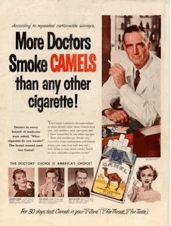
The food industry really hates it when you compare them to Big Tobacco. They try to deny the negative association by claiming that food is different than tobacco. Of course that’s true, but why are the same consultants that have worked for the tobacco industry now shilling for Big Food, opposing the ballot initiative that would require labeling of all foods containing GMO ingredients?
Hiring Secret Consultants for the Dirty Work
The latest financial filings in California for the “No on 37: Coalition Against the Deceptive Food Labeling Scheme” – reveal a $7,500 payment to the Sacramento-based political consulting firm, MB Public Affairs. Here is how the Los Angeles Times described the firm last year:
MB Public Affairs is headed by Mark Bogetich, a garrulous operative known to his friends as “Bogey,” who has helped a number of Republican candidates neutralize their opponents. In recent years, MB Public Affairs has worked for Altria, once known as the Phillip Morris Cos. …
Bogetich has also been called “the go-to guy for [the Republican] party,” and “the only game in town.” The L.A. Times article explains how last year MB Public Affairs filed more than 50 public record act requests to dig up dirt on a small but effective group called the Los Angeles Alliance for a New Economy. No wonder, since the organization has scored such important victories as a living wage for workers, which would threaten plenty of businesses.
But which ones? Who knows, because by hiring MB Public Affairs to do its dirty work, industry gets to keep its nose clean – a classic Big Tobacco tactic. Well-known brands such as PepsiCo (which I wrote about last week) and Kraft don’t want to be associated with negative campaigning, so they farm out the job to consulting firms. In this case, they went right to the top, or the bottom. Things are likely to get ugly.
Creating Front Groups for the Dirty Work
Another tactic honed by Big Tobacco is to form a front group, which appears to be made up of small businesses and others designed to give the impression of a grassroots campaign, but in reality is funded by large corporations. This tactic, known as an Astroturfing, is alive and well with “No on 37,” which describes itself as, “A broad coalition of family farmers, scientists, doctors, taxpayers, small businesses, labor, food companies, biotechnology companies and grocers.
Small farmers and small businesses? I don’t see any listed on the “Who We Are” page. I do see many not-so-small trade groups representing numerous not-so-small corporations, some of them from outside California, including CropLife America, which is a trade group for the biotech and pesticide industry.
Also, the “No on 37” campaign is represented by the law firm, Bell, McAndrews & Hiltachk, which has a sordid history of stealth tactics such as Astroturfing. And no wonder, with former Phillip Morris outside council Tom Hiltachk as the campaign’s treasurer. (His firm’s address is listed on the webpage for where to send donations; can’t get much cozier with the No campaign than that.)
Hiltachk had this disingenuous quote about the GMO labeling initiative back in February: “Farmers and food producers strongly oppose this costly, ill-conceived labeling proposition.” There are those invisible farmers again.
No stranger to California politics, Hiltachk’s firm represents the California Republican Party and helped make Arnold Schwarzenegger governor by orchestrating the statewide recall campaign of former Governor Gray Davis.
According to PolluterWatch, Tom Hiltachk and his firm are well known for creating front groups that promote or attack ballot initiatives at the behest of the firm’s wealthy corporate clients: “In the past Hiltachk has attacked anti-smoking initiatives while being paid by major tobacco corporations.”
And this scathing article at ThinkProgress from 2010 describes Hiltachk’s attempt to repeal California’s clean energy policy and says his “under-the-radar tactics of shifting money around and using phony groups are nothing new.” Specifically:
During the eighties and nineties, Hiltachk and his law partners helped the tobacco industry, with funding from Philip Morris and R.J. Reynolds, coordinate a variety of stealth front groups. While his law firm received over a million from tobacco interests, Hiltachk helped organize “Californians for Smokers’ Rights,” a supposedly “grassroots” group that relied on tobacco industry consumer lists to mobilize opposition to anti-smoking initiatives.
Another Big Tobacco front group Hiltachk’s firm managed was “Californians for Fair Business Policy,” which fought local efforts to enact smoke-free bans in California in the early 1990s.
This is going to be a busy election season for Hiltachk, as he is also the mastermind behind the deceptive union-busting Proposition 32, about which a local California paper writes: “if you liked Citizens United, you will love Prop 32.” As the New Yorker sums it up in an article describing the firm’s shady operations, “They specialize in initiatives that are the opposite of what they sound like.”
Another group with Big Tobacco origins now spreading lies about the GMO labeling initiative is the unsubtle front group, “California Citizens Against Lawsuit Abuse,” whose executive director recently warned us to “beware of trial lawyers lurking in your food.” (It seems lawyers are scarier than altering the genetic code of the food supply.) According to the Center for Media and Democracy’s Sourcewatch, Philip Morris is a primary funder of various “Citizens Against Lawsuit Abuse” groups, which under the guise of tort reform aim to make it harder to bring lawsuits for problems caused by hazardous products.
Doubt is Their Product
In sum, the food industry, to oppose a simple labeling law, is hiring lawyers and consultants with ties to the tobacco industry, to deploy stealth tactics such as creating front groups, digging up dirt on opponents, and spreading outright lies.
For decades the tobacco industry and its shills hid the truth by deploying its most effective weapon: manufacturing doubt about the health hazards of smoking. How many millions of Americans died as a result of Big Tobacco’s deceptive and cynical campaign? Why would we trust these same operators now?
You can hardly blame industry for calling on such shady characters. Big Food has seen the polling data showing that more than 90 percent of consumers want to see GMO foods labeled. When you don’t have the people or the truth on your side, all you have left is playing dirty.
McDonald’s to customers: Eat more
McDonald’s new Breakfast After Midnight menu — available in locations across the state of Ohio and in Denver and Boston — offers limited breakfast offerings from 12 a.m. onward. Included are popular items like Egg McMuffins, Sausage McMuffins, hotcakes with sausage, breakfast burritos, fruit and maple oatmeal, hash browns, juice and coffee. The Huffington Post reports that the menu will be available in all 24-hour McDonald’s stores in featured markets. One slogan for the campaign is “the moon is full you should be too.”
More on New York City Soda Limits Proposal

Cross-posted from the Center for Food Safety

Last week I had the pleasure of lending my support, on behalf of the Center for Food Safety, to New York City’s proposal to limit the size of sugary beverages sold at food service outlets. (I wrote previously about why this policy makes sense.) The hearing room at New York’s health department was packed with media outlets and hundreds of folks eager to witness the showdown with Big Soda.
Interestingly, no one from an actual soda company spoke up. But we did hear from several trade associations, along with members of the city council, several of whom objected to the idea over potential negative impacts on small business. As I explained in my own remarks, this talking point is a classic misdirect put up by major corporations. Here are a few excerpts from my comments:
This isn’t about choice or any other distracting rhetoric.
The soda industry, because it does not have science (or even common sense) on its side, is resorting to methods of distraction such as claiming that this proposal is an affront to consumer choice. Of course, this proposal doesn’t take anybody’s choice away. New Yorkers who wish to consume more than 16 ounces are free to purchase more.
But let’s take a closer look at the concept of choice. It is the soda industry that has taken away the choice of reasonable portion sizes. Nobody demanded larger beverages. Cups got larger and larger over the years because the soda industry (in coordination with food service outlets) realized it has a gold mine on its hand. When the beverage industry and its cohorts use the word “choice,” it’s really code for threatened profit margins — which are estimated to be as high as 90 percent. 90 percent.
The soda industry is acting like Big Tobacco.
One tried and true tactic of the tobacco industry is inventing “grassroots” smokers’ organizations, a strategy known as Astro-turfing (as in fake grass). It’s a great way for companies that don’t want their fingerprints on a controversial campaign to hide behind a front group. Such groups tend to garner public sympathy and support while attracting media attention.

“New Yorkers for Beverage Choices” is a classic Astro-turfing campaign led by the American Beverage Association, the soft drink industry’s lobbying group, which has retained powerful political and PR consultants. Who made this list of alleged New Yorkers so concerned with their choices? For starters, other lobbying groups outside of New York, such as:
- The Grocery Manufacturers Association
- The International Franchise Association
- The National Association of Concessionaires
- The National Association of Theater Owners
- The National Restaurant Association
Also, restaurant chains like Chick-Fil-A, Denny’s, and Darden Restaurants, owner of Olive Garden and Red Lobster, among others. Not quite the sort of grassroots activism members you hope for in a campaign about personal choice.
Additional Big Tobacco-style tactics from the soda lobby include:
- Shooting the messenger and name-calling, by depicting Mayor Bloomberg as a “nanny” in full-page ads taken out by the industry front group, Center for Consumer Freedom, which not coincidentally, began with funding from Philip Morris and is run by notorious tobacco lobbyist Rick Berman;
- Claiming to take the side of small businesses because they know the public and the press have more sympathy for the little guy than multinational corporations such as Coca-Cola and PepsiCo;
- Claiming to care about the economic plight of poor people, never mind the fact that the soda industry targets these same populations with advertising designed to get them hooked for life on their unhealthy products.
Ultimately, the tobacco industry lost all credibility with the American public (along with most policymakers) by engaging in such deceitful tactics.
In conclusion, the soda industry is running scared because they know the jig is up; that the public health crisis their products have helped create means that industry cannot keep enjoying the same unfettered regulatory environment. This common sense proposal will catch on as other cities take New York’s lead. This is an idea whose time has come.
You can read the submitted comments here. A decision by New York’s Board of Health is expected in September.
MCDONALD’S, COCA COLA SEEK GOLD IN LONDON OLYMPICS


As the London Olympic Games draw to a close, let’s take a closer look at the performance of the biggest, best-funded and most highly trained team to compete in this year’s Olympics: representatives of multinational corporations.
A few statistics illustrate the scope of the corporate investment in the Olympics:
- The 11 biggest corporate sponsors paid nearly $1 billion for the rights to flaunt the Olympic seal during the London Games and 2010’s Winter Games in Vancouver.
- Corporate valuation specialist Brand Finance valued the Olympic brand as being worth just over $47.5 billion That leaves it behind only Apple ($70.6 billion) and above the corporate world’s next biggest brand, Google ($47.4 billion), although valuation of an event such as the Olympics is difficult.
- Proctor and Gamble, an Olympic sponsor, expects its 2012 Olympic sponsorship to result in $500 million in additional sales, while NBC, the Olympic broadcaster expect to net an additional $1 billion in revenue from the Olympics.
For most corporate sponsors, however, the take-home rewards are not the green, gold or silver that flows into their bank accounts but the opportunity to shape their image. Coca Cola, an Olympic sponsor since the 1928 games in Amsterdam, expects to reach 1.5 billion people worldwide via its create-your-own-beat social-media and mobile campaign. The Coke promo begins with the sounds of six athletes set to a musical track, then asks consumers to add their own sounds to the track — and share it. Wendy Clark, Coca Cola’s senior vice president of integrated marketing, says this campaign provides “share-worthy” content that gives young adults “cred” in their social-media circles. “We don’t spend this amount of time on things that don’t work,” she said.
McDonald’s, another corporate sponsor, has built the world’s largest McDonald’s in London’s Olympic Village. It seats up to 1,500 people and is expected to serve 14,000 people a day during the games and offer free Olympic-themed Happy Meals to children. “Many athletes tell us we are their favorite place to eat,” says a McDonald’s spokeswoman. Mickey D expects to make £3 million selling fast food during the Games, after which the Olympic Golden Arches will be bull-dozed to the ground.
Heineken UK, the beer maker, is an Olympic supplier. It has erected digital outdoor screens throughout London underground and rail stations that display near-live content that directly feeds from the Heineken® Fanhub. The public screens include a daily calendar of events, Heineken pubs nearby, relevant Olympic and Paralympic facts and details of medals celebrations – “all updated regularly to drive consumer intrigue and interest.”

The outsized corporate presence at the Olympics has drawn some criticism. The Associated Press reported: A protest last week, the largest so far against the games, drew a mix of left-wing and green activists who decry the Olympics as a corporate juggernaut rolling over residents and their civil rights. They marched peacefully, chanting against what they called the “Corpolympics,” watched by police officers on foot and motorcycle. The protesters contend that the often-cited Olympic boost to traditionally gritty, working-class east London is an illusion, whereas major corporate sponsors such as McDonald’s and Coca-Cola gain from the 9.3 billion pound ($14 billion) games. They said the mass arrests at the cycling demonstration, and limits on corporate branding designed to protect sponsors, show that the games are a threat to civil liberties.
An editorial on the Games called “Chariot of Fries” in Lancet, the British medical journal, noted: Health campaigners have rightly been dismayed. On June 20, the London Assembly (an elected body that scrutinizes the work of the Mayor of London) passed a motion urging the International Olympic Committee (IOC) to adopt strict sponsorship criteria that exclude food and drinks companies strongly associated with high calorie brands and products linked to childhood obesity. Meanwhile, the UK’s Academy of Medical Royal Colleges has said that the presence of McDonald’s and Coca-Cola at the 2012 Games sends out the wrong message to children. Indeed, their presence is hardly subtle… Cadbury’s has joined forces with McDonald’s to offer what it states on its website will be the “perfect snack” to enjoy whilst watching the Games—a chocolate bar-ice cream concoction with a whopping 395 calories per serving. Coca-Cola, meanwhile, has raised its profile considerably by branding the Olympic torch relay.
As the Olympics finish in London and planning begins for the 2016 Rio Games, Michael Jacobsen from Center for Science in the Public Interest asks: Brazilians are one of the world’s biggest consumers of soda (fueled by Coca-Cola’s billion-dollars-a-year investments), and host to over 650 McDonald’s outlets. Experts predict that Brazil’s bulging waistlines may grab the world record from the United States by 2022. Will junk-food marketers get an Olympic carte blanche again?
In his recent book What Money Can’t Buy The Moral Limits of Markets, Harvard political scientist Michael Sandel warns that the most fateful change of the last three decades has been “the expansion of markets, and of market values, into spheres of life where they don’t belong.” In the distant past, the Olympic Games provided a celebration of fitness, athletic discipline, fair play and internationalism. Now they have become one more place for multinational corporations to promote the patterns of hyper-consumption that contribute to premature mortality and preventable illness.
Farm Bill Debates Show Agribusiness Lobby’s Clout

The legislative process of Congress serves as a lens to magnify the ways that corporate power and money shape policy. As the U.S. House of Representatives considers the Farm Bill passed by the Senate last month, several new reports provide details of how corporations ensure that their needs take precedence over the well-being of the American people.
Cultivating Influence The 2008 Farm Bill Lobbying Frenzy released earlier this month by Food and Water Watch, a non-profit group that works to ensure that the food, water and fish we consume is safe, accessible and sustainable, documents the scope of lobbing for the 2008 Farm Bill, the last re-authorization Congress approved. The found that:
More than 1,000 companies, trade associations and other groups spent an estimated $173.5 million lobbying on just the 2008 Farm Bill. As shown in Table 1, almost half was spent on farm policy…. During every day that the 100th Congress was in session in 2007 and 2008, special interests spent on average $539,000 lobbying on issues covered by the Farm Bill.
The 2008 Farm Bill generated more than $300 billion in federal spending over five years. The report shows that some corporations got generous payoff for their lobbying. Weyerhaeuser, the timber company, for example, spent $1 million to lobby successfully for a tax benefit that netted them $180 million.
 The 2013 re-authorization of the Farm Bill is attracting no les corporate interest. A report from Reuters documents the role Monsanto and Dow Chemical are playing to win new benefits for biotech seed companies. If successful, reports Reuters, their efforts “would severely limit U.S. oversight of genetically modified crops.” One proposed measure that the House will vote on soon would allow biotech crops to be planted even if courts rule that they were approved illegally.
Earlier in July, 40 food businesses, retailers, family farmers and other group send a protest letter to leaders of the House Agriculture Committee calling on them to remove this and other provisions that limited government oversight. The letter, sent by the National Family Farm Coalition, the Union of Concerned Scientists, the Center for Environmental Health and other groups noted that “The Farm Bill riders together would eliminate the much needed review of these novel crops, forcing hasty approvals in advancing the chemical industry’s interest in selling their products.”
Another letter, sent in June to all members of Congress and signed by more than 70 public health, nutrition, food and environmental scientists and activists identified other concerns with the proposals now being considered by the House:
We are deeply concerned that [the proposed bill] would continue to give away subsidies worth tens of billions of taxpayer dollars to the largest commodity crop growers, insurance companies, and agribusinesses even as it drastically underfunds programs to promote the health and food security of all Americans, invest in beginning and disadvantaged farmers, revitalize local food economies and protect natural resources. We strongly object to any cuts in food assistance during such dire times for so many Americans. …When it is your turn to vote, we urge you to stand up for local and healthy food and nutrition programs and to support equitable and fiscally responsible amendments that will protect and enhance public health and the environment while maintaining a reasonable safety net for the farmers who grow our food. More than ever before, the public demands this. Come November, they will be giving their votes to members of Congress who supported a healthy food and farm bill that puts the interests of taxpayers, citizens and the vast majority of America’s farmers first and foremost.”
What’s likely to happen next? According to Tom Philpott, a food policy journalist and farmer,
“The bill is now stalled in the House, in danger of being buried by right-wing backbenchers intent on even deeper food-aid cuts. If the House doesn’t vote on it before the August recess, the most likely outcome is an extension of the 2008 bill—and the 2013 Congress will have to start the farm bill process from scratch. Let’s be blunt: If that scenario plays out, no matter how the November elections go, we’re quite likely to see an equally or more dismal bill emerge next year.”
Health Groups Call for Surgeon General Report on Soda
About 100 health, medical and consumer groups are calling on the U.S. surgeon general to issue a report on the health effects of soda and sugary drinks, reports UPI. The groups include the American Diabetes Association, the American Heart Association, the Consumer Federation of America, the National Hispanic Medical Association, the Prevention Institute, the Trust for America’s Health and Yale University’s Rudd Center for Food Policy and Obesity. The effort was organized by The Center for Science in the Public Interest in Washington. “Soda and other sugary drinks are the only food or beverage that has been directly linked to obesity, a major contributor to coronary heart disease, stroke, type 2 diabetes, some cancers and a cause of psychosocial problems,” the groups wrote. “Yet, each year, the average American drinks about 40 gallons of sugary drinks, all with little, if any, nutritional benefit.”
PLoS Medicine on Manufacturing Epidemics
In a new report in the PLoS Medicine series on Big Food, David Stuckler, Martin McKee, Shah Ebrahim and Sanjay Basu describe the role of the alcohol, tobacco, and food and beverage industries in rising rates of consumption of unhealthy commodities, especially in low- and middle income countries. They write:
Unhealthy commodities are highly profitable because of their low production cost, long shelf-life, and high retail value. These market characteristics create perverse incentives for industries to market and sell more of these commodities. Coca-Cola’s net profit margins, for example, are about one-quarter of the retail price, making soft drink production, alongside tobacco production, among the most profitable industrial activities in the world. Indeed, transnational corporations that manufacture and market unhealthy food and beverage commodities, including Coca-Cola, PepsiCo, and Cadbury Schweppes, are among the leading vectors for the global spread of NCD risks. Increasingly, they target developing countries’ markets as a major area for expansion.
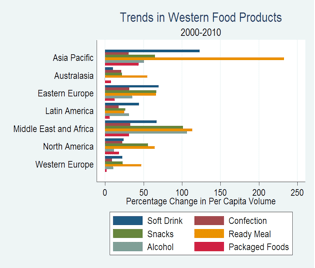
Unweighted Trends in Unhealthy Commodities, by Geographic Region,
2000-2010 and 2010-2015. Source: PLoS Medicine

Their article examines two main questions:
(1) Where is the consumption of unhealthy commodities rising most rapidly?
(2) What determines the pace and scale of these increases?
Based on analysis of market data on commodity sales in 80 countries, they offer five observations:
Observation 1. Growth of snacks, soft drinks and processed foods is fastest in LMICs (i.e. GDP≤USD12,500). Little or no growth is expected in HICs in the next 5 years.
Observation 2. The pace of increase in consumption of unhealthy commodities in several LMIC is projected to occur at a faster rate than historically in HICs.
Observation 3. Multinational companies have already entered food systems of middle-income countries to a similar degree observed in HICs.
Observation 4. Tobacco and alcohol are joint risks with unhealthy food commodities.
Observation 5. Substantial increases in consumption of unhealthy commodities are not an inevitable consequence of economic growth.
Observation 6. Foreign direct investment increases risks of rising unhealthy commodities among LMICs.
Trends in Tobacco and Alcohol Commodities, 1997-2010 and projected to 2016
Source: PLoS Medicine

The authors conclude that:
NCDs are the current and future leading causes of global ill health; unhealthy commodities, their producers, and the markets that power them, are their leading risk factors. Until health practitioners, researchers, and politicians are able to understand and identify feasible ways to address the social, economic, and political conditions that lead to the spread of unhealthy food, beverage, and tobacco commodities, progress in areas of prevention and control of NCDs will remain elusive.
For related posts on the role of the alcohol, tobacco and food industries in the production of NCDs , see here and here and here.
 Corporations and Health Watch