In his new book Salt Sugar Fat: How the Food Giants Hooked Us (New York, Random House 2013), Michael Moss describes how food companies entice customers with salt, sugar and fat to maximize sales and profits. Amy Goodman interviews Moss on Democracy Now.
Fighting the other NRA (National Restaurant Association) – Resources to support workers
Cross-posted from Appetite for Profit

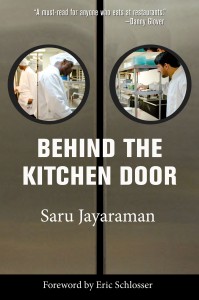
This week I’ve been writing about the National Restaurant Association (the other NRA) and why we should care about food workers, in part to bring attention to the new book Behind the Kitchen Door by labor advocate Saru Jayaraman. Today I want to offer practical resources for how to help improve the lives of the 20 million food workers who help us put food on our own tables every day.
Get Informed
In addition to buying the book, Behind the Kitchen Door, the following books and reports will help arm you with the information you need.
- American Way Eating: This book by Tracie McMillan opened my eyes to the plight of workers in the three settings where she went undercover for a first-hand experience: the farm fields of California, a Walmart in Michigan, and an Applebee’s in New York City.
- Fast Food Nation: This 2001 best-selling book by Eric Schlosser still resonates today, especially the description of the horrific dangers workers face in meat slaughterhouses, as well the exploitation of fast food workers.
- Hands that Feed Us: This report by the Food Chain Workers Alliance is the best overview I’ve seen on workers in every sector of the food industry: 1) production – farmworkers; 2) processing – slaughterhouse and other facilities; 3) distribution – warehouse workers; 4) retail – grocery workers; and 5) service – restaurant and other settings.
- Serving While Sick: This report from the Restaurant Opportunities Center based on national surveys revealed that 63% of workers reported cooking or serving while sick and that most faced high rates of exposure to dangerous working conditions.
- Dime a Day: This report from the Food Labor Research Center at University of California, Berkeley (which Jayaraman directs) explains how a reasonable increase in the minimum wage would have a minimal impact on food prices. As I have explained, scaremongering about higher food prices is a favorite talking point of the National Restaurant Association, regardless of the facts not supporting lobbyist claims.
- Tipped Over the Edge: This report from the Restaurant Opportunities Center documents disturbing gender inequalities in the restaurant industry. (71% of servers are female.) Women are kept in lower paying jobs and suffer from sexual harassment, among other mistreatment.
- The Color of Food: This report from the Applied Research Center examines the gender and racial divides across various food sectors, revealing a disturbing pattern of discrimination that keeps women and workers of color at the bottom of the food chain.
- Good Food and Good Jobs for All: Building upon the Color of Food, this report connects the dots between the good food movement and the dire need for labor reforms, recommending that we combine efforts.
Get Active
In addition to supporting campaigns to raise the minimum wage, both federally and in cities and states across the nation (sign this petition), please support the following organizations and campaigns:
- Coalition for Immokalee Workers: CIW’s hard work on behalf of farmworkers in Florida has resulted in numerous victories against such corporate behemoths as Taco Bell, McDonald’s, and Burger King. Check out their Fair Food Standards Council, which monitors conditions for tomato growers, their Anti-Slavery Campaign, which helps investigate the worst labor abuses, resulting in criminal charges, and join their March for Rights, Respect and Fair Food from March 3-17.
- Fast Food Forward: A movement of New York City fast food workers to raise the minimum wage, which is a paltry $7.25 an hour thanks to the powerful restaurant lobby there.
- Food Chain Workers Alliance: this amazing coalition of organizations brings together those who “plant, harvest, process, pack, transport, prepare, serve, and sell food, organizing to improve wages and working conditions for all workers along the food chain.”
- Restaurant Opportunities Center United: The group co-founded by Saru Jayaraman that works to improve the lives of 10 million restaurant workers. They have numerous locations in cities around the nation, as well as targeted corporate campaigns, such as Dignity at Darden. You can also download their handy Diner’s Guide (and app of course), which ranks the most popular restaurant chains on worker treatment.
- Unite Here Food Service: As anyone working on school food knows, food service workers are among the least respected professionals. Unite Here represents food service workers across the U.S. and Canada, in colleges, K-12 schools, corporate cafeterias, airports, stadiums and event centers.
- United Food and Commercial Workers Union: UFCW advocates for better conditions for 1.3 million workers in the U.S. and Canada, in grocery and retail stores and in the food processing and meat packing industries. Their largest locals include UFCW Local 1500 in New York City and UFCW Local 770 in Southern California.
- Warehouse Workers United: Among the least visible workers are those (mostly immigrants) moving tons of goods through the nation’s busiest ports often under deplorable conditions, en route to huge retailers such as Walmart. In 2011, I spoke on a panel with a warehouse worker who told his harrowing tale of abuse through a translator. He said the workers were treated like cattle. It was a humbling experience.
Finally here are a few tips about dining out that Saru Jayaraman suggests in Behind the Kitchen Door: 1) Talk to the workers to find out how they are treated; 2) ask restaurant managers about their promotion policies; and 3) adopt a definition of “sustainable food” that includes labor practices. As Jayaraman puts it so bluntly: it’s not enough to obsess over corn syrup or farm-raised salmon: “we absolutely must care about the health and sustainability of the workforce preparing, cooking, and serving our meals.”
Read Michele Simon’s other recent posts on food workers
Top 10 Reasons to Care About Food Workers
How the Other NRA is Making Us Sick
Why the Other NRA Loves the First Lady
The Other NRA: National Restaurant Association
Profits and pandemics: prevention of harmful effects of tobacco, alcohol, and ultra-processed food and drink industries
The 2011 UN high-level meeting on non-communicable diseases (NCDs) called for multisectoral action including with the private sector and industry. However, through the sale and promotion of tobacco, alcohol, and ultra-processed food and drink (unhealthy commodities), transnational corporations are major drivers of global epidemics of NCDs. In a new article in Lancet, investigators from the The Lancet NCD Action Group examine what role these industries have in NCD prevention and control. They emphasize the rise in sales of these unhealthy commodities in low-income and middle-income countries, and consider the common strategies that the transnational corporations use to undermine NCD prevention and control.
Four times more antibiotics sold for US meat and poultry production than to treat human illness
Based on a new FDA report, the Pew Charitable Trust Health Initiative finds that in 2011, four times the amount of antibiotics were sold for meat and poultry production as for treating human illnesses. Agribusinesses feed their animals antibiotics to make them grow faster and to compensate for overcrowded and unsanitary conditions. These practices contribute to the emergence of drug-resistant superbugs that make human infections more difficult and costly to treat. In 2011, more antibiotics were sold for use in meat and poultry production than ever before.
Is the ‘there is no such thing as bad foods, only bad diets’ argument helpful?
Food Navigator reports that a new position statement from the Academy of Nutrition and Dietetics (AND) which can be paraphrased as ‘there is no such thing as good and bad foods, only good and bad diets‘ is eminently sensible, but will play into the hands of ‘junk’ food companies opposed to any government intervention in their industry, claims NYU’s Marion Nestle.
Litigation: Food false advertising class actions on the rise
Throughout 2012, a wave of new false advertising class-action lawsuits in the food industry continued to roll forward, reportsInside Counsel, a newsletter for corporate lawyers. A powerful and well-financed consortium of plaintiffs’ attorneys, some of whom have in the past challenged big tobacco, asbestos manufacturers, the automobile industry and pharmaceutical companies, have set their sights on the food industry. “Food companies will argue that these are harmless crimes – the tobacco companies said the same thing,” said Don Barrett of the Barrett Law Group.
McDonald’s “educating” nutrition professionals

Cross-posted from Corporate Accountability International
 In the report I recently released, (covered by the New York Times) “And Now a Word from Our Sponsors,” I described the various ways the food industry influences the largest trade group of nutrition professionals – the Academy of Nutrition and Dietetics – through corporate sponsorship. While other corporations such as Coca-Cola play a more prominent role by being an “Academy Partner,” McDonald’s engaged in its trademark health-washing at the Academy’s annual meeting last fall.
To visit McDonald’s booth at the event’s expo hall, you would never know that it was the nation’s leading fast-food corporation. While several other companies (such as Kellogg) tried to get registered dietitians (RDs) to come to their booths for a free breakfast, McDonald’s was the most successful with this strategy. But they weren’t serving up the corporation’s common breakfast items like the Egg McMuffin or Sausage Biscuit. Rather, to visit the McDonald’s booth, you’d think the fast-food giant only sold oatmeal and smoothies. As I approached, a McDonald’s rep offered me some oatmeal, insisting that I just try it. (I declined, explaining that I make my own at home; I later learned that default version of McDonald’s oatmeal contains a whopping 32 grams of sugar.)
I asked a few RDs why they were there and they just said they were hungry. Fair enough, but it was clear that McDonald’s had succeeded in positioning itself as a purveyor of healthy food while feeding RDs breakfast. In addition, most of the banners at the McDonald’s booth showed images of healthy foods like smoothies, never mind the McRib or Big Macs. (See photos.)
McDonald’s also was spinning tall tales at an education session called “Making a Difference: Improving Nutrition at QSRs.” (QSR stands for quick service restaurant, industry’s euphemism for fast food.) While numerous other sessions were listed in the program as officially sponsored, this one was not. Moderating the panel was Ilene Smith, an RD with Porter Novelli, a public relations firm with a long list of Big Food clients, including McDonald’s.
The first panelist was a consultant to numerous fast-food chains who goes by “Dr Jo®” – yes, she actually trademarked her name. The other was Cindy Goody, director of nutrition for McDonald’s. Goody introduced the “McDonald’s nutrition team” (most were wearing red jackets, like a sports team), including several RDs and chefs.
This session was a 90-minute infomercial for the fast-food giant. In fact, when I turned to an RD sitting next to me afterward, that’s exactly what she called it. She told me she was disappointed because she came to the panel expecting substantive information about what chain restaurants were doing about nutrition. Instead, we saw slide after slide about how wonderful McDonald’s is for posting calories on its menus (never mind how the company lobbied for decades against menu labeling) and for adding apple slices to Happy Meals. Goody touted McDonald’s “commitment to children’s well-being… Now parents feel better feeding their kids Happy Meals.” But not a word about how the Happy Meals still contain hamburgers or fried chicken, and are marketed to young children. (Goody’s slides from that presentation are available online.)
When it came time for questions and answers, I was the only one willing to challenge what we just heard. I asked Goody why McDonald’s continued to market to children as young as age two, despite calls from public health professionals and others to stop exploiting kids. She simply repeated the same PR line about alleged nutrition improvements, without addressing the ongoing problem of marketing to kids. I was cut off when I tried to ask a follow-up.
Later I had a troubling conversation with an RD friend about this session. As I began to tell her about it, she countered that McDonald’s did not “have a session” at the event. I had to insist that I had witnessed it myself to convince her. This exchange demonstrated the problem with how the sessions are listed in the program. Because this particular panel did not say “Sponsored by McDonald’s,” this RD had no idea it was in fact a McDonald’s-run session.
Which made me wonder, how did McDonald’s get on the program in the first place, if it weren’t an official sponsor like the other food companies? Did Cindy Goody (or someone else at McDonald’s) actually submit an abstract to the Academy of Nutrition and Dietetics and apply to be a speaker? According to the Academy submission guidelines, proposals are “reviewed based on their individual merit and their application to the Academy’s strategic mission, vision and goals.” But how could McDonald’s PR spin possibly apply to the Academy’s stated vision of “optimizing the nation’s health through food and nutrition”?
I would expect McDonald’s to push its public relations agenda at a nutrition conference, but shame on the Academy of Nutrition and Dietetics for so readily offering up the forum in which to do so. You can read my full report (or the executive summary) on corporate sponsorship of the Academy, see photos of the expo and read what former members are saying about why they left.
Center for Science in the Public Interest translates Coca Cola ad into English
When Coca-Cola released “Coming Together,” a 2 minute ad addressing obesity, it was met with jeers and howls of laughter. Now that the laughter has died down, CSPI thought it would attempt to translate the ad’s Cokespeak into plain English. See the video.
Are America’s Nutrition Professionals in the Pocket of Big Food?
Cross posted from Appetite for Profit
Are America’s nutrition professionals in the pocket of Big Food? While the Academy of Nutrition and Dietetics’ 74,000-member trade group partners with the likes of Coke and Hershey’s, the nation’s health continues to suffer from poor diet. That’s the question Michele Simon asks in her new report, Are America’s Nutrition Professionals in the Pocket of Big Food? Here’s the Executive Summary.
By any measure, the nation is currently suffering from an epidemic of diet-related health problems. According to the U.S. Centers for Disease Control and Prevention,1 chronic diseases – such as heart disease, stroke, cancer, and diabetes – “are among the most common, costly, and preventable of all health problems.”
Against this backdrop, we must ask: what is the role of the Academy of Nutrition and Dietetics (AND)—the nation’s largest association of nutrition professionals—in preventing or at least stemming the tide of diet-related health problems? What responsibility does this influential group of registered dietitians bear to be a leading advocate for policy changes to make eating healthfully more accessible? Does forming partnerships with the food industry compromise such a group’s credibility? And what does the food industry gain from such partnerships?
Why does it matter? As this report will show, the food industry’s deep infiltration of the nation’s top nutrition organization raises serious questions not only about that profession’s credibility, but also about its policy positions. The nation is currently embroiled in a series of policy debates about how to fix our broken food system. A 74,000-member health organization has great potential to shape that national discourse – for better and for worse.
Findings:
- Beginning in 2001, AND listed 10 food industry sponsors; the 2011 annual report lists 38, a more than three-fold increase.
- The most loyal AND sponsor is the National Cattleman’s Beef Association, for 12 years running (2001-2012).
- Processed food giants ConAgra and General Mills have been AND sponsors for 10 of the last 12 years.
- Kellogg and the National Dairy Council have been AND sponsors for 9 of the last 12 years.
- Companies on AND’s list of approved continuing education providers include Coca-Cola, Kraft Foods, Nestlé, and PepsiCo.
- Among the messages taught in Coca-Cola-sponsored continuing education courses are: sugar is not harmful to children; aspartame is completely safe, including for children over one year; and the Institute of Medicine is too restrictive in its school nutrition standards.
- At AND’s 2012 annual meeting, 18 organizations – less than five percent of all exhibitors – captured 25 percent of the total exhibitor space. Only two out of the 18 represented whole, non-processed foods.
- Based on square footage, only about 12 percent of the expo floor was taken up by fruit and vegetable vendors, using AND’s own generous classification.
- The AND Foundation sells “nutrition symposia” sponsorships for $50,000 at the annual meeting. In 2012, Nestlé presented a session on “Optimal Hydration.” • The Corn Refiners Association (lobbyists for high fructose corn syrup) sponsored three “expo impact” sessions at the AND 2012 annual meeting.
- Roughly 23 percent of annual meeting speakers had industry ties, although most of these conflicts were not disclosed in the program session description.
- In an independent survey, 80 percent of registered dietitians said sponsorship implies Academy endorsement of that company and its products.
- Almost all RDs surveyed (97 percent) thought the Academy should verify that a sponsor’s corporate mission is consistent with that of the Academy prior to accepting them.
- A majority of RDs surveyed found three current AND sponsors “unacceptable.” (Coca-Cola, Mars, and PepsiCo.)
- The AND lobbying agenda reveals mostly safe issues benefiting registered dietitians. To date, AND has not supported controversial nutrition policies that might upset corporate sponsors, such as limits on soft drink sizes, soda taxes, or GMO labels.
- AND’s sponsors and their activities appear to violate AND’s own sponsorship guidelines.
- In 2011, AND generated $1.85 million in sponsorship revenue, which represents about 5% the total revenue. This is down from 9% in both 2010 and 2009.
- For the AND Foundation, corporate contributions were the single largest source of revenue in 2011: $1.3 million out of a total of $3.4 million or 38 percent.
- In 2011, the AND Foundation reported more than $17 million in net assets, more than six times its expenses for that year.
Recommendations
1) Greater Transparency: AND should make more details available to the public (or at least to members) regarding corporate sponsorship—far beyond what it currently provides in its annual reports.
2) Request Input from Membership: Trade group policies should reflect the desires of its members. Many RDs object to corporate sponsorship but don’t know how to make their voices heard.
3) Meaningful Sponsorship Guidelines: AND should implement much stronger and more meaningful sponsorship guidelines, possibly looking to the Hunger and Environmental Nutrition Dietetic Practice Group’s stricter guidelines as a model.
4) Reject Corporate-Sponsored Education: AND should reject outright corporate-sponsored continuing education, as well as corporate-sponsored education sessions at its annual meeting. AND should also consider placing more distance between its credentialing arm and the main organization.
5) Increased Leadership on Nutrition Policy: In recent years, AND’s leadership has taken important steps to improve its policy agenda and create a positive presence in Washington. However, while the staff in the D.C. office is lobbying on behalf of AND’s membership, “education sessions” are being taught to RDs by Coke and Hershey’s. This disconnect will continue to undermine AND’s credibility on critical policy issues until the conflicts are resolved.
The full report is available here.
Coca Cola launches new obesity ads
The New York Times reports that the Coca-Cola Company has launched a new television ad campaign aimed at getting on the healthy side of the national debate over obesity — a novel step for a company built on sugary soft drinks. Critics charged the company’s goal was to confuse, not educate the public.
 Corporations and Health Watch