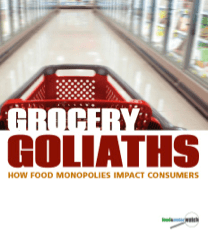
Grocery Goliaths: How Food Monopolies Impact Consumers

Last month, Food and Water Watch, a group that seeks to ensure that the food, water and fish we consume is safe, accessible and sustainably produced, released a report on concentration in the food industry.  The Executive Summary is posted below.  The full report is available here.

grocerygoliaths


Groceries are big business, with Americans spending $603 billion on grocery products in 2012. Big-box food retailers like Walmart and national grocery store chains now dominate the grocery industry. These mega-retailers are the biggest buyers of grocery products, and they exert tremendous power over food companies and ultimately farmers. This has led to a handful of food companies producing the majority of the products in the supermarket.


This growing consolidation of the food supply is severe at every step of the food chain, from farm to fork. And it impacts not only farmers and food manufacturers, but also consumers in the form of reduced consumer choices and higher grocery prices. Since the Great Recession started, grocery food prices rose more quickly than inflation and wages — twice as fast between 2010 and 2012. At the same time, the largest food, beverage and grocery retail companies pocketed $77 billion in profits in 2012. Nationally, the growing size and market power of the top grocery retailers has had tremendous ripple effects across the food chain. Food & Water Watch examined 100 types of grocery products and found that the top few companies dominated the sales of each grocery item in recent years.


Key Findings:


  • In 2012, more than half of the money that Americans spent on groceries (53.6 percent) went to the four largest retailers: Walmart, Kroger, Target and Safeway. Walmart alone sold nearly a third (28.8 percent) of all groceries in 2012.
  • The top companies controlled an average of 63.3 percent of the sales of 100 types of groceries (known as categories in industry jargon). In 32 of the grocery categories, four or fewer companies controlled at least 75 percent of the sales. In six categories, the top companies had more than 90 percent of the sales, including baby formula and microwave dinners.
  • Many firms sell multiple brands of the same product, which leads consumers to believe that they are choosing among competitors when they are actually just choosing among products made by the same firm that may have been made at the same factory. This is true across the board, including organic and healthful brands typically seen as independent, but which are being bought up by large food companies unbeknownst to consumers.
  • Supermarkets engage in a host of strategies to manipulate the shopping experience, encouraging consumers to make impulse and more expensive purchases that are unknown to consumers.
  • Regulators have largely left mega-retailers to operate unchecked as they invented new ways to extract value from consumers and even large food processors. It is time for regulators to step in to protect consumers and restore some semblance of competition for consumers in grocery stores, providing a chance for innovative, small or local food companies to get on store shelves.

Sugar Health Risk Cannot Be Compared to Smoking, Says Former UK Health Secretary Andrew Lansley

Health experts are wrong to claim that sugar is as dangerous as smoking, the former health secretary Andrew Lansley has said as he clashed with one of his old advisers on obesity, Professor Simon Capewell, reports the Guardian.  Lansley, a senior Conservative and now leader of the house, said people would not accept a rapid reduction in the sugar content of familiar foods, as he rejected calls from the Action on Sugar group for a 20% to 30% drop in the amount added to products. “Sugar is the new tobacco. Everywhere, sugary drinks and junk foods are now pressed on unsuspecting parents and children by a cynical industry focused on profit not health,” Capewell said.

Improper Use of Biocides in Food Industry Poses Risk to Public Health

Biocides used in food production at sub-lethal doses may be endangering public health by increasing antibiotic resistance in bacteria and enhancing their ability to form harmful biofilms, reports a new study published in Applied and Environmental Microbiology. Researchers found that biofilms boosted the risk of food contamination by providing a reservoir of microorganisms. They concluded that biofilm formation is a major virulence factor in human infections.

New Year’s Resolutions for a Healthier America


nye
Source

Each New Year, millions of Americans resolve to quit smoking, drink less alcohol and give up the high fat, sugar and salt diets that lead to expanding waistlines and higher risk of diabetes and heart disease.   Sad to say, however, most resolvers fail to realize their goals. According to the US Centers for Disease Control, fewer than one in ten smokers wanting to quit in 2010 actually succeeded.  For the 38 million adult Americans who report binge alcohol drinking, about 80 to 90% of those who try to stop can expect to relapse.  About 45 million Americans go on a diet each year but 80% of dieters fail to lose weight and a third actually gain.  Worse, almost 70% of US adults are now overweight or obese.


The cost of these failed New Year’s resolutions hurts not only the pride and well-being of those who try to make changes in their lifestyle.  According to the World Health Organization, overconsumption of tobacco, alcohol and unhealthy food are main causes of the growing burden of premature deaths and preventable illnesses from chronic diseases like diabetes, heart disease, cancer and stroke in the United States and around the world.  So why is so hard for us to give up the products that lead to early death, pain, and rising costs?


One main reason is that the big alcohol, food, and tobacco corporations that profit from this hyperconsumption have created a world where the easy choice is one that brings them profits, not the one that keeps us healthy.  They load their products with the nicotine, alcohol, sugar and fat that appeal to our vulnerabilities to addiction and our craving for release from stress and anxiety.  They market their products relentlessly, using every technology at their disposal to get under our cognitive radar so they can manipulate our own and our children’s most primitive fears and hopes. In 2012, the fast food industry spent $4.6 billion to advertise mostly unhealthy products, often targeting children and young people. It significantly increased use of internet advertising, allowing advertisers to bypass parental controls of television advertising.  Alcohol, food and tobacco companies make their products ubiquitous, cheaper and easier to find than healthier alternatives. To add insult to injury, these corporations and their trade associations use their political clout and campaign contributions to undermine public policies that protect health or make healthier choices more available. For example, when the Obama Administration suggested voluntary standards to restrict advertising  unhealthy food to children, a Reuters investigation last year found that the big food companies spent more than $175 million over three years lobbying to defeat the proposal.  


Given this corporate effort to promote consumption of products associated with the country’s most serious health problems, it’s hardly surprising that so many of us aren’t able to fulfill our New Year’s resolution to live healthier lives. So this year, let’s try some new resolutions:


1. Elect a Congress more willing to stand up to the tobacco, food, and alcohol industries. In the 2012 election, these three industries contributed more than $60 million to Congressional candidates in expectation of advancing their objectives of less regulation and lower taxes. In 2014, let’s resolve to support candidates who pledge to put protecting our health ahead of protecting corporate profit.


2.  Encourage our cities and towns to use their zoning power to make unhealthy products less ubiquitous.  Research shows that a lower density of alcohol outlets leads to less problem drinking, and fewer fast food outlets make it easier for people to choose healthier food.  Zoning laws were created more than a century ago to protect against earlier threats to health, such as polluted air and water, inadequate sanitation, and unsafe housing. Let’s now update our zoning rules to safeguard our communities against the promotion of alcohol, tobacco, and unhealthy food that cause today’s killer chronic diseases.


3. Encourage our mutual and pension funds, and our religious, hospital and university endowments, to stop investing in companies that profit from promoting diseases. Companies change their business practices when government regulation, consumer and investor pressure and market forces make it less profitable to stay the course than make changes. A few years ago CALPERS, the pension fund of California public employees, dropped all investments in tobacco.  In 2014, let’s resolve to begin a grassroots campaign to reward companies that end health damaging practices, and take our business and investments away from those who don’t.


4.  Support public health officials who seek to restore the visible hand of government to protect public health.  Proponents of market-knows-best have raised the bogey man of the Nanny State to defeat efforts to restrict marketing of tobacco, alcohol, fast food and soda. But it’s Nanny Ronald McDonald, Nanny Marlboro and Nanny Budweiser that are trying to persuade our children and young people to consume sickening products.  This year, let’s resolve to better protect our children from these bad nannies.


5.  Require corporations to pay for the health consequences of what they sell.  One important reason companies continue to profit from promoting unhealthy products is that they can avoid paying for the damage. Instead, they shift the costs for tobacco, alcohol and diet- related diseases to tax payers and consumers. By ending their ability to externalize these costs, new policies and laws could create incentives for companies to create healthier products.


As individuals, we have limited power to resist the pressure to consume the alcohol, tobacco and unhealthy foods that lead to early death and preventable illness. In 2014, let’s together resolve to create the environments and policies that make health the easy choice for all Americans. 


Nicholas Freudenberg is Distinguished Professor of Public Health at the City University of New York School of Public Health and author of  Lethal but Legal Corporations, Consumption and Protecting Public Health (Oxford, Feb. 2014). 

Holding Big Food Accountable for False Claims of Responsible Marketing to Children

Cross-posted from Eat Drink Politics

12.19

Looking back at 2013, while the food movement made progress in certain areas (such as school food and GMO labeling), when it comes to exploitative food marketing to children meaningful change remains elusive. Let’s Move director and White House chef Sam Kass recently acknowledged the obvious when he said this issue was “really tough” given how much money is at stake for industry.


All we seem to hear from the major food corporations about marketing to children are self-serving promises and announcements of future changes. As public health lawyers, that got us wondering, who’s making sure even these minimal commitments are being kept? The question is worth exploring if we want to actually improve children’s diets—not just create positive PR buzz for Big Food. With reports of adults ever-deteriorating eating habits in 2013 coupled with appalling teen heart health, the health stakes are too high to just wait for the food industry to do the right thing.


Following on past years, 2013 brought a steady-stream of failed voluntary efforts to protect children’s health:


  • A study comparing children’s fast food ads to adult-aimed ads found that McDonald’s and Burger King crafted messages targeting children with a focus on toy premiums and entertainment tie-ins. Such practices were in obvious violation of the companies’ pledges to follow the Children’s Advertising Review Unit’s (CARU) marketing guidelines, and occurred despite numerous CARU enforcement actions.
  • Ninety-one percent of ads for sugary cereals viewed by children were found to violate CARU’s guideline not to exploit children’s imaginations or mislead children about the benefits of using a product by associating sugary cereals with adventure, emotional appeals, play and fun.
  • The former director of nutrition at the Centers for Disease Control and Prevention criticized the food industry’s nutrition criteria for foods marketed to children as “based…more on the current products marketed by its members than on a judgment about what was best for children.”


Meanwhile, major corporations continued to pre-empt public criticism and make additional self-regulatory pledges in potentially misleading ways:


  • In May, at McDonald’s annual shareholder meeting, CEO Don Thompson made numerous questionable statements, including that his company was “not marketing food to kids” and “not marketing in schools,” and that they “follow guidelines on responsible marketing to children.” Each of these claims is false and deceptive. Shouldn’t there be some legal accountability for such irresponsible statements at a meeting of shareholders?
  • In June, the industry-led “Healthy Weight Commitment Foundation” jumped the gun on announcing how food corporations had met their pledge to reduce the number of calories in the food supply by 1.5 trillion. But the official scientific evaluation wasn’t (and still isn’t) yet publicly available. What if the real results differ from the industry spin, who is held accountable and what are the consequences if any?
  • In September, McDonald’s signed a “memorandum of understanding” with the Clinton Foundation regarding how the fast food giant markets soda with Happy Meals, but as one of us (Simon) uncovered, the fine print didn’t actually match the press release spin. While McDonald’s pledged to fix that misstep, many questions remain regarding the legal and policy implications of such agreements. Moreover, McDonald’s revealed that soda still accounts for 57 percent of the beverages it sells to kids.


One bright spot for government oversight of industry self-regulation this year was energy drinks. Energy drink makers found themselves in a perfect storm of criticism and public health concern from the FDA, state and local regulators, and the U.S. Senate. Research into energy drink self-regulation found widespread violations of pledges to not market energy drinks as a mixer with alcohol or like sports drinks. In August, a Senate committee held tobacco-style hearings with energy drink companies, calling on them to stop marketing to children. Whether energy drink marketing will improve remains to be seen, but government hearings are vital to pulling the curtain back on corporate abuses of public trust.


Holding the food industry accountable for lying about its ethical business practices has legal precedent. For example, in the late 1990s athletic shoemaker Nike came under fire for its labor practices. The company countered with a public relations campaign and public promises to improve its business conduct. When an independent review found that Nike had not followed through, the company was sued under California law for false advertising, unfair business practices, and negligent misrepresentation. After numerous appeals, Nike eventually agreed to settle the case for $1.5 million.


So far, litigation has played a limited role in holding the food industry accountable over junk food marketing to children. However, court action is proving to be a promising tool to stop deceptive food marketing claims like “natural.” Also, food marketers have been taken to court for deceptive health claims on children’s products. Just earlier this month, New York State Attorney General Eric Schneiderman announced a settlement with Abbott Laboratories over deceptive marketing of “Pediasure” products. In light of the mounting evidence of failed self-regulation of marketing to children, it also may be time to pursue Nike-style claims against the food industry for false pledges. If we are to truly hold Big Food accountable for promises about how it markets toward children, we need to use all the legal tools at our disposal.


Cara Wilking is senior staff attorney with the Public Health Advocacy Institute, Northeastern University School of Law.

Diet Sodas’ Glass Is Half Empty

The Wall Street Journal reports that sales of low-cal carbonated drinks falling faster than other types. Coca-Cola Co. and rivals had hoped zero-calorie recipes would lift the $75 billion U.S. soda industry after Americans began scaling back on full-calorie soda in the late 1990s amid obesity concerns. For a while they helped: Diet soda’s share of consumption rose from 26% to 31% between 1990 and 2010. Now diet soda is the industry’s weightiest problem. Store sales of zero- and low-calorie soda plunged 6.8% in dollar terms in the 52 weeks through Nov. 23, while sales of regular sodas dropped 2.2%. As a category, diet soda has contracted more than regular soda for three straight years.

New Soda Tax Makes Mexico a Leading Guardian of Public Health

In a Huffington Post commentary on Mexico’s new soda tax, Larry Cohen from the Prevention Institute calls the Mexican legislation “one big step towards slowing and reversing the epidemic of unnecessary and preventable disease.”  In a New York Times op ed, Mark Bittman notes that the new taxes result from “an increasing awareness that Mexico’s accelerating public health crisis could hurt its economy, and that only prevention would make practical the universal, single-payer health care system instituted last year.”

Industry’s Secret Plan to Get the Feds to Kill GMO Labeling in Every State

Cross-posted from EatDrinkPolitics


Internal documents from the Grocery Manufacturers Association reveal height of corporate chutzpah. Industry’s solution to GMO labeling is to: “Pursue statutory federal preemption which does not include a labeling requirement.”


11.20

With the disappointing results now in from I-522, the initiative in Washington State that would have required labeling of genetically-engineered food (aka GMOs), the looming question is, what’s next? At least for the junk food lobby, that answer in painfully clear: stop this state-level movement at any cost. In the New York Times, Stephanie Strom reports on the dirty details contained in industry documents that I obtained from the Washington State attorney general’s office in the wake of a lawsuit brought against the Grocery Manufacturers Association for illegally concealing donors to the No on 522 campaign.


As I explained back in February, the food industry’s ultimate game plan to stop the bleeding in the state-by-state onslaught of GMO labeling efforts is to lobby for a weak federal law that simultaneously preempts or trumps any state-level policy. While we have known that industry would want to put an end to the public relations nightmare happening state by state, this document for the first time reveals the lobbyists’ specific strategy.


The details are even worse than I thought and give new meaning to the word chutzpah. I had predicted a federal compromise, where industry would agree to a weak form of labeling in exchange for stripping state authority. But what industry wants instead is to stop state laws to require labeling, while not giving up anything in return. In their own words, the game plan is to “pursue statutory federal preemption which does not include a labeling requirement.”


Let me repeat that: The junk food lobby’s “federal solution” is to make it illegal for states to pass laws requiring GMO labeling. Period. End of story.


This is not the way preemption is supposed to work. A quick primer. Preemption simply means that a higher law trumps a lower law: so federal trumps state, and state trumps local. This is often the most economically feasible policy approach for business. But it’s also industry’s way of ensuring uniformity and stopping a movement in its tracks. Here is the pattern: a grassroots movement builds over time to enact local or state laws to protect public health or increase the minimum wage, or some other social goal, and industry fights these efforts for years, until they can no longer win. At that point, corporate lobbyists either get their own weak bill passed, or work with advocates to pass a compromise version. In exchange, this new law will preempt or prevent any state or city from passing a different or stronger law. It will also negate any law already passed. Forever.


But usually, there is some underlying legal requirement that industry must follow for the concept of preemption to even make sense. The idea is to require some action by industry, with the trade-off for companies to follow one standard instead of 50. Take menu labeling in chain restaurants as a good example. For that issue, there was also a grassroots movement in both states and cities around the nation. So when the National Restaurant Association had enough of fighting those bills, the lobbying group agreed to a federal compromise to require only calorie counts (a weak standard) in exchange for preemption, that is, not allowing any state or local laws to go further. In fact, the Grocery Manufacturers Association itself endorsed this plan.


But in the current GMA chutzpah scenario, the federal government would outlaw states from enacting GMO labeling, while food makers would not have to label their products. In other words, industry would stop the grassroots movement and not have to pay any price.


Now that the junk food lobby’s true agenda has been revealed, our federal representatives and officials are on notice: The food movement will be holding you accountable to ensure that this democracy-killing power grab does not come to fruition.


You can read the entire set of documents from GMA here. Much of the text is redacted, a sign that industry has a lot more to hide.

Advocacy for Reducing the Role of the Global Alcohol, Food and Beverage, and Tobacco Industries in Health Education


11.13.2 11.13.111.13


In recent decades, the alcohol, tobacco and food and beverage industries have become the leading global providers of public information about their products and their health impact, spending far more than governments or public health agencies to disseminate messages to consumers.


At the American Public Health Association meeting in Boston last week, Corporations and Health Watch sponsored a session that examined the implications of this corporate takeover for the discipline and profession of health education and for the prevention of chronic diseases, now the world’s leading killers.


First, Cheryl G. Healton, Dean of the  New York University Global Institute of Public Health and former CEO of the American Legacy Foundation described the role of the tobacco industry in promoting its products and compared its strategies to those used by the food and beverage and alcohol industries.


Next, Michele Simon from Eat Drink Politics and the author of Appetite for Profit examined the food and beverage industry. In her report And Now a Word From Our Sponsors, she described the ways the Academy of Nutrition and Dietetics collaborates with the food industry, jeopardizing the credibility of nutritionists and nutrition educators.


David H. Jernigan, the Director of the Center on Alcohol Marketing and Youth at the Bloomberg School of Public Health at Johns Hopkins University analyzed the role of the alcohol industry in educating consumers and policy makers about alcohol and described some of the ways the industry sought to influence alcohol policy.    


Finally, Nicholas Freudenberg from City University of New York School of Public Health and Hunter College, who served as moderator, discussed the roles that health educators and other public health professionals can play in mobilizing various constituencies to oppose the takeover of health education by the alcohol, food and beverage and tobacco industries. 

Clowning Around with Charity: How McDonald’s Exploits Philanthropy and Targets Children

Cross-Posted from  EatDrinkPolitics

11.6EXECUTIVE SUMMARY

The full report is available here.

Philanthropy is a common way for corporations to generate positive feelings among the public and the media. It is also a time-honored response to criticism of harmful corporate practices, such as McDonald’s lobbying efforts to thwart public policy and its aggressive marketing to children—marketing that demonstrably contributes to today’s epidemic of diet-related disease. And as this report reveals, the actual value of McDonald’s giving is relatively small compared to the corporation’s rhetoric.


With McDonald’s facing heightened scrutiny while being increasingly on the defensive over its role in harming child health, the corporation’s charitable activities deserve special examination. Several themes emerged over the course of our research into McDonald’s philanthropic activities that raise serious questions about the substance of the corporation’s charitable giving. They include:


• Promoting the McDonald’s brand unremittingly through Ronald McDonald House Charities, despite contributing only a fraction of the charity’s revenue.


• Taking undue credit for the generosity of its customers. For example, McDonald’s often claims the “donation box” contributions to Ronald McDonald Houses as its own.


• Selling unhealthy children’s menu items by linking their sale to very modest charitable giving.


• Profiting from marketing to children in schools under the guise of charity and education.


While other corporations have designated foundations, McDonald’s instead created a branded charity that is an extremely valuable PR vehicle. McDonald’s describes Ronald McDonald House Charities as its “charity of choice” but it’s really an extension of the McDonald’s brand. There is no question the cause is noble: mainly, providing rooms either in or near hospitals so parents can be close to their sick children during treatment. Little could be more important than giving families a comforting place to stay together during such stressful times. The cause’s importance, and the extent to which McDonald’s is serving versus exploiting that cause, is all the more reason for gaining a better understanding of McDonald’s involvement.


Major Findings

Value of McDonald’s Giving

• McDonald’s philanthropic giving is 33 percent lower than leading corporations.

• The average American earning over $50,000 donates 4.7 percent of their discretionary income to charity, which is 14 times more than what McDonald’s gives.

• McDonald’s spent almost 25 times as much on advertising as it did on charitable donations in 2011.


McDonald’s Giving to Ronald McDonald House Charities

• Based on available information, in 2012, on average, McDonald’s donated about one-fifth of the revenues of Ronald McDonald House Charities, the corporation’s “charity of choice”—yet McDonald’s enjoys 100 percent of the branded benefit of this charity.

• Local Ronald McDonald Houses use common disclaimers on their websites to explain how little McDonald’s contributes and to encourage community members to give.

• Local Ronald McDonald Houses (as distinguished from the global Ronald McDonald House Charities entity) report receiving only about 10 percent of their revenue from McDonald’s, including from direct customer donations.

• Ronald McDonald Houses report that the Ronald McDonald name causes many people to assume that McDonald’s provides 100 percent of the charity’s funds – and that this “common misperception” is “absolutely confusing.”

• The Ronald McDonald Care Mobile “Tooth Truck” (a project of the Ronald McDonald House Charities of the Ozarks) is 50 percent funded by taxpayer Medicaid funds, with the other half coming from community donations.


McDonald’s Marketing Disguised as Charity in Schools

• At events called “McTeacher’s Night,” teachers serve as free labor for McDonald’s while parents buy fast food to raise money for schools. While generously boosting sales for McDonald’s, the return for schools can equal as little as $1 per student.

• McDonald’s only donates about 15 to 20 percent of the proceeds from McTeacher’s nights, although the events are billed as fundraisers for schools.

• McDonald’s persistent targeting of school children violates its own self-regulatory pledge to not advertise in schools.


Recommendations

• McDonald’s should rename the Ronald McDonald House Charities organization it controls and stop licensing its brand to local chapters and houses to enable these entities to change their name.

• McDonald’s should retire Ronald McDonald and stop marketing to children.

• McDonald’s should conform to philanthropy best practices by being more transparent regarding its charitable giving practices.

• McDonald’s should abide by its voluntary pledge to not market in schools.

• Organizations and schools should reject McDonald’s “partnerships” and funding.


ACKNOWLEDGEMENTS

This report was written by Michele Simon. Many thanks to Seema Rupani for excellent research assistance, to Anna Lappé and the staff of Corporate Accountability International for creative input and much more, to Sarah Short and Susan Miller for financial expertise, to Haven Bourque for top-notch media outreach, and to Ross Turner for professional design. Special thanks to Josh Golin of the Campaign for a Commercial-Free Childhood for sharing research on McDonald’s in schools.


eatdrinkpolitics.com

stopcorporateabuse.org

smallplanet.org