Tracking the effects of corporate practices on health
Food & Beverage
The food and beverage industries supply the world’s population with the food they need to sustain life, but they also contribute to diet-related diseases, rapidly becoming the leading cause of global premature deaths and preventable illnesses, and also to food insecurity and malnutrition. This sector includes food and beverage retailers, distributors, manufacturers, food service and restaurants, food growers and agricultural supply companies.
For those who make a living teaching about health, August means getting ready for returning to the classroom and introducing new students to what we think is important. A basic premise of Corporations and Health Watch is that every health professional should understand something about the ways corporations influence health and what can be done to prevent or modify corporate practices that harm health.
To help CHW readers contribute to that goal, I suggest five books to add to public health, medical, nursing, social work or related course readings and discussions. These books have been published or updated in the last year or so, are available for less than $30, and can be used in a variety of courses including introductory public health, health policy, social and behavioral health, epidemiology or social epidemiology and more specialized courses.
I suggest books –in addition to the texts and journal articles we usually assign—because they give students an opportunity to read in more depth on a single topic, evaluate the range of evidence that authors present, and react to the opinions the authors draw from this evidence. The brief descriptions of each book are those provided by the publisher.
Corporations Are Not People: Reclaiming Democracy from Big Money and Global Corporations
By Jeff Clements, Updated Edition, 2014, Berrett and Kohler
Describes the new fabrication of rights and power for corporations and money, at the expense of the rights of human beings and of democracy itself. A resource for everyone who want to join the historic work to overcome partisan divides and re-engage in self-government by all Americans — community by community, state by state, and, ultimately, in Washington itself. This 2014 edition is updated throughout with surprising information and analysis about the impacts of unlimited money in federal, state, and even local elections; the spreading “corporate capture of the courts” resulting from the dangerous fabrication of “corporate rights” in the Constitution; and the growing, historic response from people of all political viewpoints to defend democracy and rebuild government of the people. A completely new chapter—“Do Something”- shows how thousands of so-called ordinary people are working to build the “most dynamic, grass-roots movement in the United States,” and offers “portals” for people to connect and act.
The Gun Debate What Everyone Needs to Know
Philip J. Cook and Kristin A. Goss, Oxford University Press, 2014
No topic is more polarizing than guns and gun control. From a gun culture that took root early in American history to the mass shootings that repeatedly bring the public discussion of gun control to a fever pitch, the topic has preoccupied citizens, public officials, and special interest groups for decades. The Gun Debate: What Everyone Needs to Know® delves into the issues that Americans debate when they talk about guns. With a balanced and broad-ranging approach, noted economist Philip J. Cook and political scientist Kristin A. Goss thoroughly cover the latest research, data, and developments on gun ownership, gun violence, the firearms industry, and the regulation of firearms. The authors also tackle sensitive issues such as the effectiveness of gun control, the connection between mental illness and violent crime, the question of whether more guns make us safer, and ways that video games and the media might contribute to gun violence. No discussion of guns in the U.S. would be complete without consideration of the history, culture, and politics that drive the passion behind the debate. Cook and Goss deftly explore the origins of the American gun culture and the makeup of both the gun rights and gun control movements.
Lethal But Legal Corporations, Consumption, and Protecting Public Health
Nicholas Freudenberg, Oxford University Press, 2014
Decisions made by the food, tobacco, alcohol, pharmaceutical, gun, and automobile industries have a greater impact on today’s health than the decisions of scientists and policymakers. As the collective influence of corporations has grown, governments around the world have stepped back from their responsibility to protect public health by privatizing key services, weakening regulations, and cutting funding for consumer and environmental protection. Today’s corporations are increasingly free to make decisions that benefit their bottom line at the expense of public health. Lethal but Legal examines how corporations have influenced — and plagued — public health over the last century, first in industrialized countries and now in developing regions. It is both a current history of corporations’ antagonism towards health and an analysis of the emerging movements that are challenging these industries’ dangerous practices. The reforms outlined here aim to strike a healthier balance between large companies’ right to make a profit and governments’ responsibility to protect their populations. While other books have addressed parts of this story, Lethal but Legal is the first to connect the dots between unhealthy products, business-dominated politics, and the growing burdens of disease and health care costs. By identifying the common causes of all these problems, then situating them in the context of other health challenges that societies have overcome in the past, this book provides readers with the insights they need to take practical and effective action to restore consumers’ right to health.
Bad Pharma: How Drug Companies Mislead Doctors and Harm Patients by Ben Goldacre (New paperback edition, 2014) Macmillan Publishers.
We like to imagine that medicine is based on evidence and the results of fair testing and clinical trials. In reality, those tests and trials are often profoundly flawed. We like to imagine that doctors who write prescriptions for everything from antidepressants to cancer drugs to heart medication are familiar with the research literature about these drugs, when in reality much of the research is hidden from them by drug companies. We like to imagine that doctors are impartially educated, when in reality much of their education is funded by the pharmaceutical industry. We like to imagine that regulators have some code of ethics and let only effective drugs onto the market, when in reality they approve useless drugs, with data on side effects casually withheld from doctors and patients. All these problems have been shielded from public scrutiny because they are too complex to capture in a sound bite. Ben Goldacre shows that the true scale of this murderous disaster fully reveals itself only when the details are untangled. He believes we should all be able to understand precisely how data manipulation works and how research misconduct in the medical industry affects us on a global scale. With Goldacre’s characteristic flair and a forensic attention to detail, Bad Pharma reveals a shockingly broken system in need of regulation. This is the pharmaceutical industry as it has never been seen before.
Food Politics: How the Food Industry Influences Nutrition and Health by Marion Nestle, University of California Press, Revised and Updated Paperback, 2013
We all witness, in advertising and on supermarket shelves, the fierce competition for our food dollars. In this engrossing exposé, Marion Nestle goes behind the scenes to reveal how the competition really works and how it affects our health. The abundance of food in the United States—enough calories to meet the needs of every man, woman, and child twice over—has a downside. Our overefficient food industry must do everything possible to persuade people to eat more—more food, more often, and in larger portions—no matter what it does to waistlines or well-being. Like manufacturing cigarettes or building weapons, making food is very big business. Food companies in 2000 generated nearly $900 billion in sales. They have stakeholders to please, shareholders to satisfy, and government regulations to deal with. It is nevertheless shocking to learn precisely how food companies lobby officials, co-opt experts, and expand sales by marketing to children, members of minority groups, and people in developing countries. We learn that the food industry plays politics as well as or better than other industries, not least because so much of its activity takes place outside the public view.
Just a week after Mexico banned commercials for soda, snacks and confectionery products during cinema showings of children’s movies and during children’s TV programming, reports Food Navigator, Mexican authorities say ads for Nestlé, PepsiCo, Coca-Cola, Hershey´s and Holanda products are already out of line with the new rules.
Sysco Corporation, the largest U.S. food distribution company will pay almost $20 million dollars in restitution, costs and penalties for the company’s illegal practice of holding perishable foods – such as seafood, milk and raw meat – in unrefrigerated sheds, reports Corporate Crime Reporter. Sysco food trucks would deliver some small food orders to unrefrigerated and unsanitary sheds. Sysco employees would then use their personal vehicles to deliver the unsafely held food to restaurants, hotels, hospitals and schools.
Late last month, the New York State Court of Appeals ruled that the New York City Board of Health exceeded the scope of its regulatory authority by adopting the “Sugary Drinks Portion Cap Rule”. The majority opinion concluded that in choosing this policy goal, the Board of Health “without any legislative delegation or guidance engaged in law-making and thus infringed upon the legislative jurisdiction of the City Council of New York.”
The New York Times called the decision “a major victory for the American soft-drink industry, which had fought the plan.” New York City Health Commissioner Mary Bassett noted that “Today’s ruling does not change the fact that sugary drink consumption is a key driver of the obesity epidemic, and we will continue to look for ways to stem the twin epidemics of obesity and type 2 diabetes by seeking to limit the pernicious effects of aggressive and predatory marketing of sugary drinks and unhealthy foods.”
So the strategy of reducing diet-related premature deaths and preventable illnesses by limiting portion sizes of sugary beverage appears to be off the policy table in New York for now. But the defeat of this approach to reducing sugar consumption does not change two simple truths.
First, all Americans—from the tax payers who pick up the burden of sugar-related health care to the low-income, Black and Latino populations that experience the highest burdens of obesity and diabetes—will benefit from reduced sugar consumption. Since most sugar we consume is “added sugar” – put in our food by food manufacturers rather than Mother Nature or our own spoons, the goal of health policy has focused on reducing these added sugars.
Second, most independent scientists agree that soda and other sugary beverages have played a major role in our epidemics of diet-related disease. Like the climate deniers, Coca Cola, PepsiCo and other Big Sugar producers (and the scientists they hire) work hard to undermine this growing consensus, but most international health organizations now agree that reducing global sugar consumption should be a priority for controlling diet-related diseases, after tobacco the world’s leading preventable killer.
The defeat of NYC’s portion cap provides health professionals and the food movement with the opportunity—and the responsibility— to deliberate on what policies might be most effective and feasible in reducing sugar consumption.
Eight Approaches to Reducing Added Sugar Consumption
Fortunately, many policy tools are available for lowering sugar consumption. The defeat of New York City’s soda portion cap provides public health and nutrition professionals and the food movement with the opportunity—and the responsibility— to deliberate on what policies might be most effective and feasible in reducing sugar consumption. In the last few years, advocates have often advanced soda policies without considering the range of options or strategizing what it would take to win. To avoid repeating this mistake, I briefly describe several of the policy approaches that have been proposed, then consider the characteristics of a good sugar policy. My goal is to encourage intense discussion among health advocates on next steps for sugar policy.
Education includes policies and programs that inform people about the risks of excess sugar consumption. It is based on the premise that changing people’s understanding of sugar and disease will lead to individual decisions to reduce consumption. Nutrition education that includes information about sugar can be offered in schools, health care institutions, community centers, churches, SNAP programs and in mainstream and digital media. More sugar education can be the result of other approaches described below, e.g., regulations for mandatory labeling of added sugar. Examples of sugar-focused education include the NYC Department of Health and Mental Hygiene’s Pouring on the Pounds media campaign, mandated sugar labeling or sugar warning on packaged food, and counter-advertising campaigns that adapt the lessons from the truth campaign, an effective anti-tobacco campaign that appealed to rebellious youths’ resistance to being manipulated by the tobacco industry that looked to profit at their expense.
A poster from Healthy CUNY’s student created Fight the Fizz Campaign.
Regulation describes government rules that result in less added sugar in our food. Regulations can require:
Government agencies to set standards for amount of sugar in food they serve (e.g., USDA rules for school food, New York City Food Standards for meal programs in city agencies)
Food makers or public agencies that serve food to limit size of portions or number of vending machines slots dedicated to sugary beverages or licensed retailers to limit portion size (e.g., defeated portion cap rule)
Food industry to label amount of sugar in product, post calories or put warning labels on front of packages of high sugar foods.
Public Benefits such as WIC and SNAP (food stamps) could set rules that limit the use of such benefits for products with high levels of added sugar. They could also provide incentives that encourage users to purchase only lower sugar foods. Currently, significant portions of the money spent on food benefit programs ends up as profits for manufacturers of high added sugar products, a case of public subsidies for these manufacturers and retailers and thus the diet-related diseases they cause. One study found that low-income children receiving SNAP benefits consumed 43 percent more sugar-sweetened beverages than low-income children not receiving SNAP, an uncomfortable finding that warrants policy attention. One proposal calls for incentives that would offer higher benefits for healthier foods. WIC recently set new food standards that included products with reduced sugar.
Public food programs in schools, hospitals, jails, child care, afterschool and senior centers use public dollars to buy food they serve their populations. Creating procurement policies that encourage reductions in added sugar can lower sugar intake for many at risk of diet-related diseases.
Taxation policies allow local, state or national to tax sugar or sugary products. Among the proposals have been:
Others have suggested alternative strategies to increase prices of sugary beverages including rules that set a minimum price for an ounce of soda (an approach to alcohol control in Scotland) and prohibitions on coupons and discounting.
Lower dietary guidelines for sugar consumption can contribute to public discussions and institutional and individual choices about food. Most such guidelines recommend limits on sugar consumption, although the levels vary widely. Americans now consume an average of 16 percent of their calories from added sugar. The USDA 2010 Dietary Guidelines urge American “to reduce the intake of calories from solid fats and added sugars” but do not give a quantitative goal for added sugar. A recent draft report from the British Scientific Advisory Committee on Nutrition recommended that the “dietary reference value for free sugars should be set at a population average of around 5% of dietary energy for age groups from 2.0 years upwards.” The World Health Organization has also recently proposed a 5 percent limit on calories from added sugar, acknowledging that such a target is now “aspirational”.
Ending Sugar Subsidies could reduce sugar consumption by increasing the price of added sugar. Currently several government programs subsidize sugar and the promotion of sugary diets. These include agricultural subsidies for growing sugar, tax breaks for the costs of advertising high sugar foods and for Big Sugar’s lobbying expenses, and the SNAP subsidy to producers and sellers of high sugar products.
Divesting from industries that continue to promote sugar consumption could lead some brand name companies to change their marketing practices. Corporate social responsibility campaigns forced Nestle to change its global marketing practices for infant formula, hastened the defeat of the apartheid government in South Africa and is now leading some universities to divest their holdings from coal companies. In the past, CALPERS, the nation’s largest health and pension fund that represents California state workers, has divested from tobacco and gun companies based on public health concerns. If every university and hospital decided to divest its endowment and pension funds from companies that continued to promote added sugar products to children, might that change food marketing practices?
Community Campaigns to cut sugar could enlist schools, hospitals, child care programs, universities and the other public and nonprofit institutions that serve food to millions of Americans to take a voluntary pledge to reduce the added sugar they serve by a fixed amount each year. Consumer groups could organize a similar campaign for chain restaurants, urging “buycotts” at outlets that took the pledge and boycotts of those that did not.
Lessons from Other Industries
In my book Lethal but Legal Corporations, Consumption and Protecting Public Health (Oxford University Press, 2014), I analyze the lessons that public health advocates can learn by comparing the strategies that the food and beverage, alcohol, automobile, pharmaceutical firearms and tobacco industries use to advance their business and political objectives. What guidance does such a comparison suggest for those promoting policies to reduce sugar consumption?
First, there is no magic bullet. None of these eight policy approaches can by itself reverse added sugar’s contribution to diet-related diseases. Each approach has strengths and weaknesses. But what tobacco activists taught us is that over time, multiple synergistic approaches lead to reductions in tobacco use. Sadly, it took fifty years to cut U.S. smoking rates in half, a delay that contributed to hundreds of thousands of premature deaths. By accelerating our multi-pronged efforts to reduce added-sugar, we can save more lives.
Second, we need to re-frame the debate from the rights of individuals to choose whatever products they want to the right of corporations to profit at the expense of public health. Corporations have spent billions in advertising, public relations and lobbying to frame the choice as individual freedom to choose Pepsi or Coke; 8 ounces or 40 ounces; highly sugared, substitute sugared or no sugar. By doubling down on what they perceive as a winning frame, Big Sugar hopes to delay action indefinitely. When tobacco activists succeed in changing the frame from the industry-favored “right to smoke” to the more public health oriented “right to breathe clean air”, policy victories followed.
What are the frames and slogans that will catalyze a similar transformation in the fight against Big Sugar? Some I like are: Which is more important: The right of parents and individuals to protect their children against marketing associated with preventable illnesses or the right of corporations to advertise as they please? Who do you trust more to look out for your children’s well-being: public health officials or the CEOs of Pepsi and Coke? When we succeed in getting elected officials, parents associations, professional organizations, and civil rights groups debating these questions, we’ll be on the road to policy successes.
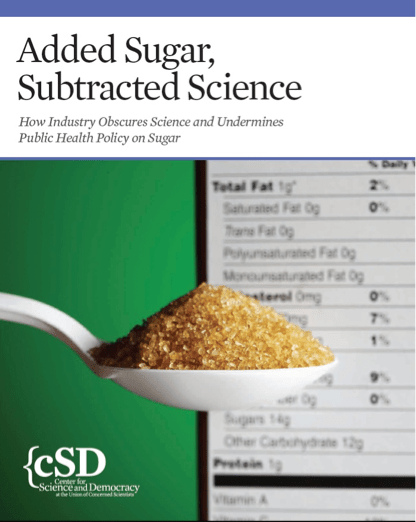
Third, to change the debate, we need to focus public attention on corporate obfuscation of science, manipulation of democracy, and deceptive marketing. In tobacco policy, the revelations that tobacco industry executives were lying to Congress and misrepresenting what they knew about the addictive and harmful effects of tobacco helped convince elected officials and the public that the industry was not a credible partner in policy debates. Two recent reports by the Union of Concerned Scientists lay out how the business and political practices of the sugar industry and its allies mislead the public, obscure science, and undermine health policy. Bringing this evidence into the policy debates on sugar can help to create a more favorable environment for better policy.
Fourth, we need to engagecommunities, constituencies and coalitions in creating and advocating for better sugar policy. Across the industries and anti-corporate campaigns that I examined, top-down strategies, ones that made no effort to elicit opinions from diverse constituencies, engage in respectful dialogue, or create broad-based coalitions were more likely to fail than campaigns that did listen, respect and involve. The most powerful asset that sugar reformers have is the power and desire of parents, families and communities to protect health, especially the health of children. Strategies that build this human capital are more likely to overcome the greater political and financial capital of Big Sugar and its supporters.
With “victories” like the portion cap rule, the soda industry may need some defeats
Finally, in planning next steps, we need to carefully considerwhat constitute victory or defeat. The prolonged debate on portion caps forced Big Soda to spend probably tens of millions dollars to defeat these policies in New York City and much more nationally. Money spent on lobbying and campaign contributions was money not spent on marketing sugary beverages or going into company profits. And during the debate, soda consumption in NYC fell even more than in the nation as a whole, as shown below. With “victories” like this, the soda industry may need some defeats. Policy and media debates that keep the public focused on the harms of soda consumption contribute to reduced soda consumption and pressure the industry to respond to public health concerns.
Source: New York City Department of Health and Mental Hygiene
In my view, it would be wrong to conclude that the failure of the portion cap rule suggest public health advocates should seek an accommodation with Big Sugar — a solution on which industry and advocates could agree. In the short run, the appeal of such appeasement is evident. But as we have learned in tobacco, industry efforts to reach accommodation with critics are often an attempt to co-opt stronger, more effective regulations and divide and weaken public health advocates. Conversely, the more public the debate about tobacco became, the more that industry was forced to make compromises.
Characteristics of good sugar policy
So here’s what a good strategy for added sugar policy should include. It should unite rather than divide potential supporters. Any single measure should be part of a comprehensive portfolio of policy approaches. Proponents should engage rather than lecture allies. Policies should focus attention on the practices of Sugar Industry and its supporters and not on the consumption patterns or choices of individuals. Its ultimate goal should be significant reductions in consumption of added sugar in order to reduce the incidence of diet-related diseases.
So together, let’s figure out how we get from where we are to where we want to be. Your summer assignment from this professor is to read some of the recent reports on sugar policy listed below. Talk with your colleagues and organizational partners about which policies can muster support now and which would be better as second steps. Anticipate Big Sugar opposition and plan how we can counter it. In the coming months, let’s see if we can find some ways that health and public health professionals, nutrition groups and the food movement can act together to prevent the premature deaths and preventable illnesses that those who profit from added sugar are imposing on our society.
Mejia P Nixon L, Cheyne A, Dorfman L Quintero F. Two communities, two debates:News coverage of soda tax proposals in Richmond and El Monte. Issue 21 Berkeley Media Studies Group, 2014.
Scientific Advisory Committee on Nutrition. Draft Report Carbohydrates and Health. This draft report from the United Kingdom’s top nutrition scientific group urges reduction in calories from sugar to 5%.
Zhen C, Brissette IF, Ruff RR. By Ounce or by Calorie: The Differential Effects of Alternative Sugar-Sweetened Beverage Tax Strategies. American Journal of Agricultural Economics. 2014; published online June 2.
The Food and Drink Federation (FDF), the voice of UK food and drink manufacturers published Ingredients for Success: Delivering Sustainable Growth Beyond 2015, setting out its agenda for working in partnership with government after the 2015 general election. Launched by FDF’s Director General Melanie Leech at the House of Commons, Ingredients for Success calls for an industrial strategy for the UK’s largest manufacturing sector driven by a new Food & Drink Manufacturing Council.
Perhaps the most visible advocate for improving school food, Michelle Obama is now defending what shouldn’t be such a controversial idea: adding fruits and vegetables to public school lunches. Ask any nutrition expert what foods Americans — especially kids — need more of in their diet, and the answer would be the same: fresh produce. But some Republicans, such as Rep. Robert Aderholt of Alabama, never seem to miss an opportunity to turn a no-brainer into a political battle, particularly when it comes to school food. (Who can forget the pizza as a vegetable debacle?) And just in time to give them the necessary cover, they got a gift from an unlikely source. The School Nutrition Association (SNA) has asked Congress to approve waiver requests for schools that are struggling to complywith federal nutrition regulations aimed at improving children’s health.
SNA represents the 55,000 school food directors, nutritionists and other professionals who have the tough and thankless job of feeding millions of schoolchildren every day. Some of its members no doubt face challenges implementing recent nutrition changes required by the feds, mostly caused by the six-cents-per-meal increase that Congress allotted, despite health advocates asking for $1 more. The Healthy Hunger-Free Kids Act, as it is called, requires several changes based on scientific evidence, such as lowering sodium while adding whole grains and fruit and vegetable servings, along with an increase in federal reimbursement rates.
But instead of finding ways to help schools comply with the new rules, SNA has instead decided to pick a fight with the first lady and dozens of other public health and child-advocacy groups (PDF).
SNA originally supported the law when it was passed in 2010 with bipartisan support. And by most accounts, the rollout of the new rules has gone smoothly. But along the way, SNA had a change of heart. Its waiver language was included, for instance, in the agriculture appropriations bill that was passed in late May. (What does the agriculture appropriations bill have to do with school lunches? Technically, nothing. It’s just a convenient political maneuver and an end run around the usual regulatory process.)
While good for only one year, the waiver could become permanent, as a recently released SNA position paper (PDF) indicates. Meanwhile, the Senate passed compromise languageto study the issue and has scheduled a hearing on child nutrition this Thursday.
How did this happen? That’s exactly what Michelle Obama would like to know. At a recent roundtable discussion covered by Politico, the first lady asked: “Why are we even having this conversation? Help me understand why, especially given the fact that the School Nutrition Association worked to pass the original changes in the nutrition standards.”
Nobody will take the School Nutrition Association seriously as long as sales of soda, pizza and muffins are paying their bills.
Part of the answer lies in a change in leadership, as reported by Jerry Hagstrom in the National Journal. A longtime lobbyist for SNA with close ties to the Obama administration was let go last year. It seems the new leadership is more inclined to let the group’s food industry connections interfere with doing the right thing.
Politico’s food and agriculture reporter, Helena Bottemiller, did some digging into SNA’s corporate connections. She spoke to several former presidents of the organization who said they are “worried that food companies have influenced the group’s agenda” because nutrition improvements “will take a big bite out of sales of popular items like pizza and salty snacks.”
It’s not a big stretch, given that half of SNA’s $10 million budget comes from food industry members, according to Politico. Much of the group’s revenue is generated at its annual conference, which brought in $4.7 million in 2012. At the meeting, Bottemiller found, “companies can pay $15,000 to sponsor an education session track featuring a company representative or $20,000 to put their logo on the hotel key cards.” The sponsors listed for the 2014 event, coming up in July, include such partners as Domino’s Pizza, Schwans (pizza again), General Mills, PepsiCo, Tyson Foods, Sara Lee and Muffin Town.
Predictably, SNA strongly denies any undue influence from its sponsors, despite the fact that they happen to have a hefty economic stake in the fight over school food.
“Proponents of the regulations are trying hard to explain away SNA’s efforts by spinning theories about industry influence,” SNA’s president, Leah Schmidt, told Politico. But, she said, “this is about our members, this is not about the food industry.”
How then, does she explain away a letter (PDF) signed by 19 former SNA presidents in support of maintaining the nutrition improvements? The letter urges Congress to “reject calls for waivers” and “maintain strong standards in all schools” and calls on the Department of Agriculture to provide additional technical assistance to help schools meet the new standards. So who is really representing school food professionals, and who is doing the bidding of the junk food industry?
SNA’s current leadership may truly believe it is speaking out on behalf of its members rather than its corporate funders; regardless, partnering with companies such as Domino’s and PepsiCo has tarnished the group’s reputation. Last year, I published a report exposing Big Food’s ties to the Academy of Nutrition and Dietetics, the trade organization representing the nation’s registered dietitians. The academy’s credibility, I argued, is compromised by its strong affiliations with corporations whose products and aggressive marketing tactics are harming the nation’s health. In both cases, these groups may have valid positions that just happen to align with those of the junk food lobby, but nobody will take them seriously as long as sales of soda, pizza and muffins are paying their bills.
Scientific evidence suggests that the overconsumption of sugar—whether from sugar cane, sugar beets, or corn syrup—has detrimental health impacts. Yet, Americans continue to eat excessive amounts of sugar, often without even realizing it, while our current food and health policies fail to address this growing public health risk. Why do Americans not know how much sugar they are consuming? Why is the public largely in the dark about the harmful effects of sugar? And why haven’t we adapted nutritional standards and food policies in response to the scientific evidence?
This report explores how sugar interests—food and beverage manufacturers along with industry-supported organizations such as trade associations, front groups, and public relations (PR) firms —have actively sought to deceive the public and ensure that Americans continue to consume high amounts of sugar. Through the use of many of the same tactics employed by the tobacco industry, sugar interests from various sectors have intentionally worked to interfere with the science that links consumption of added sugars to adverse health effects by attacking the science and spreading misinformation. They have hired their own scientists and paid seemingly independent scientists to speak to the academic community and to the public on behalf of the industry and its products. And they have launched sophisticated PR campaigns to influence public opinion.
Sugar interests have attempted to influence policy in the direction of continued high consumption of sugar by Americans. Their lobbying dollars, political contributions to lawmakers, and influence on rule making at federal agencies have all contributed to a lack of effective federal and state policies that would address the public health concerns of sugar consumption. Decision makers seeking to enact such policies have faced uphill battles, as sugar interests, through a combined force of these tactics, have swayed our public policies on food, nutrition, and health. But solutions are possible, and a number of initiatives are already being developed and implemented in many places across the country.
With the public’s health as the paramount consideration, communities and decision makers need to adopt policies that stand up against political and corporate influence and are informed by the scientific evidence demonstrating the harmful health impacts of added sugar. Sugar interests should be held accountable by scientific and public health experts, investors, decision makers, the media, and the public for their current efforts to obscure the science on sugar and its detrimental health effects. Ultimately, communities should be empowered to make democratic decisions about their food systems and public health.
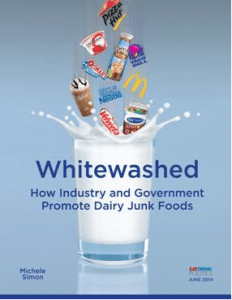
The United States is in the midst of a public health epidemic due to poor diet. While much of the focus has been on obvious culprits such as sugary soft drinks and fast food, dairy foods often get a pass. The dairy industry, propped up by government, has convinced us of the health benefits of milk and other dairy products. But the context of how people consume dairy matters. This report shines a light on the shifting patterns of consumption away from plain milk toward dairy products laden with sugar, fat, and salt.
Report Findings
Dairy Consumption Patterns
• Consumption of milk as a beverage has decreased nearly 50 percent since 1909
• About half of all milk is consumed either as flavored milk, with cereal, or in a drink
• Nearly half of the milk supply goes to make about 9 billion pounds of cheese and 1.5 billion gallons of frozen desserts–two-thirds of which is ice cream
• Cheese is the single largest source of saturated fat in the diet
• 11 percent of all sugar goes into the production of dairy products
Government Support for Dairy
• The federal government mandates the collection of industry fees for “checkoff programs” to promote milk and dairy
• USDA employees attend checkoff meetings, monitor activities, and are responsible for evaluation of the programs
• Checkoff money is not supposed to be used for lobbying but USDA gave $2.1 million to the U.S. Dairy Export Council, which lobbies for dairy products overseas
• The U.S. Supreme Court has upheld the legality of the checkoff programs as “government speech”, finding: “the message … is controlled by the Federal Government”
Fast Food Promotion Despite Checkoff Being for “Generic” Marketing
• McDonald’s has six dedicated dairy checkoff program employees at its corporate headquarters who work to ensure that dairy plays an important role in McDonald’s product development
• The dairy checkoff program helped Taco Bell introduce its double steak quesadillas and cheese shreds, which resulted in a four percent increase in the chain’s dairy sales
• The dairy checkoff program helped Pizza Hut develop a 3-Cheese Stuffed Crust Pizza and the “Summer of Cheese” ad campaign
• Between 2009 and 2011, Dominos benefitted from a $35 million partnership with the dairy checkoff program, resulting in the company adding more cheese, with other pizza makers following their lead
• Domino’s “Smart Slice” program brought the pizza to more than 2,000 schools in 2011, with help from the checkoff program
Dairy Junk Foods in Schools
• 70 percent of milk consumed in schools is flavored
• USDA’s milk checkoff program promotes “Chocolate Milk Has Muscle” and “Raise Your Hand for Chocolate Milk” campaigns to defend chocolate milk
• Industry leader Dean Foods’ TruMoo is a popular brand sold in schools; one serving of TruMoo strawberry milk = 21g of sugar
• Milk checkoff materials were used to change the mind of one school official who was planning to remove flavored milk
• The checkoff-supported “Fuel Up to Play” program contains health messaging that is contradictory to federal dietary advice
• Fuel Up to Play promotes chocolate milk in schools as a way for children to “Fuel Up” with protein and vitamins
Misleading Health Claims by USDA Checkoff Program Recipients
• “Cheese can fit into almost any eating plan”
• “Process cheese is made from natural cheese”
• “Cheese contributes essential nutrients for good health”
• “Studies show that when chocolate milk is not an option in the school meal line, many kids don’t drink any milk at all. That means they completely miss out on essential nutrients they need to think, learn and grow”
• “Chocolate milk is the perfect balance of vitamins, minerals, carbohydrates and protein—a combination that can’t be found in any other beverage”
• “What’s more important: a small amount of added sugar, or missing out completely on a powerful package of nutrients?”
Recommendations
The federal government should stop mandatory assessments of the dairy industry and put an end to the dairy checkoff program. At a minimum:
1) Checkoff funding should not promote dairy junk foods that conflict with dietary guidelines or health programs
2) Checkoff funding should not promote name brands such as Domino’s “Smart Slice” pizza in schools
3) Checkoff funding should not promote sugary milk in schools
4) Checkoff funding should not be used for the “Fuel Up To Play 60” program in schools due to questionable benefits
5) The federal government should closely review checkoff recipients’ materials to avoid deceptive or questionable nutrition and health claims
6) The federal government should conduct better oversight to ensure checkoff money is not used for lobbying
In Addition:
7) The federal government should not allow dairy junk foods to be approved as “Smart Snacks” in schools
8) The federal government should not allow sugary milk in school
9) The Women’s Infants and Children’s Program should not be exploited by the dairy industry to allow sugary yogurts
10) State governments such as New York State should stop subsidizing yogurt companies such as Chobani
The Burlington Free Press reports that Ben and Jerry ice cream maker Jerry Greenfield and Vermont Governor Peter Shumlin have teamed up to fight Monsanto’s effort to overturn a new Vermont law that will require labeling of genetically modified food. Ben and Jerry’s has created a new ice cream flavor, Food Fight Fudge, whose profits will contribute to Vermont’s Food Fight Fund.
Last week, the National Soda Summit met in Washington, D.C. to consider national and local strategies to limit consumption of sugary beverages. The conference brought together national and international experts, public health professionals and local, state and national policymakers to explore a comprehensive set of topics, including:
The latest science on sugar drinks and health
Lessons learned from past and current soda tax battles
Other policies that help limit the consumption of sugar drinks including government procurement standards, warning labels and capping portion sizes
Here are a few reports from the Summit:
Staff from ChangeLab Solutions led a workshop on their Sugar-Sweetened Beverages Playbook. The guide provides 10 strategies for communities and states to consider, organized in a sequence that the organization has seen many places follow. In general, communities and states begin with public education campaigns and work their way up to restrictions on the availability of SSBs. It is important to remember, says ChangeLab Solutions, that no single policy will substantially reduce SSB consumption or radically improve health. A collection of strategies, such as those listed in the playbook, will create environments that promote health.
Writing after the Summit, Sally Greenberg from the National Consumer League makes the case for a national soda tax.
Representative Rosa DeLauro (D-CT) addressed the second National Soda Summit via video, saying that a national soda excise tax would help address the serious damage sugar drinks are doing to our health.


 Bad Pharma: How Drug Companies Mislead Doctors and Harm Patients






 Corporations and Health Watch
