The Law Center to Prevent Gun Violence has analyzed the strengths and weaknesses of 30 new guns laws under consideration by the California state legislature in 2013.
PROTECT CHILDREN NOT GUNS 2013
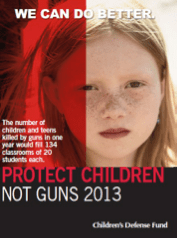
Last month, the Children’s Defense Fund released a new report, PROTECT CHILDREN NOT GUNS 2013. An overview and action steps are below. The full report is here.

Overview
2,694 children and teens died from guns in the United States in 2010.
The Children’s Defense Fund’s publication, Protect Children, Not Guns 2013, analyzes the latest fatal and nonfatal gun injury data from the U.S. Centers for Disease Control and Prevention for children and teens ages 0-19.
The U.S. has as many guns as people.
- The U.S. accounts for less than 5 percent of the global population, but owns an estimated
35 to 50 percent of all civilian-owned guns in the world.
- The most recent estimate of U.S. civilian gun ownership is as high as 310 million, about one gun per person. In contrast, U.S. military and law enforcement agencies possess 4 million guns.
- American companies manufacture enough bullets each year to fire 31 rounds into every one of our citizens.
A gun in the home increases the risk of homicide, suicide and accidental death.
- A gun in the home makes the likelihood of homicide three times higher, suicide three to five times higher, and accidental death four times higher. For every time a gun in the home injures or kills in self-defense, there are 11 completed and attempted gun suicides, seven criminal assaults and homicides with a gun, and four unintentional shooting deaths or injuries.
- More than half of youth who committed suicide with a gun obtained the gun from their home, usually a parent’s gun.
U.S. children and teens are 17 times more likely to die from a gun than their peers in 25 other high-income countries combined.
- U.S. children and teens made up 43 percent of all children and teens in these 26 countries but were 93 percent of all children and teens killed by guns.
- In 2010, children and teen gun death rates in the U.S. were over four times higher than in Canada, the country with the next highest rate, nearly seven times higher than in Israel, and nearly 65 times higher than in the United Kingdom.
- U.S. children and teens were 32 times more likely to die from a gun homicide and 10 times more likely to die from a gun suicide or a gun accident than all their peers in the other high-income countries combined.
A child or teen dies or is injured from guns every 30 minutes.
- 18,270 children and teens died or were injured from guns in 2010.
- 1 child or teen died or was injured every 30 minutes.
- 50 children and teens died or were injured every day.
- 351 children and teens died or were injured every week.
More children and teens die from guns every three days than died in the Newtown massacre.
- 2,694 children and teens died from guns in 2010.
- 1 child or teen died every 3 hours and 15 minutes.
- 7 children and teens died every day, more than 20 every three days.
- 51 children and teens died every week.
- The children and teens who died from guns in 2010 would fill 134 classrooms of 20 children
Guns are the second leading cause of death among children and teens ages 1-19 and the number one cause among Black children and teens.
- Only motor vehicle accidents kill more children and teens every year.
- White and Asian/Pacific Islander children and teens were nearly three times more likely, American Indian/Alaska Native children and teens more than two times as likely, and Hispanic children and teens one-and-a-half times more likely to be killed in a car accident than by a gun.
- In contrast, Black children and teens were twice as likely to be killed by a gun than to be killed in a car accident.
Although total gun deaths dropped in 2010 for the fourth consecutive year, gun death rates remained higher than in the early 1960s.
- In 2010, the rate of gun deaths in children and teens was 30 percent higher than in 1963, when data were first collected from all states.
- While Black children and teens have experienced the highest rates of gun deaths, the largest number of deaths has been among White children and teens. Out of the estimated 166,600 children and teens who have died from guns between 1963 and 2010, 53 percent were among White children and teens, and 36 percent were among Black children and teens.
- Between 1963 and 2010, 59,265 Black children and teens were killed by guns—more than 17 times the recorded lynchings of Black people of all ages in the 86 years from 1882 to 1968.
Since 1963, three times more children and teens died from guns on American soil than U.S. soldiers killed in action in wars abroad.
- 166,500 children and teens died from guns on American soil between 1963 and 2010, while 52,183 U.S. soldiers were killed in action in the Vietnam, Afghanistan, and Iraq wars combined during that same period.
- On average 3,470 children and teens were killed by guns every year from 1963 to 2010, or 174 classrooms of 20 children every year.
Nearly three times more children and teens were injured by guns in 2010 than the number of U.S. soldiers wounded in action that year in the war in Afghanistan.
- An estimated 15,576 children and teens were injured by guns in 2010.
- 1 child or teen was injured every 34 minutes.
- 43 children and teens were injured every day.
- 300 children and teens were injured every week.
- 5,247 U.S. soldiers were injured in the war in Afghanistan in 2010.
Children and teens die from gun violence in all states.
- Every state lost children to gun violence between 2000 and 2010. The number of deaths varied from 15 in Hawaii to 4,668 in California.
- The deadliest state was Alaska with 8.7 gun deaths for every 100,000 children and teens each year, more than twice the nationwide rate of 3.6. Alaska was 21 times more deadly for children and teens than Hawaii, the safest state.
Guns kill more children under 5 than law enforcement officers in the line of duty.
- 82 children under 5 died from guns in 2010, compared to 55 law enforcement officers killed by guns in the line of duty.
Children are more likely to be exposed to violence than adults.
- The 2008 National Survey of Children’s Exposure to Violence found that nearly two-thirds of children and youth had been victims or witnesses of violence within the past year.
- Nearly 1 in 10 children and 1 in 5 14-17 year-olds had witnessed a shooting at some point in their lives.
Black, Hispanic, American Indian and Alaska Native children and teens are disproportionately more likely to die or be injured by guns.
- In 2010, 45 percent of gun deaths and 46 percent of gun injuries were among Black children and teens, although they comprised only 15 percent of all children and teens.
- Black children and teens were 4.7 times more likely to die from guns than White children the same age, and 8.5 times more likely to be injured. American Indian or Alaska Native children and teens were 2.4 times more likely to die from guns, and Hispanic children were 3.3 times |more likely to be injured from guns than White children and teens.
- Black children and teens were 17 times more likely to die from a gun homicide than White children the same age.
- American Indian or Alaska Native children and teens had the highest rate of gun suicides, nearly twice as high as White children and teens.
Homicide is the leading manner of gun death among children and teens and assault the leading manner of gun injury.
- Children and teen gun deaths were most likely to be homicides; adult gun deaths were most likely to be suicides.
- Two out of three child and teen gun deaths were homicides; a little over one out of four were suicides.
- Among nonfatal gun injuries, a little over three out of four resulted from assaults while nearly one out of five was accidental.
Older teenagers are most at risk from gun violence, Black male teens are most at risk
- Eighty-six percent of gun deaths and 89 percent of gun injuries in 2010 occurred in 15-19 year-olds.
- Black males ages 15-19 were nearly 30 times more likely to die in a gun homicide than White males and more than three times more likely to die in a gun homicide than Hispanic males of the same age.
Total gun deaths and injuries in 2010 cost the U.S. $174.1 billion, or 1.15 percent of our gross domestic product.
- The 105,177 gun deaths and injuries to children, teens and adults that occurred in 2010 cost the nation $8.4 billion in medical and other direct costs, $52.5 billion in lost productivity and lost wages, and $113.3 billion in lost enjoyment of life.
Stand Up and Take Action
1. Urge your members of Congress to protect children from gun violence. Support commonsense gun safety and gun violence prevention measures for the nation including:
- Universal background checks;
- Limits on assault weapons and high-capacity ammunition magazines;
- Consumer safety standards, childproof safety features, and authorized-user identification technology for all guns;
- Better preventive and therapeutic services for children and families facing violence in their homes and communities and for children with unmet mental health needs;
- Adequate funding for gun violence prevention research and programs; and
- Resources and authority for the federal Bureau of Alcohol, Tobacco, Firearms and Explosives (ATF) and law enforcement agencies to properly enforce gun laws.
2. Urge state and local governments to protect children from guns. Urge your state legislators and local officials to:
- Support laws to prevent child access to guns including childproofing and keeping all guns secured from unsupervised children;
- Support universal background checks;
- Support limits on assault weapons and high-capacity ammunition magazines; and
- Oppose efforts to limit the ability of schools, physicians and others to warn parents and students about the dangers of guns.
3. Parents, remove guns from your home and be vigilant about where your children play.
4. Boycott businesses and products that glamorize and normalize violence.
5. Bring attention to the number of children killed and injured by gun violence and the truth about guns.
6. Offer parents, children and teens the resources, support and tools to survive and combat the culture of violence.
Firearms Industry Sues Connecticut
The Connecticut Mirror reports that the National Shooting Sports Foundation, a firearms industry trade group, filed a federal lawsuit accusing the Connecticut General Assembly of bypassing normal legislative procedures in passing its emergency-certified gun violence reduction bill. NSSF is based in Newtown near the elementary school where 20 children and six educators were shot to death on December 14.
Institute of Medicine Calls for Research on Gun Violence

Last week, the Institute of Medicine (IOM) released Priorities for Research to Reduce the Threat of Firearm-Related Violence, a report intended to inform scientific research that can guide policies to reduce gun violence. The report was in part a response President Barack Obama’s directive to the Centers for Disease Control and other federal agencies after the Newton Connecticut shootings to resume scientific research on gun violence. In 1996, at the behest of the gun industry and its supporters, Congress had ended most federal funding for research on gun violence.
In 2010, firearms injured or killed more than 105,000 Americans, with twice as many nonfatal firearm-related injuries (73,505) as deaths. “The complexity and frequency of gun-related violence combined with its impact on the health and safety of the nation’s residents make it a topic of considerable public health importance,” said Alan Leshner, chairman of the IOM study committee and chief executive of the American Association for the Advancement of Science. The IOM works outside of government to provide unbiased and authoritative advice to decision makers and the public.
The report calls for additional research on several topics including:
- The characteristics of firearm violence,
- Risk and protective factors,
- Interventions and strategies to reduce gun violence ,
- Gun safety technology, and
- The influence of video games and other media.
It proposes a research agenda that will produce results in three to five years. The report makes the case that “the evidence generated by implementing a public health research agenda can enable the development of sound policies that support both the rights and the responsibilities central to gun ownership in the United States. In the absence of this research, policy makers will be left to debate controversial policies without scientifically sound evidence about their potential effects.”
To illustrate the dangers of ideology rather than evidence-based policy, the report notes that while “firearm safety education programs are widespread in public schools… they are inadequately studied and the few evaluations that have been conducted provide little evidence of effectiveness.” This directly contradicts the NRA’s assertion that these programs have been shown to reduce gun injuries and deaths and should be the foundation of public policy.
The report is an important step forward in defining a research agenda on gun violence and provides scientific credibility for several important lines of research. But the IOM report is as important for what it does not say as for its recommendations. The term “gun industry” or “firearm industry” does not appear in the report. The words “National Rifle Association”, the organization that is the main obstacle to sensible gun policy, do not appear, except in the Appendix as identifications for two witnesses to the panel. The word “political” appears once and “campaign contributions” and “lobbying” not at all. These omissions are not surprising because in mainstream scientific discourse describing the political or corporate influences on research is as impolite and inappropriate as farting in public.
Some readers may argue that such criticism of a worthwhile report is unfair —this was after all a scientific report not a political analysis. But corporate practices have become an increasingly important influence on health and health policy. As the firearms, pharmaceutical, automobile, alcohol and food and beverage industries—among others—use their political and financial clout to influence health policy, failing to address these political dimensions makes it less likely that effective policies will emerge. Ignoring their role and failing to support research that documents industry influence on policy leaves advocates of healthier policies unequipped to succeed in the political arena where policies are shaped. It’s bad science and bad policy analysis.
As long as the behavior of corporations is off the polite scientific agenda, it will be difficult to design research studies or develop public health policies and programs that can address the most important causes of premature mortality and preventable illness and injury in the world today. In failing to discuss the need for research on the role of the gun industry and its supporters in gun violence, the IOM panel missed an important opportunity to educate the public, policy makers and scientists.
Gun Makers Saw No Role in Curbing Improper Sales
In a review of court documents from earlier lawsuits against the gun industry, The New York Times found that the industry’s leaders argued, often with detachment and defiance, that their companies bear little responsibility, beyond what the law requires, for monitoring the distributors and dealers who sell their guns to the public. The executives claimed not to know if their guns had ever been used in a crime. They eschewed voluntary measures to lessen the risk of them falling into the wrong hands. And they denied that common danger signs — like a single person buying many guns at once or numerous “crime guns” that are traced to the same dealer — necessarily meant anything at all.
U.S. Firearms Trafficking to Guatemala and Mexico
A new report from the Woodrow Wilson International Center for Scholars examines the role that the trafficking of US weapons into Guatemala may play a role in the continuing violence and criminality in that Central American nation. The report reviews an analysis that the US Bureau of Alcohol, Tobacco, Firearms and Explosives (ATF) conducted of weapons from two Guatemalan military bunkers in 2009. One bunker contained firearms and the other explosives and military ordnance.
How to Disarm the NRA and Gun Industry Lobbyists
Last year, writes J. Adam Skaggs of the Brennan Center for Justice in the New York Times, the N.R.A. outspent the leading gun control lobby 73 to 1. Senators facing tough re-election campaigns ignore the wishes of 90 percent of Americans because they fear the gun lobby could mount a $9 million ad campaign against them. The solution to this political dysfunction is to empower regular voters as a counterweight to big political money. The Empowering Citizens Act, sponsored by Representatives David Price and Chris Van Hollen, would do precisely that. By matching grass-roots donations from regular voters with public funds, the system would give Congressional candidates an alternative path to victory in which they depend on constituents and voters, instead of deep-pocketed donors seeking political favors.
UN General Assembly approves Small Arms Trade Treaty
The New York Times reported last week that the United Nations General Assembly voted overwhelmingly to approve a pioneering treaty aimed at regulating the enormous global trade in conventional weapons, for the first time linking sales to the human rights records of the buyers. Although implementation is years away and there is no specific enforcement mechanism, proponents say the treaty would for the first time force sellers to consider how their customers will use the weapons and to make that information public. The goal is to curb the sale of weapons that kill tens of thousands of people every year.
Second chance for governments to make history and agree to an Arms Trade Treaty
Cross posted from Oxfam

“Seeing young boys carrying AK-47’s, and young girls with their babies in one arm and a gun in the other was a frightening sight.”
Djimon Hounsou
Actor and Oxfam ambassador
Governments from over 190 member states have a second chance to make history this month by agreeing the first ever Arms Trade Treaty, a coalition of NGOs and human rights groups said.
Diplomats are meeting in New York for two weeks of negotiations at the United Nations, to agree an Arms Trade Treaty, which will control the international supply of arms and ammunition.
The Control Arms coalition, supported by Academy Award nominee Djimon Hounsou, urged diplomats to use the time effectively to close the massive loopholes in the current draft text and agree a treaty that will truly save lives.
In July 2012, member states were unable to reach agreement on the ATT after a number of countries including the US and Russia requested more time in the final hours of negotiations. Since July, there have been indications that some of those major exporters are more open to agreeing a treaty this time around.
Bring the arms trade under control
“It’s ‘crunch time’ in New York this week. The negotiations must successfully deliver a strong treaty text as the world can wait no longer for a global treaty to bring the arms trade under control. Too many unscrupulous regimes, militias, arms dealers and criminals can easily get their hands on dangerous weapons. Too many innocent civilians including teachers, doctors or children die as a result of the current situation. It’s now time to put an end to this and agree on robust and clear rules that will bring the trade of M16s, AK47s, attack helicopters and countless rounds of ammunition under control,” said Anna Macdonald, Oxfam’s Head of Arms Control.
“Seeing young boys carrying AK-47’s, and young girls with their babies in one arm and a gun in the other was a frightening sight, like something out of a Hollywood movie, but for me it was a painful reminder of what I myself could’ve become,” said Djimon Hounsou, Actor and Oxfam ambassador. “But it’s apparent that the people of South Sudan long for peace with both their brothers to the north and within their own borders.”
“It doesn’t solve every problem, but a strong Arms Trade Treaty on weapons and ammunition is not something we can question. It is something we must act upon; today,” continued Hounsou.
The Control Arms coalition said that the draft text from July 2012 contains many of the basic elements needed to better regulate the global arms trade. However, the campaigners say the text also includes a number of weaknesses which threaten to fatally undermine the treaty’s overall effectiveness.
Several weaknesses and loopholes
In its current form, Control Arms believes, the treaty does little to increase responsibility and restraint in the global arms trade. One major concern is that ammunition, a deadly trade worth more than $US4 billion annually, is covered by weaker provisions than other types of weapons.
“We cannot have a treaty that regulates the trade in arms but excludes one of the main causes of death: the bullets. Some conflicts in Africa have been prolonged because of the ability of combatants to reload. We need to regulate how ammunitions are transferred from the production line, to the end destination,” said Geoffrey Duke, National Coordinator of the South Sudan Action Network on Small Arms (SSANSA).
Another clause could exempt weapons transfers from the treaty if they are labeled as being part of a “national defence cooperation agreement”. This clause, introduced by India, would mean that transfers made under existing defence contracts, between Russia and Syria for example, would be allowed to stay outside of the jurisdiction of a future treaty.
Control Arms is also worried that the criteria that set out whether or not an arms transfer is permissible are too weak and contain loopholes that could allow some irresponsible deals to continue to slip through the net.
“These ‘escape clauses’ have been pushed by a vocal minority of states. They want a Swiss cheese Treaty, full of holes to continue their deadly trade with impunity. The majority of governments who are craving for a safer world must speak out and get the most robust ATT agreed in two weeks’ time,“ said Allison Pytlak, Campaign Manager at Control Arms.
Oxfam has also recently published a report Getting it Right: The pieces that matter for the Arms Trade Treaty
A vicious circle: Declining sales lead gun and sugary beverage corporations to hypermarketing and hyperlobbying

A recent report in the New York Times found that the share of American households with guns has declined sharply over the last forty years. In the 1970s, an average of 50 percent of American households owned guns; by 2012 the proportion had fallen to 34 percent.
The decline in gun owner was most precipitous among younger Americans, reports the Times. Household ownership of guns among elderly Americans remained virtually unchanged from the 1970s to this decade at about 43 percent, while ownership among Americans under the age of 30 fell to 23 percent this decade from 47 percent in the 1970s. The survey showed a similar decline for Americans ages 30 to 44.
Declining Soda Sales

As shown in the chart to the left, consumption of carbonated soft drinks, sugary and diet beverages associated with a variety of health problems, has also declined in the United States. It fell from a high of 2.4 eight ounce servings per week in 1998 to a low of just under 2 in 2011, a drop in per capita consumption of about 16 percent since the peak in 1998, according to Beverage Digest, a trade publication.
Hypermarketing and Hyperlobbying
What’s the connection between the declines in these two very different legal but lethal products? In both cases, demographic changes in the consumer market and public health campaigns contributed to decreased sales. In both cases, the response of the industry was to amplify its marketing and lobbying campaigns in an effort to reverse these declines.
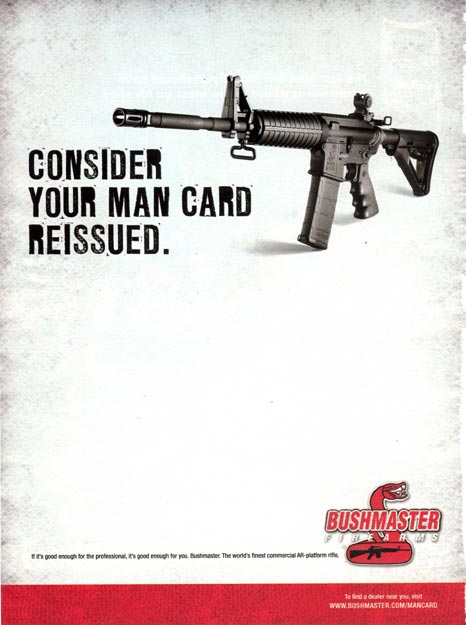
The gun industry stokes the apprehension that each mass shooting and each proposed gun safety measure may lead to the confiscation of the more than 300 million guns American own. The NRA has learned that generating fear helps to sell guns, further strengthening its alliance with the gun makers who help to fund it. For the gun industry, declines in sales have led to new efforts to advertise to men (“Consider your man cared reissued”, says Bushmaster) and women. The New York Times described an advertisement by Colt in the 1990s that showed a mother tucking a child into bed — “Self-protection is more than your right … it’s your responsibility,” the ad said.
According to the Wall Street Journal, a prolonged drop in U.S. soda revenues would represent a serious blow to the beverage industry since soda represents nearly 25% of the U.S. beverage market. For decades, its massive scale has also guaranteed profit margins for decades. To counter the threat, PepsiCo has invested hundreds of millions of dollars in marketing to turn around its U.S. soda business after losing market share to Coke. In January, Coke launched new television ads this week to counter consumer concerns about obesity and moves by officials to restrict soda sales.
So here’s the problem: public health successes in reducing demand for unhealthy or dangerous products leads industries to double down on marketing the unhealthy product in an effort to overcome declining sales. This effort can take several forms. It can lead to increased advertising to the same market or to new market segments (e.g., youth, women, Blacks and Hispanics) that are seen to present opportunities for growth. Or it can lead industries to take their unhealthy products overseas—the soda industry is hoping to restore global profits in China, India and elsewhere. Finally, as we have seen with the gun and soda industries, the campaign to restore sales can lead to aggressive political efforts to discredit the science and public health messages that contribute to declining sales or to remove or water down regulations or taxes that might further discourage sales.
In these cases, corporations are simply fulfilling their mandate to maximize profits. For public health, however, this hypermarketing and hyperlobbying presents a “can’t win for losing” dilemma. If our successes accelerate the very practices we seek to end, then perhaps we need to consider broader and deeper strategies for modifying the business and political practices that harm public health.
 Corporations and Health Watch