A new video by Cuéntame and the Washington Office on Latin America, part of a campaign to stop gun smuggling into Mexico, shows the lines of accountability in the gun trade. According to official data, “Over the last 5 years, nearly 60,000 people have lost their lives in Mexico’s drug-related wave of violence. More than 70% of the weapons seized in Mexico in the last three years and submitted for tracing came from the U.S.”
UN Fails to Agree to Arms Trade Treaty
One person every minute dies from armed violence around the world, and arms control activists say a convention is needed to prevent illicitly traded guns from pouring into conflict zones and fueling wars, criminal violence and atrocities. Last week, however, delegates from 170 nations who had spent the last month negotiating a treaty, announced their failure to reach agreement, at least for now. Ultimately, reports Reuters, arms-control activists blamed the United States and Russia, two of the world’s largest arms exporters, for the inability to reach a decision, as both countries said there was not enough time left for them to clarify and resolve issues they had with the draft treaty.
Can a New United Nations Arms Trade Treaty Reduce Gun Deaths?
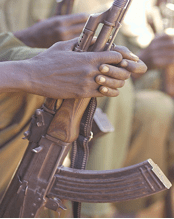

This month, representatives from more than 100 governments and 100 Non-Governmental Organizations (NGOs) are meeting at the United Nations in New York to work out a new global arms trade treaty by a July 27 deadline. The goal is to establish common standards for the import, export, and transfer of conventional arms and ammunition, a business worth about $55 billion a year. A report by the British government estimates that at least 400,000 people are killed by illegal small arms and light weapons each year while armed violence is responsible for more than 740,000 deaths annually. Many more people are injured. A recent report by the International Action Network on Small Arms and Amnesty International concluded that the “use of firearms in non-conflict settings is the most prevalent form of armed violence and the form that results in the most deaths and injuries. This fact underscores the importance of adopting an approach to addressing armed violence that will encompass violence outside of armed conflict settings.”
The UN meeting, three years in the works, has the opportunity to reduce this death toll by moving the illegal gun trade into the open with verifiable international standards that are enforced by national governments.
Several obstacles could block a successful outcome. First, a few governments and some powerful NGOs like the National Rifle Association (NRA) oppose the inclusion of small arms. On July 11, NRA CEO Wayne LaPierre told the UN meeting, “The only way to address NRA’s objections is to simply and completely remove civilian firearms from the scope of the treaty. That is the only solution. On that, there will be no compromise.”
And in the usual NRA-gun industry tag team, Richard Patterson, the managing director of The Sporting Arms and Ammunition Manufacturers’ Institute, one of the NGOs participating in the deliberations, testified “that hundreds of millions of citizens regularly use firearms for the greater good” and that a “treaty that does not support the positive use of firearms is doomed to cause more harm than good.”
In an alliance that show that guns make strange bedfellows , several states, including China, Egypt, Ethiopia, Venezuela, and Iran also oppose inclusion of small arms in the treaty. In a statement released last week at the UN meeting, the government of Iran echoed Wayne La Pierre:

In our view, a well-defined and universally accepted scope for a potential Arms Trade Treaty would be a determining factor in the acceptance of its provision. In this regard, we are not in favor of the inclusion of missiles, Small Arms and Light Weapons and ammunition in the scope of the treaty.
According to The Hill, proponents of the treaty say the NRA’s concerns are unfounded since the treaty has no impact on the domestic gun trade and leaves national governments with the power to enforce the treaty. These treaty supporters assert that the exclusion of civilian weapons would gut the effort to keep deadly arms out of the hands of terrorists, criminals and rogue regimes.
Another conflict is about the role that NGOs can play in the meeting. For many governments, national security concerns may trump reducing deaths from illegal guns. Thus, keeping the meeting open can help to keep the spotlight on health and human rights. Yet last week, treaty organizers moved to close half the sessions to all but government delegates. Anna MacDonald, the Head of Control Arms Campaign for Oxfam explained the objections:
The arms trade is often a shadowy business with arms deals being conducted in isolation, behind closed doors. The Arms Trade Treaty is attempting to shed some light over this trade and ensure that we have transparent and robust laws to prevent arms ending up in the wrong hands. Thanks to a tiny minority of countries it now seems like negotiations on the Arms Trade treaty will also become secretive.
This secrecy may make it harder to keep the focus on reducing deaths from the illegal arms trade. As Frank Jannuz, from Amnesty International USA and Daryl G. Kimball of the Arms Control Association argued in a recent op ed in The Christian Science Monitor:
To succeed, the assembled ambassadors must put sons over guns and daughters over slaughter. At a minimum, the new treaty should require states to withhold approval for the international transfer of arms in contravention of UN embargoes or when there is a substantial risk the items will be used to commit serious violations of human rights. Despite its strong, pro-human rights rhetoric, the Obama administration has not yet endorsed such a formula.
If the UN members at the meeting agree on a final document by July 27, the treaty would still need to win a two-thirds majority in the Senate to be binding on the United States. The NRA has vowed to prevent that.
Federal Judge Finds Florida Gun Gag Law Burdens Doctors’ Free Speech
Late last month, reports Bloomberg News, Florida federal judge Marcia Cooke, an appointee of President George W. Bush, struck down Florida’s “gun gag” law. The legislation sought to restrict physician inquiries into patients’ gun ownership. According to Judge Cooke, the legislation signed by Florida Governor Rick Scott inserted the state “in the doctor-patient relationship, prohibiting and burdening speech necessary to the proper practice of preventive medicine, thereby preventing patients from receiving truthful, nonmisleading information.”
NRA and Gun Industry Love New York Politicians
In the last nine years, reports the New York Daily News, the National Rifle Association has sent New York politicians more campaign donations than in any other in state in the nation. Since 2003, the NRA has reported giving New York legislators and political committees $217,400 — the organization’s largest outlay over that period. In addition, the National Shooting Sports Foundation, the firearms industry trade association, contributed another $103,500, including $80,000 to the Senate Republican Campaign Committee in 2010. In addition, the two groups have also spent a combined $159,000 in lobbying in New York since 2009. The prime target – successful so far — has been to defeat Mayor Bloomberg’s push for microstamping of bullet casings, which backers say would be an effective crime fighting tool. Ironically, Bloomberg is also a large donor to New York State Senate Republicans.
Glock: The Book
A recent review of the book “Glock: The Rise of America’s Gun,” by Paul Barrett in the Washington Post described the book as “a story of innovation, manufacturing, marketing, money, lawsuits, power, influence, politics and a little sex.” Barrett “explains how the company was able to remain profitable despite allegations of corruption, tax avoidance and malfeasance. A seasoned reporter and now assistant managing editor of Bloomberg Businessweek, Barrett originally covered the more disturbing allegations of Glock’s financial and managerial irregularities in a series of articles for the magazine.
Surge in Gun Ownership Boosts Gun Industry
Bloomberg News reports that domestic handgun production and imports more than doubled over four years to about 4.6 million in 2009, citing the National Shooting Sports Foundation, a gun-industry trade group. In addition, reports USA Today, on this year’s Black Friday, the holiday shopping bonanza that follows Thanksgiving, gun retail sales surged to 129,166, far surpassing the previous single day high of 97,848 on Black Friday of 2008.
Freedom Group Leads in Gun Sales
In the 12 months that ended in March 2010, the Freedom Group, a new company created by the private investment group Cerberus Capital Management, sold 1.2 million long guns and 2.6 billion rounds of ammunition. Its rapid growth makes it a major player in the international arms market. In an in-depth report, the New York Times profiles the creation and growth of this new weapons behemoth. Stephen Feinberg, the founder and CEO of Cerberus, specializes in buying companies cheap, restructuring them and selling at a profit. In the first nine months of 2011, gun sales at the Freedom Group were up 5.6 percent.
NRA and Gun Industry Team Up to Oppose UN Small Arms Treaty
“I just delivered a message to those anti-gun elitists at the United Nations, who are meeting to discuss ways to craft an Arms Trade Treaty (ATT) that could go after your Right to Keep and Bear Arms,” wrote Wayne La Pierre, Executive Vice President of the National Rifle Association of America recently.
Beginning in 2001 at the first UN Conference on Illicit Trade in Small Arms and Light Weapons, the United Nations has convened member states to draft a treaty to regulate the international trade in small arms, a treaty scheduled to be ready for a vote in July of next year.
At the behest of the arms industry and the NRA, the US has for the most part opposed the treaty. Now some gun proponents are worried they can’t depend on the Obama Administration to defend their interests. To date, 57 senators have vowed they will not approve a treaty that in their view undermines the Second Amendment. The small arms the treaty addresses are weapons estimated to contribute to about 200,000 deaths a year, a body count that does not include those killed in military conflicts. Other groups, including the International Physicians for the Prevention of Nuclear War (IPPNW) have supported the treaty, claiming it would help to slow illegal gun trafficking and the diversion of arms to gangs, drug dealers and terrorist organizations. “By recognizing the interconnectedness of the unregulated arms trade, armed violence and the undermining of human rights, including implicitly the right to health, a robust ATT would help prevent the misuse of arms and thus reduce resultant deaths and injuries,” noted Dr. Robert Mtonga MD, IPPNW co-president.
New Montana Nonprofit to Advocate for Gun Industry
The Montana Firearms Institute was launched last week, according to the Flathead Beacon, a weekly newspaper in the Flathead Valley of Montana. The Institute seeks to foster communication between firearms businesses, help those small businesses compete for lucrative government contracts, and lobby at the legislative level for policies favorable to the industry. “It’s great that MFI wants to put Montana on the map as a friendly place for the gun industry to locate,” said Wayne La Pierre, the National Rifle Association’s Executive Vice President and CEO, who attended the launch.
 Corporations and Health Watch