GM’s $35 Million Fine a Downpayment on Fixing America’s Regulation

cross-posted from Talking Point Memo

The General Motors Chevy Cobalt. credit

“What GM did was break the law,” Anthony Foxx, the secretary of transportation, announced as a news conference on Friday. The National Highway Safety and Transportation Agency imposed a $35 million penalty on General Motors, the largest ever imposed on an automaker, for its failure to correct and its cover up of known defects in the ignition switch of the Cobalt, a problem that contributed to at least 13 deaths.


While the fine and the multiple continuing federal investigations of GM may deter future wrong doing, they risk closing the garage door after car has crashed. GM is not alone. Toyota and Ford both recently paid hefty fines for misleading the public and regulators or failing to recall defective vehicles.


Something is wrong — and the problem goes beyond cars. In January, Freedom Industries tanks spilled thousands of gallons of chemicals into West Virginia’s Elk River, an industrial chemical spill in the Elk River, contaminating the drinking water for 300,000 people and sickening hundreds. The spill came after Freedom had failed to carry out regulators’ recommendations made after previous spills. Last month, federal investigators concluded that the explosion at the West Fertilizer Company in Texas that last year killed 14 people and injured more than 200 was due to a lack of oversight and regulations at the local, state and federal levels.


Americans rely on health and safety regulations to ensure that the products we use – and the processes that make them – won’t kill us. But today America’s health and safety enforcers are weaker than they have been in decades.


Once, the United States led the world in protecting public health from corporate excess. Between 1960 and 1980, spurred by the environmental and consumer movements, 49 federal laws were passed that set rules for the health and environmental practices of nearly every industry. Majorities of the public and both parties supported these regulations. And these regulations saved lives. After NHTSA was created, the United States motor vehicle death rate per 100,000 fell from 25.9 in 1966 to 10.8 in 2012, although countries with stronger regulations saved even more lives.


Beginning in the late 1970s, however, corporate America launched a counter-offensive. Using President Ronald Reagan’s 1981 inaugural claim that “government is not the solution to our problem, government is the problem,” corporate leaders began a systematic effort to roll back, underfund, and delay regulations. Corporations bankrolled advocacy campaigns that won support of lawmakers from both parties – advocacy campaigns that continue in 2014. It is this legacy that sowed the seeds for today’s regulatory failures in the auto, food, pharmaceutical and other industries.


What are the health consequences? Today chronic diseases and injuries are the nation’s leading causes of premature death and preventable illnesses and injuries. Three of every four health care dollars is spent treating chronic diseases. Injuries, especially those related to automobiles, firearms, and alcohol, are the leading causes of death for young people. The practices and products of the tobacco, food, alcohol, firearms and automobile industries are major contributors to the most common chronic conditions and injuries. The decisions the United States makes about regulation of these industries will determine whether we can reverse the growing burden of chronic diseases and injuries.


Three changes could help. First, all companies should have a duty to disclose what they know about the harmful effects of their products and executives who withhold such evidence should be subject to criminal penalties. Second, making false health claims (for example, claiming that sugary cereals with a few added vitamins are healthy) should be subject to sanctions that are tough enough to deter violations. Third, regulatory agencies should use the full scope of their existing powers to protect public health. This could include more forceful regulation of tobacco, more aggressive and timely analysis and investigation of consumer complaints about the safety of cars and trucks, and bigger penalties for drug or device makers who fail to report adverse events promptly.


Reform will not be easy. For four decades, corporate America has campaigned effectively to roll back health and safety rules. But unless citizens and health and consumer organizations push back, Americans will increasingly be guinea pigs for risky products.


Nicholas Freudenberg is Distinguished Professor of Public Health at City University of New York and author of Lethal But Legal: Corporations, Consumption and Protecting Public Health (Oxford University Press, 2014). He has written about corporations and health for Slate, Salon, the Guardian, the Daily Beast, the American Interest and numerous scientific journals and is a member of the Scholars Strategy Network.


Senators Target Ad Tax Deduction — This Time for the Children

Two U.S. senators are making a new attack on the long-targeted ad tax deduction, and this one goes squarely after the food and beverage industries, reports Advertising Age. Tom Harkin, D-Iowa, and Richard Blumenthal, D-Conn., have introduced a bill called the “Stop Subsidizing Childhood Obesity Act,” that would prohibit deductions of expenses from the advertising of foods and beverages of “poor nutritional quality” that are marketed to kids.

Pediatricians Take on the NRA Over Gun Safety

For the past three decades, writes The Daily Beast, the American Academy of Pediatrics has been an outspoken voice on the issue of gun control, a position that has landed it on the NRA’s (admittedly very long) list of enemies. For its part, the National Rifle Association (NRA) says pediatricians have no business talking about gun laws. Now, the AAP has started to focus on how to realistically reach parents in red states as well as blue—and to soften some of its language on gun control.

Guns by the Numbers

Gunshow
                   A gunshow in Houston, Texas. credit

As the United States continues to grapple with developing sensible gun policies, a few numbers illustrate the magnitude of the problems our nation faces.

Total Incidents of Gun Violence in United States since January 1, 2014 14,899
Total deaths 3,842
Total injuries 6,539
Total gun deaths between Newtown shooting and December 31, 2013:         12,042
% of firearms transfers that occur between private parties: 40
Number of federally licensed firearms dealers in US >50,000
% of firearm dealers not inspected within 5 years:                                              58
Number of firearms stolen from federally licensed dealers in 2012: 16,667
Firearms reported stolen or lost by other than dealers 173,000
Results of survey of federally licensed firearm retailers in 43 states                   % who favored five year prohibitions of purchasing a gun for:
Publicly displaying a firearm in a threatening manner 84.8
Possession of equipment for illegal drug use 80.7
Multiple DUI convictions 70.7
Assault & battery without lethal weapon or serious injury 67.4
           Resisting arrest 53.1
Number of personalized firearms commercially available in US:                             0
Public opinion on guns in 2013:% supporting background checks for all gun sales:
American public 89
Republicans 86
Guns owners 84
Members of National Rifle Association 74
Number of members of NRA 5 million
% of US adults belonging to NRA 2
Gun rights groups expenditures on lobbying to Congress 2013               $15,292,052
Gun rights groups contributions to Congress 1990 to 2014                                                                                           $26,691,884

Sources

Gun Violence Archive        

Open Secrets

Slate and@GunDeaths

Webster DW, Vernick JS, eds. Updated Evidence and Policy Development on Reducing Gun Violence in America. Baltimore: Johns Hopkins University Press, 2014. Available at:

WHO Proposes Framework of Engagement with Non-state Actors

As part of WHO reform, the WHO Secretariat has submitted a draft framework for engagement with non-State actors, which contains: (a) an overarching framework for engagement with non-State actors, and (b) four separate WHO policies and operational procedures on engagement with nongovernmental organizations, private sector entities, philanthropic foundations and academic institutions.

Private Documents Show Coca-Cola Played Both Sides of the Drunk Driving Debate

According to the Huffington Post, at various moments over the past two decades, Coca-Cola, the massive soft-drink conglomerate, has aligned itself with Mothers Against Drunk Driving in campaigns to promote vehicular safety. But unbeknown to MADD, at the same time that Coca-Cola was helping organizations combat drunk driving, the company was also a member of a trade association that fought tougher drunk driving laws.

Most Polluted U.S. Cities

A new report from the American Lung Association lists the cities that have the worst air pollution in the U.S. In many places, such as Southern California and the Central Valley, including Los Angeles, Fresno, Visalia and Modesto, Las Vegas, and Salt Lake City, automobile and truck exhaust are primary contributors to the pollution and the health problems it causes.

Sugar-Coating Science: How the Food Industry Misleads Consumers on Sugar

This week the Center for Science and Democracy at the Union of Concerned Scientists released a new report.


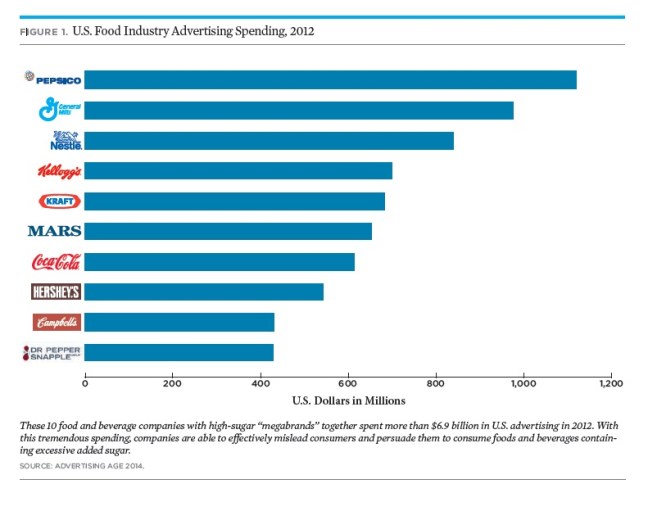
source: Advertising
source: Advertising Age 2014


Whether or not you believe that Lucky Charms cereal is “magically delicious”, that “life tastes good” when you drink a Coke, or that “there’s lots of joy in Chips Ahoy”, the odds are good that you have heard these and others advertising slogans for sugary foods and drinks.


Billions of dollars are spent annually by food and beverage manufacturers along with industry-supported organizations such as trade associations, front groups, and public relations (PR) firms (hereafter “sugar interests”) on emotional appeals such as these. Such ads insert the brands and products into our everyday lives, infuse our psyches with manufactured cravings for them, and shape the complex relationship we have with food.


Evading Science, Engineering Opinion


While it should be no surprise to consumers that cookies and soda contain added sugar, food companies also engineer the image of many foods to appear healthier than they actually are. Many unlikely products contain surprising amounts of added sugar. These foods include breads, crackers, pasta sauces, salad dressings, yogurts, and a wide variety of other processed foods. Yogurt, for example, has nutritional benefits, and General Mills wants us to eat its brand Yoplait because it “tastes SO good” (Yoplait 2014). However, whether we choose the healthy-sounding Blackberry Harvest flavor or the more dessert-themed Boston Cream Pie, Yoplait Original yogurt contains 26 grams of sugar per serving—more than six teaspoons of sugar, which surpasses the American Heart Association’s recommendations for a woman’s total daily consumption. Yoplait Light contains 10 grams of sugar per 90-calorie serving, still a lot of sugar-laden calories for a product marketed for its healthfulness.


Scientific research shows that the overconsumption of added sugar in our diets—not just the actual calories but the sugar itself—has serious consequences for our health. Added sugars—whether from corn syrup, sugar cane, or sugar beets—are a source of harmful calories that displace calories from other, more nutritious foods, especially at the level these sugars are consumed by most Americans (O’Callaghan 2014; Hellmich 2012). As discussed in our forthcoming report Added Sugar, Subtracted Science: How Industry Obscures Science and Undermines Public Health Policy on Sugar, scientific evidence increasingly confirms a relationship between sugar consumption and a rise in the incidence of chronic metabolic diseases—obesity, diabetes, cardiovascular disease, high triglycerides, and hypertension (Basu et al. 2013; Lustig, Schmidt, and Brindis 2012; Tappy 2012; Stanhope et al. 2011; Johnson et al. 2007; Jacobson 2005). Also, new research suggests that a higher percentage of calories from sugar is associated with an increased risk of heart disease, independent of the link between sugar and obesity (Yang et al. 2014). This scientific evidence has led several scientific and governmental bodies, including the World Health Organization, the American Heart Association, the U.S. Department of Health and Human Services, and the U.S. Department of Agriculture, to recommend sugar intake limits far below typical American consumption levels. In March 2014, the World Health Organization proposed new draft guidelines that recommend, as did the organization’s 2002 guidelines, that sugar should not exceed 10 percent of a person’s total energy intake per day (which amounts to a maximum of 50 grams per day or 12 teaspoons for a 2000-calorie diet). The 2014 guidelines further suggest that a reduction of sugar to below 5 percent of the total calorie intake per day—that is, six teaspoons—would have additional benefits, especially in slowing tooth decay, which is now globally prevalent (WHO 2014). Yet despite the existence of a great deal of scientific evidence linking excessive sugar intake to a range of health problems, and despite these science-based recommendations by prominent national and international organizations, Americans have continued to consume high levels of added sugar. One factor that has kept our sugar consumption so high is the deceptive and exploitative marketing strategies of industry sugar interests. Through advertising, marketing, and Sugar-coating Science 3 PR, sugar interests influence public opinion and consumer behavior at the cost of scientific evidence.


Their tactics trigger psychological, behavioral, social, and cultural responses that distract and manipulate consumers and divert their attention away from science-based health and nutrition information. Some companies have engaged in blatantly false advertising, and major industry trade groups have financed sophisticated PR campaigns that emphasize consumer freedom but facilely overlook the influence of sugar interests in shaping consumers’ perceptions of available food choices. The industry also targets children, women, minorities, and low-income populations—strategic for the industry, but a problem for public health. Children are unable to recognize persuasive intent the way adults do, women are exploited as the primary food decision makers in most families, and minorities and low-income groups in the United States have disproportionately high obesity rates driven by sugar interests’ concern for their profits rather than for public health. Together, sugar interests’ actions interfere with how the public responds to scientific information about added sugar, distorts our understanding of our food choices, and contributes to our continued high consumption of foods with added sugar.


Full report available here.


Business Gears Up for Assault on Consumer-Protection Laws

That low rumbling you hear, writes Bloomberg Businessweek is the business lobby revving its engines for an assault on state consumer-protection laws. The corporate-funded American Tort Reform Association gave fair warning at an event in Washington last week, when it announced “a multiyear, multistate campaign to reform such laws.” By “reform,” ATRA means water down, roll back—choose your metaphor.