
Corporations and Health Watch Goes Back to School: 10 Recent Articles for Fall 2013 Courses

1
source: Flickr


As the summer draws to an end and the start of a new semester looms, those of us in the health teaching and learning business consider how best to make sure how our Fall courses prepare students to meet their professional responsibilities.  To assist CHW readers who believe that public health professionals ought to understand more about how business practices influence health, I suggest 10 articles that can be added to a variety of Fall courses, including courses on health behavior, epidemiology, global health, health policy, public health history, health ethics, or health equity. To suggest others, send a message to newsletter@corporationsandhealth.org and we’ll post a compilation of your responses. The goals of these readings are to encourage students to analyze corporate practices as a modifiable social determinant of health and consider public health strategies to change harmful corporate practices. They can also help readers to assess the similarities and differences among the strategies these different industries use. 


Ten Recent Articles to Add to Health Courses on the Impact of Corporate Practices on Health


Baum FE, Sanders DM. Ottawa 25 years on: a more radical agenda for health equity is still required. Health Promot Int. 2011 Dec;26 Suppl 2:ii253-7.  pdf


Brandt AM. Inventing conflicts of interest: a history of tobacco industry tactics. Am J Public Health. 2012 Jan;102(1):63-71.  Abstract


Douglas MJ, Watkins SJ, Gorman DR, Higgins M. Are cars the new tobacco?  J Public Health (Oxf). 2011 Jun;33(2):160-9.  pdf


Freudenberg N. The manufacture of lifestyle: the role of corporations in unhealthy living. J Public Health Policy. 2012;33(2):244-56. Abstract


Igumbor EU, Sanders D, Puoane TR, Tsolekile L, Schwarz C, Purdy C, Swart R, Durão S, Hawkes C. “Big food,” the consumer food environment, health, and the policy response in South Africa. PLoS Med. 2012;9(7):e1001253.  pdf


Labonté R, Mohindra KS, Lencucha R. Framing international trade and chronic disease. Global Health. 2011 Jul 4;7:21.  pdf


Monteiro CA, Cannon G. The impact of transnational “big food” companies on the South: a view from Brazil. PLoS Med. 2012;9(7):e1001252. pdf


Moodie R, Stuckler D, Monteiro C, Sheron N, Neal B, Thamarangsi T, Lincoln P, Casswell S; Lancet NCD Action Group. Profits and pandemics: prevention of harmful effects of tobacco, alcohol, and ultra-processed food and drink industries. Lancet. 2013 Feb 23;381(9867):670-9. Abstract


Siegel M, Dejong W, Naimi TS, Fortunato EK, Albers AB, Heeren T, Rosenbloom DL, Ross C, Ostroff J, Rodkin S, King C, Borzekowski DL, Rimal RN, Padon AA, Eck RH, Jernigan DH. Brand-specific consumption of alcohol among underage youth in the United States. Alcohol Clin Exp Res. 2013;37(7):1195-203. Abstract


Steinman MA, Landefeld CS, Baron RB. Industry support of CME–are we at the tipping point? N Engl J Med. 2012;366(12):1069-71. pdf


And for those of you planning to teach on this topic in the Spring 2014 semester, here’s a shameless self-promotion.  My new book Lethal but Legal Corporations, Consumption and Protecting Public Health will be published by Oxford University Press in January 2014.  It’s available for pre-order at Oxford and at Amazon.  More details in future posts on CHW.
Conflicts of Interest in Approvals of Additives to Food Out of Balance

A recent article in JAMA Internal Medicine concludes that between 1997 and 2012, financial conflicts of interest were ubiquitous in determinations that an additive to food was generally regarded as safe (GRAS). The lack of independent review in GRAS determinations raises concerns about the integrity of the process and whether it ensures the safety of the food supply, particularly in instances where the manufacturer does not notify the Food and Drug Administration of the determination.

Why South Africa’s Proposed Advertising Ban Matters

In an editorial in Addiction, David Jernigan explains that South Africa’s proposed ban on alcohol advertising in Africa is a bellwether for the continent, whose populations are already among the most adversely affected by alcohol use in the world. An advertising ban may give the public health community a chance to keep the abstainers abstaining, and to convince the heavy drinkers that there are better ways to live—and die.

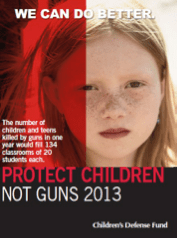
PROTECT CHILDREN NOT GUNS 2013

Last month, the Children’s Defense Fund released a new report, PROTECT CHILDREN NOT GUNS 2013. An overview and action steps are below.  The full report is here.


source: Children's Defense Fund
source: Children’s Defense Fund

Overview


2,694 children and teens died from guns in the United States in 2010.

The Children’s Defense Fund’s publication, Protect Children, Not Guns 2013, analyzes the latest fatal and nonfatal gun injury data from the U.S. Centers for Disease Control and Prevention for children and teens ages 0-19.


The U.S. has as many guns as people.

  • The U.S. accounts for less than 5 percent of the global population, but owns an estimated

            35 to 50 percent of all civilian-owned guns in the world.

  • The most recent estimate of U.S. civilian gun ownership is as high as 310 million, about one gun per person. In contrast, U.S. military and law enforcement agencies possess 4 million guns.
  • American companies manufacture enough bullets each year to fire 31 rounds into every one of our citizens.


A gun in the home increases the risk of homicide, suicide and accidental death.

  • A gun in the home makes the likelihood of homicide three times higher, suicide three to five times higher, and accidental death four times higher. For every time a gun in the home injures or kills in self-defense, there are 11 completed and attempted gun suicides, seven criminal assaults and homicides with a gun, and four unintentional shooting deaths or injuries.
  • More than half of youth who committed suicide with a gun obtained the gun from their home, usually a parent’s gun.


U.S. children and teens are 17 times more likely to die from a gun than their peers in 25 other high-income countries combined.

  • U.S. children and teens made up 43 percent of all children and teens in these 26 countries but were 93 percent of all children and teens killed by guns.
  • In 2010, children and teen gun death rates in the U.S. were over four times higher than in Canada, the country with the next highest rate, nearly seven times higher than in Israel, and nearly 65 times higher than in the United Kingdom.
  • U.S. children and teens were 32 times more likely to die from a gun homicide and 10 times  more likely to die from a gun suicide or a gun accident than all their peers in the other high-income countries combined.


A child or teen dies or is injured from guns every 30 minutes.

  • 18,270 children and teens died or were injured from guns in 2010.
  • 1 child or teen died or was injured every 30 minutes.
  • 50 children and teens died or were injured every day.
  • 351 children and teens died or were injured every week.


More children and teens die from guns every three days than died in the Newtown massacre.

  • 2,694 children and teens died from guns in 2010.
  • 1 child or teen died every 3 hours and 15 minutes.
  • 7 children and teens died every day, more than 20 every three days.
  • 51 children and teens died every week.
  • The children and teens who died from guns in 2010 would fill 134 classrooms of 20 children


Guns are the second leading cause of death among children and teens ages 1-19 and the number one cause among Black children and teens.

  • Only motor vehicle accidents kill more children and teens every year.
  • White and Asian/Pacific Islander children and teens were nearly three times more likely, American Indian/Alaska Native children and teens more than two times as likely, and Hispanic children and teens one-and-a-half times more likely to be killed in a car accident than by a gun.
  • In contrast, Black children and teens were twice as likely to be killed by a gun than to be killed in a car accident.


Although total gun deaths dropped in 2010 for the fourth consecutive year, gun death rates remained higher than in the early 1960s.

  • In 2010, the rate of gun deaths in children and teens was 30 percent higher than in 1963, when data were first collected from all states.
  • While Black children and teens have experienced the highest rates of gun deaths, the largest number of deaths has been among White children and teens. Out of the estimated 166,600 children and teens who have died from guns between 1963 and 2010, 53 percent were among White children and teens, and 36 percent were among Black children and teens.
  • Between 1963 and 2010, 59,265 Black children and teens were killed by guns—more than 17 times the recorded lynchings of Black people of all ages in the 86 years from 1882 to 1968.


Since 1963, three times more children and teens died from guns on American soil than U.S. soldiers killed in action in wars abroad.

  • 166,500 children and teens died from guns on American soil between 1963 and 2010, while 52,183 U.S. soldiers were killed in action in the Vietnam, Afghanistan, and Iraq wars combined during that same period.
  • On average 3,470 children and teens were killed by guns every year from 1963 to 2010, or 174 classrooms of 20 children every year.


Nearly three times more children and teens were injured by guns in 2010 than the number of U.S. soldiers wounded in action that year in the war in Afghanistan.

  • An estimated 15,576 children and teens were injured by guns in 2010.
  • 1 child or teen was injured every 34 minutes.
  • 43 children and teens were injured every day.
  • 300 children and teens were injured every week.
  • 5,247 U.S. soldiers were injured in the war in Afghanistan in 2010.


Children and teens die from gun violence in all states.

  • Every state lost children to gun violence between 2000 and 2010. The number of deaths varied from 15 in Hawaii to 4,668 in California.
  • The deadliest state was Alaska with 8.7 gun deaths for every 100,000 children and teens each year, more than twice the nationwide rate of 3.6. Alaska was 21 times more deadly for children and teens than Hawaii, the safest state.

Guns kill more children under 5 than law enforcement officers in the line of duty.

  • 82 children under 5 died from guns in 2010, compared to 55 law enforcement officers killed by guns in the line of duty.

Children are more likely to be exposed to violence than adults.

  • The 2008 National Survey of Children’s Exposure to Violence found that nearly two-thirds of children and youth had been victims or witnesses of violence within the past year.
  • Nearly 1 in 10 children and 1 in 5 14-17 year-olds had witnessed a shooting at some point in their lives.


Black, Hispanic, American Indian and Alaska Native children and teens are disproportionately more likely to die or be injured by guns.

  • In 2010, 45 percent of gun deaths and 46 percent of gun injuries were among Black children and teens, although they comprised only 15 percent of all children and teens.
  • Black children and teens were 4.7 times more likely to die from guns than White children the same age, and 8.5 times more likely to be injured. American Indian or Alaska Native children and teens were 2.4 times more likely to die from guns, and Hispanic children were 3.3 times |more likely to be injured from guns than White children and teens.
  • Black children and teens were 17 times more likely to die from a gun homicide than White children the same age.
  • American Indian or Alaska Native children and teens had the highest rate of gun suicides, nearly twice as high as White children and teens.


Homicide is the leading manner of gun death among children and teens and assault the leading manner of gun injury.

  • Children and teen gun deaths were most likely to be homicides; adult gun deaths were most likely to be suicides.
  • Two out of three child and teen gun deaths were homicides; a little over one out of four were suicides.
  • Among nonfatal gun injuries, a little over three out of four resulted from assaults while nearly one out of five was accidental.


Older teenagers are most at risk from gun violence, Black male teens are most at risk


  • Eighty-six percent of gun deaths and 89 percent of gun injuries in 2010 occurred in 15-19 year-olds.
  • Black males ages 15-19 were nearly 30 times more likely to die in a gun homicide than White males and more than three times more likely to die in a gun homicide than Hispanic males of the same age.


Total gun deaths and injuries in 2010 cost the U.S. $174.1 billion, or 1.15 percent of our gross domestic product.

  • The 105,177 gun deaths and injuries to children, teens and adults that occurred in 2010 cost the nation $8.4 billion in medical and other direct costs, $52.5 billion in lost productivity and lost wages, and $113.3 billion in lost enjoyment of life.


Stand Up and Take Action


1. Urge your members of Congress to protect children from gun violence. Support commonsense gun safety and gun violence prevention measures for the nation including:

  • Universal background checks;
  • Limits on assault weapons and high-capacity ammunition magazines;
  • Consumer safety standards, childproof safety features, and authorized-user identification technology for all guns;
  •  Better preventive and therapeutic services for children and families facing violence in their homes and communities and for children with unmet mental health needs;
  • Adequate funding for gun violence prevention research and programs; and
  • Resources and authority for the federal Bureau of Alcohol, Tobacco, Firearms and Explosives (ATF) and law enforcement agencies to properly enforce gun laws.


2. Urge state and local governments to protect children from guns. Urge your state legislators and local officials to:

  • Support laws to prevent child access to guns including childproofing and keeping all guns secured from unsupervised children;
  • Support universal background checks;
  • Support limits on assault weapons and high-capacity ammunition magazines; and
  • Oppose efforts to limit the ability of schools, physicians and others to warn parents and students about the dangers of guns.


3. Parents, remove guns from your home and be vigilant about where your children play.


4. Boycott businesses and products that glamorize and normalize violence.


5. Bring attention to the number of children killed and injured by gun violence and the truth about guns.


6. Offer parents, children and teens the resources, support and tools to survive and combat the culture of violence.

The Impact of Initiatives to Limit the Advertising of Food and Beverage Products to Children: A Systematic Review

In recent years, many governments and food companies have introduced new codes on food advertising to children.  A report in Obesity Reviews presents findings from a systematic review of evidence on levels of exposure of children to the advertising of less healthy foods since the introduction of these codes. Scientific, peer-reviewed papers show that high levels of such advertising of less healthy foods continue to be found in several different countries worldwide. In contrast, the evidence provided in industry-sponsored reports indicates a remarkably high adherence to voluntary codes. We conclude that adherence to voluntary codes may not sufficiently reduce the advertising of foods which undermine healthy diets, or reduce children’s exposure to this advertising.

Indonesia to Seek Compensation from US in Tobacco Trade Fight

Indonesia will seek compensation from the United States for pulling its clove cigarettes from shelves despite a World Trade Organization (WTO) ruling that deemed the ban discriminatory, reports the Jakarta Globe.  Indonesia’s trade ministry said it had lost between $200 million and $300 million annually from the 2009 ban, aimed at helping prevent youths from taking up smoking. The WTO found that the US had flouted trade rules in its health act — under which cinnamon, coffee, grape and strawberry-flavored cigarettes were also banned — because it allowed menthol-laced tobacco to stay on the market.