Can Corporations Provide Sustainable Solutions to Global Food Insecurity?

On February 15, Marion Nestle, a public health professor at New York University, spoke on corporate influences on food policy at a meeting of the NGO Working Group on Food and Hunger. Nestle proposed food insecurity as one of the main issues around corporations and food policy for 2012, arguing that the main thing we can do to combat food insecurity is address its root causes. “There’s plenty that can be done at the local level if not at the international level, but work on the root causes, all you public health people,” she urged.

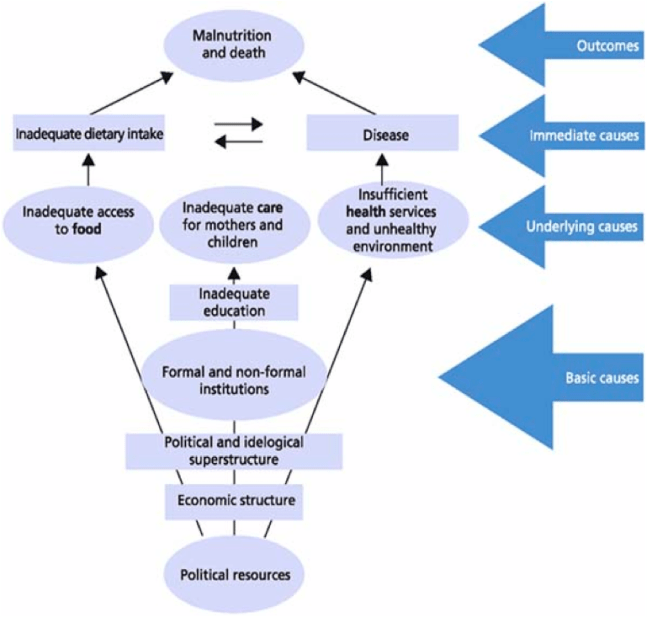
Figure 1

Nestle referred to UNICEF’s conceptual framework for the causes of malnutrition in society (Figure 1) to emphasize that food insecurity stems from social issues, not just from a lack of food. Lack of food is the end problem, but dealing only with that lack does not solve the root causes of food insecurity. According to Nestle, in order for everyone on the planet to be adequately nourished, we must create income equity and political stability, invest in sustainable agriculture and education, empower women, ensure access to clean water and safe food, and promote breastfeeding.

Some food and beverage corporations seek to position themselves as part of the solution to the problem of global food insecurity, marketing fortified food products in developing countries to target under-nutrition.

For example, European consumer-goods corporation Unilever produces food and beverages, among other products. Under “Sustainability” on the Unilever website, you can read about how the corporation’s “brands can play a role in tackling under-nutrition and many of [its] products already make an important contribution to the micronutrient intakes of hundreds of millions of people worldwide.” These products include fortified margarines, instant porridges, powdered drinks and snacks, and instant hot school meals. American food processing company H.J. Heinz is also investing in micronutrients in the name of sustainability. According to its website, Heinz has been a pioneer in supporting the development of micronutrient powders, provided in convenient, “single-serve sachets.”

While such products do indeed address nutrient deficiencies, according to Nestle, “these efforts are about products, not food.” And in the words of Dr. Alfred Sommer, dean emeritus of the Johns Hopkins Bloomberg School of Public Health, “Nutrition can only be sustainable if people ultimately pay for it. Nutrition could stop being a program when governments change priorities.” So, while fortified foods are important suppliers of emergency nutrients, they come at a price. Rather than addressing root causes of food insecurity, fortified foods are marketable products that must be purchased. People suffering from food insecurity will have to rely on government programs or charitable donations to access fortified foods, instead of benefitting from sustainable solutions to undernourishment.

In a 2010 article in the American Journal of Public Health entitled, “Can the Food Industry Help Tackle the Growing Global Burden of Undernutrition?” Derek Yach et al argue that, yes, food and beverage corporations are ideally positioned to address under-nutrition. According to the authors, corporate business expertise, distribution capacity, and product development capabilities are all vital components of successfully combating problems of food insecurity. (It is, perhaps, important to note that Yach, a former WHO health official, is now a senior vice president at PepsiCo.) True, corporations have resources and expertise that could have a huge impact on food insecurity, but would they be able to use this expertise to address the root causes?

Marion Nestle

In his 2010 Wall St. Journal article, “The Case Against Corporate Social Responsibility,” business professor Aneel Kanmani corroborates Nestle’s argument: “The fact is that while companies sometimes can do well by doing good, more often they can’t. Because in most cases, doing what’s best for society means sacrificing profits.” In our economic system, a corporation’s end goal is always to make a profit, and profit comes from products. And products, no matter how healthy, can never address the inequality that is the root cause of food insecurity.”The goal of the company is to make a profit. It’s really that simple,” Nestle said in her presentation. And, as she argued with co-author David Ludwig in a 2008 Lancet article, “In a Western-style capitalistic economy, food corporations, like all corporations, must make the financial return to stockholders their first priority. Wall Street places corporations under great pressure not only to be profitable, but also to meet quarterly growth targets… Far greater profits come from highly processed, commodity-derived products.” Nestle sees an irreconcilable conflict between highly processed products and public health, even if these products contain essential nutrients.
Image Credits:


1.     Food Politics

2.     Kintampo Health Research Centre

Patients Say FDA Lets Big Pharma Create Artificial Drug Shortages

Two dozen people suffering from life-threatening Fabry disease, a rare condition caused by deficiencies in an enzyme needed to metabolize lipids, say the U.S. Food and Drug Administration and the Department of Health and Human Services give drug manufacturers carte blanche to create drug shortages that deny them the medicine that keeps them alive, reports Courthouse News. Twenty-five people sued the agencies in Federal Court on constitutional claims. Most of the plaintiffs say they are being denied interstate access to Fabrazyme, a drug that treats Fabry disease, due to a shortage created by Genzyme, the drug’s manufacturer, but not a party to the case. They seek an injunction ordering the government to take the enforcement actions and they want the drug companies to disgorge profits unjustly created by drug shortages and fined for creating shortages.

Alcohol Industry Reaching for New Markets in Asia

As the European market decreases, big alcohol companies are searching for new Asian markets. Unregulated markets and  big populations promise new opportunities for growth. Bloomberg Businessweek describes how Carlsberg, “the world’s fourth- biggest brewer, is seeking acquisition opportunities in Asia, including China, amid slowing growth in Europe.”

Campaign Against Retail Marketing of Tobacco to Youth

The New York chapter of the American Lung Association has launched a campaign to reduce aggressive retail marketing of tobacco to youth in New York City. A video shows local youth from Queens leading decision makers and the media on a tour of the rampant tobacco advertising they encounter. In New York State, the tobacco industry spends $1 million every day to market its products.

Pharma Looks for Digital Marketing Edge

At the recent ePharma Summit in NYC, Charlotte McKines, Global Vice President, Marketing Communications and Channel Strategies, Merck & Co, spoke on “How Digital is Transforming the Pharmaceutical Marketing Model.” She noted, “Customers are increasingly looking for information using digital to get information so you see… most of our customers, physicians, use the web to gather information, but more importantly they use the non-pharmaceutical sites to get information about our products. They really don’t have a lot of trust and value right now in pharmaceutical sites. So we really struggle… to really become a primary trusted source. We have got to get there because finding the right place and being in the right destination for our customers really does give us the competitive advantage.”

SNAP: the Other Corporate Subsidy in the Farm Bill?

Cross posted from Appetite for Profit.

This week Congress begins hearings on the 2012 farm bill, the massive piece of legislation that gets updated about every five years and undergirds America’s entire food supply, but that few mortals can even understand. As nutrition professor Marion Nestle recently lamented, “no one has any idea what the farm bill is about. It’s too complicated for any mind to grasp.”

Nestle also called the Supplemental Nutrition Assistance Program (SNAP, formerly known as food stamps) “the huge elephant in the farm bill” because its enormity trumps everything else. This entitlement program (the budget expands as more people enroll) provides modest monthly benefits for food purchases and represents a critical lifeline to many people in need.

In recent years, public health and food policy experts have sounded the alarm about how farm bill programs supporting all the wrong crops (think corn and soy) contribute to America’s epidemic of obesity and diet-related diseases. This is certainly true, along with a host of other economic drivers.

But are we focusing too much on the commodity title and not enough on the nutrition title when it comes to how the farm bill truly subsidizes Big Food? After all, even if the commodity title was completely eliminated, most economists believe it would have minimal impact on healthy food consumption.

SNAP spending dwarfs all farm bill programs

According to federal data, food assistance made up 68 percent of the farm bill budget in 2008 and SNAP accounts for almost that entire amount. (Other food assistance programs such as school meals are funded through other legislation.) In contrast, the next three largest farm bill programs were commodity support (12 percent), crop insurance (10 percent), and conservation (9 percent).

Looking at the dollars and cents, the U.S. Department of Agriculture reported that in fiscal year 2011, taxpayers spent $71.8 billion on SNAP benefits, compared to $64.7 billion in 2010. The total number of enrolled participants was 44.7 million last year compared to 40.3 million in 2010. Obviously these increasing numbers reflect our struggling economy, and SNAP benefits are a crucial component of addressing hunger in the U.S. Sadly, estimates are that about 30 percent of Americans who qualify for SNAP aren’t even enrolled.

So how exactly was close to $72 billion of the taxpayers’ money spent last year? Good question. Unfortunately, we have little clue. We have somewhat better information on commodity payments. See for example, the Environmental Working Group’s handy Farm Subsidy Database. (But EWG also warns of an increasing lack of transparency in farm bill commodity and insurance subsidies.)

Other than broad categories of retailers (e.g., large versus small) we don’t know where SNAP dollars go because USDA does not require retailers to report specific purchase data; rather, all the agency wants to know is the total amount to be reimbursed.

Bill would require retailers to report SNAP receipts

In December, Senator Ron Wyden (D-OR) introduced the FRESH Act (Fresh Regional Eating for Schools and Health), which (in addition to other provisions) aims to “increase accountability” in the SNAP program by requiring corporations receiving more than $1 million a year “to provide taxpayers with an itemized receipt for their share” of the SNAP program.

Sounds pretty reasonable, since any retailer large enough to rake in over a million bucks a year from SNAP is almost certain to have the technology necessary to send an electronic report to USDA on how that money was spent.

Such information is a crucial factor in the debate over restricting benefits, which is once again heating up in states around the country, with Florida being the most recent example. (However, that measure appears to be dead for now.)

In 2010, New York City applied to USDA for a waiver to conduct a 2-year pilot test to exclude unhealthy beverages such as soda from the SNAP-eligible food list. (The feds denied the request, citing complexity.) An unfortunate divide exists between public health experts targeting “sugar-sweetened beverages” as enemy number one and anti-hunger advocates, who vociferously oppose any SNAP restrictions.

But conveniently left on the sidelines of this very public debate, and laughing all the way to the bank, has been the food and beverage industry. Of course, they made their voices heard loud and clear through their usual behind-the-scenes lobbying efforts.

Senator Wyden’s bill should spark a conversation that’s long overdue: exactly how much does Big Soda and Big Food benefit from SNAP funding? Some of my colleagues are concerned that such data could backfire by giving more fodder to certain politicians who will use any excuse to cut benefits for the poor.

Yes, the data is likely to show that SNAP participants’ purchase habits parallel those of other Americans, who are also consuming too many empty calories. But that’s not a valid reason to fear collecting the information. The “personal responsibility” argument – that individuals alone are responsible for how they eat regardless of their environment and shear lack of affordable healthy options – will continue with or without Uncle Sam picking up the tab.

But how will we ever improve and strengthen SNAP if we cannot accurately evaluate it? How else will we truly integrate public health into our food assistance programs? Why should Walmart—probably the single largest beneficiary of SNAP—have access to information that the USDA doesn’t?

Now more than ever we need to ensure the nation’s largest food assistance program is truly helping those in need, instead of just lining the pockets of Corporate America.


Image Credit:

Thomas Hawk via Flickr.

Regulation Works

A Research Letter in last week’s Journal of the American Medical Association reported that blood levels of trans fatty acids, a substance with known adverse metabolic effects, fell 56 percent between 2000 and 2009. The study compared trans fat levels in adult white men in samples from the NHANES studies, a periodic  assessment of the heath and well-being of a representative sample of the US population. In 2003, the US Food and Drug Administration required that food companies declare the trans fatty acid content on the nutrition label of foods and dietary supplements. In addition, some community and state health departments have required restaurants to limit TFAs and reductions have been shown in supermarket and restaurant products.

Glock: The Book

A recent review of the book “Glock: The Rise of America’s Gun,” by Paul Barrett in the Washington Post described the book as “a story of innovation, manufacturing, marketing, money, lawsuits, power, influence, politics and a little sex.” Barrett “explains how the company was able to remain profitable despite allegations of corruption, tax avoidance and malfeasance. A seasoned reporter and now assistant managing editor of Bloomberg Businessweek, Barrett originally covered the more disturbing allegations of Glock’s financial and managerial irregularities in a series of articles for the magazine.

Corporate Practices, Human Rights and Health: New Principles, New Questions

As more people accept the notion that governments have an obligation to follow certain universal standards of human rights, a new question that has emerged is what are the responsibilities of corporations to follow human rights principles? In just the last year, several new developments have put this question on the agenda in various settings.

In June 2011, the United Nations Human Rights Council approved the document Guiding Principles on Business and Human Rights, developed over the last six years.

The United Nations

Under the slogan “Protect, Respect and Remedy”, the document describes three obligations:

“The first is the State duty to protect against human rights abuses by third parties, including business enterprises, through appropriate policies, regulation, and adjudication. The second is the corporate responsibility to respect human rights, which means that business enterprises should act with due diligence to avoid infringing on the rights of others and to address adverse impacts with which they are involved. The third is the need for greater access by victims to effective remedy, both judicial and non-judicial.”

In October 2011, the European Commission issued a  new corporate social responsibility policy for 2011-2014, stating that the Commission “expects all European enterprises to meet the corporate responsibility to respect human rights, as defined in the UN Guiding Principles,” and “invites EU Member States to develop by the end of 2012 national plans for the implementation of the UN Guiding Principles.”

And in Asia, the Association of Southeast Asian Nations (ASEAN) has announced that its Intergovernmental Commission on Human Rights will this year focus on business and human rights. One of the Commissioners has said:

“The target for this thematic study is an ASEAN Guideline that is fully compliant with the UN frameworks, especially the Protect, Respect and Remedy Framework for Business and Human Rights and the Guiding Principles for Business and Human Rights which were endorsed by the UN Human Rights Council.”

These recent initiatives build on the United Nations Global Compact which started more than a decade ago after then-U.N. Secretary-General Kofi Annan called on business leaders to embrace shared values as a way to promote stability in the new era of globalization. So far, more than 6,800 companies in 140 countries have joined the compact by sending letters from their CEOs and agreeing to report annually on their activities. The box below lists the 10 principles of the Global Compact. “A lot of global challenges require active engagement of business,” says Matthias Stausberg, spokesman for the United National Global Compact, an initiative for companies that voluntarily commit to aligning operations with 10 principles covering human rights, the environment, labor and corruption.

What does this new attention on corporate responsibility for following human rights principles have to do with health and the impact of business practices on population health? So far, the existing codes have focused more on labor and environmental practices of corporations than on health consequences of the products that corporations produce and market. Labor and environmental practices certainly have a major impact on health but the current focus does not provide an obvious entry point for addressing the world’s most important causes of premature mortality and preventable deaths: rising rates of non-communicable disease and injuries. The concerns raised about the production and marketing practices of the food, tobacco, alcohol and pharmaceutical industries at the UN High Level Meeting on Non-Communicable Diseases in New York City last September pointed to the importance of these factors in causing global epidemics.

Here are some questions that public health and human rights professionals, researchers and advocates, government officials and business leaders will need to consider if a human rights approach can be applied to reducing harmful business practices.

  1. Do businesses have a right to produce and market products that have been demonstrated to harm public health?
  2. Do businesses have an obligation to disclose to the public what they know about the harmful effects of products they produce?
  3. Do governments have an obligation to protect their citizens from business practices that harm health?
  4. Does providing misleading or untruthful information about the health consequences of a product violate human rights?
  5. What standards are used to determine whether a business has provided adequate judicial or non-judicial remedies to consumers whose health has been harmed by their products?

For the public health community, the notion that corporations have a responsibility to follow basic human rights principles has the potential to suggest new approaches to better balancing the rights of governments and corporations. But for human rights to move from an aspirational statement to a practical strategy, human rights and public health practitioners will need to forge new tools to bring this perspective into the policy, legal and political arenas.


Image Credits:

1. Whiskeygonebad via Flickr.

Should Sugar be Regulated like Alcohol?

In a commentary in Nature, Robert Lustig, Laura Schmidt and Claire Brindis make the case that excessive consumption of sugar causes many of the same health problems as alcohol, suggesting that regulation should seek to put similar limits on sugar’s toxic consequences. Charles Baker, the chief scientific officer for the Sugar Association disagrees. “When the full body of science is evaluated during a major review, experts continue to conclude that sugar intake is not a causative factor in any disease, including obesity,” he writes.