Sysco Corporation, the largest U.S. food distribution company will pay almost $20 million dollars in restitution, costs and penalties for the company’s illegal practice of holding perishable foods – such as seafood, milk and raw meat – in unrefrigerated sheds, reports Corporate Crime Reporter. Sysco food trucks would deliver some small food orders to unrefrigerated and unsanitary sheds. Sysco employees would then use their personal vehicles to deliver the unsafely held food to restaurants, hotels, hospitals and schools.
Uruguay’s New Law Leads to Full Compliance With WHO Tobacco Control Guidance
Uruguay has introduced stringent new bans on all forms of tobacco advertising, promotion and sponsorship (TAPS), including cigarette displays at point of sale, reports the International Union against Tuberculosis and Lung Disease. When this legislative upgrade comes into force in August, Uruguay will be fully implementing the World Health Organization’s MPOWER guidelines – which assist countries to build and manage tobacco control.
Pharmaceutical Crime and Organized Criminal Groups
Interpol, the world’s largest police organization recently released this report. The Executive Summary and Conclusion are posted here.

EXECUTIVE SUMMARY
- INTERPOL member countries are reporting that criminals involved in pharmaceutical crime are operating through informal networks. Nevertheless, traditional organized crime groups across the globe are also involved in pharmaceutical crime throughout the supply chain.
- Several member countries have reported an increase in pharmaceutical crime during the past five years, especially in South and Central America.
- Both the informal networks and the organized crime groups seem to be trafficking in the same types of illicit medicines: erectile dysfunction medication; slimming pills; as well as pain and anxiety relief medication.
- A primary trend in many member countries is the increased use of illicit online pharmacies, operated by both informal networks and organized criminal groups.
- Large amounts of money are involved in these transnational criminal enterprises: one illicit online pharmacy network, which was dismantled by US authorities in 2011, managed to earn USD 55 million during two years of operations.
- Other crimes – such as money laundering, prostitution networks and weapons smuggling – can also be tied to criminals involved in pharmaceutical crime.
- INTERPOL has also received increased reporting of illegal trafficking of Tramadol over the past year. The origin of shipments seems to be Asia, routed via the Middle East, with a final destination in West Africa.
CONCLUSION
Pharmaceutical crime is a multifaceted criminal area. We see varying forms of criminal organizations involved in pharmaceutical crime, ranging from small clusters of three to 10 members, to larger well- established hierarchical groups, to sophisticated international networks with elusive structures. With the move to the Internet to sell counterfeit and illicit medicines, law enforcement agencies are increasingly dealing with the latter form of criminal enterprises. Such networks are difficult to target due to the ease with which they can move and establish new websites, the high level of anonymity offered in the virtual world, and the difficulty in piecing together the different criminals involved in wide-ranging affiliate networks.
Authorities are also faced with auxiliary challenges, such as corruption within the licit pharmaceutical community and a lack of dedicated national enforcement units to tackle the issue. This second point is especially alarming given that criminals are increasingly using the Internet to carry out their activities and are, in turn, developing sophisticated techniques to avoid detection. As a result, there is a need to enhance the number of specialized enforcement officers dedicated to targeting the ever evolving online activities of criminal networks.
Some INTERPOL member countries also face legislative challenges to thwarting those responsible for pharmaceutical crime, as few countries appear to possess specific legislation to target this type of crime. Furthermore, many countries cited poor penalties as a contributing factor for the proliferation of criminal networks, who are encouraged to continue to take risks as the rewards outweigh the potential punishments.
Yet from many questionnaire replies, there is an apparent confidence that enforcement and legislative structures currently in place are strong enough to tackle the issue of pharmaceutical crime. The law enforcement community is gradually gaining a fuller picture of the scope of such criminal activity and the structures behind it. For example, there is already a recognition of the problem of the sale of medicines online, illustrated by the growing global interest in participation in Operation Pangea, which reached 100 participating countries in 2012.
This study has also highlighted the need for law enforcement and the public health sector to work together in order to prevent illicit medicines from entering the market and to prosecute those responsible once it does. Some countries have employed a well-functioning multi-agency approach, with close communication between law enforcement officials and public health employees in order for both sectors to gain a better understanding of the challenges within each specific field.
Such coordination and concerted efforts are a step in the right direction to effectively combat pharmaceutical crime. In the long term, this will serve as a prime antidote against a crime area in which traditional structures are being replaced with more dynamic and constantly evolving network- orientated criminal enterprises.
New Legislation Would Allow Criminal Penalties Against Corporate Officers Who Hide Information on Dangerous Products
Consumer safety, public health, environmental and other groups in the Coalition for Sensible Safeguards lauded a new bill introduced by U.S. Sen. Richard Blumenthal (D-Conn.), co-sponsored by Sens. Bob Casey (D-Pa.) and Tom Harkin (D-Iowa). The “Hide No Harm” bill would hold corporate officers criminally accountable if they knowingly conceal serious dangers that lead to consumer or worker deaths or injuries. Penalties could include jail time. Read more from the Consumer Federation of America.
R.J. Reynolds Loses $23.6 Billion Verdict
A $23.6 billion jury verdict on Friday against R.J. Reynolds Tobacco Co. represents the latest in a string of blows against the tobacco industry in Florida, the last major hub of tobacco litigation in the U.S., reports the Wall Street Journal. The award is almost certain to be cut down significantly either by the judge in the case or on appeal, legal experts said. Still, the verdict sends a message to the industry that the public continues to find it responsible for smoking-related illnesses and deaths.
New Report on Point-of-Sale Tobacco Retail and Policy Landscape
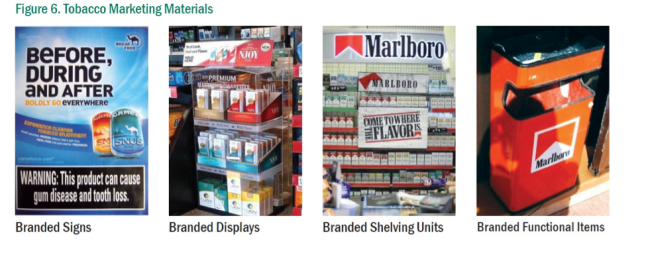
The Center for Public Health System Science at Washington University recently published a report on tobacco point-of-sale promotion. The executive summary is below. Full report is here.

Tobacco companies promote their brands through advertising, product placement, and price promotions. Advertising and promotions at the POS increase impulse purchases and normalize the presence of tobacco products in everyday life.(1) Tobacco product exposure and price promotions at the POS encourage initiation and discourage cessation.(2-4)
It is important for professionals looking to advance POS work to understand the current retail and legal landscape, as well as potential policy options. This report provides data on the tobacco retail environment, tangible next steps and resources to get started in the POS area, and important evidence to help guide the tobacco control policy debate.
FINDINGS
What does the tobacco retail environment look like?
In the U.S. only 36 states mandate tobacco retailer licensing. Without a nationwide mandatory licensing system for tobacco retailers, it is impossible to know how many tobacco retailers operate in the U.S. We estimate that there are 374,584 retailers in the contiguous U.S. Relative to consumer demand for tobacco products, the number of tobacco retailers is excessive.
We found that tobacco retailer density is highly correlated with population density and tobacco retailers are frequently clustered together. The majority of tobacco is sold at convenience stores. In the U.S. supermarkets are another top seller of tobacco products. Other common tobacco retailers include: liquor stores, pharmacies, and tobacco shops. The high number of retailers correlates to a vast amount of POS advertising and marketing in the retail environment.
The tobacco industry spends most of its marketing budget at the POS.5 The tobacco industry uses the strategic placement of products, price promotions and price discounts, signage and functional items containing product logos, and the products themselves to advertise and market tobacco products. Marketing and advertising in the POS is ever-present, yet policies to restrict advertising and promotions at the POS are largely underused in the U.S.
What policy activity is occurring across the nation?
The majority of states perceive POS policies as important to their state tobacco control programs. However, most states and communities are underusing POS policies. Policy activity was reported in all six policy areas surveyed, including policies that: address licensing and density, utilize non-tax approaches to raise tobacco prices, restrict product placement, restrict advertising at the POS, require health warnings, and ‘Other POS’ policies. The majority of states surveyed reported state-level activity in at least one area. California reported the greatest amount of POS policy activity, yet its policy activity was low when compared to the total number of policy options examine in this study.
Overall, the two most common of the six policy areas were the Licensing and Density area and the Non-tax Approaches area. The most common activity reported within the Licensing and Density area was to establish or increase tobacco licensing fees. Still, most states either have no licensing fee provision or require just a small fee (less than $75 annually) for licenses. The most common activity reported in the Non- tax Approaches area was implementing cigarette minimum price laws.
What are the barriers to policy implementation?
Given that POS is still an emerging area and that policy activity is low, we asked states what barriers they have experienced when trying to plan or implement POS policies. The most common barriers reported include:
• Lack of background knowledge;
• Lack of funding; and
• Competing priorities.
What resources would help advance POS policy work?
States were also asked to describe resources that have been helpful in advancing POS efforts and to identify what resources are needed to advance POS work in the future.
The most helpful resources reported include:
• Relationships with national organizations;
• Legal and policy support; and
• Learning from successful campaigns in other communities.
The most needed resources reported include:
• Funding and
• Model case studies.

RECOMMENDATIONS
Given the national tobacco retail and policy environment, states and communities should consider POS policies as a core strategy of tobacco control. States that have already achieved levels of success with strong smoke-free air policies and higher than average excise taxes could consider expanding their efforts into the POS policy area. States at other stages of tobacco control policy success may also benefit from incorporating POS policies into their current tobacco control programs. Tobacco control advocates in the planning stages of POS policy adoption should take the following steps:
#1: Assess the retail environment
Map and visit retailers. Find out what products are being sold, survey where advertising and products are situated inside and outside stores, and monitor prices and price promotions.
#2: Examine public opinion and assess the policy and legal landscape
Survey the public and conduct interviews with key leaders and decision makers. Work with legal counsel to understand what agency has administrative authority in the state or community and to understand if and how preemption and other legal concerns will affect policy development.
#3: Strategize and design the campaign
Build support by understanding the target audience and use appropriate messages that reflect their interests and concerns. Include strategies that will garner support from decision makers. Seek guidance from states and communities that have implemented similar policies.
#4: Implement the policy and evaluate the process
Raise both retailer and public awareness about provisions of the policy to aid in compliance and enforcement. Highlight successes by demonstrating the positive effects the implemented policy is having in the community or state.
References
1. Campaign for Tobacco-Free Kids. Deadly Alliance: How Big Tobacco and Convenience Stores Partner to Market Tobacco Products and Fight Life-Saving Policies. 2012.
2. Paynter J, Edwards R. The impact of tobacco promotion at the point of sale: A systematic review. Nicotine Tob Res. Jan 2009;11(1):25-35.
3. Slater SJ, Chaloupka FJ, Wakefield M, Johnston LD, O’Malley PM. The impact of retail cigarette marketing practices on youth smoking uptake. Arch Pediatr Adolesc Med. May 2007;161(5):440-445.
4. Wakefield M, Germain D, Henriksen L. The effect of retail cigarette pack displays on impulse purchase. Addiction. Feb 2008;103(2):322-328.
5. Federal Trade Commission. Cigarette Report for 2011. 2013. http://1.usa.gov/1n69LX6 . Accessed June 16, 2014.
Advancing Science and Policy in the Retail Environment (ASPiRE) is funded by the National Cancer Institute’s (NCI) State and Community Tobacco Control (SCTC) Research Initiative. ASPiRE is a consortium of researchers from the Center for Public Health Systems Science (CPHSS) at Washington University in St. Louis, the Stanford Prevention Research Center, and the University of North Carolina Gillings School of Global Public Health. In 2011, ASPiRE received a five-year grant from SCTC to conduct research on how to maximize state and local policies to restrict tobacco marketing in the point of sale (POS) and in the broader retail environment.
Gun Deaths Outpace Motor Vehicle Deaths in 14 States and District of Columbia in 2011
A new study by Violence Policy Center found that gun deaths outpaced those from cars and trucks in 14 states that year, the latest for which full data is available. More than 90 percent of American households own a car while little more than a third of American households have a gun. Yet in 2011, there were 32,351 gun deaths and 35,543 motor vehicle deaths nationwide. In 1999, there were 28,874 gun deaths and 42,624 motor vehicle deaths nationwide.
Senate May Expand GM Recall Probe to Industry-wide Review
The chairwoman of a Senate panel said she may broaden her look at auto safety problems at General Motors Co. into whether there are systemic recall issues present at other major automakers, reports The Detroit News. In an interview, Sen. Claire McCaskill, D-Missouri, also said she planned to hold another hearing focusing on the role of the National Highway Traffic Safety Administration and its handling of complaints over several years into ignition switch issues.
Designed for Addiction
A new report by the Campaign for Tobacco Free Kids Designed for Addiction How the Tobacco Industry Has Made Cigarettes More Addictive, More Attractive to Kidsand Even More Deadly concludes “the evidence is sufficient to infer that the relative risk of dying from cigarette smoking has increased over the last 50 years in men and women in the United States.”
PhRMA Claims Transparency Risks Damaging Public Health
Publishing information from clinical trials “risks damaging public health and patient welfare” says the Pharmaceutical Research and Manufacturers of America. PhRMA made the statement in a letter to the chief US trade negotiator for the free trade agreement between the European Union and the USA, the Transatlantic Trade and Investment Partnership deal. In the letter, PhRMA says, “Disclosure of companies’ non-public data submitted in clinical and pre-clinical dossiers and patient-level data risks damaging public health and patient welfare.”
 Corporations and Health Watch