Two new reports shed light on how big corporations and the wealthy elites who control them use their riches to advance their policy agenda. A new report by Oxfam, Wealth: Having it All and Wanting More describes the increasing concentration of global wealth.
Richest 10 billionaires (ranked in 2013) who have made (at least part of) their fortunes from activities related to the pharmaceutical and healthcare sectors, and their increase in wealth between March 2013 and March 2014.
A few highlights from this report:
In 2014, the richest 1% of the people in the world owned 48% of the global wealth., leaving just 52% to be shared among the others 99% of the adults on the planet.
Wealth of the 80 richest people in the world has doubled in nominal terms between 2009 and 2014, while the wealth of the bottom 50% is lower in 2014 than it was in 2009
In the last two years, billionaires listed as having interests and activities in the pharmaceutical and health care sectors saw the biggest increase in their collective wealth. Their collective wealth increased from $170 billion to $250 billion, a 47% increase and the largest increase in wealth of the different sectors on the Forbes list.
In 2013, the pharmaceutical and health care sectors spent more than $487 million on lobbying in the United States alone, more than any other US sectors and representing 15% of total lobbying in 2013. In 2012, this sector spent $260 million on campaign contributions. The pharmaceutical and health care industry spent another $50 million on lobbying in the European Union.
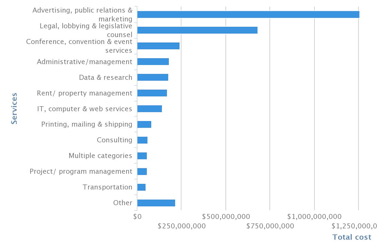
From 2008 through 2012, the most politically active trade groups spent a total of $3.4 billion on their top contractors, according to a Center for Public Integrity analysis of annual tax filings. This graph shows where their money went.
CVS pharmacy’s decision last year to pull tobacco from its 7,800 stores is paying off, business-wise, reports the Washington Times, and now it’s earned the chain’s CEO a prime seat at Tuesday’s State of the Union Address.
An expert group convened by the Robert Wood Johnson Foundation’s Healthy Eating Research has released a set of recommendations calling on the food, beverage, restaurant and entertainment industries to close several loopholes in their voluntary programs and commitments to market healthy food and beverage products to children.
The Topps Company— the maker of the candy Ring Pops—may have been just trying to have a little marketing fun, writes the privacy blog Safe and Sound. But a recent contest the company sponsored in 2014 around its jewel-shaped ring candy has caused a ruckus among several children’s rights advocacy groups and is at the root of a complaint recently filed with the Federal Trade Commission.
Last month, the U.S. Food and Drug Administration issued a safety announcement and mandated a new warning label after it found evidence that the antipsychotic drug Geodon – also known as ziprasidone and manufactured by Pfizer –can cause a potentially fatal skin reaction. The serious side effect may affect up to 2.5 million Americans who were prescribed the popular drug.
Last week, I wrote about some of the 2014 news stories that revealed how the auto, pharmaceutical and alcohol industries had harmed health. In this post, I turn to some of the top stories in last year’s coverage of the other industries Corporations and Health Watch follows: food and beverages, firearms and tobacco.
Early this month, the New York Times reported that Coca-Cola says it will cut between 1,600 and 1,800 jobs in coming months to trim costs. These moves are part of an ongoing restructuring to reflect declining sales of Coca Cola in the United States—and in many other parts of the world. In October, Coca-Cola announced it hoped to cut costs by $3 billion a year through a variety of measures. The savings would be used to pay for more marketing to drive up beverage sales.
But throughout the year, business analysts have been questioning Coke’s strategy. For example, Bloomberg BusinessWeek carried a story called Coke Confronts Its Big Fat Problem. It concluded:
Americans may not have figured out the answer to the obesity epidemic, but for years they’ve pointed to Coca-Cola and other soda as one of the causes. Coke has tried fighting against this. It’s tried ignoring it. Now it accepts this as a reality… (The company) has to persuade people to drink Coca-Cola again, even if they don’t guzzle it like water the way they did before.
recognizing that the big problem is the leadership team’s fixation with defending its Coke brand, rather than finding new growth businesses as the market moves away from carbonated soft drinks. This problem requires the CEO and his entire management team to step up their strategy efforts, not just fire the leader who has been updating the branding mechanisms.
For public health, Coke’s failures are our success. The continuing decline in soda consumption is in part a reflection of the health policy and education campaigns that have changed the image of soda that Coke has tried to market. Declining sales at Coke now hold the promise of less diabetes and diet-related diseases in the future. Key questions for the coming years are will Coke’s fizzed up advertising be able to delay the shift in tastes and to what extent will the company apply tobacco industry response to flat sales in the US by stepping up marketing in Asia, Africa and Latin America.
When e-cigarettes were introduced a few years ago, it wasn’t clear if the makers of this product would take business away from the tobacco industry or become a subsidiary of the nicotine delivery business. Last year, most of the world’s largest tobacco companies expanded their e-cigarette business, suggesting the emergence of an integrated Big Nicotine business. For example, according to Bloomberg Businessweek, R.J. Reynolds in 2014 scaled up marketing of its Vuse brand of e-cigarettes from four states to a national market. Lorillard sells Blu eCigs and controls about 40 percent of the current market. Altria Group owns two e-cig brands and plans to expand nationally as well. While some public health advocates continue to argue that e-cigarettes have the potential to reduce tobacco use, others make the case that the increasing control of the e-cigarette market by transnational tobacco companies does not bode well for this product being used to advance public health or reduce the demand for nicotine products. As public health advocates debate our positions on e-cigarettes, we need to keep our eyes not just on the theoretical potential of a new technology but on the actual practices of the industry that makes and markets the product.
Just as policy battles on abortion and gay marriage have bounced between state and federal levels over the last decade, the fight on gun safety, long played out on the federal level, has now bounced back to the state level. Earlier this month, the New York Times noted that,
“the gun control movement, blocked in Congress and facing mounting losses in federal elections, is tweaking its name, refining its goals and using the same-sex marriage movement as a model to take the fight to voters on the state level.”
Last November, Washington state voters approved a ballot measure that will require broader background checks on gun buyers and gun safety advocates are looking to add ballot measures in 2016 in Nevada, Arizona, Maine and Oregon.
At the same time, gun rights advocates are using state legislatures to seek to overturn federal guns laws. According to one report, eight states have recently passed laws voiding federal firearms regulations and in the last decade more than 200 such bills have been considered by states.
A recent report by the Law Center to Prevent Gun Violence found that states with stronger gun regulation have lower gun death rates, and the states with weaker regulation have higher gun death rates. As gun safety advocates study the successes of the gay marriage movement in using state level successes to win national victories, they’ll need to devise strategies that choose the settings and the messages that can ultimately lead to national successes in reducing gun violence.
For observers of how corporations find ways to profit at the expense of public health, the news coverage of 2014 provides a wealth of evidence. Here are three stories that caught my eye last year. Next week I’ll present stories about the food, firearms and tobacco industries, the other sectors that Corporations and Health Watch follows.
Auto Recalls at General Motors, Chrysler, Ford, Toyota, Honda and Others Set New Record
Last year, reported the New York Times, more than 60 million vehicles have been recalled in the United States, double the previous annual record in 2004. In all, there have been about 700 recall announcements — an average of two a day — affecting the equivalent of one in five vehicles on the road. The eight largest automakers have each recalled more vehicles in the United States this year than they have on average since 1966, when data collection began, with G.M., Honda, and Chrysler each setting corporate records, the review by The Times found.
GMs failed ignition switches on Chevy Cobalts and several other models were one source for the recalls. Another was airbags manufactured by Takata, a Japanese parts maker, that occasionally exploded injuring or killing passengers or drivers. According to Consumer Reports, 7.8 million vehicles, made by 10 different automakers, have been recalled to replace frontal air bags on the driver’s, passenger’s sides or both. An ominous lesson from the Takata recalls is that globalization of the auto industry and the concentration of parts makers into a few giant companies can result in many manufacturers relying on the same few parts suppliers. If these parts fail, the population impact can be enormous.
AstraZeneca, Eli Lilly, GlaxoSmithKline, Merck and Other Drug Makers Pay Doctors and Hospitals Billions to Promote their Drugs
According to the Centers for Medicare & Medicaid Services, as of December 19, 2014, drug makers paid at least 366,000 U.S. doctors and 900 teaching hospitals $3.7 billion for gifts, meals, travel, speaking about their products, or attending promotional events.
In a series of stories called Dollars for Docs: How Industry Dollars Reach Your Doctors, Pro Publica describes the many ways that drug companies pay doctors—often physicians who have been previously sanctioned for unethical or illegal practices– to promote their products. Pro Publica also provides a database that allows readers to look up what companies have paid which doctors. This information is now available thanks to the Physician Payment Sunshine Act, a part of the Affordable Care Act that went into effect in 2014. Would requiring other companies in other sectors to report who they paid to promote their products help consumers to make more informed judgments on products?
Powdered alcohol hasn’t even arrived in stores yet, but some states already are moving to ban the product touted by its inventor as an easy way to mix a drink on the go. The UK-based Daily Mail reports that Colorado is the latest state considering prohibiting ‘Palcohol’ amid concern it will increase underage drinking. The product is marketed as an ounce of rum or vodka in powdered form, which is then added to water. Each serving is the equivalent of a shot of liquor, according to Lipsmark, the company that owns Palcohol. The company awaits labeling approval from the Alcohol and Tobacco Tax and Trade Bureau. The Food and Drug Administration said it does not have a legal basis to block the product after examining the non-alcoholic ingredients in the powder. Will this product make it to market in 2015? Stay tuned.
“Based on our experience with jello shots, alcoholic energy drinks, and other “cutting edge” alcohol products, we anticipate that allowing powdered alcohol onto the market will have grave consequences for our nation’s young people. Youth is a time of risk-taking and experimentation, and these types of products have proven most popular among the heaviest drinking and more risk-prone youth. Powdered alcohol is also highly concealable, making it all too easy for youth to access and consume. Currently 4300 young people under age 21 die each year from alcohol-related causes; our efforts should be focused on making alcoholic products less, not more, available to our nation’s youth.”
A landmark treaty regulating the multibillion-dollar global arms trade came into force last month, reports the Associated Press. The new treaty seeks to stop weapons sales to dictators, terrorists and human rights abusers. Secretary-General Ban Ki-moon said the pact reflects the commitment of states, international organizations and civil society “to stop irresponsible arms transfers.”
According to Wenona Hauter of Food and Water Watch, writing in Common Dreams, the swearing-in of the 114th Congress this week spells trouble for our food, water and environment, and for all those who seek to champion healthy, safe communities for our families. We may be looking at the most hostile Congress ever in terms of protecting the environment, she warns.
Every year, more than 30,000 Americans die from gun violence. But there’s more to the story. The Law Center to Prevent Gun Violence has been fighting for smart gun laws for over 20 years, and we’ve noticed a trend: the states with stronger gun regulation have lower gun death rates, and the states with weaker regulation have higher gun death rates.
By grading all 50 states on their gun laws and showing the clear correlation between smart gun laws and reduced gun violence, we can encourage state legislators to adopt the common-sense solutions that will save lives. And not just at home—we found that states with the weakest gun laws are also responsible for trafficking the most crime guns.
The good news is that there’s been tremendous progress. Since the horrific tragedy at Sandy Hook in 2012, 37 states have passed an unprecedented 99 laws strengthening gun regulation. Ten states have enacted major overhauls.
We grade the states each year to urge our leaders to build on the momentum for smart gun laws in America, stand up to the gun lobby, and not rest until the entire country has an A+.
Here are some examples of new legislation this year:
California enacted the groundbreaking Gun Violence Restraining Order law. Crafted in response to this summer’s tragic shooting in Isla Vista, where the shooter exhibited warning signs of dangerous behavior, this lifesaving new law allows family members and law enforcement officers to ask a court to disarm people who are a danger to themselves or others and prohibit them from purchasing or possessing guns.
In Washington State, voters overwhelmingly approved a ballot initiative requiring background checks for all firearms, making Washington the ninth state, plus the District of Columbia, to require background checks on private sales at the point of transfer. An additional eight states require background checks when an individual applies for a permit to purchase a firearm.
Raising its smart gun law grade, Massachusetts passed a comprehensive bill strengthening its gun laws in the areas of domestic violence, background checks, and licensing of gun owners.







 Corporations and Health Watch