Consumer Reports writes that vehicles made by 14 different automakers have been recalled to replace frontal airbags on the driver’s side or passenger’s side, or both in what NHTSA has called “the largest and most complex safety recall in U.S. history.” The airbags, made by major parts supplier Takata, were mostly installed in cars from model year 2002 through 2015. Some of those airbags could deploy explosively, injuring or even killing car occupants. At the heart of the problem is the airbag’s inflator, a metal cartridge loaded with propellant wafers, which in some cases has ignited with explosive force. If the inflator housing ruptures in a crash, metal shards from the airbag can be sprayed throughout the passenger cabin—a potentially disastrous outcome from a supposedly life-saving device.
Changing Corporate Practices to Reduce Non-Communicable Diseases and Injuries: A Promising Strategy for Improving Global Public Health?
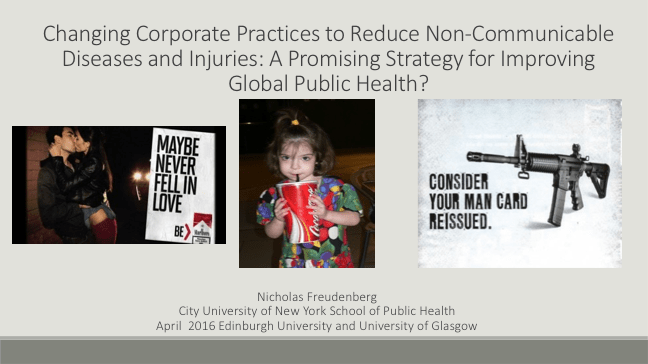
In presentations on “Changing Corporate Practices to Reduce Non-Communicable Diseases and Injuries: A Promising Strategy for Improving Global Public Health?” at Edinburgh University and University of Glasgow, Nicholas Freudenberg, Distinguished Professor of Public Health at City University of New York School of Public Health, described the role of corporate business and political practices on the growing global burden of non-communicable diseases and injuries. He also analyzed what roles public health professionals can play in countering the adverse health effects of these practices. View the presentation.
Ford Recalls 280,000 Vehicles
Ford has issued a recall for around 202,000 of its best-selling pick-up trucks, SUVs and cars over a problem with the transmission that could suddenly downshift and cause a drop in speed, reports Fortune. Ford said the problem was based in the software installed in its speed sensor, and the recall will involve an update and vehicle inspections. The Detroit-based automaker also recalled 81,000 2014-2015 Ford Explorer and Ford Police Interceptor Utility vehicles to fix poor weld quality in its rear suspension links that could lead to a fracture.
Valeant’s Michael Pearson Admits Aggressive Drug-Price Increases Were a Mistake
The Wall Street Journal reports that Valeant Pharmaceuticals International Inc. was too aggressive in dramatically raising the prices of some of its drugs, the company’s outgoing chief executive told a Senate committee Wednesday, while its newest board member promised swift changes. Michael Pearson, who oversaw the rise and fall of Valeant, told the committee that Valeant’s strategy of buying and increasing prices on many drugs was a mistake. The testimony, under sharp questioning, highlighted Valeant’s stark fall from Wall Street darling to Washington punching bag, and showed how much it has at stake. Its stock is down more than 85% from its high last August. Drug-price increases have overshadowed the company’s broader work, and “we therefore need to work to regain the confidence of Congress, the public, doctors and patients,” Mr. Pearson told the Senate Special Committee on Aging.
The Trans-Pacific Partnership: Is It Everything We Feared for Health?

Photo: Protesters concerned about the TPP effect on health gather in Atlanta, Georgia. Credit.
by Ronald Labonté, Ashley Schram, Arne Ruckert
Negotiations surrounding the Trans-Pacific Partnership (TPP) trade and investment agreement have recently concluded. Although trade and investment agreements, part of a broader shift to global economic integration, have been argued to be vital to improved economic growth, health, and general welfare, these agreements have increasingly come under scrutiny for their direct and indirect health impacts.
Continue reading The Trans-Pacific Partnership: Is It Everything We Feared for Health?
Ten of the world’s biggest food and beverage companies battle to improve their social sustainability through the Behind the Brands campaign
Nine of the “Big 10” global food and beverage companies have improved their ratings by at least 10 percent in three years since Oxfam began keeping score through its “Behind the Brands” scorecard. Oxfam highlighted the major strides most of them have made to improve their policies on land rights, agricultural greenhouse gas emissions and gender equality in company supply chains. Kellogg (up 30 percent) and Unilever (up 26 percent) made the most progress across all themes since the campaign began.
The S.U.V. Arms Race Goes Upscale
One of the last big profit centers for Detroit’s automakers, the sport utility vehicle, is under siege, reports the New York Times. An onslaught of competitive new S.U.V.s, especially in the most profitable high-end segment, is in the development pipeline or already showing up in dealer showrooms. At this year’s New York International Auto Show, the star attractions weren’t the usual sleek sports and muscle cars, but new luxury S.U.V.s from Jaguar, Maserati (where a line formed for a chance to be enveloped in the wood-and leather-lined interior) and even Bentley, which had its new Bentayga safely cordoned off behind velvet ropes.
Reducing the Role of the Food, Tobacco, and Alcohol Industries in Noncommunicable Disease Risk in South Africa

Noncommunicable diseases (NCDs) impose a growing burden on the health, economy, and development of South Africa. According to the World Health Organization, four risk factors, tobacco use, alcohol consumption, unhealthy diets, and physical inactivity, account for a significant proportion of major NCDs. We analyze the role of tobacco, alcohol, and food corporations in promoting NCD risk and unhealthy lifestyles in South Africa and in exacerbating inequities in NCD distribution among populations. Through their business practices such as product design, marketing, retail distribution, and pricing and their business practices such as lobbying, public relations, philanthropy, and sponsored research, national and transnational corporations in South Africa shape the social and physical environments that structure opportunities for NCD risk behavior.
More than 100 medical groups urge Congress to fund CDC research on gun violence
The Guardian reports that a coalition of more than 100 medical groups is asking Congress to fund research on gun violence at the US Centers for Disease Control and Prevention to end a decades-long drought of federal public health research on the subject. The groups sent a letter requesting that Congress “end the dramatic chilling effect of the current rider language restricting gun violence research and to fund this critical work”.
Engineers, safety advocates and even automakers have a message for federal regulators eager to get self-driving cars on the road: slow down
Engineers, safety advocates and even automakers have a safety message for federal regulators eager to get self-driving cars on the road: slow down, reports U.S. News and World Report. Fully self-driving cars may be the future of the automotive industry, but they aren’t yet up to the demands of real-world driving, several people told the National Highway Traffic Safety Administration during a public meeting Friday. A slower, more deliberative approach may be needed instead of the agency’s rapid timetable for producing guidance for deploying the vehicles, according to an auto industry trade association. In January, the federal agency announced that it would begin work on writing guidance for deploying the vehicles. Officials have promised to complete that guidance by July.
 Corporations and Health Watch