The 100 Largest Governments and Corporations by Revenue in 2016

By Nicholas Freudenberg                                                                                       Screen Shot 2017-10-09 at 9.50.59 AM

Credit

Screen Shot 2017-10-09 at 9.51.15 AM

Credit

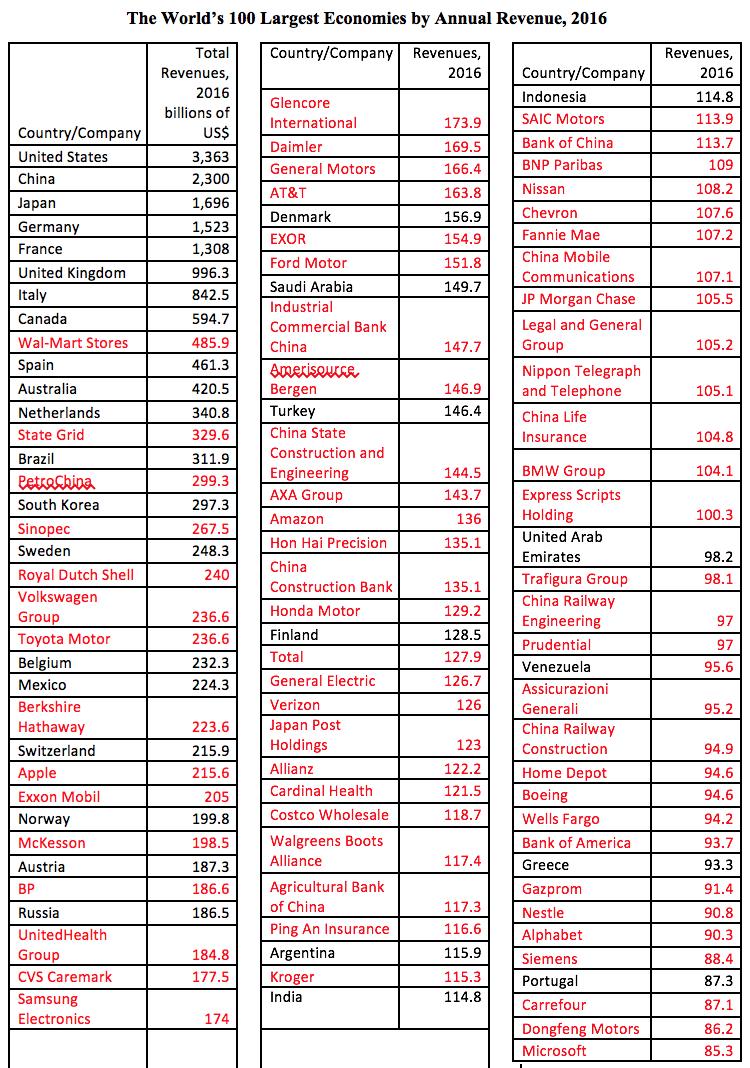
In 2014, 64 of the largest economies in the world were corporations and 36 were governments.  Two years later, in 2016, 69 were corporations and 31 governments.  The source for estimated revenues for governments was The CIA World Factbook and for corporations The Global Fortune 500 List, which reported 2016 annual revenues.

Between 2014 and 2016, total revenues for the 100 largest economies fell by 9%, from $29.9 trillion to $27.2 trillion. In that same period, the ratio of government to corporate revenues of the economies on the top 100 list fell from 1.9 in 2014 to 1.7 in 2016.  In both years, governments on the list spent almost twice as much as corporations. This suggests that among the world’s largest economies, governments continue to play a crucial role in spending. What they do and don’t spend their revenues on has a crucial impact on health.

In 2016, the top 5 corporations accounted for about 16% of the revenues reported by businesses on the list.  For governments, the five largest accounted for 59% of government spending, a mark of the continuing spending power of the governments of the world’s largest economies: United States, China, Japan, Germany and France.  In 2016, the five largest governments outspent the five largest corporations by a ratio of almost six to one. Among the world’s largest economies, Big Government is still much bigger the Big Corporations.

Between 2014 and 2016, government revenues fell for a striking 26 of the 31(84%) governments that were on the list both times. For the 52 corporations on the list in both years, revenues fell for 32(62%), a lower percentage of revenue losers than among governments.  Declines in oil prices contributed to falling revenues for both countries and corporations that lost revenue between 2014 and 2016.

Annual revenues are of course only one indicator of the size of a government or corporation but it is one metric that enables comparison of the two.   Understanding the changing dynamics between governments and corporations is a critical priority for public health researchers seeking to take on the social determinants of health.

Screen Shot 2017-10-09 at 9.36.15 AM

Eliminating tax deductibility of advertising for corporations: An old idea whose time has come?

Screen Shot 2017-09-27 at 4.44.12 PM

Credit

As the debate on the Republican plan for tax reform that promises big reductions in taxes for the wealthy and corporations heats up, public health professionals may have the opportunity to expand the national discussion on taxes and health.  One way that Congress could balance the cuts in taxes for the well-off is to reduce the tax deductions that corporations now use.  Since the federal tax code was created in 1913, businesses have been able to immediately deduct their full advertising costs. But over the years, proposals to limit the deduction have been floated as a way to raise revenue. In May, The Hill reported that industry groups and more than 100 lawmakers want to prevent tax reform legislation from curbing the deduction for businesses’ advertising expenses. Opponents of dropping this deduction include both Democrats and Republicans and Senate Minority leader Chuck Shumer.  “If you make advertising more expensive, there will be less information available to the public,” Jim Davidson, executive director of the Advertising Coalition told The Hill.

For more than 35 years, however, public health advocates and researchers have examined the public health consequences of Internal Revenue Service rules that allow corporations to deduct advertising expenses from their income for tax purposes. The conclusions of that research suggest that advertising by the tobacco, pharmaceutical, ultraprocessed food, alcohol, firearms, automobile and other industries does much more than provide information to the public. It encourages and promotes use of products that are associated with major causes of premature death and preventable illness in the United States.  And after getting a tax deduction for this health damaging marketing, corporations then send another bill to their consumers and the public: for the costs of health care and lost productivity generated by the illnesses their aggressively promoted products induce.

Corporations and Health Watch readers who want to become familiar with the evidence on the health impact of the tax deductibility of advertising costs can consult the following sources:

  1. In 1981, James Mosher and Lawrence Wallack urged the Bureau of Alcohol, Tobacco and Firearms to reconsider the tax deductibility of the billion a year the industry then spent on advertising, given the costs this advertising imposed on the nation.
  2. In 1992, the American Public Health Association passed a resolution urging Congress to eliminate the tax deductibility of expenses for promoting and advertising of alcohol and tobacco products.
  3. According to a 2008 study in the Journal of Law and Economics, eliminating the deductibility of costs associated with unhealthy food marketing could reduce rates of obesity by five to seven percent, which would mean 700,000 to 1 million fewer obese children.
  4. By revoking the tax deductions for Direct to Consumer Advertising, argued a 2012 report in the Santa Clara Law Review, Congress could minimize the harms associated with that practice by using a “sin tax” to force pharmaceutical companies to consider more fully the consequences of such marketing.
  5. In the 1990s, the automobile industry spent 9 billion tax deductible dollars advertising sports utility vehicles, their most profitable product but also one associated with higher rates of accidents, fatalities and pollution.  Once again, tax payers were asked first to subsidize the promotion of these vehicles, the pay again for the higher costs these vehicles incurred.

By introducing this evidence into the current public debate on taxes, public health advocates can set the stage for revisiting an end to the tax deductibility of advertising products that contribute substantially to our nation’s most serious public health problems.

Nicholas Freudenberg

How Big Business Got Brazil Hooked on Junk Food

Screen Shot 2017-09-20 at 11.13.57 AM

Nestlé candies from Brazil.  Credit.

A New York Times examination of corporate records, epidemiological studies and government reports — as well as interviews with scores of nutritionists and health experts around the world — reveals a sea change in the way food is produced, distributed and advertised across much of the globe. The shift is contributing to a new epidemic of diabetes and heart disease, chronic illnesses that are fed by soaring rates of obesity in places that struggled with hunger and malnutrition just a generation ago.  “What we have is a war between two food systems, a traditional diet of real food once produced by the farmers around you and the producers of ultra-processed food designed to be over-consumed and which in some cases are addictive,” said Carlos A. Monteiro, a professor of nutrition and public health at the University of São Paulo.  “It’s a war,” he said, “but one food system has disproportionately more power than the other.”  Watch a Times video of the story.

The shift in framing of food and beverage product reformulation in the United States from 1980 to 2015

Food and beverage product reformulation is a public health nutrition policy of recent prominence; it is a so-called ‘win-win’ policy, as unlike other nutrition policies, it has the potential to also benefit the food and beverage industry. This study investigates how and why reformulation became a public health initiative by conducting a framing analysis on 278 US newspaper articles from 1980 to 2015. Three primary frames of reformulation were identified: business, health, and political. The political frame of reformulation grew in importance after 2001, to describe reformulations occurring in response to public health policy initiatives aimed at obesity and noncommunicable diseases. The increasing use of a political frame suggests that voluntary reformulation followed a growing threat of policy change and litigation facing the industry, a finding that provides important context to debates about voluntary reformulation initiatives.

Scott C, Nixon L. The shift in framing of food and beverage product reformulation in the United States from 1980 to 2015. Critical Public Health. 2017 Jun 7:1-3.

Exploring the complex policy formulation process of the draft Control of Marketing of Alcoholic Beverages Bill in South Africa

This study by Adam Bertscher, posted on Open UCT  explores the complex policy formulation process in South Africa, using the draft Control of Marketing of Alcoholic Beverages Bill as a tracer case and focused on the alcohol industry, as a central actor, to understand how it – together with other actors – may influence this process. The study concludes that networks of actors with financial interest use diverse strategies to influence policy formulation processes to contest proposed regulation.  The implications are that measures to insulate policy development are needed to prevent industry influence potentially undermining public health goals, such as: government to moderate certain consultations with industry; industry to declare conflict of interest; guidelines for bureaucrats and policymakers to advise on whose evidence to consider; and guidelines for bureaucrats and policymakers to assess quality of evidence.

Fueling an Epidemic

Screen Shot 2017-09-13 at 8.48.40 AM

Credit

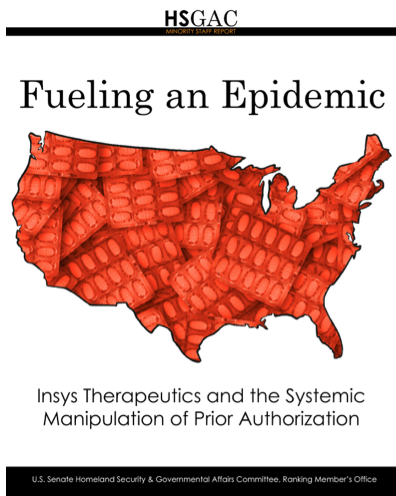
A report released by the minority members of the US. Senate Homeland Security and Governmental Affairs Committee provides new information regarding the significant efforts the pharmaceutical company Insys has undertaken to reduce barriers to the prescription of Subsys, its powerful fentanyl product. These efforts include actions to mislead pharmacy benefit managers (PBMs) about the role of Insys in the prior authorization process and the presence of breakthrough cancer pain in potential Subsys patients. An internal Insys document suggests Insys apparently lacked even basic measures to prevent its employees from manipulating the prior authorization process and received clear notice of these deficiencies.

Don’t let pharma take down a new Maryland price gouging law

In May, Maryland became the first state to take action against the alarming trend of price gouging of off-patent brand-name and generic drugs, writes Jeremy Greene in an op-ed in  The Washington Post. The state’s concise new law, which permits the attorney general to argue in front of a court when the price of an older essential medication increases so precipitously as to “shock the conscience,” passed with overwhelming bipartisan votes and broad popular support. The generic pharmaceutical industry would prefer to see it overturned.  While the problem of pharmaceutical pricing is felt most keenly in newer specialty drugs that can cost more than $30,000 a year, interpretations of federal patent law limit the ability of states to protect residents from price increases in these newer drugs whose monopolies are protected by patents.

Novo Nordisk Reaches USD 58.65 million Settlement with US Department of Justice over Allegedly Illegal Marketing for Victoza

Novo Nordisk (Denmark) has agreed to pay $58.65 million to end a federal investigation by the US Department of Justice (DoJ) related to the company’s diabetes medication marketing practices, reports Bloomberg News. The investigation was launched in February 2011 into sales and marketing activities concerning Novo Nordisk’s leading type 2 diabetes drug Victoza. The financial terms of the agreement mean that Novo Nordisk will pay about $46.5 million as settlement to the federal government and to US states responsible for reimbursing Victoza under the Medicaid program. Furthermore, Novo Nordisk has agreed to pay $12.15 million to resolve complaints lodged by the US administration on behalf of the FDA.  The alleged off-label marketing unnecessarily increased the costs for government healthcare programs while allegedly endangering patients, according to the whistleblower complaints and the government.

Bringing Corporations into the Public Health Classroom

CHW Sept

Credit

With a new semester getting underway, students and faculty in public health and related fields are looking for additional ways to gain the skills and competencies they need to become effective public health professionals.  One promising approach may be to bring corporations more squarely into the public health classroom.  No, we’re not talking about giving away McDonald’s branded backpacks to our students, as some schools in Detroit are doing. Nor are we suggesting inviting Fortune 500 CEOs to teach public health classes on corporate social responsibility or market solutions to global health problems.

Today corporations play a decisive role in shaping patterns of health and diseases, public health policy and what the public knows about lifestyles and health.  Yet few schools of public health teach systematically about the health impact of corporations or prepare their students to analyze the role of corporations in health and social policy.

In this post, I suggest a few resources for public health faculty and students who want to bring a deeper understanding of corporations into the public health curriculum.  These sources can help public health faculty to add assignments and readings about the role of corporations to required and elective public health courses in policy, health education, epidemiology, public health history and environmental and occupational health. They can also help students to write papers, find field work opportunities and pursue careers that help to define appropriate roles for public and private sectors and to prevent or reduce corporate practices that harm health.

Five Useful Websites on Corporations and Health

Corporate Accountability International.  One of the oldest and largest global corporate accountability groups with documents covering its campaigns against infant formula, tobacco, fast food, water, nuclear weapons and other industries.  Organizes and supports global campaigns to end abusive corporate practices.

Corporations and Health Watch Monitors the impact of corporate business and political practices of food and beverage, firearms, automobile, pharmaceutical, alcohol and tobacco industries.  Contains repository of media articles and scientific publications on these topics.

Corporate Watch  Provides information on the social and environmental impacts of corporations and capitalism. Since 1996 its research, journalism, analysis and training have supported people affected by corporations and those taking action for radical social change.

The Poison Papers  Documents the Hidden History of Chemical and Pesticide Hazards in the United States.   The “Poison Papers” represent a trove of rediscovered chemical industry and regulatory agency documents and correspondence stretching back to the 1920s. The papers show that both industry and regulators understood the extraordinary toxicity of many chemical products and worked together to conceal this information from the public and the press. These papers will transform our understanding of the hazards posed by certain chemicals on the market and the fraudulence of some of the regulatory processes relied upon to protect human health and the environment.

Toxic Docs Contains millions of pages of previously secret documents about toxic substances. They include secret internal memoranda, emails, slides, board minutes, unpublished scientific studies, and expert witness reports — among other kinds of documents — that emerged in recent toxic tort litigation. Based at Columbia University and the City University of New York.

Know of other non-profit websites or organizations useful in learning more corporations and health?  Send us link and description and we will update resources.

Five Useful Recent Books

These books published in the last year or two introduce recent scholarship on corporations and health.  They provide faculty and students with an overview of the topic and can be used in teaching about the health impact of corporations.  

Freudenberg N.  Lethal But Legal: Corporations, Consumption, and Protecting Public Health. Paperback Edition With new Afterword. Oxford University Press, 2016.

Kenworthy N, MacKenzie R. Lee K, eds. Case Studies on Corporations and Global Health Governance: Impacts, Influence and Accountability 1st Edition Rowman & Littlefield International; 1 edition (July 18, 2016)

Lee K, Hawkins B.  Researching Corporations and Global Health Governance An Interdisciplinary Guide. Rowman and Littlefield, 2016.

Quelch JA, ed.   Consumers, Corporations, and Public Health: A Case-Based Approach to Sustainable Business . Oxford University Press, 2016.

Walker MJ.  (Editor)Corporate Ties That Bind: An Examination of Corporate Manipulation and Vested Interest in Public Health, 2017.

Know of other recent books that might help public health professionals learn more about corporations and health?  Send us link and description and we will update resources.

15 Recent Useful Articles

This selection of articles from the last two years shows some of the questions public health researchers are asking about corporations and should provoke discussion in a variety of public health classes.  They might also serve as starting points for semester projects or research papers for public health students.

Ajunwa I, Crawford K, Ford JS. Health and Big Data: An Ethical Framework for Health Information Collection by Corporate Wellness Programs. J Law Med Ethics. 2016 Sep;44(3):474-80.

Anaf J, Baum FE, Fisher M, Harris E, Friel S. Assessing the health impact of transnational corporations: a case study on McDonald’s Australia. Global Health. 2017 Feb 6;13(1):7.

Baker P, Friel S. Food systems transformations, ultra-processed food markets and the nutrition transition in Asia. Global Health. 2016 Dec 3;12(1):80

Banerjee D. Markets and Molecules: A Pharmaceutical Primer from the South. Med Anthropol. 2017 May-Jun;36(4):363-380.

Baum FE, Sanders DM, Fisher M, Ana J, Freudenberg N, Friel S, Lamont R, London L, Monteiro C, Scott-Samuel A, Sen A. Assessing the health impact of transnational corporations: its importance and a framework. Global Health. 2016 Jun 15;12(1):27.

Brisbois BW, Cole DC, Davison CM, Di Ruggiero E, Hanson L, Janes CR, Larson CP, Nixon S, London K, Stim B. Corporate sponsorship of global health research: Questions to promote critical thinking about potential funding relationships. Can J Public Health. 2016 Dec 27;107(4-5): e390-e392.

Casswell S, Callinan S, Chaiyasong S, Cuong PV, Kazantseva E, Bender T, Chuckle T, Parker K, Rialtos R, Wall M. How the alcohol industry relies on harmful use of alcohol and works to protect its profits. Drug Alcohol Rev. 2016 Nov;35(6):661-664.

Delobelle P, Sanders D, Puoane T, Freudenberg N. Reducing the Role of the Food, Tobacco, and Alcohol Industries in Noncommunicable Disease Risk in South Africa. Health Educ Behav. 2016 Apr;43(1 Suppl):70S-81S.

Hawkins B, Holden C, Eckhardt J, Lee K. Reassessing policy paradigms: A comparison of the global tobacco and alcohol industries. Glob Public Health. 2016 Mar 21:1-19.

Hawkins B, Holden C. a Corporate Veto on Health Policy? Global Constitutionalism and Investor-State Dispute Settlement. J Health Polit Policy Law. 2016 Oct;41(5):969-95.

Hernandez-Aguayo I, Zaragoza GA. Support of public-private partnerships in health promotion and conflicts of interest. BMJ Open. 2016 Apr 18;6(4): e009342.

Robaina K, Babor TF. Alcohol industry marketing strategies in Latin America and the Caribbean: the way forward for policy research. Addiction. 2017 Jan;112Suppl 1:122-124.

Scrinis G, Monteiro CA. Ultra-processed foods and the limits of product reformulation. Public Health Nutrition 2017;(in press) 1–6.

Weishaar H, Dorfman L, Freudenberg N, Hawkins B, Smith K, Razum O, Hilton S. Why media representations of corporations matter for public health policy: a scoping review. BMC Public Health. 2016 Aug 30; 16:899.

Zoller HM. Health Activism Targeting Corporations: A Critical Health Communication Perspective. Health Commun. 2017 Feb;32(2):219-229.

Know of other recent books that might help public health professionals learn more about corporations and health?  Send us citation and link and we will update this list.

Some Corporate Related Competencies for Public Health Students 

As the Council on Education for Public Health and other professional bodies are requiring schools of public health to revise and update their competencies and learning objectives, schools have an opportunity to introduce new expectations for their students –and faculty.  The competencies listed below can be used in several ways.  Core public health courses can include sessions on these topics as they relate to, for example, epidemiology, health policy, environmental health, or health education. Some public health programs have developed specialized courses on the topic, allowing students to pursue this interest.  Or a student-faculty interest group can bring together those who want to pursue research, advocacy or practice on the corporate impact on public health

1. Identify corporate business and political practices that affect health.

2. Elucidate the pathways by which they shape patterns of health and disease.

3. Develop public health strategies to encourage health-promoting corporate practices and discourage or end health-damaging ones.

4. Analyze the public health advantages and disadvantages of various government/market relationships

5.  Create alliances with consumer, environmental, labor and health organizations and movements that seek to change harmful corporate practices and policies

6.  Describe the roles of public health professionals and researchers in modifying harmful corporate practices or policies.

Do you have a syllabus to share or suggested additional competencies?  Send them (or a link) to us for posting.
EU starts in-depth probe of Bayer, Monsanto deal

Screen Shot 2017-08-23 at 11.09.28 AM

Credit

Reuters reports that the European Commission has started an in-depth investigation of Bayer’s planned $66 billion takeover of U.S. seeds group Monsanto, saying it was worried about competition in various pesticide and seeds markets. The deal would create the world’s largest integrated pesticides and seeds company, the Commission said, adding this limited the number of competitors selling herbicides and seeds in Europe.  If the deal goes through, the newly merged company will be one of the largest agrochemical firms in the world and could put 90 percent of the world’s food supply in the hands of only four multinational corporations.