What’s at stake as GOP moves to slash regulations? For starters, clean air

Air pollution over Los Angeles. Credit

The linchpin of a new 87-page proposal being considered by Congress is a directive to regulators that may be impossible to meet, reports the LA Times.  Regulatory agencies would have to prove they have taken the least costly option possible to business before imposing any major new rule. A similar mandate became stifling when applied for decades to the regulation of chemicals such as asbestos because it allowed companies to keep rules at bay by continually arguing for cheaper approaches. “I don’t think lawmakers are focusing on how extreme this legislation is,” said Paul Billings, lobbyist for the American Lung Association, which has joined several major public health groups imploring congressional leaders to apply the brakes. “It has been viewed as this abstraction that creates improvements in the regulatory process. This would undermine bedrock public health laws.”
Republicans Are Using Big Tobacco’s Secret Science Playbook to Gut Health Rules

Much of the country has been watching in horror as Donald Trump has made good on his promises to eviscerate the Environmental Protection Agency, writes Sharon Lerner for The Intercept.  He has delayed 30 regulations, severely limiting the information staffers can release, and installing Scott Pruitt as the agency’s administrator to destroy the agency from within. But even those keeping their eyes on the EPA may have missed a quieter attack on environmental protections now being launched in Congress. This week, the House Committee on Science, Space, and Technology held a hearing on a bill to undermine health regulations that is based on a strategy cooked up by tobacco industry strategists more than two decades ago. At what Republicans on the committee have dubbed the “Making EPA Great Again” hearing, lawmakers are likely to discuss “The Secret Science Reform Act,” a bill that would limit the EPA to using only data that can be replicated or made available for “independent analysis.” The proposal may sound reasonable enough at first. But because health research often contains confidential personal information that is illegal to share, the bill would prevent the EPA from using many of the best scientific studies.

‘Dangerous’ and ‘Dumb’: Trump Signs Executive Order Torching Regulations

President Donald Trump signed an executive order this week that aims to slash regulations—an action, advocacy groups say, that puts lives at risk, writes Andrea Germanos for Common Dreams. The order—the latest of a flurry since he took office—states that “for every one new regulation issued, at least two prior regulations be identified for elimination,” fulfilling a campaign promise he made. “For fiscal year 2017, which is in progress, the heads of all agencies are directed that the total incremental cost of all new regulations, including repealed regulations, to be finalized this year shall be no greater than zero.” Trump said before signing the order: “We’ll be reducing [regulations] big league,” adding “This will be the biggest such act our country has ever seen.”

An Economy for the 99 Percent

Credit

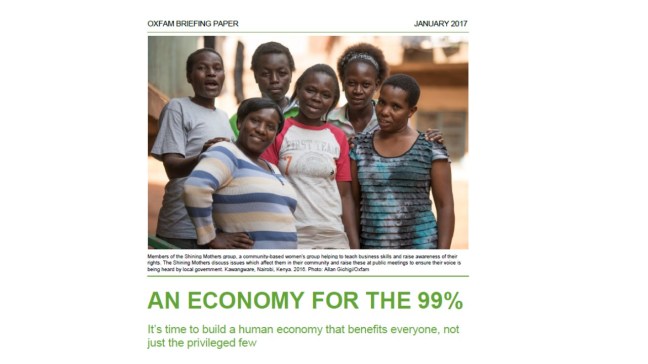
Eight men own the same wealth as the 3.6 billion people who make up the poorest half of humanity, according to a new report published by Oxfam today to mark the annual meeting of political and business leaders in Davos. Oxfam’s report, ‘An economy for the 99 percent’, shows that the gap between rich and poor is far greater than had been feared. It details how big business and the super-rich are fuelling the inequality crisis by dodging taxes, driving down wages and using their power to influence politics. It calls for a fundamental change in the way we manage our economies so that they work for all people, and not just a fortunate few.

OxyContin goes global — “We’re only just getting started”

Credit

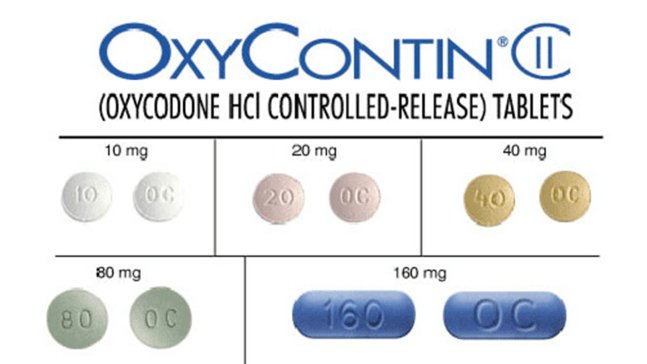
OxyContin is a dying business in America. With the nation in the grip of an opioid epidemic that has claimed more than 200,000 lives, the U.S. medical establishment is turning away from painkillers. Top health officials are discouraging primary care doctors from prescribing them for chronic pain, saying there is no proof they work long-term and substantial evidence they put patients at risk. Prescriptions for OxyContin have fallen nearly 40% since 2010, meaning billions in lost revenue for its Connecticut manufacturer, Purdue Pharma. So the company’s owners, the Sackler family, are pursuing a new strategy: Put the painkiller that set off the U .S. opioid crisis into medicine cabinets around the world. This report is the third in a three part series in which the Los Angeles Times explores the role of OxyContin in the nation’s opioid epidemic. In another post, the journalists who reported the story describe their investigatory methods.

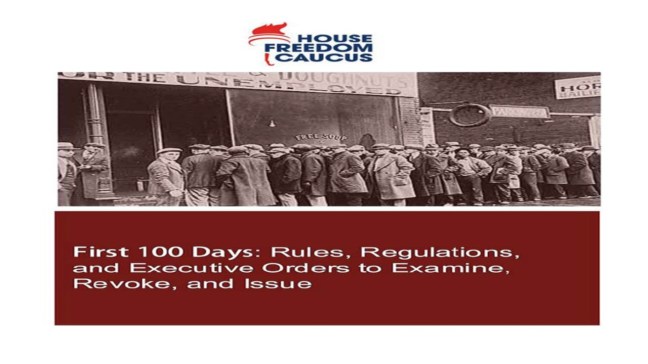
House Freedom Caucus Targets Regulations to Examine or Revoke in First 100 days

The Freedom Caucus of the U.S. House of Representatives, a group of more than 30 conservative Republicans,  released a report listing more than 200 federal rules and regulations that President-elect Donald J. Trump could wipe off the books after he takes office Jan. 20.  Among the public health measures on the proposed chopping block:
•    Nutrition standards for the school lunch and breakfast program
•    Various requirements for the USDA’s Food Safety and Inspection Service
•    FDA rules on tobacco
•    Coverage of preventive services under the Affordable Care Act
•    Various FDA rules that enable drugs that are unsafe or ineffective to be taken off the market.


The Trump Organization: Corporate Track Record

As Donald Trump moves into the White House next month, health advocates may find it helpful to review the business record of the Trump Organization, the real estate and development conglomerate he leads.  The Corporate Research Project, a nonprofit group that assists community, environmental and labor organizations in researching companies and industries, provides a summary of his record. For more than 30 years, Donald Trump has been almost continuously in the public eye, portraying himself as the epitome of business success and shrewd dealmaking, CRP writes. He took a business founded by his father to build modest middle-class housing in the outer boroughs of New York City and transformed it into a high-profile operation focused on glitzy luxury condominiums, hotels, casinos and golf courses around the world. Operating through the Trump Organization, his family holding company, Trump also capitalized on the name recognition gained through years of reality-television appearances in a wide range of licensing deals.

Health Activism Targeting Corporations: A Critical Health Communication Perspective

Health activists and health social movements have transformed medical treatment, promoted public health policies, and extended civil rights for people with illness and disability. This essay in Health Communications explores health activism that targets corporate-generated illness and risk in order to understand the unique communicative challenges involved in this area of contention. Arguing for greater critical engagement with policy, the article integrates policy research with social movements, subpolitics, and issue management literature. Drawing from activist discourse and multidisciplinary research, the article describes how a wide array of groups build visibility for corporate health effects, create the potential for networking and collaboration, and politicize health by attributing illness to corporate behaviors. The discussion articulates the implications of this activism for health communication theory, research, and practice.

Full citation: Zoller HM. Health Activism Targeting Corporations: A Critical Health. Communication Perspective. Health Commun. 2017 Feb;32(2):219-229.

The Absurd, Illegal Logic Behind Trump’s ‘Two for One’ Regulation Proposal

The president-elect recently described in a YouTube video what he intends to do on his very first day in office, writes Ken Kimmell on InsideSources.  Among other things, he will issue a new command to all federal agencies: “If you want to issue a new regulation, you must repeal two existing ones.”  So, for example, if the Environmental Protection Agency wants to issue a new rule to protect kids from mercury pollution from power plants, it would need to cut two existing rules, such as reducing lead in drinking water or requiring school buses to cut smog-causing emissions. Or if the Consumer Product Safety Commission wants to protect families from dangerous car seats for children, the commission would need to drop rules such as requiring better labeling of age appropriate toys, or reducing toxic substances in baby products.  As these examples illustrate, the idea is absurd. Agencies issue multiple regulations because there are multiple threats to public health, safety and the environment. Each regulation must be judged on its own merits. If a new regulation is warranted, it should be issued. If an existing regulation is outdated or no longer effective, it should be changed. One shouldn’t be held hostage for the other.

Standardised tobacco packaging: a health policy case study of corporate conflict expansion and adaptation

Writing in BMJ Open, investigators conclude that the multifaceted opposition to standardised packaging in the United Kingdom was primarily undertaken by third parties with financial relationships with major tobacco manufacturers. Low levels of transparency regarding these links created a misleading impression of diverse and widespread opposition. Countries should strengthen implementation of Article 5.3 of the FCTC by systematically requiring conflict of interest declarations from all organisations participating in political or media debates on tobacco control.

Full citation: Hatchard JL, Fooks GJ, Gilmore AB. Standardised tobacco packaging: a health policy case study of corporate conflict expansion and adaptation. BMJ Open. 2016 Oct 7;6(10):e012634.