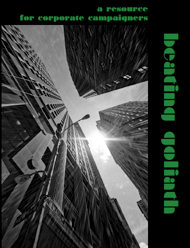
New Resource: Beating Goliath Examines Successful Campaigns Against Corporations

In a recent report called ‘Beating Goliath’, The Democracy Center gathers case studies from previous successful campaigns against corporations, looking at how they won and what we can learn from them. It provides links to many useful resources for activists, and highlights current campaigns engaged in the fight against climate change through targeting corporations. The Democracy Center works globally to help citizens become effective advocates on environmental and social justice issues.

In its Introduction, the authors of ‘Beating Goliath’ explain its purposes:

All across the world people are engaged in urgent battles: on worker rights, protection of the environment, trade, health, and a range of other issues that shape our lives and our futures. In many of these struggles we face a powerful adversary – the corporation. National laws and international trade agreements are drafted under the influence of corporate power. Corporate interests form the donor base of major political parties, and often have bigger balance sheets than the countries they operate in. Waves of deregulation and privatization have eroded limits to corporate accumulation of profit and power. In this hostile environment, groups have had to become more and more sophisticated in how they confront companies in their workplaces and communities.

Struggles to win concessions from corporate power are not new. As the influence and reach of the corporation has grown, so has resistance to it. From early worker struggles for better wages and conditions, to the late 1990s campaign that targeted Shell’s bright yellow logo to stop it sinking an old drilling platform in the North Sea, confronting corporate interests has long been part of the struggle for social and environmental justice.

Groups confronting corporations have a range of politics and use a range of tactics. They include Christian shareholder groups that talk about increasing ‘corporate responsibility’, direct action campaigners that see capitalism itself as the root cause of climate change, well-funded NGOs and confederations of neighbourhood organizations. The Democracy Center designed this resource to be useful for both newcomers to this kind of campaigning and old hands, no matter where they lie on the political or tactical spectrum.

This resource opens with some background on corporate campaigning, and why we think it’s important to take on corporate power through individual campaigns. We then look at a series of wins from corporate targets, with a focus on what we can learn from them as we put together new campaigns. This is followed by introductions to tools and more detailed resources for campaigners fighting corporations – including organizing, research, strategy, communications, coalition building, direct action, shareholder and financier strategies, legal strategies, and consumer strategies. Finally, we’ve included six profiles of climate justice campaigns against corporations that are happening right now, with brief outlines of what they’re campaigning for and how they’re going about it.

And for additional ideas on corporate campaigns, the Spring 2012 issue of Yes! Magazine describes 9 strategies to end corporate rule. They are:

  1. Amend the constitution to end corporate personhood.
  2. Dive into grassroots campaigns.
  3. Hold corporations accountable to our laws.
  4. Get past the propaganda.
  5. Support independent media and keep the Internet free.
  6. Protect the Commons.
  7. Vote. Protect our democracy.
  8. Make your dollars matter.
  9. Get creative to raise awareness.


Image Credit:

1. The Democracy Center

Corporate Practices, Human Rights and Health: New Principles, New Questions

As more people accept the notion that governments have an obligation to follow certain universal standards of human rights, a new question that has emerged is what are the responsibilities of corporations to follow human rights principles? In just the last year, several new developments have put this question on the agenda in various settings.

In June 2011, the United Nations Human Rights Council approved the document Guiding Principles on Business and Human Rights, developed over the last six years.

The United Nations

Under the slogan “Protect, Respect and Remedy”, the document describes three obligations:

“The first is the State duty to protect against human rights abuses by third parties, including business enterprises, through appropriate policies, regulation, and adjudication. The second is the corporate responsibility to respect human rights, which means that business enterprises should act with due diligence to avoid infringing on the rights of others and to address adverse impacts with which they are involved. The third is the need for greater access by victims to effective remedy, both judicial and non-judicial.”

In October 2011, the European Commission issued a  new corporate social responsibility policy for 2011-2014, stating that the Commission “expects all European enterprises to meet the corporate responsibility to respect human rights, as defined in the UN Guiding Principles,” and “invites EU Member States to develop by the end of 2012 national plans for the implementation of the UN Guiding Principles.”

And in Asia, the Association of Southeast Asian Nations (ASEAN) has announced that its Intergovernmental Commission on Human Rights will this year focus on business and human rights. One of the Commissioners has said:

“The target for this thematic study is an ASEAN Guideline that is fully compliant with the UN frameworks, especially the Protect, Respect and Remedy Framework for Business and Human Rights and the Guiding Principles for Business and Human Rights which were endorsed by the UN Human Rights Council.”

These recent initiatives build on the United Nations Global Compact which started more than a decade ago after then-U.N. Secretary-General Kofi Annan called on business leaders to embrace shared values as a way to promote stability in the new era of globalization. So far, more than 6,800 companies in 140 countries have joined the compact by sending letters from their CEOs and agreeing to report annually on their activities. The box below lists the 10 principles of the Global Compact. “A lot of global challenges require active engagement of business,” says Matthias Stausberg, spokesman for the United National Global Compact, an initiative for companies that voluntarily commit to aligning operations with 10 principles covering human rights, the environment, labor and corruption.

What does this new attention on corporate responsibility for following human rights principles have to do with health and the impact of business practices on population health? So far, the existing codes have focused more on labor and environmental practices of corporations than on health consequences of the products that corporations produce and market. Labor and environmental practices certainly have a major impact on health but the current focus does not provide an obvious entry point for addressing the world’s most important causes of premature mortality and preventable deaths: rising rates of non-communicable disease and injuries. The concerns raised about the production and marketing practices of the food, tobacco, alcohol and pharmaceutical industries at the UN High Level Meeting on Non-Communicable Diseases in New York City last September pointed to the importance of these factors in causing global epidemics.

Here are some questions that public health and human rights professionals, researchers and advocates, government officials and business leaders will need to consider if a human rights approach can be applied to reducing harmful business practices.

  1. Do businesses have a right to produce and market products that have been demonstrated to harm public health?
  2. Do businesses have an obligation to disclose to the public what they know about the harmful effects of products they produce?
  3. Do governments have an obligation to protect their citizens from business practices that harm health?
  4. Does providing misleading or untruthful information about the health consequences of a product violate human rights?
  5. What standards are used to determine whether a business has provided adequate judicial or non-judicial remedies to consumers whose health has been harmed by their products?

For the public health community, the notion that corporations have a responsibility to follow basic human rights principles has the potential to suggest new approaches to better balancing the rights of governments and corporations. But for human rights to move from an aspirational statement to a practical strategy, human rights and public health practitioners will need to forge new tools to bring this perspective into the policy, legal and political arenas.


Image Credits:

1. Whiskeygonebad via Flickr.

The Manufacture of Lifestyle: The Role of Corporations in Unhealthy Living

What causes unhealthy lifestyles? In a new article now online at the Journal of Public Health Policy, I make the case that corporate business practices such as product design, marketing and retailing and corporate political practices such as lobbying, campaign contributions and sponsored research are fundamental causes of the of the lifestyles associated with the growing global burdens of non-communicable diseases and injuries.

By focusing attention on lifestylers, the organizations and institutions that shape lifestyles, as well as on the behaviors associated with unhealthy living (e.g., tobacco use, high fat, sugar and salt diets, excess alcohol consumption and so on), we expand our options for developing health-promoting public policies.

The figure below, described in detail in the article, illustrates some of the pathways by which corporate practices influence lifestyle.

This boy sells cigarettes at a small shop in Bangladesh, where over 40 percent of the population is under the age of 15 — a target consumer market for Philip Morris International.

In the article, I suggest four actions that public health professionals can take to advance policies that reduce unhealthy lifestyles.

1. Encourage governments to set advertising standards prohibiting promotion of unhealthy products and making misleading health claims.

2. Strengthen laws making corporations liable for the health-related damage associated with products they produce and promote.

3. Actively promote healthier, more sustainable lifestyles, addressing the demand for unhealthy products as well as the supply.

4. Demand political reforms that reduce corporations’ privileged voice in public policy.

The Occupy Wall Street movement and its critique – a world where fewer than one percent of the population determines the living conditions for the other ninety-nine per cent – suggests the potential to mobilize people in opposition to a corporate-controlled world. Our generation’s public health challenge: Can we find ways to link the Occupy Wall Street spirit to the task of overcoming the corporate control of lifestyles that are killing us?


Image Credit:

1. Campaign for Tobacco-Free Kids

2012: The Year to Stop Playing Nice

Cross-posted from Appetite for Profit.

Instead of a potentially depressing year-in-review post, I decided to look ahead. (But do see Andy Bellatti’s amusing compilation of 2011 food news.) Given all the defeats and set-backs this year due to powerful food industry lobbying, the good food movement should by now be collectively shouting: I am mad as hell and I’m not going to take it anymore.

If you feel that way, I have two words of advice: get political.

I don’t mean to ignore the very real successes: increases in farmers markets, innovative and inspiring programs such as Food Corps, and an increasingly diverse food justice movement, just to name a few. But lately, at least when it comes to kids and junk food, we’ve been getting our butts kicked.

And it’s not just because corporations have more money to lobby, of course they do. It’s that too often, we’re not even in the game. Or, we tend to give up too easily. While I know many food justice advocates who understand this is a political fight over control of the food system, sadly I cannot say the same thing about some of my public health colleagues. Too many nonprofits, foundations, and professionals are playing it safe, afraid to take on the harder fights.

A politician from Maine I interviewed for my book was complaining to me about how food industry lobbyists were in his state capital every single day, while public health sent the occasional volunteer. His sage advice to us advocates: “You may be out-gunned, but you have to bring a gun.”

Moreover, many groups have shown that you don’t always even need a bigger gun. The small but impressive organization, Campaign for a Commercial-Free Childhood proved that this summer when it won an important victory against Scholastic regarding its corporate-sponsored materials. How did they do it? A combination of smart campaigning and effective media. Not by playing nice.

Campaign for a Commercial Free Childhood Logo

Many public health folks I know are more comfortable with research and data than politics and lobbying. But if we are to make real progress, that has to change. Back in May, after a series of defeats, my colleague Nancy Huehnergarth wrote a great call-to-action. She noted how public health advocates and its funders are “very genteel” and that when industry lobbying beats us back, advocates just want more science, believing that the new data “will finally convince policymakers and the public to take action.” But it doesn’t work that way, as she explains:

The reality is that when going up against deep-pocketed, no-holds barred opponents like Big Food, Big Beverage and Big Agriculture, public health’s focus on science and evidence is easily trumped by money and messaging. If public health advocates don’t start rolling up their sleeves and using some of the same tactics used by industry, progress in this fight to create a safe, healthy, sustainable food system is going to move very slowly.

OK, now for some good news. We are already seeing positive signs that indeed, the food movement is getting more political. Recent defeats are helping to mobilize people even more, as folks realize the food industry is not playing nice, so we can’t either. Here then, are just a few signs of hope for 2012:

1)  The growing political movement opposing genetically-engineered foods, which includes a huge Just Label It campaign with an impressive list of supporters. Stay tuned also for the 2012 ballot initiative in California to label GMOs.

2) Powerful nonprofit organizations (who don’t shy away from politics) getting involved for the first time in nutrition policy. For example, the Environmental Working Group’s recent report on sugary cereals called out the utter failure of Big Food’s voluntary nutrition guidelines on marketing to children. Given EWG’s one million-plus supporters, I can’t wait to see where they go with this issue in 2012.

3) Increasing coverage in mainstream media that food industry marketing (and not just personal responsibility) bears much of the blame for the nation’s public health crisis. Examples include a front page story in a recent Sunday edition of the San Francisco Chronicle and Mark Bittman’s weekly Opinionator column in the New York Times, which is consistently smart and hard-hitting.

4) Speaking of media, as traditional investigative journalism outlets have become more scarce, a new breed of reporters may be born from an innovative project just launched in November: Food and Environmental Reporting Network. Its mission is to “produce investigative journalism on the subjects of food, agriculture, and environmental health in partnership with local and national media outlets.” Judging from its first in-depth report on dairy CAFOs in New Mexico, I am looking forward to more in 2012.

5) Finally, the Occupy movement, while still very young, has already inspired a number of food politics offshoots. As I wrote after Food Day, several others have penned calls to action showing the deep connections between corporate control of the food supply and economic injustice. (If you read just one, Tom Philpott’s Foodies, Get Thee to Occupy Wall Street should convince you.) Also, the amazing grassroots organization Food Democracy Now (based in Iowa) recently organized an “Occupy Wall Street Farmers’ March” to bring the message that family farmers are also the 99%. (Read organizer Dave Murphy’s moving account of the successful event and watch the videos of the passionate speakers – I promise you will be inspired.)

There are many other amazing groups, farmers, and eaters organizing all over the country (and the world) to take back our food supply from corporate profiteers. We’ve got plenty of challenges ahead, with the farm bill up for renewal and more school food nutrition standards to fight for, just for starters. I am hopeful that next year we will see the food movement get even more political. I just hope I can also say, by the end of 2012, that it was the year more of my public health colleagues joined in.


Image Credits:

1.  Natalie Maynor via Flickr.

2.  Campaign for a Commercial-Free Childhood

3.  Just Label It Blog

4.  Environmental Working Group

Interview with Joel Bakan, Author of Childhood Under Siege: How Big Business Targets Children

Joel Bakan is Professor of Law at the University of British Columbia in Canada, where he teaches and writes about constitutional law. He is author of the book The Corporation: The Pathological Pursuit of Profit and Power, (2004) and writer and co-creator of the documentary film, The Corporation. Last year, he published Childhood Under Siege: How Big Business Targets Children (Free Press, 2011). Recently, CHW’s Monica Gagnon interviewed Bakan. An edited version follows.

CHW: Your previous book, The Corporation, focused on the behavior of corporations more generally. What inspired you to look specifically at corporate targeting of children in Childhood Under Siege?

JB: In The Corporation, I saw that the way that corporations targeted children was a really important topic, but I was only able to look at it as part of this larger project. As I was out on the road with both the book and the film, this seemed to be an issue that people were really concerned about. I’m also a father of two teenagers who were then around six or seven, so I was starting to see some of the effects of the corporate world on their lives and on my life as a parent. So that all came together and got me back into the writing chair to write this book.

CHW: In your new book, you write about the “new curriculum of childhood.” What do you mean by this?

JB: I found the term the “new curriculum of childhood” in another source, and it really hit me at the time. I had just finished reading a study by the Kaiser Family Foundation, which showed that children spend, on average, 8-10 hours a day engaged with commercial media. That is twice the amount of time they spend in school, and so it really seemed a propos to call this the “new curriculum of childhood.” What kids are learning from commercial media is the dominant influence in terms of their intellectual formation and their value formation. Increasingly, family influence and the influence of teachers have really subsided in relation to the influence of corporate marketers, advertisers and companies that are producing products. To me that is a quite radical shift.

CHW: You write that parents can be powerless to protect children from this harmful corporate influence. Why is this case?

JB: I think parents are the first line of defense for children, but the issues have become much larger than what parents can handle. As a society we can create conditions that are either hostile or facilitative of parents being able to do their job of protecting kids’ interests, and currently we’re creating conditions that are disempowering parents. I did an interview with a children’s environmental health expert, Dr. Bruce Lanphear, about the effect of industrial chemicals on children’s developing biological systems. I said, “How do you deal with this as a father?” and he said, “I can’t.” Parents shouldn’t be expected to be chemists. They simply don’t have the knowledge or the ability, and this is something that government regulators can and should do but are not dealing with.

Look at marketing targeted to children. When I was young, all my mother and father had to worry about was a television set in the living room and three channels. Now kids are out in the world with mobile devices, interacting with media. So how do parents control their children’s use of media in this context? How do you do it when your kids’ very social life depends on their being on Facebook, which is a marketing platform?

I look at pharmaceuticals as well. I tell the story of the tragic suicide of a girl while she was on Zoloft. The doctors and her parents thought Zoloft was a good drug. It turned out the company that produces it, Pfizer, had actually done studies that showed that when kids or teens took that antidepressant, the risk of suicide increased substantially. How is a parent supposed to protect his or her child without access to information that the company has failed to disclose, but that has crucial relevance for making decisions about their child? The problem is too big and the information too inaccessible. Parents don’t have 24 hours a day to become researchers in all of these areas. What we need to do as a society is deal with these issues in a way that makes it possible for parents to make good decisions that protect their children.

CHW: What are some of the implications of these corporate actions for public health?

JB: One of the public health issues I describe in the book is marketing. The American Psychological Association has just come out with a report that summarizes a review of a year’s literature on the effects of sexualized media on girls, and finds that there are links to low self-esteem, eating disorders and inappropriate sexual behavior. All of these things as companies are targeting younger and younger girls with more and more sexualized material. That’s a public health issue.

It’s a public health issue that many kids are becoming compulsive game players and social network participants. Currently, gaming and social network addiction are not recognized as true addictions, but I think any parent can tell you that their kids’ use of this media sometimes reaches unhealthy levels of compulsion, taking them away from interactions with family, from their school work and from sports. In the book, I look very closely at how game designers specifically rely upon behaviorists and psychological research to try to create games that are addicting.

Another issue I deal with is children’s unique vulnerability to environmental toxins. You have research showing that even very small quantities of industrial chemicals can have profound effects on developing biological systems. Industry continues to lobby for the most minimal constraints on production, distribution and emission of these chemical toxins, to the point where right now there are 90,000 industrial chemicals in the environment, and only 200 of those have been sufficiently tested for health effects. We’ve been taking this approach that chemicals are effectively innocent until proven guilty, and as a result, we’re creating an environment that is likely very toxic for children. One of the people I interviewed, an expert on children’s environmental health, Dr. Leo Trasande, said, “We are the humans in a dangerous and unnatural experiment, and it’s unconscionable.”

CHW: How have corporations responded to your criticisms?

JB: People who work in corporations really wear two hats. Yes, they make decisions that lead to actions that cause harm, but at the same time they’re human beings. They’re parents too. They live in this world too, and they’re as concerned as any other audience. I think I have, with this book, hit a nerve, because if you’re a parent there’s really nothing you care about more than your kids’ health and wellbeing. But there is a powerful feeling of disempowerment among parents today. What I suggest in the book is we have to perform our responsibilities as parents and do the best we can to protect our kids from all of this, but we also have a responsibility as citizens to try to change the conditions in which we’re parenting, to try to create a better society from the perspective of our kids.

CHW: One of the five ways corporations harm kids that you detail in your book is through pharmaceuticals. This is also one of the issues we examine at CHW. Can you give an example of how the pharmaceutical industry harms children?

JB: Over the last 30 years, pharmaceutical companies have ramped up their efforts to get kids on psychotropic drugs. In 1980, it was almost unheard of for a child to be diagnosed with a mental disorder and prescribed drugs to treat it. Now it’s as common as giving out antibiotics for strep throat. What has happened over the last 30 years? Have kids become so much more mentally ill? Is it a result of us becoming better at diagnosing mental illness? Or is there a third factor — pharmaceutical companies’ relentless marketing campaigns to doctors, to parents and children to sell the idea that certain behavioral difficulties are, in fact, psychiatric disorders that require treatment with drugs. The pharmaceutical industry has also managed, through various legal changes that took place in the early 1980s, to effectively take over medical research. The process of conducting clinical trials and publishing studies is much more driven now by corporate money than it ever was. This creates a systemic bias in favor of drug treatments that, I argue in the book, is likely leading to more kids being put on more psychotropic drugs for more disorders than is scientifically justified.

CHW: In your opinion, why is there not more governmental regulation of these issues?

JB: We’re currently going through a period where the notion of governments playing an active role in protecting public interest and promoting public good has been thoroughly undermined, and where the notion that markets and corporations should be free of any government restrictions seems to be in play. What I’m saying in this book is that as governments have pulled out of the task of trying to protect children, whether from chemical toxins or from mental toxins in the marketing context, or from undue prescriptions of psychotropic drugs, we’ve seen mounting harms to children.

CHW: Is government regulation the best solution? Are there other solutions?

JB: Government is definitely not sufficient. You can’t run childhood simply through government regulation. But, while it’s not sufficient, I do believe it’s necessary, because I don’t believe parents have the ability to protect their children from many of the harms that I outline. We need governments to step in and actually stop industry from throwing certain kinds of harms at our kids. In a democracy, that’s how it’s supposed to work. Governments are supposed to represent the people and defend the people’s interests, and somehow we’ve gone all askew on that. The main people whose interests are being protected in our current order are corporate persons. The rest of us have been told that it’s no longer the job of government to protect us.

CHW: What have you found in your research that gives you hope that corporations’ effect on children can be reversed? What can health advocates do to help?

JB: In all the areas I look at, there are real champions at all levels of government, in various non-governmental organizations and in parents’ groups. The problem, at the moment, is really a political problem. It’s that somehow the political will isn’t strong enough to address these issues in the way that they need to be addressed. There are lots of reasons for that, not the least of which that the industries involved have both feet in the door of the political process. Democracy is messy, difficult, complicated, and the only way we’re going to turn these things around is if we as citizens become active and do what we can in relation to these issues.
The 2011 Top Ten Worst Pollution Problems Worldwide

Cross-posted from Green Cross Switzerland.

Earlier this month, Green Cross Switzerland and the US-based Blacksmith Institute released a report that presented the top ten list of the world’s worst pollution problems. Using data collected over the past three years from more than 2,000 toxic hotspots, the Environmental Report 2011 identifies the top ten sources of pollution and calculates their health impacts.

“Toxic exposure associated with mining and industrial processes all over the world is a major health risk for the affected population,” says David Hanrahan, Head of Global Program at the Blacksmith Institute.

“Despite the fact that at least as many people suffer from pollution-related illnesses as from malaria or tuberculosis, the international community does not support aid initiatives in most countries,” emphasizes Nathalie Gysi, Executive Director, Green Cross Switzerland.

Toxic chemicals are among the worst health risks
The 2011 Pollution Report calculates for the first time the impact of pollution based both on years of life lost and years spent in poor health, whereas much of the current research in environmental health focuses on the number of deaths a problem causes. Because toxic pollution often leads to crippling disability that does not always result in death, many victims are often left uncounted. This report calculates that, on average, a person impacted by the types of pollution in the top ten list could lose 12.7 years to death or disability. This measurement is called Disability-Adjusted Life Year (DALY) and represents the sum of life years lost and years lived with disability.

Globally, The World Health Organization (WHO) has estimated that toxic chemical exposure was responsible for 4.9 million deaths and 86 million DALYs in 2004. The large difference between deaths and DALYs illustrates that a substantial amount of people are living with disabilities caused by exposure to chemicals. This report goes a step further and pinpoints the cause and effect by calculating DALYs for one specific community plagued by one economic activity and the toxic pollutant it releases. This allowed to more accurately and directly isolate and identify the most severe and widespread pollution problems. These surveys will serve as a tool to help prioritize future resource allocation and cleanup efforts. “The world community is called upon to provide the needed resources and commitment to eliminate the pollution sources and to address the most severe problems immediately,” says Dr. Stephan Robinson, Unit Manager (Disarmament, Water) at Green Cross Switzerland.

The 2011 Top Ten Worst Toxic Pollution Problems Worldwide:
(Ranked according to population at risk)

  1. Mining and ore processing; estimated population at risk: 7,02 million
  2. Metal smelting; estimated population at risk: 4.95 million
  3. Chemical production; estimated population at risk: 4.78 million
  4. Artisanal mining; estimated population at risk: 4.23 million
  5. Industrial estates; estimated population at risk: 3.86 million
  6. Agricultural production; estimated population at risk: 3.27 million
  7. Landfills with industrial and household waste; estimated population at risk: 3.21 million
  8. Heavy industry (casting, milling, stamping); estimated population at risk: 2.77 million
  9. Petrochemical industry; estimated population at risk: 1.91 million
  10. Tannery operations; estimated population at risk: 1.89 million

The 2011 Environmental Report is based on the estimated number of people affected by the pollutants and the number of sites identified globally where pollutants exist in concentrations above health standards. Its focus is specifically on pollutants considered “toxic” by the Blacksmith Institute Technical Advisory Board. Unlike the 2008 report, it excludes problems like indoor air pollution, which might contain nontoxic elements. It also focuses on sites with a clear, fixed source of toxic pollution that can be targeted for remediation efforts. This scope excludes pollution problems where the source is unclear or distributed – such as automobile emissions, general urban air pollution, non-point source water pollution from urban storm runoff, general household or commercial waste disposal, and oil or chemical spills from transport and distribution activities.

The report also reveals that, contrary to popular belief, many of the worst pollution problems are not caused by multi-national companies but by poorly regulated small-scale operations like artisanal mining, small-scale metal recycling, and abandoned factories. However, high-income countries are indirectly contributing to the problem in a significant way, as demand for commodities and consumer goods is largely driven by the economies of high-income countries. They thus support many of these smaller industries, adding to the severity of pollution problems in low-income countries.

Unlike the 2008 report, which included input from external experts and sources, the 2011 report is based entirely on site assessment data that Blacksmith with support from Green Cross Switzerland has collected directly at the locations with toxic pollution problems. Over the last three years, information on over 2,000 polluted sites has been catalogued, including data about concentrations of key pollutants, industrial sources, GPS coordinates, observed health effects, exposure pathways, photos, maps, and information about the potentially exposed population.

Yearly pollution reports
Since 2006, Blacksmith Institute’s yearly reports have been instrumental in increasing public understanding of the health impacts caused by the world’s worst polluted places, and in some cases, have even compelled cleanup work at these sites. Previous reports have identified the worst toxic threats and the worst pollution problems. Blacksmith reports have been issued jointly with Green Cross Switzerland since 2007.

About Blacksmith Institute and Green Cross Switzerland
Blacksmith Institute is an international non-profit organization dedicated to solving life-threatening pollution issues in the developing world. It addresses a critical need to identify and clean up the world’s worst polluted places. Blacksmith focuses on places where human health, especially that of women and children, is most at risk. Based in New York, Blacksmith works cooperatively in partnerships that include governments, the international community, NGOs and local agencies to design and implement innovative, low-cost solutions to save lives. Since 1999, Blacksmith has completed over 50 projects; Blacksmith is currently engaged in over 40 projects in 20 countries.

Green Cross Switzerland facilitates overcoming consequential damages caused by industrial and military disasters and the clean-up of contaminated sites from the period of the Cold War. Central issues are the improvement of the living quality of people affected by chemical, radioactive and other types of contamination, as well as the promotion of a sustainable development in the spirit of co-operation instead of confrontation. This includes the involvement of all stakeholder groups affected by a problem. Green Cross International with headquarters in Geneva was founded in 1993 by Mikhail Gorbachev, former President of the Soviet Union. The organization consists of a worldwide network of 32 subsidiaries committed to important issues such as peace, security, the fight against poverty and protection of the environment.

Image Credits:

Green Cross Switzerland

Extractive Industries, Intellectual Property and the Health of Indigenous Peoples

Because the corporate goal is to obtain the highest profit possible, not social welfare, public health or environmental sustainability, business interests often give little or no consideration to the effects of corporate practices on indigenous peoples. Thus, the estimated 257 to 370 million indigenous peoples in about 5,000 communities in 70 countries, speaking 5,000 of the 6,000 existing languages, often experience severe detrimental consequences from commercial activity. The effects of extractive industries such as mining, agricultural crops and timber, and the theft of intellectual property rights illustrate some of those consequences.

Extractive industries

Mining

In many parts of the world, indigenous people inhabit areas that have been identified as areas with abundant resources that are in demand as profitable ventures for global industries:

Forests for the logging industry; oil and gas for exploration and drilling industries; gold and other minerals for mining companies and agriculture; use of the land for mono crop farming such as tobacco, palm oil, coffee, rubber; dams on indigenous land to create lakes or use of rivers to produce electrical energy; and nature reserves established in areas where they displace the indigenous peoples living there.

These extractions are reminiscent of early European appropriation of the Americas under the concept of “terra nulius” that is, land not belonging to anyone, and therefore available for the taking, even though millions of indigenous peoples had inhabited an area for thousands of years prior to European explorations.

The various extractive industries have several effects in common relative to indigenous peoples: [1]

  1. The industrial operations displace indigenous people from their ancestral homes and land which have been integral to their spiritual, physical, mental and emotional life, requiring indigenous people to move to other remote but unfamiliar areas, or to migrate to the unsanitary, unhealthful fringes of urban areas with unlikely means of earning a decent livelihood. As a result the indigenous people experience social disorganization in their relationships to each other, and disruption of their relations with other indigenous group. They are forced to interact in new and unfamiliar settings with unfamiliar types of people, practices and ways of behavior.
  2. This displacement, dispersion and migration leads to loss of their language and culture.
  3. Their ancestral land may be confiscated with no or little financial remuneration for the land or for the extracted substance.
  4. With loss of land, they lose their traditional livelihood, subsistence farming or place for gathering food and traditional medicinal plants.
  5. Their sacred land or water be polluted by the extractive operations.
  6. Contacts with extractive industry workers may expose the indigenous peoples to new diseases that they then transmit to their families, neighbors and other groups of indigenous peoples.
The Case of the Nahua and Nati Peoples in Peru
Clear cut logging

Napolitano described a 20 year history of an indigenous peoples’ contact with extractive industries within a territorial reserve the government established for four groups of indigenous people in an isolated area of the Amazon River. [2] Logging of mahogany and cedar, and oil operations in or near the area during the 1970s and 1980s led to some violence against the industry operations, some displacement of one indigenous group, and interethnic clashes between groups. In about 2001, work began on a gas field concession granted by the Peruvian government, 75 percent of which was within the territorial reserve.

Loggers working in an area of the Amazon encountered members of the Nahua indigenous group. Some of the Nahua went down river and interacted with the loggers. Upon their return up river, epidemics, including pneumonia, complicated by parasites and malaria, began among the Nahua. The people were too sick to hunt, fish or harvest. There were too many dead to bury and the bodies were left on the ground. The indigenous people became dependent upon the loggers and missionaries for sustenance. Logging expanded and virtually took over the area of the indigenous people. Many of the indigenous people moved to a town but later became dissatisfied and returned to their communities. Some also worked in the logging industry. In the area occupied by another group, the Nati, a mission and a school were established where respiratory and gastrointestinal infections were brought from down river, leading to many deaths.

Epidemics of respiratory and diarrheal disease also began in company work camps where some indigenous workers also lived.  Indigenous peoples’ movements between camps and their home communities facilitated the spread of disease, including scabies outbreaks from donations of clothing from worker camps to the indigenous peoples.

After extractive industries entered the area, infant mortality was high and there were fewer pregnancies, due in part to changes in traditional gender roles of food gathering and cultivation and the growth of industry jobs that led to malnutrition and thereby comprised resistance.

Intellectual Property

Pharmaceutical and agricultural corporations have an interest in commercialization of medicinal plants that indigenous peoples have developed and used over thousands of years. Collectors and researchers (that is, “bioprospectors”) travel into indigenous peoples’ territories and obtain information from them about their traditional medicinal plants, the preparation and use, and they collect and take specimens with them. They return to their labs, test the plants, develop products from the active ingredients, patent and sell them with no credit or compensation to the indigenous people. This is one aspect of what indigenous communities call “biopiracy.” [3]

A similar process sometimes occurs with indigenous food crop seeds that indigenous people have produced through selective genetic breeding research over centuries. The corporation sells those patented seeds to farmers and prohibits the farmers from saving seeds from their own crops for the next year, and requires them to buy company seeds. In some areas of India where this has occurred, the suicides of many farmers has been attributed to the poverty that resulted from this process.

There is commercial interest in mapping the genomes of indigenous peoples in order to develop new medications and other treatments. Indigenous people have had their blood specimens taken and used for this purpose without their permission, and without any compensation for the products developed from the research on their tissue.

Some indigenous cultures have beliefs about extracting bodily parts, contact with human tissue and specific practices for discarding tissue that may not be respected by those who collect the specimens.

The symbols and designs of indigenous peoples have been used in commercial products without their permission and without financial compensation. Without a history of private ownership, patents and copyright of art is a new concept to indigenous peoples, requiring them to learn about and develop new procedures and practices.

Protection of Indigenous Rights

United Nations

Hydroelectric Dam

Within the United Nations, progress has been made toward protecting indigenous peoples’ rights:

1. In 2000 the Permanent Forum on the Rights of Indigenous Peoples was established,

2. In 2001 the Office of the Special Rapporteur on the situation of human rights and fundamental freedoms of indigenous people was established,

3. In 2007 the “Declaration of the Rights of Indigenous Peoples” was passed (but not by all countries).

There are several specific articles in the Declaration of the Rights of Indigenous Peoples that are particularly relevant:

Article 24 is the right to conserve their medicinal plants, animals and minerals;

Article 26 is the right to lands, territories and resources they traditionally owned, occupied, used or acquired;

Article 28 is the right to compensation for their lands, territories and resources that have been confiscated, taken, occupied, used or damaged;

Article 29 is the right to control, develop and protect their sciences, technologies and cultural manifestations.


Declarations

The 2009 Declaration of the International Conference on Extractive Industries and Indigenous Peoples specifically asks the extractive industry to abide by certain safeguards and precautions:

  • Respect international standards on the right to lands, territories and resources and attendant rights;
  • Submit to independent and credible monitoring;
  • Be accountable for the environmental disasters, destruction and human rights violations as a result of their operations;
  • Employ proven technology and adhere to the precautionary principle at all levels and in each project;
  • Recognize the specific vulnerability of indigenous women to the negative impacts involved with extractive industries;
  • Ensure full transparency in all aspects of their operations, and especially to ensure affected communities have full access to information in forms and languages they can understand; and
  • Conduct and implement environmental, social, cultural, and human rights impact assessments to the highest international standards ensuring independent review and participation of indigenous peoples.


A Role for Public Health

The public health profession can take a variety of actions to address the effects of commerce on the health of indigenous peoples.

  1. Strive continuously to make the issues of indigenous people visible in discussions about commerce and health, and to bear witness to injustices resulting from business;
  2. Engage indigenous organizations and individuals in health professions organizations, and collaborate with them;
  3. Ensure that there are public health programs to address personal health and environmental health issues wherever commerce intersects with indigenous peoples;
  4. Create specific official organizational policies to support indigenous rights and health in policy processes and commercial agreements.

References

1.     Mander, J. & Tauli-Corpuz, V. Paradigm wars: Indigenous peoples’ resistance to globalization. San Francisco: Sierra Club Books, 2006.

2.     Napolitano, D.A. Towards understanding the health vulnerability of indigenous peoples living in voluntary isolation in the Amazon rainforest: Experiences from the Kugapakori Nahua reserve, Peru. EcoHealth 2007; 4, 515-531.

3.      Gheorghiu, V.A. Sailing The seas of treaties: Biopiracy in the wake of the International Treaty on Plant Genetic Resources for Food and Agriculture. Fourth World Journal, 2007; 7 (2), 1-39.


Image Credits:

  1. Mongabay.com
  2. Eye on Mining
  3. RitchieWiki

State-Level Ramifications of the Citizens United Decision

In January 2010, the U.S. Supreme Court issued its Citizens United v. Federal Election Commission opinion,[1] which changed the laws that determine how corporations participate in the political process. Specifically, Citizens United overturned laws that prevented corporations from using their own funds for advertisements that support or oppose candidates running for elected office. A corporation can now spend unlimited monies to run advertisements that support candidates whose platforms it favors and to oppose candidates whose stated positions are contrary to its own interests.


On its face, the decision did not concern health, but its ramifications will likely have significant impacts for health policy, the delivery of health care, and public health initiatives.[2],[3] For example, corporations can examine incumbent legislators’ voting records on particular issues (e.g., menu-labeling requirements for restaurants) and, if candidates have voted against their interests, corporations can finance advertisements against their re-election. Similarly, corporations can now fund advertisements that support the re-election of candidates with voting records that support their interests. The potential for well-funded political advertisements may dramatically affect some legislators’ votes on important health issues, particularly if they seek to avoid a series of negative corporation-funded advertisements in the final weeks of their re-election campaigns.

In recent months, the Citizens United decision—which concerned regulatory actions taken by the federal government—has raised potential concerns in many U.S. states. Approximately half of the states have laws that entirely prohibit or partially restrict corporations’ ability to fund advertisements in advance of political elections. Several states initially considered repealing these laws, in anticipation of fallout from the Supreme Court’s Citizens United opinion.[4] The National Conference of State Legislatures (NCSL) has noted that “it is likely that states will choose not to enforce these laws [that prevent corporations from funding political advertisements], which has the potential to radically change the political landscape.”[5]

Since 2010, several states have indeed amended or repealed laws that seemed to conflict with Citizens United. For example, according to NCSL, Alaska, Arizona, Connecticut, Iowa, Minnesota, North Carolina, South Dakota, and West Virginia have repealed laws that prevented corporations from directly funding political advertisements. In addition, several state courts have heard challenges to their state laws that prohibit corporation-funded political advertisements.

National attention turned to Montana this September, when its Supreme Court heard oral arguments regarding the constitutionality of its century-long ban on political advertisements funded by corporations.[6] The case began when several corporations—Western Tradition Partnership, Inc., Champion Painting, Inc., and Montana Shooting Sports Association, Inc.—brought a lawsuit in which they alleged that the state’s Corrupt Practices Act of 1912 was unconstitutional in light of the U.S. Supreme Court’s Citizens United decision. The act states, “A corporation may not make a contribution or an expenditure in connection with a candidate or a political committee that supports or opposes a candidate or a political party.”[7]

The state of Montana presented several arguments in favor of the constitutionality of the Corrupt Practices Act. The state’s legal team also explained that the act had been drafted in response to “early corporate domination of state government,”[8] specifically “to limit the inordinate influence of the copper mining companies and their owners, known as the Copper Kings, over Montana politics. . .”[9] In October 2010, a lower Montana court held that the Corrupt Practices Act was unconstitutional after the Citizens United decision.

Activists rally for a constitutional amendment overturning the Citizens United Supreme Court decision on Friday, January 21, 2011 in Washington, DC

Shortly after the decision was released, Montana’s Attorney General, Steve Bullock, issued a statement in which he expressed his intention to appeal the ruling. He explained that:

“This isn’t just about our history: two former secretaries of state and other experts in the field testified that an influx of corporate spending will corrupt the political process and drown out the voices of everyday Montanans. . . While I have a great deal of respect for the district court, the people of Montana have long said that its citizens, not corporations, should decide the outcome of elections.”[10]

In briefs submitted in anticipation of the case’s appellate hearing, Bullock, representing the state of Montana, argued that under the Corrupt Practices Act, corporations are still able to participate in the state’s political processes. The brief stated that,

“No other corporations have challenged Montana’s law in one hundred years.  Still, one would have to ignore the record—and Montana history and politics—to suggest. . . that corporations have been silenced for the past century. To the contrary, corporations are active participants in Montana politics through accountable means such as the political committee requirements applicable to other organizations that seek to associate for campaign purposes. It is undisputed that within this system, corporations large and small are heavily involved in Montana politics through expenditures, contributions by managers, and lobbying.”[11]

In response, the plaintiffs, led by Western Tradition Partnership, argued that the Corrupt Practices Act “expressly prohibits corporations from making independent expenditures at a critical time during our election process; i.e., the campaign for political office. Furthermore, even if [corporate] managers can make expenditures, the manager is not the corporation, just as a PAC [political action committee] is not the corporation.”[12] Numerous organizations submitted amicus (i.e., friend of the court) briefs in anticipation of this fall’s oral argument.[13] The oral argument before Montana’s Supreme Court occurred on Sept. 21, 2011, and the court will likely announce its decision within the next few months.[14]

Because states have broad powers to act to protect the health, safety, and welfare of their residents, they often serve as public health innovators. The extent to which states choose to pursue efforts to protect and promote the public’s health often depends on the composition of the state’s legislature, and the priorities of its elected members. In the period leading up to an election, the public receives information about political candidates through the media, which includes advertisements that support or oppose particular individuals. If Montana’s Corrupt Practices Act is overturned, corporations will have an expanded ability to fund these types of advertisements, which may dramatically influence who Montanans vote into office.

Jennifer Pomeranz is the Director of Legal Initiatives at the Rudd Center for Food Policy & Obesity at Yale University. She publishes and speaks on issues related to marketing to children, regulating unhealthy products, labeling, weight bias, and the government’s role in obesity and food policy.


References

[1] Citizens United v. Federal Election Commission, 130 S.Ct. 876 (2010).

[2] Rutkow L, Vernick JS, Teret SP, The potential health effects of Citizens United, New Eng J Med 2010;362:1356-1358.

[3] Wiist WH, Citizens United, public health, and democracy: the Supreme Court ruling, its implications, and proposed action, Am J Public Health 2011;101:1172-1179.

[4] National Conference of State Legislatures, State laws affected by Citizens United, 2011, at http://www.ncsl.org/default.aspx?tabid=19607#laws.

[5] National Conference of State Legislatures, Life after Citizens United, 2011, at http://www.ncsl.org/default.aspx?tabid=19607#intro.

[6] Charles E. Johnson, Corporate political spending goes before Montana Supreme Court Wednesday, Missoulian, Sept. 19, 2011.

[7] Mont. Code Ann. § 13-35-227 (2010).

[8] Brief of Appellant at 2, Western Tradition Partnership, Inc., et al. v. Montana Attorney General et al., No. DA 11-0081 (Apr. 15, 2011).

[9] Charles E. Johnson, Judge throws out Montana’s ban on corporate campaign spending, Missoulian, Oct. 19, 2010.

[10] Office of the Montana Attorney General, Bullock releases statement on corporate electioneering case, Oct. 18, 2010.

[11] Appellant Reply and Answer to Cross Appeal at 9, Western Tradition Partnership, Inc., et al. v. Montana Attorney General et al., No. DA 11-0081 (June 10, 2011).

[12] Appellees and Cross-Appellants’ Reply Brief at 9, Western Tradition Partnership, Inc., et al. v. Montana Attorney General et al., No. DA 11-0081 (July 1, 2011).

[13] Charles E. Johnson, Corporate political spending goes before Montana Supreme Court Wednesday, Missoulian, Sept. 19, 2011.

[14] Charles E. Johnson, Montana Supreme court grills attorney general on corporate spending ban, Missoulian, Sept. 21, 2011.

Image Credits:

1.    Ilaannaa via Flickr.

2.    Public Citizen via Flickr

LittleSis: A Tool for Activists and Researchers

Want to learn more about who-knows-who at the heights of business and government? For those interested in knowing where a certain politician is getting his or her funding, finding out what individuals sit on which corporate boards, or learning more about the networks that connect the most powerful people in the world, the website LittleSis is a helpful tool. The site is a self-proclaimed, “‘involuntary Facebook’ of powerful people and organizations,” aiming to bring “transparency to networks of influence, tracking the key relationships between politicians, corporate executives, lobbyists, financiers, and their affiliated organizations.”

LittleSis, the name a play on “Big Brother,” was developed by the Public Accountability Initiative(PAI), founded in 2008 by Kevin Conner and Matthew Skomarovsky. According to its website, PAI is a “nonprofit, non-partisan research and educational organization focused on corporate and government accountability,” whose mission is “to facilitate and produce investigative research that empowers citizens to hold their leaders accountable.” To further its mission, PAI set up LittleSis so that citizens can better understand the relationships and financial actions of powerful people and their networks. LittleSis is a free database of who knows who in the top positions of business and government.LittleSis supports the work of journalists, watchdogs and grassroots activists by documenting where individuals in positions of power work, who they know, and who they donate to. This information is already publicly available, but the goal of LittleSis is to bring it all together in one place so that it can be a useful tool for revealing the social networks that have the greatest influence over U.S. public policy. In addition to being a searchable database, LittleSis also has a blog, called Eyes on the Ties, that helps readers keep up with the shifting networks in the database.

To explore how LittleSis can be used, I decided to see what I could find out about James Skinner, the CEO of the McDonald’s Corporation.  Here’s what I learned:

James A. Skinner, who has been CEO of McDonald’s since 2004, is also on the Board of Directors of two other corporations, Illinois Toolworks and the Walgreens drug store chain. He has contributed money to the Illinois Republican Party, John McCain, the Republican National Committee, Mitt Romney, the National Republican Congressional Committee, and McDonalds Corporation Political Action Committee, among others. Skinner is also on the Board of Catalyst, a leading nonprofit membership organization that defines its mission as expanding opportunities for women and business.

Skinner sits on boards of other organizations with 229 other people, including:

  • Judith Dimon, the wife of JPMorgan Chase CEO Jamie Dimon;
  • William F. Aldinger  III, who is President, Chief Executive Officer and Director of Capmark Financial Group Inc., a commercial real estate finance company, and also serves on the boards of AT&T Inc., KKR Financial Corp. and The Charles Schwab Corporation;
  • William M. Goodyear, Past Chairman and Chief Executive Officer of Bank of America,
  • Barbara Paul Robinson, a partner at Debevoise & Plimpton LLP;
  • Enrique Hernandez Jr, President & CEO of Inter-Con Security Systems and a director at Wells Fargo.

Following a link to McDonald’s Corporation, we learn that McDonald’s has hired Michael Tiner as a lobbyist, paying him $390,000 between 1999 and 2008. Tiner has also served as lobbyist for the agribusiness company Amgen. We learn that James Simons, a former mathematician whose quantitative hedge fund returned 73 percent net of fees – as high as 5 percent of assets and 40 percent of profits – in 2007, owns 8,165,300 shares of McDonalds. These random factbits illustrate the world in which McDonald’s operates and show its multiple connections to the financial sector, responsible for many of the nation’s current economic woes.

James A. Skinner

Anyone can contribute to the LittleSis database by signing up on the website. Users can add to the database, fill in gaps, and correct errors. In addition to the online community of researchers, LittleSis gets its information from government filings, news articles and other sources. Because the database is so participant-driven, there is no guarantee that all of the information will be completely accurate all of the time.

“LittleSis is an experiment – an ambitious one – in the world of crowd-sourcing of transparency and accountability efforts,” says Ellen Miller, co-founder and executive director of the Sunlight Foundation, one of the original funders of LittleSis. “It empowers us all to be our own best watchdogs and collectively develop an unprecedented, authoritative database of information on the powers that be.”


Image Credits:

LittleSis.org

Why is the Federal Government Giving its Stamp of Approval to Ronald McDonald?

Bowing to industry pressure, the Federal Trade Commission announced that its final proposed voluntary guidelines to protect children from predatory marketing would not require food corporations to remove “brand equity characters from food products that don’t meet nutrition guidelines.”

The FTC’s decision is extremely disappointing, and prioritizes the interests of corporations such as McDonald’s and PepsiCo over kids’ health.

More specifically, the federal government is sending the message that powerful child-friendly icons such as Ronald McDonald are A-OK, regardless of the lifelong health consequences of getting kids hooked on a steady diet of cheeseburgers, fries, and Coke.The FTC’s testimony was startling and disturbing. While the agency says such characters are “appealing to children,” they also appeal “to a broader audience and are inextricably linked to the food’s brand identity.”A “broader audience?” Who exactly are characters such as Toucan Sam, Tony the Tiger, and especially Ronald McDonald designed to appeal to other than children? The FTC is absolutely correct that such characters are inextricably linked to the brand’s identity, and that is exactly the point.

McDonald’s deploys its ubiquitous mascot in myriad ways—in schools, community events—wherever children congregate—for the sole purpose of building brand loyalty from a very young age. And often at these appearances, there’s not a Happy Meal in sight. Because McDonald’s knows the key to getting kids to nag their parents to visit McDonald’s is getting vulnerable children to fall in love with Ronald first, and Chicken McNuggets second.

If the federal government backs off setting some minimal guidelines for how these characters can be utilized, it would set a dangerous precedent, potentially even undermining state and local policy along with other legal actions to stop this predatory marketing practice.

Obviously the Obama Administration is under tremendous political pressure from the food industry, in addition to the powerful advertising industry lobby. But the entire process of the Interagency Working Group was compromised early on because government officials agreed with the food corporations that voluntary, self-regulation is a viable solution to junk food marketing to kids.

Decades of experience combined with ample scientific research, not to mention common sense, tells us that relying on the food industry to police itself is futile. Having federal agencies provide guidance to the food industry to improve their own voluntary standards was wishful thinking at best. In the process of trying to gain food industry cooperation, the Federal Trade Commission seems to have forgotten its own motto: “Protecting America’s Consumers.” You would hope that kids would be at the top of the list for FTC protection.

Federal officials should stop hiding behind free speech rhetoric, pretending that voluntary self-regulation will work, and instead roll up their sleeves and get to work drafting legally feasible safeguards against predatory junk food marketing to children. It’s the best solution we have.


Image Credit:

Kcolwell via Flickr