New York Attorney General Asks Major Retailers to Halt Sales Of Certain Herbal Supplements

credit
credit
walmart
St John’s Wort and other herbal ingredients were not found in products with this name sold at Wal-Mart’s and other chains. credit

NEW YORK — Attorney General Eric T. Schneiderman announced that his office sent letters to four major retailers, GNC, Target, Walmart, and Walgreens, for allegedly selling store brand herbal supplement products in New York that either could not be verified to contain the labeled substance, or which were found to contain ingredients not listed on the labels. The letters, sent Monday, call for the retailers to immediately stop the sale of certain popular products, including Echinacea, Ginseng, St. John’s Wort, and others. Schneiderman requested the companies provide detailed information relating to the production, processing and testing of herbal supplements sold at their stores, as well as set forth a thorough explanation of quality control measures in place.

  • Read Attorney General Eric Schneiderman’s full press release
  • Read the Cease and Desist Notification from the AG
  • Read about the bill Senators Richard Blumenthal and Richard Durbin introduced in 2013 that would require dietary supplement manufacturers to register their products with the FDA and disclose the known risks of any ingredients on their labels.

How Wealthy Individuals and Corporations Protect their Interests

Two new reports shed light on how big corporations and the wealthy elites who control them use their riches to advance their policy agenda. A new report by Oxfam, Wealth: Having it All and Wanting More describes the increasing concentration of global wealth.


credit: Oxfam
credit: Oxfam

Richest 10 billionaires (ranked in 2013) who have made (at least part of) their fortunes from activities related to the pharmaceutical and healthcare sectors, and their increase in wealth between March 2013 and March 2014.


A few highlights from this report:


  • In 2014, the richest 1% of the people in the world owned 48% of the global wealth., leaving just 52% to be shared among the others 99% of the adults on the planet.
  • Wealth of the 80 richest people in the world has doubled in nominal terms between 2009 and 2014, while the wealth of the bottom 50% is lower in 2014 than it was in 2009
  • In the last two years, billionaires listed as having interests and activities in the pharmaceutical and health care sectors saw the biggest increase in their collective wealth. Their collective wealth increased from $170 billion to $250 billion, a 47% increase and the largest increase in wealth of the different sectors on the Forbes list.
  • In 2013, the pharmaceutical and health care sectors spent more than $487 million on lobbying in the United States alone, more than any other US sectors and representing 15% of total lobbying in 2013. In 2012, this sector spent $260 million on campaign contributions. The pharmaceutical and health care industry spent another $50 million on lobbying in the European Union.


Who Needs Lobbyists?

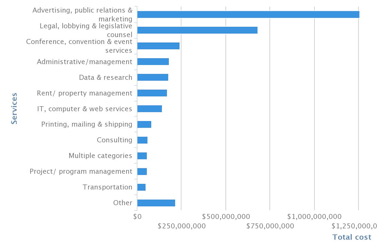
A second report Who needs lobbyists? See what big business spends to win American minds by the Center on Public Integrity analyzed how much US trade associations spent on advertising and public relations, a much higher expenditure than lobbing. Some highlights:


  • Spending on public relations faces far less disclosure requirements, making transparency more difficult than for lobbying.
  • By industry sector, the biggest clients of PR services are energy and natural resources associations.
  • All five of the U.S. Chamber of Commerce’s top contractors in 2010 and 2012 were advertising agencies.
  • PR giant Edelman collected $346.8 million from trade groups from 2008-2012, way more than any other communications firm.
  • Industries relying most on PR campaigns are usually those facing the heaviest regulation


lobbyists
credit: Center for Public Integrity


From 2008 through 2012, the most politically active trade groups spent a total of $3.4 billion on their top contractors, according to a Center for Public Integrity analysis of annual tax filings. This graph shows where their money went.

2014 Stories on Health Impact of Corporations-Part II

Last week, I wrote about some of the 2014 news stories that revealed how the auto, pharmaceutical and alcohol industries had harmed health. In this post, I turn to some of the top stories in last year’s coverage of the other industries Corporations and Health Watch follows: food and beverages, firearms and tobacco.


Coca-Cola Sales Go Flat

CC
credit

Early this month, the New York Times reported that Coca-Cola says it will cut between 1,600 and 1,800 jobs in coming months to trim costs. These moves are part of an ongoing restructuring to reflect declining sales of Coca Cola in the United States—and in many other parts of the world. In October, Coca-Cola announced it hoped to cut costs by $3 billion a year through a variety of measures. The savings would be used to pay for more marketing to drive up beverage sales.


But throughout the year, business analysts have been questioning Coke’s strategy. For example, Bloomberg BusinessWeek carried a story called Coke Confronts Its Big Fat Problem. It concluded:


Americans may not have figured out the answer to the obesity epidemic, but for years they’ve pointed to Coca-Cola and other soda as one of the causes. Coke has tried fighting against this. It’s tried ignoring it. Now it accepts this as a reality… (The company) has to persuade people to drink Coca-Cola again, even if they don’t guzzle it like water the way they did before.


Fortune published Coca-Cola’s Problems Reflect a Giant Losing Relevance. Its harsh assessment is that Coca Cola has failed in:


recognizing that the big problem is the leadership team’s fixation with defending its Coke brand, rather than finding new growth businesses as the market moves away from carbonated soft drinks.  This problem requires the CEO and his entire management team to step up their strategy efforts, not just fire the leader who has been updating the branding mechanisms.


For public health, Coke’s failures are our success. The continuing decline in soda consumption is in part a reflection of the health policy and education campaigns that have changed the image of soda that Coke has tried to market.   Declining sales at Coke now hold the promise of less diabetes and diet-related diseases in the future. Key questions for the coming years are will Coke’s fizzed up advertising be able to delay the shift in tastes and to what extent will the company apply tobacco industry response to flat sales in the US by stepping up marketing in Asia, Africa and Latin America.


Big Tobacco Takes Up Vaping

vaping
credit

When e-cigarettes were introduced a few years ago, it wasn’t clear if the makers of this product would take business away from the tobacco industry or become a subsidiary of the nicotine delivery business. Last year, most of the world’s largest tobacco companies expanded their e-cigarette business, suggesting the emergence of an integrated Big Nicotine business. For example, according to Bloomberg Businessweek, R.J. Reynolds in 2014 scaled up marketing of its Vuse brand of e-cigarettes from four states to a national market. Lorillard sells Blu eCigs and controls about 40 percent of the current market. Altria Group owns two e-cig brands and plans to expand nationally as well. While some public health advocates continue to argue that e-cigarettes have the potential to reduce tobacco use, others make the case that the increasing control of the e-cigarette market by transnational tobacco companies does not bode well for this product being used to advance public health or reduce the demand for nicotine products. As public health advocates debate our positions on e-cigarettes, we need to keep our eyes not just on the theoretical potential of a new technology but on the actual practices of the industry that makes and markets the product.


Gun Fight Turns to the States

credit
credit

Just as policy battles on abortion and gay marriage have bounced between state and federal levels over the last decade, the fight on gun safety, long played out on the federal level, has now bounced back to the state level. Earlier this month, the New York Times noted that,


“the gun control movement, blocked in Congress and facing mounting losses in federal elections, is tweaking its name, refining its goals and using the same-sex marriage movement as a model to take the fight to voters on the state level.”


Last November, Washington state voters approved a ballot measure that will require broader background checks on gun buyers and gun safety advocates are looking to add ballot measures in 2016 in Nevada, Arizona, Maine and Oregon.


At the same time, gun rights advocates are using state legislatures to seek to overturn federal guns laws. According to one report, eight states have recently passed laws voiding federal firearms regulations and in the last decade more than 200 such bills have been considered by states.


A recent report by the Law Center to Prevent Gun Violence found that states with stronger gun regulation have lower gun death rates, and the states with weaker regulation have higher gun death rates. As gun safety advocates study the successes of the gay marriage movement in using state level successes to win national victories, they’ll need to devise strategies that choose the settings and the messages that can ultimately lead to national successes in reducing gun violence.

Roundup of 2014 Stories on Health Impact of Corporations

For observers of how corporations find ways to profit at the expense of public health, the news coverage of 2014 provides a wealth of evidence. Here are three stories that caught my eye last year. Next week I’ll present stories about the food, firearms and tobacco industries, the other sectors that Corporations and Health Watch follows.


Auto Recalls at General Motors, Chrysler, Ford, Toyota, Honda and Others Set New Record


credit
credit

Last year, reported the New York Times, more than 60 million vehicles have been recalled in the United States, double the previous annual record in 2004. In all, there have been about 700 recall announcements — an average of two a day — affecting the equivalent of one in five vehicles on the road. The eight largest automakers have each recalled more vehicles in the United States this year than they have on average since 1966, when data collection began, with G.M., Honda, and Chrysler each setting corporate records, the review by The Times found.


GMs failed ignition switches on Chevy Cobalts and several other models were one source for the recalls. Another was airbags manufactured by Takata, a Japanese parts maker, that occasionally exploded injuring or killing passengers or drivers. According to Consumer Reports, 7.8 million vehicles, made by 10 different automakers, have been recalled to replace frontal air bags on the driver’s, passenger’s sides or both. An ominous lesson from the Takata recalls is that globalization of the auto industry and the concentration of parts makers into a few giant companies can result in many manufacturers relying on the same few parts suppliers. If these parts fail, the population impact can be enormous.


AstraZeneca, Eli Lilly, GlaxoSmithKline, Merck and Other Drug Makers Pay Doctors and Hospitals Billions to Promote their Drugs


credit
credit


According to the Centers for Medicare & Medicaid Services, as of December 19, 2014,  drug makers paid at least 366,000 U.S. doctors and 900 teaching hospitals $3.7 billion for gifts, meals, travel, speaking about their products, or attending promotional events.


In a series of stories called Dollars for Docs: How Industry Dollars Reach Your Doctors, Pro Publica describes the many ways that drug companies pay doctors—often physicians who have been previously sanctioned for unethical or illegal practices– to promote their products. Pro Publica also provides a database that allows readers to look up what companies have paid which doctors. This information is now available thanks to the Physician Payment Sunshine Act, a part of the Affordable Care Act that went into effect in 2014.  Would requiring other companies in other sectors to report who they paid to promote their products help consumers to make more informed judgments on products?


Alcohol Makers Market Powdered Alcohol


credit
credit


Powdered alcohol hasn’t even arrived in stores yet, but some states already are moving to ban the product touted by its inventor as an easy way to mix a drink on the go. The UK-based Daily Mail reports that Colorado is the latest state considering prohibiting ‘Palcohol’ amid concern it will increase underage drinking. The product is marketed as an ounce of rum or vodka in powdered form, which is then added to water. Each serving is the equivalent of a shot of liquor, according to Lipsmark, the company that owns Palcohol. The company awaits labeling approval from the Alcohol and Tobacco Tax and Trade Bureau. The Food and Drug Administration said it does not have a legal basis to block the product after examining the non-alcoholic ingredients in the powder. Will this product make it to market in 2015? Stay tuned.

In May 2014, David H. Jernigan, Director of the Center on Alcohol Marketing and Youth at the Johns Hopkins Bloomberg School of Public Health noted:


“Based on our experience with jello shots, alcoholic energy drinks, and other “cutting  edge” alcohol products, we anticipate that allowing powdered alcohol onto the market  will have grave consequences for our nation’s young people. Youth is a time of risk-taking and experimentation, and these types of products have proven most popular among the heaviest drinking and more risk-prone youth. Powdered alcohol is also highly concealable, making it all too easy for youth to access and consume. Currently 4300 young people under age 21 die each year from alcohol-related causes; our efforts should be focused on making alcoholic products less, not more, available to our nation’s youth.”

Exposed: Decades of Denial on Poisons

Last week, The Center for Public Integrity announced that it was joining with Columbia University and City University of New York to make public some 20,000 pages of benzene documents — the inaugural collection in Exposed: Decades of denial on poisons, an archive of previously secret oil and chemical industry memoranda, emails, letters, presentations and meeting minutes. Hundreds of thousands of additional documents on different chemicals will be added in 2015 and beyond. To find out more about Exposed, Corporations and Health Watch director Nicholas Freudenberg interviewed one of its founders, Gerald Markowitz, CUNY Distinguished Professor of History and Public Health.


Gerry Markowitz
Gerald Markowitz

CHW: What led you and your colleagues to create this new resource for scholars, journalists and activists?


GM: Over the past 20 to 25 years David Rosner (Ronald Lauterstein Professor of History at Columbia’s Mailman School of Public Health) and I have been using the private records of corporations that have been obtained through discovery procedures in legal cases. These include hundreds of thousands of documents from the chemical industry, the lead industry, the silica industry among others, which we have used in our books and articles. For many years we have worked with Merlin Chowkwanyun, currently a Robert Wood Johnson Foundation Health & Society Scholar at the University of Wisconsin-Madison, who will be an assistant professor of sociomedical sciences at Columbia next year. In addition to his extraordinary talents as a scholar, Chowkwanyun is knowledgeable about how to make masses of documents available and searchable for researchers. Together we realized that these documents could be used to tell multiple stories and thus they could be a tremendous resource for scholars, journalists, students and activists.


CHW: How do you think a resource like this can contribute to a better understanding of the impact of corporations on health?


GM: These are internal corporate documents that often hold information found nowhere else. This is an opportunity for people to understand not only the effects of corporate actions on health, but also the thinking within corporations about how and why they take the actions they do. It also provides us with the opportunity to examine secret studies that corporations have conducted on a variety of products and substances as well as their attempts to influence government activities and public perceptions of their products.


CHW: Why did you decide to partner with the Center on Public Integrity, an investigative journalism organization?


GM: It is crucial that information that is in these documents gets to as broad a public and scholarly community as possible. CPI has a rich and distinguished history of examining and analyzing a wide range of public health, occupational and environmental issues and has been very successful in getting its stories into the public arena.


CHW: How can students in public health, history and other disciplines use this resource?


GM: This resource is open to the public and we hope that it will provide the basis of many masters theses, PhD dissertations, and articles.


CHW: What future do you see for this database? Are you hoping that it will include documents from other industries?


GM: We are just at the beginning of developing this database. As time goes on we will be expanding and refining the search engine so that users will be able to make use of it in many creative and productive ways. In addition, although right now we only have the benzene documents on line, in the coming months we will be adding a wide range of other industry documents, including those of the chemical industry, the asbestos industry, the silica industry and the lead industry among others.


Benzene
Benzene


See the following CPI reports based on documents in Exposed:


Benzene and worker cancers: ‘An American tragedy’

A dozen dirty documents

Internal documents reveal industry ‘pattern of behavior’ on toxic chemicals

New battlefront for petrochemical industry: benzene and childhood leukemia


Walmart’s Hunger Games: How America’s Largest How America’s Largest Employer and Richest Family Worsen the Hunger Crisis

re-posted from EatDrinkPolitics

WalmarLJ

In the United States, 49 million individuals suffer from hunger, including 15.8 million children. In the last three years, the number of participants in the federal Supplemental Nutrition Assistance Program (SNAP, formerly called food stamps) grew by 42% to more than 47 million Americans. The growth in SNAP eligibility is not just due to people who can’t find work, but also because many people are under- employed or in jobs where they are paid too little to cover their own food costs.


The hunger crisis in the United States is the result of larger economic factors at play. Today, income inequality is at its highest levels since the 1920s. While corporate profits are reaching record levels, the majority of American families are working harder for less and average wages are at the lowest point since 1948.


Men and women are looking for fair pay for their hard work, but low wages, erratic scheduling and involuntary part-timing are keeping them from supporting their families, including putting a warm dinner on the table at night.


At Walmart – our country’s largest employer – too many workers are unable to provide food for their families because they are paid poverty wages and cannot get full-time, consistent hours.


Walmart and the Walton family are at the center of a profit-building empire that allows them to build their wealth off of workers’ inability to afford food.


In addition to paying workers so little that too many rely on public assistance, Walmart and the Waltons are building their wealth with income from food stamps.


And while Walmart and the Waltons often tout their anti-hunger charities, this giving, through its huge public relations push, shifts the conversation away from addressing the larger food insecurity issues the corporation and its owners are creating.


The conversation they want to avoid is how Walmart and the Waltons have helped to create the hunger crisis in America. They also have the ability – more than any other business – to lift hundreds of thousands of working families out of poverty by improving jobs at its stores, which would, in turn, reduce hunger across the nation.


Walmart Sets the Standard for Low- Pay in Retail and the Economy


A close look at the causes of hunger in America shows the overlap with the symptoms of the Walmart economy. And that is no coincidence.

In the U.S. today, the fastest growing job sector is low-wage retail jobs, with one in every 10 retail employees working at Walmart. With its size and reach nationwide, Walmart’s pay and other practices set the standard for the retail industry and drive down pay in other industries as well.

Estimates of hourly Walmart wages vary, but one study by the National Bureau of Economic Research found that Walmart cashiers average just $8.48/hour, while another industry report found the average pay to be $8.818 per hour. At this rate, an employee who works 34 hours per week, which is Walmart’s definition of full-time, is paid $15,500 per year, which is about $8,000 below the federal poverty line for a family of four.

Walmart has confirmed that the company pays the majority of its workers less than $25,000 a year. As a result, many Walmart workers are at or near the federal poverty line and are unable to feed and clothe their families and provide basic necessities for their children.


Walmart’s Systematic Part-Timing Keeps Take Home Pay Low


Since 2006, the retail and wholesale sector has cut one million full-time jobs while adding 500,000 part-time jobs. As many as 600,000 Walmart workers currently work part-time, although many want to work full-time and are pushing for additional hours. The company intensified its hiring of temporary workers last year, while continuing to deny full-time hours to many employees who want them.


Read more on Walmart’s Hunger Games

G.O.P. Error Reveals Donors and the Price of Access

Recently published documents, reports The New York Times, show that many of America’s most prominent companies, from Aetna to Walmart, have poured millions of dollars into the campaigns of Republican governors since 2008. “This is a classic example of how corporations are trying to use secret money, hidden from the American people, to buy influence, and how the governors association is selling it,” said Fred Wertheimer, the president of Democracy 21, a nonpartisan group that advocates more transparency and controls over political money.

Action on Smoking and Health Releases Report on US Implementation of FCTC


credit
credit

Action on Smoking and Health, an organization founded in 1967 that seeks to ensure that the public health community addresses the tobacco epidemic in a unified and coherent manner, has released a report The WHO FCTC Implementation Guide for U.S. State and Local Officials. The introduction is below. The full report is here.


Introduction


Tobacco use is still the number one preventable cause of death in the U.S., killing about 480,000 people each year; it is responsible for over 20% of all American deaths. Tobacco kills about half of its long-term users. With approximately 44 million adult smokers, we can expect the death toll to continue for decades to come. And every day, about 3,200 children smoke their first cigarette. Over 1,000 of those children will eventually be killed by tobacco.1


The United States has made serious strides in combating the death and disease caused by tobacco. The federal government, states, and localities have enacted many effective laws and programs, severely limiting cigarette advertising, banning smoking in public places, and raising taxes on cigarettes. These actions have led to a decrease in cigarette consumption and averted many premature deaths. We’ve come a long way, but there is still a lot left to do.


To combat this epidemic, countries around the world negotiated and then, in 2003, adopted the first international treaty on health, the Framework Convention on Tobacco Control (FCTC). Since that time, 178 countries and the European Union have become party to the FCTC,2 and countries all over the globe have begun implementing its life-saving measures. The FCTC sets out specific steps for governments on how to address tobacco use, including how to adopt tax and price measures to reduce tobacco consumption; ban or restrict tobacco advertising, promotion and sponsorship; create smoke-free work and public spaces; put prominent health warnings on tobacco packages; and limit tobacco industry interference when setting public health policies. In addition to the FCTC, the parties have drafted guidelines for implementation for many of the relevant articles, including Articles 5.3, 8, 12, 13, and 14. These guidelines were designed to give countries assistance when implementing the FCTC, to make sure the measures contained in the treaty are implemented as effectively as possible. The FCTC measures have had an immensely positive effect in countries that have ratified and implemented the treaty.


The United States negotiated and signed the FCTC on May 10th, 2004 but unfortunately, the U.S. has not yet ratified the treaty and is not a party to the FCTC.3 Action on Smoking and Health strongly encourages the United States to become a party. However, regardless of whether the United States ever ratifies the treaty, the FCTC still provides excellent lessons and examples that federal, state, and local governments can adopt in order to further protect the health of the U.S. population.


Now that most nations of the world have become parties to the FCTC, the focus on implementation is at the national level. In federal systems such as the United States, significant sovereign powers reside with state governments, which to varying degrees empower local governments to regulate in the public interest. While tribes and territories are not the target audience for this guide due to the wide variance in laws and sovereign status, many of the lessons would be applicable to those jurisdictions as well. This guide and the associated database are intended to help state and local officials adopt effective strategies, based on the FCTC, in their home jurisdictions.


Many of the most crucial advancements in tobacco control in the U.S. began at the local level. National ratification of the FCTC is not a prerequisite for greater action.


1 U.S. Department of Health and Human Services, The Health Consequences of Smoking- 50 Years of Progress: A Report of the Surgeon General (2014), available at http://ash.org/wp-content/uploads/2014/01/full-report.pdf .

2 Action on Smoking & Health, A half Century of Avoidable Death: A Global Perspective on Tobacco in America 5 (2014), available at http://ash.org/wp-con­tent/uploads/2014/06/US-TOBACCO-REPORT_FNL-WEB1.pdf.


Climate Change, Food and Health: Taking Action to Address Root Causes

ClimateTree

The “good” news is that three of the world’s most serious threats —human-induced climate change, accelerating epidemics of chronic diseases, and growing food insecurity — have common causes and therefore potentially common solutions. The 2014 Climate Summit at the United Nations later this month provides an opportunity for scientists, government leaders, activists and concerned citizens from around the world to examine these common causes and identify the actions we can take to modify the underlying causes of these intersecting crises.


What are these common roots?   Our economy’s continued dependence on fossil fuels ensures that carbon continues to accumulate, accelerating rising global temperatures and their impact on weather, climate and human well-being. The global energy industry from Exxon to BP to Gazprom uses its economic and political power to thwart widespread implementation of alternatives. Evidence shows that coal plays an especially important role in climate change yet countries like China, the United States and others continue to support coal production. According to Greenpeace, the fossil fuel industry is planning 14 massive coal, oil and gas projects that would produce as much new carbon dioxide emissions in 2020 as the entire US, and delay action on climate change for more than a decade.


Hyperconsumption describes lifestyles and health behaviors that put people at risk of premature death and preventable chronic illnesses. Each year the tobacco, alcohol and processed food industries spend billions of dollars aggressively promoting their products around the world, despite the World Health Organization’s finding that increased consumption of tobacco, alcohol and unhealthy food are primary drivers of growing rates of chronic diseases, today’s leading global killers. The production and distribution practices of the food, alcohol and tobacco industries contribute to global warming and also magnify global health inequalities.


Autocentrism is the irrational promotion of automobiles as the main mode of human transportation. Despite growing evidence that active transportation like walking and bicycling and mass transitcontribute to more physical activity, better health, fewer emissions of carbon and other pollutants, and people-friendlier cities and towns, the automobile industry and the governments that support it resist pursuing alternatives at a scale that can achieve their benefits.


Industrial agriculture describes the transformation of food production from small and medium size farmers and manufacturers to a system where giant multinational corporations like Monsanto, Cargill, Coca Cola, McDonald’s, Nestle and Walmart control every stage of our food system from patented seeds, monoculture farming, and integrated distribution to global marketing and retail outlets. Industrial agriculture insists that the bottom line is their profit, not human need. Its practices on fertilizers, transportation, meat production and global trade contribute to carbon emissions, diet-related diseases and food insecurity.


One reason that climate change, chronic disease and food insecurity have worsened in recent decades is that the industries involved and business and international trade associations they have created have coordinated a massive effort to roll back regulations that protect public health and the environment and discredit the science that documents the dangers the world faces.


Underlying these trends has been the growing concentration of wealth and power in the hands of corporations and the moneyed interests that own and control them. The synergistic impact of these developments has been a rise in inequality and declines in democracy, developments that make it harder to propose and mobilize public support for alternative policies.


Some who agree on the magnitude of the threats and the evidence on common causes of climate change, premature deaths from chronic diseases and growing food insecurity are reluctant to act because they believe the problems are too big and complex and the perpetrators too powerful to make change possible. But the acceleration of each of these problems results from human decisions made over the course of the last few decades. And what people decide in one time, they can change in another.


To the chorus of the powerful that there is no alternative to the status quo the response of the majority must be that another world is possible. By encouraging public discussion of the common roots of climate change, chronic diseases and food insecurity, we can begin to shine a light on the actions that will lead us to that other world.


Every generation is judged by the world we leave our children and grandchildren. The decisions we make in the years to come will determine whether our legacy is shortened lifespans, growing hunger, and further deterioration of the environment that supports life. Or we can decide that our gift will be better health, food security and a more sustainable planet. The choice is ours.


Another World is Possible

ClimateTreeHealthy


For more information, read the recent Lancet summary on climate change and health and Chapter 7 on food security and Chapter 11 on Human Health from the Intergovernmental Panel on Climate Change, 2014.