This report considers the current state of pharmaceutical marketing vis-à-vis ethical and legal standards and advocates measures to improve it. There is abundant evidence of unethical or illicit marketing. It fuels growing concerns about undue corporate influence over pharmaceutical research, education, and consumption.
Regulating Pharmaceutical Industry Marketing: Development, Enforcement, and Outcome of Marketing Rules
This essay reviews work in sociology and cognate fields regarding pharmaceutical marketing and its regulation. In particular, it considers how this literature contributes to a better understanding of the process of pharmaceuticalization, defined as “the translation or transformation of human conditions, capabilities, and capacities into opportunities for pharmaceutical intervention.”
Beyond Obamacare: Stopping Corporations from Making People Sick

Cross-posted from the American Prospect
by Nicholas Freudenberg
The next generation of health reforms should loosen the grip of corporations on the health of Americans, an issue that will resonate with voters angry about special interests in 2016.
Since the sweeping health-care law best known as Obamacare took effect in 2010, Republicans have voted 63 times to repeal or gut it, and Democrats have argued over whether to expand it or scrap it in favor of a public single-payer plan. But not much attention has been given to going beyond the Affordable Care Act to take on the root cause of our nation’s most serious health problems: a corporate system that profits by sickening people.
Continue reading Beyond Obamacare: Stopping Corporations from Making People Sick
Changing Corporate Practices to Reduce Non-Communicable Diseases and Injuries: A Promising Strategy for Improving Global Public Health?
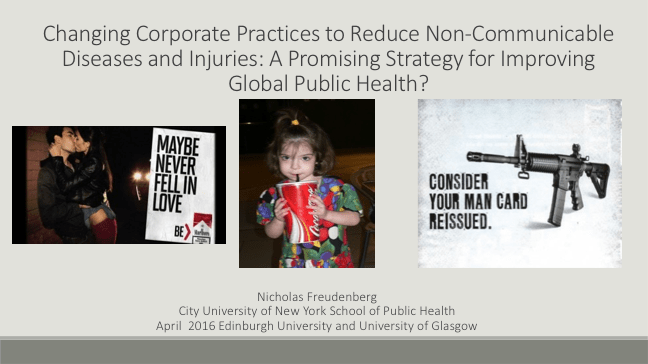
In presentations on “Changing Corporate Practices to Reduce Non-Communicable Diseases and Injuries: A Promising Strategy for Improving Global Public Health?” at Edinburgh University and University of Glasgow, Nicholas Freudenberg, Distinguished Professor of Public Health at City University of New York School of Public Health, described the role of corporate business and political practices on the growing global burden of non-communicable diseases and injuries. He also analyzed what roles public health professionals can play in countering the adverse health effects of these practices. View the presentation.
Valeant’s Michael Pearson Admits Aggressive Drug-Price Increases Were a Mistake
The Wall Street Journal reports that Valeant Pharmaceuticals International Inc. was too aggressive in dramatically raising the prices of some of its drugs, the company’s outgoing chief executive told a Senate committee Wednesday, while its newest board member promised swift changes. Michael Pearson, who oversaw the rise and fall of Valeant, told the committee that Valeant’s strategy of buying and increasing prices on many drugs was a mistake. The testimony, under sharp questioning, highlighted Valeant’s stark fall from Wall Street darling to Washington punching bag, and showed how much it has at stake. Its stock is down more than 85% from its high last August. Drug-price increases have overshadowed the company’s broader work, and “we therefore need to work to regain the confidence of Congress, the public, doctors and patients,” Mr. Pearson told the Senate Special Committee on Aging.
Now There’s Proof: Docs Who Get Company Cash Tend to Prescribe More Brand-Name Meds

ProPublica calculated brand-name prescribing rates for doctors who received no payments, $0.01 to $100, $100 to $500, $500 to $1,000, $1,000 to $5,000 and more than $5,000 in payments from drug or device companies in 2014. Source: Centers for Medicare and Medicaid Services; ProPublica analysis. Credit: Sisi Wei/ProPublica
In its ongoing Dollars for Doctors series, on the impact of pharmaceutical industry funding on physicians’ prescribing, ProPublica found that doctors who receive payments from the medical industry prescribe drugs differently on average than their colleagues who don’t. And the more money they receive, the more brand-name medications they tend to prescribe.
The First Amendment And Pharmaceutical Promotion
In Health Affairs, Jerry Avorn from Harvard Medical School writes, “traditionally, communication about medications has been granted a privileged status different from that accorded to other forms of communication. This makes sense for several reasons… (One) reason that the nation has determined that drug promotion should be more restricted than promotional statements about, for example, toasters or computers, is that the consequence of getting a medication-use decision wrong can be catastrophic. This helps explain why so many of us are worried about the growing movement to consider the promotional claims of drug makers to be in a class of commercial free speech protected under the First Amendment. While overtly fraudulent statements would not be permitted (“This pill will make you live forever”), a study used in promotional materials could be inaccurate or misleading in many ways without being overtly fraudulent.”
From new Lethal but Legal Afterword: The World That Is Possible

This week Oxford University Press releases a new paperback edition of Lethal but Legal Corporations, Consumption and Protecting Public Health with a new Afterword by the author. An excerpt is below.
Nicholas Freudenberg
New York City, October 2034.
I wrote Lethal but Legal more than 20 years ago because I was worried about humanity’s survival. Growing epidemics of chronic diseases and injuries, escalating environmental damage, increasing concentration of corporate power and wealth, and declining democracy and government protection of health were converging towards a dangerous tipping point. After the book’s release, I had many conversations about these fears with readers, researchers, activists, health professionals and students. What struck me most was that although most agreed that the rise of the corporate consumption complex and its relentless marketing of hyperconsumption threatened public health and democracy, even those persuaded by the book’s arguments were pessimistic that another future was possible. Corporations were too powerful, they said, opposition too weak. Acquiescence was more popular than resistance and any possibility of a real alternative seemed hopelessly naïve.
Continue reading From new Lethal but Legal Afterword: The World That Is Possible
Does the FDA now belong to Big Pharma?
In Salon, Martha Rosenberg writes that it is hard to believe only four senators opposed the confirmation of Robert Califf, who was approved today as the next FDA commissioner. Vocal opponent Bernie Sanders condemned the vote from the campaign trail. But where was Dick Durbin? Where were all the lawmakers who say they care about industry and Wall Street profiteers making money at the expense of public health? Califf, chancellor of clinical and translational research at Duke University until recently, received money from 23 drug companies including the giants like Johnson & Johnson, Lilly, Merck, Schering Plough and GSK according to a disclosure statement on the website of Duke Clinical Research Institute.
Theranos Lab Practices Pose Risk to Patient Health, Regulators Say
Federal inspectors found “deficient practices” at a Theranos Inc. laboratory that “pose immediate jeopardy to patient health and safety,” according a letter released last week, reports the Wall Street Journal. The Centers for Medicare and Medicaid Services said an inspection completed in November at the company’s lab in Newark, Calif., uncovered five major infractions that violate the federal law governing clinical labs. Theranos, valued at $9 billion, has been under fire since an October Wall Street Journal report revealed that the company’s inventions were only used on a small number of tests sold to patients. A follow-up report said that Theranos had actively hidden its proprietary technology from lab inspectors during previous inspections.
 Corporations and Health Watch