The Wall Street Journal reports that a Chinese court found GlaxoSmithKline’s local subsidiary guilty of bribery and fined the company nearly $500 million, capping a scandal that has shaken China’s pharmaceutical industry. Five of the company’s managers, including Mark Reilly, its former top China executive, were convicted of bribery-related charges and received suspended prison sentences. Glaxo still might be fined in the U.S. and U.K., and it faces several continuing investigations around the world.
Maker of Costly Hepatitis C Drug Sovaldi Strikes Deal on Generics for Poor Countries
Gilead Sciences, the maker of one of the costliest drugs in the world announced on Monday, reports the New York Times, that it had struck deals with seven generic drug makers in India to sell lower-cost versions of the medicine — a $1,000-a-pill hepatitis C treatment — in poorer countries. Gilead, which is based in California, also said it would begin selling its own version of the drug in India and other developing countries at a fraction of the price it charges in the United States.
FTC Sues Pharmaceutical Companies for Blocking Consumer Access to Lower-Cost Drug
The Federal Trade Commission has filed a complaint in federal district court charging several major pharmaceutical companies with illegally blocking American consumers’ access to lower-cost versions of the blockbuster drug AndroGel. The FTC’s complaint alleges that AbbVie Inc. and its partner Besins Healthcare Inc. filed baseless patent infringement lawsuits against potential generic competitors to delay the introduction of lower-priced versions of the testosterone replacement drug AndroGel..
Novartis Japan Admits Concealing Drug Side Effects
The Japanese unit of Swiss pharma giant Novartis has admitted it did not report more than 2,500 cases of serious side effects in patients using its leukaemia and other cancer drugs, reportedly including some fatalities, writes AFP. The revelations, which marked the latest in a string of scandals at the company’s Japanese subsidiary, come after local authorities slapped the firm on the wrist, saying it had to clean up its operations.
To Lower Prescription Drug Costs, Give Medicare Authority to Bargain With Drug Companies
Late last month, reports the Center for Public Integrity, two advocacy groups, the Medicare Rights Center and Social Security Works, released a report suggesting that Congress could save taxpayers $141 billion over 10 years just by reauthorizing a program that was eliminated at the behest of drug makers in 2003. The groups noted that while the prescription drug benefit helped Medicare beneficiaries afford their medications, “the law also severely limited the government’s ability to control Medicare drug prices.”
Why the Drug Industry Hasn’t Come Up with an Ebola Cure
The lack of an Ebola cure amid the deadliest outbreak in the disease’s history is highlighting a significant challenge in the public health world: developing life-saving cures to those who need them the most. In many cases, the Washington Post reports, drug manufacturers don’t have strong enough economic incentives to devote resources to making drugs for populations that would have trouble affording them.
Back to School Books on Corporations and Health

For those who make a living teaching about health, August means getting ready for returning to the classroom and introducing new students to what we think is important. A basic premise of Corporations and Health Watch is that every health professional should understand something about the ways corporations influence health and what can be done to prevent or modify corporate practices that harm health.
To help CHW readers contribute to that goal, I suggest five books to add to public health, medical, nursing, social work or related course readings and discussions. These books have been published or updated in the last year or so, are available for less than $30, and can be used in a variety of courses including introductory public health, health policy, social and behavioral health, epidemiology or social epidemiology and more specialized courses.
I suggest books –in addition to the texts and journal articles we usually assign—because they give students an opportunity to read in more depth on a single topic, evaluate the range of evidence that authors present, and react to the opinions the authors draw from this evidence. The brief descriptions of each book are those provided by the publisher.

Corporations Are Not People: Reclaiming Democracy from Big Money and Global Corporations
By Jeff Clements, Updated Edition, 2014, Berrett and Kohler
Describes the new fabrication of rights and power for corporations and money, at the expense of the rights of human beings and of democracy itself. A resource for everyone who want to join the historic work to overcome partisan divides and re-engage in self-government by all Americans — community by community, state by state, and, ultimately, in Washington itself. This 2014 edition is updated throughout with surprising information and analysis about the impacts of unlimited money in federal, state, and even local elections; the spreading “corporate capture of the courts” resulting from the dangerous fabrication of “corporate rights” in the Constitution; and the growing, historic response from people of all political viewpoints to defend democracy and rebuild government of the people. A completely new chapter—“Do Something”- shows how thousands of so-called ordinary people are working to build the “most dynamic, grass-roots movement in the United States,” and offers “portals” for people to connect and act.

The Gun Debate What Everyone Needs to Know
Philip J. Cook and Kristin A. Goss, Oxford University Press, 2014
No topic is more polarizing than guns and gun control. From a gun culture that took root early in American history to the mass shootings that repeatedly bring the public discussion of gun control to a fever pitch, the topic has preoccupied citizens, public officials, and special interest groups for decades. The Gun Debate: What Everyone Needs to Know® delves into the issues that Americans debate when they talk about guns. With a balanced and broad-ranging approach, noted economist Philip J. Cook and political scientist Kristin A. Goss thoroughly cover the latest research, data, and developments on gun ownership, gun violence, the firearms industry, and the regulation of firearms. The authors also tackle sensitive issues such as the effectiveness of gun control, the connection between mental illness and violent crime, the question of whether more guns make us safer, and ways that video games and the media might contribute to gun violence. No discussion of guns in the U.S. would be complete without consideration of the history, culture, and politics that drive the passion behind the debate. Cook and Goss deftly explore the origins of the American gun culture and the makeup of both the gun rights and gun control movements.

Lethal But Legal Corporations, Consumption, and Protecting Public Health
Nicholas Freudenberg, Oxford University Press, 2014
Decisions made by the food, tobacco, alcohol, pharmaceutical, gun, and automobile industries have a greater impact on today’s health than the decisions of scientists and policymakers. As the collective influence of corporations has grown, governments around the world have stepped back from their responsibility to protect public health by privatizing key services, weakening regulations, and cutting funding for consumer and environmental protection. Today’s corporations are increasingly free to make decisions that benefit their bottom line at the expense of public health. Lethal but Legal examines how corporations have influenced — and plagued — public health over the last century, first in industrialized countries and now in developing regions. It is both a current history of corporations’ antagonism towards health and an analysis of the emerging movements that are challenging these industries’ dangerous practices. The reforms outlined here aim to strike a healthier balance between large companies’ right to make a profit and governments’ responsibility to protect their populations. While other books have addressed parts of this story, Lethal but Legal is the first to connect the dots between unhealthy products, business-dominated politics, and the growing burdens of disease and health care costs. By identifying the common causes of all these problems, then situating them in the context of other health challenges that societies have overcome in the past, this book provides readers with the insights they need to take practical and effective action to restore consumers’ right to health.
 Bad Pharma: How Drug Companies Mislead Doctors and Harm Patients
by Ben Goldacre (New paperback edition, 2014) Macmillan Publishers.
We like to imagine that medicine is based on evidence and the results of fair testing and clinical trials. In reality, those tests and trials are often profoundly flawed. We like to imagine that doctors who write prescriptions for everything from antidepressants to cancer drugs to heart medication are familiar with the research literature about these drugs, when in reality much of the research is hidden from them by drug companies. We like to imagine that doctors are impartially educated, when in reality much of their education is funded by the pharmaceutical industry. We like to imagine that regulators have some code of ethics and let only effective drugs onto the market, when in reality they approve useless drugs, with data on side effects casually withheld from doctors and patients. All these problems have been shielded from public scrutiny because they are too complex to capture in a sound bite. Ben Goldacre shows that the true scale of this murderous disaster fully reveals itself only when the details are untangled. He believes we should all be able to understand precisely how data manipulation works and how research misconduct in the medical industry affects us on a global scale. With Goldacre’s characteristic flair and a forensic attention to detail, Bad Pharma reveals a shockingly broken system in need of regulation. This is the pharmaceutical industry as it has never been seen before.

Food Politics: How the Food Industry Influences Nutrition and Health by Marion Nestle, University of California Press, Revised and Updated Paperback, 2013
We all witness, in advertising and on supermarket shelves, the fierce competition for our food dollars. In this engrossing exposé, Marion Nestle goes behind the scenes to reveal how the competition really works and how it affects our health. The abundance of food in the United States—enough calories to meet the needs of every man, woman, and child twice over—has a downside. Our overefficient food industry must do everything possible to persuade people to eat more—more food, more often, and in larger portions—no matter what it does to waistlines or well-being. Like manufacturing cigarettes or building weapons, making food is very big business. Food companies in 2000 generated nearly $900 billion in sales. They have stakeholders to please, shareholders to satisfy, and government regulations to deal with. It is nevertheless shocking to learn precisely how food companies lobby officials, co-opt experts, and expand sales by marketing to children, members of minority groups, and people in developing countries. We learn that the food industry plays politics as well as or better than other industries, not least because so much of its activity takes place outside the public view.
For previous Corporations and Health Watch Back to School posts see:
Corporations and Health Watch Goes Back to School: 10 Recent Articles for Fall 2013 Courses
Bringing Corporations and Health into the Public Health Curriculum
Corporations and Health Watch Goes Back to School: 10 Ways to Bring the Health Impact of Business Practices into the Classroom
“Hide No Harm” Bill Will Tip the Balance in Favor of Science and Safety over Corporate Profits
Cross-posted from The Equation

On July 16, Senators Richard Blumenthal (CT), Tom Harkin (IA) and Robert Casey (PA) introduced S. 2615, the “Hide No Harm Act.” Their legislation would impose criminal penalties—fines and even imprisonment—on corporate executives if they knowingly failed to warn the public about life-threatening dangers in their products.
Senator Blumenthal introduced the “Hide No Harm Act” because it is time to hold executives accountable when public health and safety are at stake.
The bill was prompted by revelations that executives at General Motors had ignored red flags about the ignition switch in many GM models, a switch that could suddenly shut down power to the car, including its air bags. The product defect has been implicated in at least 13 deaths and many injuries. After GM learned about the defective part, the company took years to warn consumers or address the problem.
But the “Hide No Harm” bill addresses a more fundamental problem than one company’s mishandling of a significant product hazard. It aims to give the public and regulatory agencies timely access to public health and safety information, so that deaths and serious injuries can be avoided.
The bill requires that corporate officers and executives—the people running companies—disclose information about these dangers to the appropriate government agency, and warn employees and consumers. They must issue these warnings promptly, not years after the company detects the problem. The bill also makes clear that corporate managers may not retaliate against any conscientious employee who discloses these dangers.
The science connection
What does this legislation have to do with scientific integrity? Quite a bit. In numerous cases, scientists, engineers, and technicians working for corporations have raised concerns about product safety, only to be ignored by corporate accountants, marketers and lawyers.
If corporate executives know that they can be held directly accountable for their actions, it may persuade them to pay more attention to the potential harms a product may cause, and may tip the balance in favor of the scientific evidence that raises red flags. Whistleblowers are invaluable in helping to identify problems before they create deaths and injuries.
In GM’s case, Courtland Kelley, then the head of an inspection program for GM products throughout the country, raised concerns about safety problems he was finding in GM models in 2002. He tried to take his concerns to company managers, but was rebuffed. He sued the company to help prompt corrective action, using Michigan’s whistleblower law. But his efforts sandbagged his career at the auto company, with the company downgrading his duties.
The way that engineer was treated affected others at GM, who kept quiet when in 2004, reports were surfacing about another safety defect in ignitions. The recall of millions of cars, not to mention the loss of lives, could have been prevented if GM managers welcomed safety concerns and did not punish whistleblowers.
No spinning science

Vioxx was a huge money maker, a painkiller that reportedly was easier on the stomach than older pain pills such as aspirin. But as early as 2000, in a clinical trial of 8,000 patients comparing Vioxx to the painkiller naproxen, researchers found that five times as many Vioxx patients had heart attacks as those on naproxen.
Merck did disclose the findings of the clinical trial to the Food and Drug Administration and to the media, but it spun the message. It stressed that Vioxx caused fewer digestive problems than naproxen, and concluded that naproxen must have some property that protects the heart, thus explaining away any possible harm Vioxx might do.
In truth, Merck’s scientists were concerned about the clinical trial, wondering whether the drug was truly safe. Some corporate scientists were so worried that they proposed withdrawing the drug until their questions could be answered.
Merck failed to address its scientists’ concerns. The company did not try to determine what caused this uptick in heart attacks. Was naproxen really protective for the heart, or did Vioxx potentially cause heart problems?
Instead, the company opted to monitor clinical trials looking at other aspects of Vioxx to see if any disturbing trends turned up. It continued to insist on the safety of its drug even after the Journal of the American Medical Association (JAMA) in 2001 published the findings of two Cleveland Clinic cardiologists who re-analyzed data from several Vioxx clinical trials and concluded that the drug did raise the risk of heart attack and stroke.
Even worse, despite all these unresolved questions and emerging red flags, the company sold the drug to doctors for a use that the FDA had not yet approved—to treat rheumatoid arthritis.
At Merck, the marketers and bean counters prevailed over the scientists who wanted more answers. Merck took four years to voluntarily withdraw the drug from the market. Withdrawal occurred only after a much larger clinical trial established the damage Vioxx could do. As a consequence, tens of thousands of patients who took Vioxx suffered fatal heart attacks.
Accountability is important
Merck ultimately sold Vioxx to 25 million Americans. Global sales of the drug totaled $2.5 billion the year before it was withdrawn. (The FDA also has earned justifiable criticism for its lax regulation of Vioxx and its efforts to suppress the warnings of Dr. David Graham, an FDA scientist who also sounded the alarm about the painkiller).
After misrepresenting the science, Merck was able to celebrate billions of dollars in profits off a drug that was directly linked to thousands of heart attacks.
The government did punish the company, levying a $950 million fine in 2011, which also resolved civil suits in several states. In 2007, Merck paid more than $4.8 billion to settle 27,000 lawsuits by those who claimed they or their relatives suffered injury or death due to Vioxx.
But Merck executives were not held accountable by the U.S. Department of Justice. The DOJ’s charges concerned illegal marketing, and not the more fundamental wrongdoing of failing to adequately or promptly warn patients of the potential dangers of the drug, and not taking action for four years, while the evidence of serious concerns about Vioxx’s safety continued to mount. Indeed Merck’s press release announcing the negotiated deal made just that point: “As part of the plea agreement, the United States acknowledged that there was no basis for a finding of high-level management participation in the violation. The government also recognized Merck’s full cooperation with its investigation.”
It is time for corporate executives to be held personally accountable for subsuming the concerns of their scientists and others in the scientific community for the sake of profits and share price. Fines, even large ones, can be offset by the astounding money that can be made from an unsuspecting public.
As Erik Gordon, an assistant professor of business at the Ross School of Business at the University of Michigan told the New York Times: “It’s just a cost of doing business until a pharmaceutical executive does a perp walk.”
Celia Wexler is a senior Washington representative for the Scientific Integrity Initiative at UCS. A former award-winning journalist, Wexler is the author of Out of the News: Former Journalists Discuss a Profession in Crisis, published in 2012 by McFarland. At UCS, Wexler’s issue portfolio includes food and drug safety, protections for scientist whistleblowers, and government transparency and accountability. See Celia’s full bio.
Pharmaceutical Crime and Organized Criminal Groups
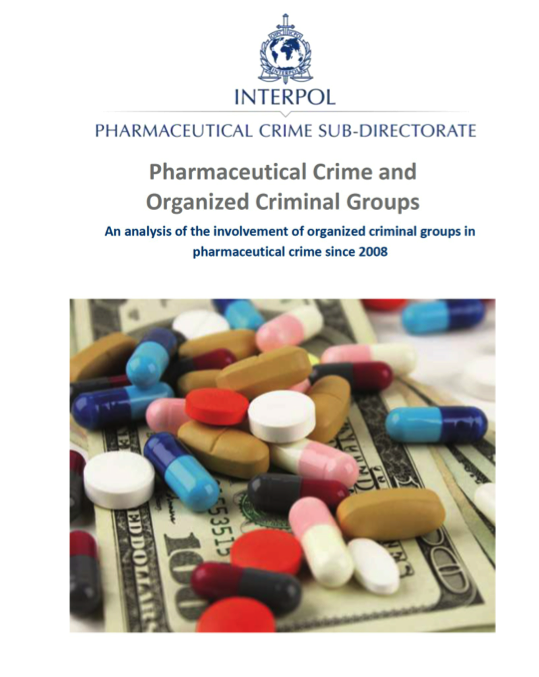
Interpol, the world’s largest police organization recently released this report. The Executive Summary and Conclusion are posted here.

EXECUTIVE SUMMARY
- INTERPOL member countries are reporting that criminals involved in pharmaceutical crime are operating through informal networks. Nevertheless, traditional organized crime groups across the globe are also involved in pharmaceutical crime throughout the supply chain.
- Several member countries have reported an increase in pharmaceutical crime during the past five years, especially in South and Central America.
- Both the informal networks and the organized crime groups seem to be trafficking in the same types of illicit medicines: erectile dysfunction medication; slimming pills; as well as pain and anxiety relief medication.
- A primary trend in many member countries is the increased use of illicit online pharmacies, operated by both informal networks and organized criminal groups.
- Large amounts of money are involved in these transnational criminal enterprises: one illicit online pharmacy network, which was dismantled by US authorities in 2011, managed to earn USD 55 million during two years of operations.
- Other crimes – such as money laundering, prostitution networks and weapons smuggling – can also be tied to criminals involved in pharmaceutical crime.
- INTERPOL has also received increased reporting of illegal trafficking of Tramadol over the past year. The origin of shipments seems to be Asia, routed via the Middle East, with a final destination in West Africa.
CONCLUSION
Pharmaceutical crime is a multifaceted criminal area. We see varying forms of criminal organizations involved in pharmaceutical crime, ranging from small clusters of three to 10 members, to larger well- established hierarchical groups, to sophisticated international networks with elusive structures. With the move to the Internet to sell counterfeit and illicit medicines, law enforcement agencies are increasingly dealing with the latter form of criminal enterprises. Such networks are difficult to target due to the ease with which they can move and establish new websites, the high level of anonymity offered in the virtual world, and the difficulty in piecing together the different criminals involved in wide-ranging affiliate networks.
Authorities are also faced with auxiliary challenges, such as corruption within the licit pharmaceutical community and a lack of dedicated national enforcement units to tackle the issue. This second point is especially alarming given that criminals are increasingly using the Internet to carry out their activities and are, in turn, developing sophisticated techniques to avoid detection. As a result, there is a need to enhance the number of specialized enforcement officers dedicated to targeting the ever evolving online activities of criminal networks.
Some INTERPOL member countries also face legislative challenges to thwarting those responsible for pharmaceutical crime, as few countries appear to possess specific legislation to target this type of crime. Furthermore, many countries cited poor penalties as a contributing factor for the proliferation of criminal networks, who are encouraged to continue to take risks as the rewards outweigh the potential punishments.
Yet from many questionnaire replies, there is an apparent confidence that enforcement and legislative structures currently in place are strong enough to tackle the issue of pharmaceutical crime. The law enforcement community is gradually gaining a fuller picture of the scope of such criminal activity and the structures behind it. For example, there is already a recognition of the problem of the sale of medicines online, illustrated by the growing global interest in participation in Operation Pangea, which reached 100 participating countries in 2012.
This study has also highlighted the need for law enforcement and the public health sector to work together in order to prevent illicit medicines from entering the market and to prosecute those responsible once it does. Some countries have employed a well-functioning multi-agency approach, with close communication between law enforcement officials and public health employees in order for both sectors to gain a better understanding of the challenges within each specific field.
Such coordination and concerted efforts are a step in the right direction to effectively combat pharmaceutical crime. In the long term, this will serve as a prime antidote against a crime area in which traditional structures are being replaced with more dynamic and constantly evolving network- orientated criminal enterprises.
PhRMA Claims Transparency Risks Damaging Public Health
Publishing information from clinical trials “risks damaging public health and patient welfare” says the Pharmaceutical Research and Manufacturers of America. PhRMA made the statement in a letter to the chief US trade negotiator for the free trade agreement between the European Union and the USA, the Transatlantic Trade and Investment Partnership deal. In the letter, PhRMA says, “Disclosure of companies’ non-public data submitted in clinical and pre-clinical dossiers and patient-level data risks damaging public health and patient welfare.”
 Corporations and Health Watch