Tracking the effects of corporate practices on health
Pharma
The pharmaceutical and medical device industries make the drugs and devices that are used to diagnose, treat and sometimes prevent diseases. These companies produce life-saving goods but many of the world’s people cannot afford essential medicines and the industry often fails to ensure that its products are safe and effective before marketing and selling them.
The Centre for Health Equity, Training Research and Evaluation at the University of New South Wales in Australia has released a report assessing the health impact of the Trans Pacific Partnership. The executive summary is below. Read the full report.
The Global Health Impact Index, developed by a professor at Binghamton University, ranks the world’s largest pharmaceutical companies according to their impact on global diseases. The index assesses the companies on the need and effectiveness of their drugs, and the number of people who can access the drugs.
creditSt John’s Wort and other herbal ingredients were not found in products with this name sold at Wal-Mart’s and other chains. credit
NEW YORK — Attorney General Eric T. Schneiderman announced that his office sent letters to four major retailers, GNC, Target, Walmart, and Walgreens, for allegedly selling store brand herbal supplement products in New York that either could not be verified to contain the labeled substance, or which were found to contain ingredients not listed on the labels. The letters, sent Monday, call for the retailers to immediately stop the sale of certain popular products, including Echinacea, Ginseng, St. John’s Wort, and others. Schneiderman requested the companies provide detailed information relating to the production, processing and testing of herbal supplements sold at their stores, as well as set forth a thorough explanation of quality control measures in place.
Read Attorney General Eric Schneiderman’s full press release
Read about the bill Senators Richard Blumenthal and Richard Durbin introduced in 2013 that would require dietary supplement manufacturers to register their products with the FDA and disclose the known risks of any ingredients on their labels.
Two new reports shed light on how big corporations and the wealthy elites who control them use their riches to advance their policy agenda. A new report by Oxfam, Wealth: Having it All and Wanting More describes the increasing concentration of global wealth.
Richest 10 billionaires (ranked in 2013) who have made (at least part of) their fortunes from activities related to the pharmaceutical and healthcare sectors, and their increase in wealth between March 2013 and March 2014.
A few highlights from this report:
In 2014, the richest 1% of the people in the world owned 48% of the global wealth., leaving just 52% to be shared among the others 99% of the adults on the planet.
Wealth of the 80 richest people in the world has doubled in nominal terms between 2009 and 2014, while the wealth of the bottom 50% is lower in 2014 than it was in 2009
In the last two years, billionaires listed as having interests and activities in the pharmaceutical and health care sectors saw the biggest increase in their collective wealth. Their collective wealth increased from $170 billion to $250 billion, a 47% increase and the largest increase in wealth of the different sectors on the Forbes list.
In 2013, the pharmaceutical and health care sectors spent more than $487 million on lobbying in the United States alone, more than any other US sectors and representing 15% of total lobbying in 2013. In 2012, this sector spent $260 million on campaign contributions. The pharmaceutical and health care industry spent another $50 million on lobbying in the European Union.
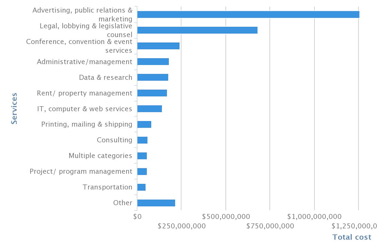
From 2008 through 2012, the most politically active trade groups spent a total of $3.4 billion on their top contractors, according to a Center for Public Integrity analysis of annual tax filings. This graph shows where their money went.
Last month, the U.S. Food and Drug Administration issued a safety announcement and mandated a new warning label after it found evidence that the antipsychotic drug Geodon – also known as ziprasidone and manufactured by Pfizer –can cause a potentially fatal skin reaction. The serious side effect may affect up to 2.5 million Americans who were prescribed the popular drug.
For observers of how corporations find ways to profit at the expense of public health, the news coverage of 2014 provides a wealth of evidence. Here are three stories that caught my eye last year. Next week I’ll present stories about the food, firearms and tobacco industries, the other sectors that Corporations and Health Watch follows.
Auto Recalls at General Motors, Chrysler, Ford, Toyota, Honda and Others Set New Record
Last year, reported the New York Times, more than 60 million vehicles have been recalled in the United States, double the previous annual record in 2004. In all, there have been about 700 recall announcements — an average of two a day — affecting the equivalent of one in five vehicles on the road. The eight largest automakers have each recalled more vehicles in the United States this year than they have on average since 1966, when data collection began, with G.M., Honda, and Chrysler each setting corporate records, the review by The Times found.
GMs failed ignition switches on Chevy Cobalts and several other models were one source for the recalls. Another was airbags manufactured by Takata, a Japanese parts maker, that occasionally exploded injuring or killing passengers or drivers. According to Consumer Reports, 7.8 million vehicles, made by 10 different automakers, have been recalled to replace frontal air bags on the driver’s, passenger’s sides or both. An ominous lesson from the Takata recalls is that globalization of the auto industry and the concentration of parts makers into a few giant companies can result in many manufacturers relying on the same few parts suppliers. If these parts fail, the population impact can be enormous.
AstraZeneca, Eli Lilly, GlaxoSmithKline, Merck and Other Drug Makers Pay Doctors and Hospitals Billions to Promote their Drugs
According to the Centers for Medicare & Medicaid Services, as of December 19, 2014, drug makers paid at least 366,000 U.S. doctors and 900 teaching hospitals $3.7 billion for gifts, meals, travel, speaking about their products, or attending promotional events.
In a series of stories called Dollars for Docs: How Industry Dollars Reach Your Doctors, Pro Publica describes the many ways that drug companies pay doctors—often physicians who have been previously sanctioned for unethical or illegal practices– to promote their products. Pro Publica also provides a database that allows readers to look up what companies have paid which doctors. This information is now available thanks to the Physician Payment Sunshine Act, a part of the Affordable Care Act that went into effect in 2014. Would requiring other companies in other sectors to report who they paid to promote their products help consumers to make more informed judgments on products?
Powdered alcohol hasn’t even arrived in stores yet, but some states already are moving to ban the product touted by its inventor as an easy way to mix a drink on the go. The UK-based Daily Mail reports that Colorado is the latest state considering prohibiting ‘Palcohol’ amid concern it will increase underage drinking. The product is marketed as an ounce of rum or vodka in powdered form, which is then added to water. Each serving is the equivalent of a shot of liquor, according to Lipsmark, the company that owns Palcohol. The company awaits labeling approval from the Alcohol and Tobacco Tax and Trade Bureau. The Food and Drug Administration said it does not have a legal basis to block the product after examining the non-alcoholic ingredients in the powder. Will this product make it to market in 2015? Stay tuned.
“Based on our experience with jello shots, alcoholic energy drinks, and other “cutting edge” alcohol products, we anticipate that allowing powdered alcohol onto the market will have grave consequences for our nation’s young people. Youth is a time of risk-taking and experimentation, and these types of products have proven most popular among the heaviest drinking and more risk-prone youth. Powdered alcohol is also highly concealable, making it all too easy for youth to access and consume. Currently 4300 young people under age 21 die each year from alcohol-related causes; our efforts should be focused on making alcoholic products less, not more, available to our nation’s youth.”
The Los Angeles Daily News analyzed financial ties between drug manufacturers and doctors who prescribed psychotropic medications to California foster children from July 2009 to July 2014. The investigation found that drug makers, anxious to expand the market for some of their most profitable products, spent more than $14 million from 2010 to 2013 to woo the California doctors who treat this captive and fragile audience of patients at taxpayers’ expense. The drug makers distribute their cash to all manner of doctors, but the investigation found that they paid the state’s foster care prescribers on average more than double what they gave to the typical California physician.
Recently published documents, reports The New York Times, show that many of America’s most prominent companies, from Aetna to Walmart, have poured millions of dollars into the campaigns of Republican governors since 2008. “This is a classic example of how corporations are trying to use secret money, hidden from the American people, to buy influence, and how the governors association is selling it,” said Fred Wertheimer, the president of Democracy 21, a nonpartisan group that advocates more transparency and controls over political money.
In response to recent reports that the cost of some generic drugs has been unexpectedly rising at a rapid clip, reports the Wall Street Journal, two members of Congress have launched an investigation and asked 14 generic drug makers to provide data about what the lawmakers called the “escalating prices they have been charging” for generic medicines.
The New York Times reports that a new federal reporting requirement shows that pharmaceutical and device makers paid doctors roughly $380 million in speaking and consulting fees during a five-month period last year. The data shed new light on the often murky financial ties between physicians and the health care industry. From August to December 2013, drug and device companies made 4.4 million payments to more than half a million health care professionals and teaching hospitals — adding up to about $3.5 billion.




 Corporations and Health Watch