The Union of Concerned Scientists has released a new report The $11 Trillion Reward that demonstrates that new policies that increase consumption of fruits and vegetables can save lives and money. The report recommends national and local actions to achieve this goal.
Conflicts of Interest in Approvals of Additives to Food Out of Balance
A recent article in JAMA Internal Medicine concludes that between 1997 and 2012, financial conflicts of interest were ubiquitous in determinations that an additive to food was generally regarded as safe (GRAS). The lack of independent review in GRAS determinations raises concerns about the integrity of the process and whether it ensures the safety of the food supply, particularly in instances where the manufacturer does not notify the Food and Drug Administration of the determination.
The Impact of Initiatives to Limit the Advertising of Food and Beverage Products to Children: A Systematic Review
In recent years, many governments and food companies have introduced new codes on food advertising to children. A report in Obesity Reviews presents findings from a systematic review of evidence on levels of exposure of children to the advertising of less healthy foods since the introduction of these codes. Scientific, peer-reviewed papers show that high levels of such advertising of less healthy foods continue to be found in several different countries worldwide. In contrast, the evidence provided in industry-sponsored reports indicates a remarkably high adherence to voluntary codes. We conclude that adherence to voluntary codes may not sufficiently reduce the advertising of foods which undermine healthy diets, or reduce children’s exposure to this advertising.
Industry Lawyers Tell Big Food How Not to Get Sued

Cross-posted from Eat, Drink Politics

Earlier this month I attended a conference in Washington DC with the lofty title: “3rd Advanced Regulatory and Compliance Summit on Food & Beverage Marketing & Advertising.” The event’s main sponsor was the law firm of Faegre Baker Daniels, whose numerous mega-corporate food clients include Cargill, Dean Foods, and Nestlé. In addition, the firm represents (under the heading of “crop protection“) Big Biotech players such as Bayer, Dow, and DuPont. The presenters were almost all industry lawyers, with a few government types. Not one member of the plaintiffs bar or anyone from a public interest organization was a speaker, and it seemed most of the audience was also from industry.
In all fairness, I think it’s a good thing for defense lawyers to share information and best practices about how food companies can and should comply with the law. Adhering to laws and regulations, as feeble as those rules can be, is a good thing and corporations should strive for it. And I am happy to report that’s what most of this meeting was about: to help food companies (in legalese) “mitigate risk,” as opposed to how to get away with skirting the law.
For example, in a session called “Minimizing the Risk of Deceptive Health Claims Post-POM Wonderful” an attorney with the Federal Trade Commission tried to explain what sort of “substantiation” a food company would need to back up any health claims. (POM Wonderful has been embroiled in quite a fight with the feds over its exaggerated claims.)
A similar presentation was called “How to Use Clinical Studies, Data, and Results without Violating FTC Regulations: A Case Study on Omega-3 Claims.” You see, the feds are OK with making certain types of health claims on food products as long as you can back it up with actual science. Just how strong the research needs to be however, was never made very clear. When I tried to ask one government lawyer, What if the science is funded by industry?, the answer was also unsatisfactory: that might be considered as a factor but not a disqualifying one. Generally the feds like to consider these matters on a case by case basis.
The most unbalanced and frustrating panel was called: “Maintaining the Delicate Balance of Marketing to Children‚ Obesity and the Integrity of your Product.” The main speaker was Elaine Kolish, director of the Children’s Food & Beverage Advertising Initiative, a fancy name for the food industry’s sad excuse for voluntary self-regulation. Numerous groups have criticized CFBAI for its ridiculously generous nutrition guidelines and self-serving loopholes.
But to hear Kolish tell it, CFBAI was the best way to protect children, far better than government regulation. She claimed that all by itself, industry “has created robust rules, and changed them twice” and that “in a five-year period, self-regulation has done more than government.” Of course it has, because that same industry lobbied like hell to stop government from doing its job in setting better guidelines. Throughout her presentation, which at times bordered on shrill, Kolish showed her utter disdain for the feds, along with numerous public interest groups. She disparaged Center for Science in the Public Interest, saying they engaged in “litigation by press release.” She also attacked other groups including the Campaign for a Commercial-Free Childhood and Berkeley Media Studies Group for daring to complain about food industry exploitation of children.
Now reasonable people can disagree on this controversial topic and I realize I was attending an industry-friendly meeting, but Kolish said several things that should not have gone unchallenged. For example, she misrepresented the current science on how marketing to children is deceptive. If someone from the other side had been on that panel, the audience would have heard a far more balanced take. It was in fact a disservice to the industry representatives in the room to downplay the issue. I had this feeling at numerous other times during the event: that including a public interest perspective would have allowed for a more nuanced and stimulating discussion.
Another notable presentation was called “Update on State Food Labeling Laws: How GMO Labeling Initiatives Impact your Business Strategies.” Obviously industry is very concerned about the growing movement to label genetically-engineered foods. This panel was a good overview of current efforts, and mentioned several advocacy groups, including Food Democracy Now! for its role in the state bills. (Unlike Ms. Kolish, the speakers on this panel – both with the sponsoring law firm – were factual and respectful.) It was interesting, though not surprising, to see how much industry lawyers were staying on top of advocacy efforts.
Finally, as would be expected, there were several presentations on the current threat of private class action litigation over deceptive food marketing claims, some offering tips on how to defend against such lawsuits. (I recently wrote about this trend in class actions.) The “natural” cases were clearly a huge concern. One attorney in the audience suggested food makers stop using natural labeling at all, which was very sound advice and refreshing to hear. Also discussed was emerging case law in which judges are deferring to FDA ruling on whether or not “natural” labels should be allowed on products containing genetically-engineered ingredients. But no one in the room expected FDA to do so anytime soon.
Over the three-day event, I had several constructive conversations with food industry attorneys who really don’t want their clients to get into legal trouble. But it was also clear that their good advice can sometimes come into conflict with the marketing department. So next time you see a food product making a deceptive claim, it’s probably either because the company received bad legal advice, or the marketers overruled the lawyers.
Nutrition Standards Won’t Fix Big Food’s Worst Child Marketing Tactics

Cross Posted from Corporate Accountability International

Last month, I participated in an important panel at a childhood obesity conference to discuss the current strategy backed by some advocacy groups: asking industry to market “healthier” foods to children. But as Susan Linn and I recently argued, any marketing to children is harmful, regardless of the product’s nutritional content.
Instead of begging corporations to tweak the grams of sugar, fat and salt that these highly processed junk foods contain, we should demand that industry stop exploiting children altogether. Some advocates argue this approach is too radical. But it’s actually far more practical and ultimately more effective because of certain key tactics that industry uses to target children.
You can’t put nutrition standards on a clown
A nutrition standards approach to marketing to children fails to address the powerful and ubiquitous marketing strategy of branding. When Ronald McDonald goes into elementary schools or anywhere else he may roam, he (in the words of McDonald’s own CEO) “does not hawk food.” Problem solved, right? Except that the very purpose of using Ronald as a brand ambassador is to get children to associate fun and happy times with McDonald’s. This technique is so effective that young children prefer the taste of food wrapped with the McDonald’s logo. This is true even for food McDonald’s doesn’t sell. Here is how researchers described it: “Our findings add to past research by demonstrating that specific branding can alter young children’s taste preferences.” That’s powerful stuff.
Another study of 3-to-5-year-old children found that McDonald’s was the most recognized brand, followed by other fast food and soda brands. (The children were shown 50 different brands across 16 product categories.) These researchers seemed surprised that even very young children could recognize brands, “at a much earlier age than previously theorized.”
Branding is a key strategy for every corporation trying to build lifelong brand loyalty among impressionable children. They know the key to getting more consumers hooked on their products is to target children as young as possible. There is simply no way to apply nutrition standards to branding.
Stealth ads on the internet don’t have nutrient content
Another critical way that food corporations such as McDonald’s target children is through “advergaming” websites. For example, you hardly see any food images on HappyMeal.com, just a lot of fun and games. So improving nutrition standards won’t work there either. Moreover, the name of the game for such sites is to gather information about users, which in this case are unsuspecting children. That’s why the Center for Digital Democracy filed a complaint last year with the Federal Trade Commission charging that McDonald’s and several other food and media corporations violated the Children’s Online Privacy Protection Act by asking children to share their friends’ email addresses. But as Adweek explained, McDonald’s engages in even more aggressive tactics:
McDonald’s website for Happy Meals goes a step further, inviting children to make a music video by uploading their pictures and encouraging them to share the video with up to four friends, who then receive an email from McDonald’s: “You’ve been tagged for fun by a friend! Check it out! It’s a Star in Video at the McDonald’s Happy Meal Website.”
That Happy Meals contain apple slices and milk seems rather irrelevant when you consider how low this corporation will stoop to exploit children. According to McDonald’s internet privacy policy (almost a year after this complaint was filed) the company still encourages children to share friends’ names and email addresses but assures us that such information is deleted after McDonald’s contacts the friend. That’s a relief.
Most importantly, research suggests that this sort of stealth advertising can be more effective than traditional television commercials because children are less aware of online ads, probably because they are too busy having fun. According to a report from the Kaiser Family Foundation:
From a marketer’s perspective, one of the potential advantages of an “advergame” is the ability to draw attention to your brand in a playful way, and for an extended period of time (at least relative to a 30-second television ad) … On the Internet, the boundaries between advertising and other content may be harder for a child to distinguish. This medium does not have the natural breaks between commercial and non-commercial content which typify television.
That could help explain why the most recent federal government report on food marketing to children suggested that corporations were shifting their advertising spending from television to “new media” such as online, mobile and viral marketing, which are also relatively inexpensive.
An incremental approach to end food marketing to children
Some advocates contend that tweaking the nutritional content of foods marketed to children is a good approach because it’s incremental, while stopping marketing altogether is asking for too much. But why must this be the only way to engage in incrementalism? I can think of many incremental alternative solutions to the nutrition approach to food marketing to children. The possibilities are truly endless, starting with the above examples of branding and internet targeting.
Let’s take branding. Even if McDonald’s won’t agree to Corporate Accountability International’s demand to Retire Ronald, there are plenty of smaller steps the fast food giant could take right now. For example, Ronald could stop visiting grade schools. I would consider that a pretty huge victory; far better than the addition of apple slices and milk to Happy Meals. Or Ronald’s image could stop appearing on children’s toys. Speaking of toys, McDonald’s could stop including them in Happy Meals. As could other fast food chains like Burger King, which is now promoting its “BK Crown Activity Box” with various toy tie-ins. Imagine, parents buying food for the food, not the toys.
These and many other incremental steps the food industry could take to stop targeting children have the advantage of not being dependent on nutrition standards that industry gets to define and manipulate. It’s also far easier to monitor and enforce a policy such as “no advergaming” than one based on grams of salt, sugar and fat. But most importantly, marketing to children is inherently deceptive and harmful and we should demand corporations stop engaging in this unethical behavior. Because that’s the right thing to do.
Why Junk Food Can’t End Obesity: It’s the Food System, Stupid
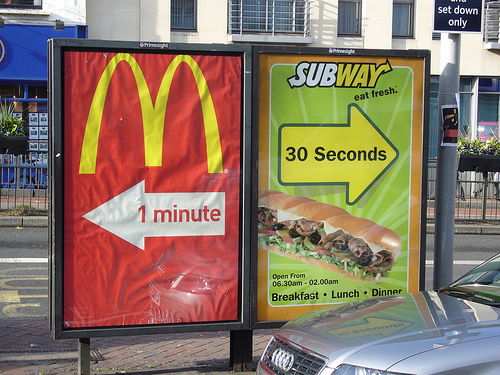

In a recent article in The Atlantic, David Freedman argues that demonizing fast food may be dooming many people to obesity and disease and that embracing fast food could make us all healthier. Freedman’s How Junk Food Can End Obesity uses the familiar journalistic trope of man-bites-dog to make the case that what he calls “the whole food movement” (aka Pollanites, after Michael Pollan) is the obstacle to reducing obesity while junk food companies willingness to modify their products is the solution.
Freedman makes some important observations: he highlights the class composition of the some parts of the food movement, he calls attention to the limits of making processed food the villain of the American diet, and he faults the food movement for rarely considering the scale of changes needed to make healthy food available throughout the country, much less the world.
But for the most part, Freedman so ignores the political and economic realities of America that his arguments are silly, like your contrarian cousin who claims Rand Paul ought to be President. I’ll focus on three gaps in his arguments.
First, Freedman ignores the role of market forces. He writes that fast food companies should be encouraged to use food technology to market healthier products, claiming that “these roundly demonized companies could do far more for the public’s health in five years than the wholesome-food movement is likely to accomplish in the next 50.” But how has that strategy played out in the last five years?
In 2008, with much fanfare, Indra Nooyi, the Chair and CEO of beverage and snack manufacturer PepsiCo, announced plans to double the revenues from its nutritious products by 2020, from 20 percent to 40 percent. She invested in product reformulation, increasing the research and development budget by 25 percent between 2008 and 2010, while PepsiCo’s advertising emphasized images of health.(1)
When these new products failed to quickly deliver profits, however, investors and the Board of Directors demanded change. Their argument was mathematical: surveys showed that while 65 percent of Americans indulge in high fat, sugar and salt snacks, only 25 percent choose “healthy snacks”.(2) PepsiCo shifted gears to re-focus on its more profitable and indulgent brands. Products that PepsiCo calls “good for you” still account for only about 20 percent of revenue. The bulk of the money still comes from drinks and snacks the company dubs “fun for you,” including Lay’s potato chips, Doritos corn chips and Pepsi–by far the company’s biggest seller with about $20 billion in annual retail sales globally.(2) Sixteen of the company’s 22 “billion-dollar” brands are “fun-for you” (but make you sicker quicker) high sugar or fat products and three are diet sodas.(3) By confusing Big Food hype for their actual practices, Freedman misleads his readers.

Source: 350.org
Second, Freedman doesn’t consider the political record of Big Food in resisting democratic efforts to hold them accountable for their business practices. According to a 2012 special investigative report by Reuters, between 2009 and 2012, more than 50 leading food and beverage companies and trade associations spent $175 million to lobby the Obama Administration against the federal effort to write tougher — but still voluntary — nutritional standards for foods marketed to children.(4) This expenditure was more than double the $83 million spent in the previous three years, during the Bush Administration. The food and media companies hired Anita Dunn, Obama’s former White House communications chief, to run their media strategy. In contrast, Reuters found, the Center for Science in the Public Interest, widely regarded as the lead public health advocacy organization lobbying against the food industry, spent about $70,000 lobbying last year — roughly what those opposing the stricter guidelines spent every 13 hours.(4) And Freedman wants to leave these companies to decide how to improve the American diet and reduce obesity? Who’s being naive now?
Finally, Freedman writes as if one segment of the food movement, what he calls the “wholesome foodies”, is the entire food movement. What about the white, Black, Latino and Asian parents from low and middle income neighborhoods in Brooklyn working with the Brooklyn Food Coalition to improve school food in New York City? The fast food workers organizing in Los Angeles, Chicago, New York and elsewhere? The many groups looking to convert SNAP from a subsidy for Big Food into a force for health for poor and hungry Americans? By demonizing one admittedly influential sector of the food movement as if its views were monolithic, Freedman missed an opportunity for constructive debate within the movement. By parroting the slurs on the food movement that Big Food executives like to use at their shareholder meetings (elitists who look to take choices away from poor Americans), Freedman ends up reinforcing those stereotypes.
In the final analysis, it’s not processed food, it’s not McDonald’s and it’s not soda that are the chief reasons our food system contributes so much to poor health. Rather, it’s a food—and economic — system that values the profits of a handful of big companies more highly than the health and nutritional needs of the population or the well-being of the environment that sustains life.
References
1. Bauerlein V. PepsiCo chief defends her strategy to promote ‘good for you’ foods. The Wall Street Journal.June 28, 2011. Available at:http://online.wsj.com/article/SB10001424052702303627104576412232408827462.html. Accessed August 9, 2012.
2. Esterl M, Bauerlien V. PepsiCo wakes up and smells the cola. The Wall Street Journal. June 28,2011:B1.
3. PepsiCo. PepsiCo Welcomes our newest Billion-Dollar Brands. Advertisement. New York Times, January 26, 2012, p. B5.
4. Wilson D, Roberts J. Special Report: How Washington went soft on childhood obesity. Reuters. Available at: http://www.reuters.com/article/2012/04/27/us-usa-foodlobby-idUSBRE83Q0ED20120427. Published on April 27, 2012. Accessed on August 21, 2012.
Nutrition, Inc: In-depth Story in Progressive Magazine

Cross Posted from EatDrinkPolitics

Proving that a good story just won’t die, the current issue of the Progressive takes an in-depth look at my report from January on the conflicted corporate sponsorships of the Academy of Nutrition and Dietetics. And good timing too, because registered dietitian Andy Bellatti’s Change.org petition on this subject is gathering steam. You can download the Progressive article here. Thanks to investigative journalist Christopher Cook for such great coverage. Is anyone at the Academy listening yet?
Big Reality Check on Big Food’s Claims on Reducing Calories
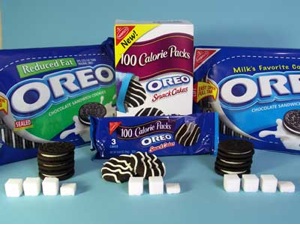

In what is becoming an all too familiar sight, the major food corporations recently teamed up with the First Lady’s Partnership for a Healthier America to announce their latest PR attempt to look like they are helping Americans eat healthier. A group calling itself the Healthy Weight Commitment Foundation, led by the CEO of PepsiCo–the nation’s largest junk food and sugary beverage pusher–claims to have delivered on its promise made in 2010 (a commitment, get it?) to reduce calories “in the marketplace” by 1.5 trillion. They further claim to have exceeded this goal, and all this a full three years ahead of schedule. The quotes by all involved were practically giddy.
The funny thing is, the official evaluation, funded by the Robert Wood Johnson Foundation, is not actually out yet, and won’t be until sometime this fall. Instead of waiting for what could be a negative, and certainly more scientific take, industry instead jumped the gun. The alleged data to back up its claims is contained in a vague document, posted here under the heading of “Preliminary Report,” even though industry is not even conducting the actual analysis. Instead, that effort is being done independently by Barry Popkin, a researcher at University of North Carolina at Chapel Hill, who confirmed with me that his results won’t be available until the fall.
Meantime, what to make of this industry spin? I asked Bruce Bradley, a former food industry executive turned blogger and author. He was skeptical, to put it mildly. Here are his thoughts about industry’s claims of calorie reduction:
First off, measuring something like this at such a high level is recipe for bias. There are just so many ways to manipulate the data to say what you want. Then when you consider who is issuing the report (HWCF) and their self-interest in appearing as responsible, I am very suspicious.
One big question I have about the data is the economic times we live in. Pre-recession habits are reflected by 2007 data. Certainly lots of families have had to cut back their food expenditures with the harder times of 2012. Again, this is certainly convenient for the sake of HCWF’s calculation. One big caveat to this is that while harder times may have required people to cut down their grocery expenditures, it also required them to cut down their “eating out” spending and make more meals at home. I don’t know restaurant trend data as well as grocery data, but I’m guessing that given how this recession has hit lower/middle income households harder than upper middle/upper income households, the impact of restaurant/foodservice consumption trends is somewhat muted, especially since this data is for 2007 and 2012.
Another big question is how Walmart was accounted for in the data. Since about 2001 Walmart refused to release any sales data. They changed that policy in 2012 and again started to share their sales information going back three years (to 2008) [Source: MediaPost Publications Nielsen Adds Walmart Data To Sales Product 03/15/2012]. Since this report goes back to 2007 what I’m imagining HWCF had to do to equalize this number was to remove Walmart from the calculation since no data was available for Walmart from that period. This would be a very convenient “have-to” for HWCF since sales volume continues to shift from more traditional grocery formats to Walmart.
Another trend that could distort this data is the increased consumption of private label foods. Since the economic downturn, private label has grown significantly. Although private label has made inroads into healthier categories, it still packs a bigger punch in traditional, high fat/salt/sugar categories. I’m guessing growth in private label is yet another way that disproportionately took high calorie volume away, hence making the HWCF’s number look better.
Finally, the beverage category is for sure one that is “helping” HWCF’s numbers. Lower/no calorie drinks is a huge trend, but it’s a crime that low/no calorie beverages are considered “healthy.”
Let’s see if the analysis due out this fall paints a more accurate picture.
WHO Director Condemns Business Influences on Health Promotion
In a speech last week at the 8th Global Conference on Health Promotion, held in Helsinki, Finland, WHO Director Margaret Chan observed that “efforts to prevent non-communicable diseases go against the business interests of powerful economic operators…It is not just Big Tobacco anymore. Public health must also contend with Big Food, Big Soda, and Big Alcohol. All of these industries fear regulation, and protect themselves by using the same tactics.”
Food Industry Creates New Group to “Balance” Public Debate
More than 50 food and biotechnology trade groups including Monsanto have a new coalition called Alliance to Feed the Future. Coordinated by the International Food Information Council, the alliance was created to “balance the public dialogue” on modern agriculture and large-scale food production and technology. According to the group’s website, “there is insufficient focus in today’s public discussion regarding the benefits that our modern, efficient food system provides to consumers and society. This unbalanced public debate is negatively influencing public policy and consumers’ choices.”
 Corporations and Health Watch