Too many cars, too many guns, too many deaths: The public health consequences of over-production

In Beijing last month, the level of pollution for the fine particles known as PM 2.5 was 755, more than double the US EPA definition of hazardous, 300 micrograms per cubic meter .  PM 2.5 pollution is associated with higher death rates from lung cancer and heart disease as well as with a number of acute respiratory conditions.  According to the New York Times, Beijing residents described the air as “postapocalyptic,” “terrifying” and “beyond belief.”  The sources of PM 2.5 pollution are factories, coal furnaces and especially automobiles.  According to the Xinhua, the Chinese state news agency there are now 5.18 million vehicles in Beijing, compared with 3.13 million in early 2008, a choking 65% increase. 


Chinese officials have taken a number of emergency measures, including further limiting the number of cars allowed into the city ordering 180,000 older vehicles off the roads; and promoting the use of “clean energy” for government vehicles .


China is not alone in achieving record levels of urban air pollution.  Last week, levels of PM 2.5 pollution in New Delhi India exceeded those in Beijing. To date, Delhi’s government has not introduced any emergency measures.  In an earlier interview, Sheila Dikshit, the chief minister of the state of Delhi, acknowledged that the city could not keep up with the factors that cause air pollution.  Last year, a study in Lancet showed that air pollution has become a major health risk in developing countries, contributing to about 3.2 million premature deaths worldwide and moving for the first time onto the top ten killer list. More than 2.1 million of these deaths are in Asia. 


In the weeks since the Newtown Connecticut shootings on December 14, at least another 1,502 Americans have been killed by firearms (as of February 3, 2013), according to a crowd sourced story by Slate.  The deaths illustrate the myriad ways that guns in America can lead to tragedy: a girl shot as a bystander in a Chicago street, a two year old in South Carolina accidentally shot himself with his father’s .38 caliber handgun, an instructor in a shooting range shot by an angry customer, a soldier shot and killed in his barracks in Alaska, police officers and a Texas prosecutor. 


What do these air pollution deaths in Asia and gun deaths in the United States have in common?  Both are the result of the over-production and relentless marketing of products by the leading multinational corporations in two major consumer industries.  The global auto industry has set its sights on Asia, especially China and India, as the growth opportunities for this century. 


In 2009, General Motors sold 1.83 million vehicles in China and its market share grew from 1.3 per cent to 13.4 per cent. The firm is now the largest volume seller in China. At the time, GM China boss Kevin Wale told a reporter, “Despite the sales records in 2009, it looks as if 2010 will be even stronger,” he said. “The industry outlook is strong and we expect more growth, albeit at a somewhat slower pace.” In 2013, Forbes reports, GM expects continued growth.  Earlier this year, Dan Ammann, GM senior vice president and chief financial officer, told a  meeting of global auto leaders in Detroit, “We’re launching more vehicles globally than at any time in our history and some of our most important models are targeting the two largest markets in the world – the U.S. and China.


Of course the people of China want better transportation and the Chinese government is eager for partnerships that promote economic development.  But only the global auto companies have the capacity to translate that desire into a particular product –individual passenger vehicles — and to design, produce and market the products that maximize their profits.  Given their mandate to maximize returns on investment, they choose to contribute to increasing the millions of annual preventable deaths that their choice imposes rather than to consider alternative methods of transportation.  Producing enough cars to maintain profitability is more important than producing too many cars to sustain human health and the environment.


More than 300 million firearms sit in this country’s closets, under beds, in weapons racks and in glove compartments.  With less than 5% of the world’s population, we own more than 40% of all the firearms that are in civilians hands.  Why so many?   Prior to the 1960s, the gun industry had lost business as fewer people hunted or collected guns,  causing sales of rifles and shotguns to plummet.    Handguns –pistols and revolvers—became the industry’s hope for renewed profitability. In order to realize this goal, handgun producers had to make handguns affordable and they had to convince more people that they needed the protection a handgun offered.  To restore profitability, firearm companies have designed a sequence of products, from Saturday Night Specials in the 1970s and 1980s, to the super-sized semi-automatic handguns that Glock, Colt and Smith & Wesson produced in the last two decades to the assault rifles that are today’s must-have weapon.  To promote these products, the gun industry advertises relentlessly.  A few examples:

  • Bushmaster Firearms, a leading manufacturer of AR-15 weapons took the lead in aggressively marketing militarized assault weapons to civilians.  Its website uses the slogan, “Forces of opposition, bow down”. 
  • An ad for a pistol from Taurus USA promotes it as “the extreme-duty next generation handgun, created for Special Operations Personnel.”
  • In an effort to recruit young people into gun use, Junior Shooters, an industry-supported magazine, once featured a smiling 15-year-old girl clutching a semiautomatic rifle. At the end of an accompanying article that extolled target shooting with a Bushmaster AR-15, the author encouraged youngsters to share the article with a parent, an advertising strategy borrowed from McDonald’s.

Yes, American culture cherishes guns and yes, many Americans seem to have a deep emotional attachment to their weapons. But as with automobiles, only a handful of multinational corporations have the resources and the motivation to nurture those feelings, to translate the longing into finding, buying and sometimes using that weapon.  And it is that capacity that leaves America with an arsenal of 300 million weapons, a number that grows daily.  Having a firearm available increases the risk that suicides will be fatal, that gang disputes will result in deaths, that a bystander or family member will be killed during an intrusion, and that the partner of a domestic abuser will be killed rather than “only” injured. 


As a result, since 1960, more than one million people in the United States have been killed by guns and more than two million more have suffered non-fatal gun injuries. In this period, 13 times more Americans have been killed by firearms in the US than by the wars in Vietnam, Iraq, and Afghanistan combined.  The gun death rate in the United States is 20 times higher than in other developed nations.


So what’s the solution?  In the short run, the incremental solutions that are already on the policy agenda are part of the answer.  For automobiles, this means stronger public health regulations to require manufactures to make less polluting and safer cars.  It means public incentives for mass transit and better designed cities that encourage active transportation like walking and bicycling.  And it means limiting car use during high pollution conditions, even though this is a closing-the-barn-door-after-the-horses-escape strategy.    


For firearms, it means safer guns—trigger locks, loaded chamber indicators, manual thumb safeties, grip safeties, magazine disconnectors, and more effective background checks and registration systems.


But in the long run, the world needs fewer cars, fewer guns, and fewer other lethal but legal products.  Humanity and the environment that sustains us cannot survive in a world where a few thousand companies decide to make and market what they want in the quantities they decide regardless of the long term health and environmental consequences. In the twentieth century, each of the two major economic systems, state socialism and market capitalism, demonstrated their incapacity to promote well-being, democracy and a sustainable environment. The health consequences of the overproduction of cars and guns tell us it’s time for some new ideas on how to balance public needs with the quest for private profits.
Gun violence debates open doors for public discussion on role of gun industry

Mayors Against Illegal Guns report

As President Obama lays out plans for executive and legislative action to reduce injuries and deaths from firearms and New York State approves a sweeping package of gun control measures, health advocates have new opportunities to inform the public debate.  A few recent reports will assist in this task.


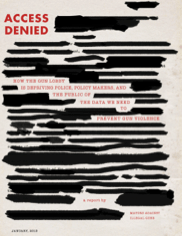
Mayors Against Illegal Guns released a new report  Access Denied How the Gun Lobby is Depriving Police, Policy makers and the Public of the Data We Need to Prevent Gun Violence.  The report asserts that:


Information is central to the American idea. It fuels our economy, keeps our elected officials accountable, and guides our public policy choices.  But not always.  Since the 1990s, the Washington gun lobby has led an aggressive effort to limit what we know about firearms.  And it has largely succeeded.


The report describes how the gun industry and the National Rifle Association have advocated policies that restrict scientists, law enforcement officials, the military and doctors from gathering the evidence that could inform more effective policies.  The Mayors’ group makes these recommendations to end the evidence blackout:

For nearly two decades, the U.S. has failed to make progress in reducing gun violence and gun crime because it has refused to look at them, to research them, and to talk about them. To make progress in the future, the federal government must revive research on firearms and remove restrictions on the use of information that can reduce crime and save lives.


Elected officials should take the following steps:

  • Remove “policy riders” on federal appropriations bills that limit firearms research at the CDC and NIH and provide appropriate funding to study the role of firearms on public health.
  • Fully fund the National Violent Death Reporting System and expand it to all 50 states to            improve our understanding of the role firearms play in fatalities.
  • Reconstitute the research program on gun trafficking at the National Institute of Justice to update and expand our understanding of the market for illegal guns.
  • Resume the publication of Justice Department reports on illegal gun markets and trafficking patterns.
  • Rescind the Tiahrt Amendments.
  • Expand the bulk sale reporting program for assault weapons to include all 50 states.


An investigation by George Zornick,  “How Walmart Helped Make the Newtown Shooter’s AR-15 the Most Popular Assault Weapon in America”, published in the Nation magazine examines how Walmart became the largest gun and ammunition  retailer in the country.  The Bushmaster AR-15 used by Lanza in the Newtown massacre is familiar to many Walmart shoppers. It’s on sale at about 1,700 Walmart stores nationwide, though the retail chain pulled the weapon from its website three days after the attack. Zornick reports that in 2006:


The chain announced that it was rolling back gun sales, citing declining profit margins on the relatively expensive weapons, which even at Walmart can retail for hundreds of dollars. But in 2011, company executives were looking at eight straight quarters of declining sales at stores open for a year or more—the worst slump in Walmart’s history.


This report shows that the ready access to guns that contributes to the nation’s high gun death rates is not mainly the result of a few shady gun dealers but of business deals between America‘s largest corporations that are looking to maximize profits by any means necessary. 


Finally, Johns Hopkins University this week convened more than 20 global experts for a summit on gun policy and violence to summarize relevant research and its implications for policymakers and concerned citizens.  “The(se) research-informed measures address not only mass shootings but also the less publicized U.S. gun violence that takes an average of 30 lives every day,” said Summit organizer Jon Vernick, JD, MPH, co-director of the Center for Gun Policy and Research at the Johns Hopkins Bloomberg School of Public Health. “We can reduce this number through implementation of such measures as expanding conditions which would prohibit high-risk individuals from possessing guns, strengthening the background check system by covering all firearm sales, and ensuring that necessary records for prohibited individuals are available.”

Gun makers, video game industry and NRA partner to promote fun and guns to children

In recent years, reports The New York Times, the firearms and video game industries have quietly forged a mutually beneficial marketing relationship. The McMillan Group, the maker of a high-powered sniper’s rifle, and Magpul, which sells high-capacity magazines and other accessories for assault-style weapons are listed as partners of the Electronic Arts, a maker of video games. Assault-style rifles made by Bushmaster Firearms have a roster of credits on various video games. Many of the same producers of firearms and related equipment are also financial backers of the N.R.A. For example, Glock, Browning and Remington are listed as corporate sponsors of the NRA.

Newtown massacre as a public health failure—and opportunity


27 Glocks and Sig Sauers

While the nation grapples with how 27 lives were lost in small-town America last Friday, the bigger question is, how are so many lives lost all year around in cities big and small? The public health profession – whose primary aim is prevention – is at least partly to blame for the nation’s failure to address gun violence.


While conventional medicine treats patients with problems such as lung cancer and gunshot wounds, public health professionals instead focus on the related behaviors, aiming to prevent people, for example, from smoking or drinking too much. Similarly, when it comes America’s gun problem, public health speaks of “violence prevention” or the even more sterile “injury control.”


However, each of these approaches fails to address the underlying factor driving the negative behaviors: massive industries that manufacture and market the products of destruction, whether it’s tobacco, alcohol, or in this case, guns.


Of course it’s not just the market for deadly product these industries create; it’s also the powerful lobbyists that hold our political system hostage to reform. The public health profession has failed miserably in the political arena due to its collective unwillingness to identify and oppose harmful corporate lobbying.


While much has been said about how the National Rifle Association intimidates politicians, this is no excuse for inaction by the public health field. (Some also argue the NRA’s political influence is exaggerated.) Now more than ever public health professionals working in violence prevention need to speak out about the role the firearms industry in destroying lives forever. They need to step out of their academic ivory towers and government offices to tell the truth about how the manufacture, sale, and marketing of guns contribute to our “culture of violence.”


Fortunately, there is no lack of effective policies available to reduce gun violence and the influence of the gun’s industries harmful practices. For example:


1. Taxes on bullets, a strategy designed to make ammunition more expensive and to bypass current interpretations of the Second Amendment;

2. Mandatory trigger locks, in which only the legal owner of the gun can fire the weapon, often using finger print technology, and other such built-in safety devices;

3. Bans on assault weapons and other military style firearms, which have proven helpful in other nations;

4. Stricter enforcement of systems for registration of those banned from owning firearms including those with felony convictions, serious mental illness, and histories of domestic violence and extension of this background check system to gun shows;

5.  Legal liability for gun companies for the consequences of unscrupulous retail distribution practices which make it easy for purchasers to bypass registration system;

6.  Rescinding recent laws that allow people to carry concealed weapons to churches, universities, national parks and other settings;

7.  Licensing systems that would require gun owners, like car owners, to obtain a license to operate a firearm and require periodic re-licensing;

8.  Stricter standards for the manufacture of firearms, now one of the least regulated products on the market;

9. Adequate funding for enforcement of the above measures at local, state and federal levels;

10. An end to the ban on federal funding for research on gun violence, which muzzles public health research, depriving society and policymakers the evidence needed to make informed policy decisions.


No one of these actions alone will end the gun carnage that makes us an outlier among developed nations. But, as we have learned with tobacco, a wide array of evidence-based public health interventions, designed to counter the power of an industry that profits from lethal but legal products can, over time, reduce premature deaths and preventable harm.


What can public health professionals do now to support and amplify public pressure for action to protect the public against the harmful practices of the fire arms industry and its supporters? First, we can educate ourselves. Just as thousands of public health researchers and professionals can now discuss the science and politics of the tobacco industry efforts to undermine health, we need a similar effort to educate the public about the gun industry. The resources below are a few places to start.


Second, we need to take on the collective gun lobby: the National Rifle Association, the National Shooting Sports Foundation, and the gun companies. Like the climate deniers, these groups seek to obfuscate the science about gun control, discredit effective public health measures and stoke fears. In a recent commentary the journalist Bill Moyers called the NRA “the enabler of death—paranoid, delusional and venomous as a scorpion.” This report, Blood Money: How the Gun Industry Bankrolls the NRA examines the close relationship between industry and the NRA. 


Third, we need to mobilize support for specific legislative proposals. It’s not enough to just have the date and educate, we also need to act. The public health profession is great at collecting data and publishing articles, but miserable at taking political action. This requires a fundamental shift in both allocation of resources and in attitude.


Of course, many other important public health measures can also help reduce gun violence such as better prevention and treatment of mental illness and efforts to reduce violent media and violence of all kinds. But what makes the United States stand out is our unwillingness to put the safety of our people ahead of the economic interests of the gun industry. Let’s make sure that the unfortunate window the Newtown massacre has opened doesn’t close before another town has to bury its children.


Books on Gun Violence

  • Barrett PM. Glock: The Rise of America’s Gun.  New York, NY: Crown; 2012.
  • Spitzer RJ. The Politics of Gun Control, 5th Edition, Paradigm, 2011
  • Hemenway D. Private Guns, Public Health.  Ann Arbor, MI: University of Michigan Press; 2004.
  • Diaz T. Making a Killing: The Business of Guns in America. New York, NY: New Press; 1999.

Organizations and Campaigns Challenging Industry Practices

Violence Policy Center
The Brady Center to Prevent Gun Violence
Coalition to Stop Gun Violence
Where Did the Gun Come From?
Harvard Injury Control Research Center
Means Matter Suicide, Guns, and Public Health
Stop Handgun Violence

The takers: State and local governments subsidize corporations


In his campaign for President, Mitt Romney famously charged that 47% of the American population paid no federal income tax and “are dependent upon government, who believe that they are victims, who believe the government has a responsibility to care for them, who believe that they are entitled to health care, to food, to housing, to you-name-it.”  A new investigation by the New York Times identifies another category of taker: the corporations who take more than $80 billion in subsidies each year from state and local governments. According to the Times, these governments award $9.1 million in corporate subsidies every hour. More than 5,000 companies have been awarded a total of more than $1 million each in local subsidies.   Using the database of state and local government subsidies to corporations created by the New York Times, the table below shows 25 selected companies frequently mentioned in Corporations and Health Watch that received more than $1 million in subsidies.  The largest recipient of local government subsidies was the automobile industry.  The top three US car companies alone received $4.75 billion in local subsidies in the period reviewed by the New York Times.  Most troubling, the Times investigation noted:


A portrait arises of mayors and governors who are desperate to create jobs, outmatched by multinational corporations and short on tools to fact-check what companies tell them. Many of the officials said they feared that companies would move jobs overseas if they did not get subsidies in the United States.   Over the years, corporations have increasingly exploited that fear, creating a high-stakes bazaar where they pit local officials against one another to get the most lucrative packages. States compete with other states, cities compete with surrounding suburbs, and even small towns have entered the race with the goal of defeating their neighbors.


The Times further observed that for many communities, “the payouts add up to a substantial chunk of their overall spending… Oklahoma and West Virginia give up amounts equal to about one-third of their budgets, and Maine allocates nearly a fifth.”  As national, state and local officials debate about how best to balance revenues and expenses, corporate subsidies deserve further scrutiny.  CHW readers can visit the Times searchable database to examine their states’ record or the subsidies received by corporations they are tracking. 


Name of Company

Total Subsidy

Number of Grants

Number of States


General Motors

$1.77 billion

208

16


Ford

$1.58 billion

119

8


Chrysler

$1.4 billion

14

3


Orca Bay Seafood

$296 million

4

1


Fresh Direct

$131 million

9

1


Archer Daniels Midland

$110 million

23

6


Daimler

$101 million

24

8


Toyota Motor Company

$96.5 million

16

5


Pfizer

$92.9 million

44

9


Walmart Stores

$80.5 million

176

23


Merck and Company

$60.7 million

18

5


Coca Cola Bottling

$49 million

61

16


Diageo

$40 million

7

2


Abbott Laboratories

$14.7 million

21

9


Pepsi Cola(various franchises)

$13.3 million

23

9


Jim Beam Brands

$10.8 million

7

1


Philip Morris USA

$8.06 million

5

2


Remington Arms Company

$8.32 million

13

3


Millercoors

$7.46

7

4


Smith & Wesson

$6.16 million

9

1


Lorillard Tobacco Company

$5.5 million

2

1


Anheuser-Busch

$4.62 million

2

2


Cargill

$4.4 million

9

5


Reynolds Tobacco Company

$3.09 million

1

1


Pernod Ricard

$1 million

1

1

18 of 26 losing incumbent House members endorsed by the National Rifle Association

For years, the media has claimed  that the National Rifle Association is an electoral powerhouse with a real ability to impact the outcomes of elections. The 2012 elections clearly demonstrate that the conventional wisdom is at odds with reality. While most incumbents in the House of Representatives kept their seats on November 6, over two-thirds of incumbents who lost were backed by the NRA. In a post on Media Matters for America, Timothy Johnson describes the fate of NRA backed candidates. 

NY appeal court: Shooting victim may sue gun maker

The Wall Street Journal reported last month that a former high school athlete, who was shot in 2003, may sue the companies that made and distributed the handgun used in the crime.  The suit brought an appellate court ruling that gun control advocates say will keep irresponsible gun makers and sellers from taking advantage of a federal law shielding them from lawsuits. The ruling by the Appellate Division of the New York State Supreme Court reversed a lower court’s 2011 dismissal of victim Daniel Williams’ complaint, which accused Ohio gun maker Hi-Point and distributor MKS Supply Inc. of Ohio of intentionally supplying handguns to irresponsible dealers because they profited from sales to the criminal gun market.

Half of gun dealers report it’s too easy for criminals to get guns

The first study to survey owners and senior executives of federally licensed firearms dealers and pawnbrokers, published online in the Journal of Urban Health,   found that 54.9 % believed that “it is too easy for criminals to get guns in this country. Garen Wintemute, director of the UC Davis Violence Prevention Research Program, and author of the study  said that these groups  are “valuable sources of information on retail commerce in firearms, links between legal and illegal gun sales, and policies designed to prevent the firearms that they sell from being used in crimes.”

Bringing Corporations and Health into the Public Health Curriculum

As public health students and faculty head back to school this week, Corporations and Health Watch continues its tradition of starting the academic year with a commentary on teaching about corporations and health. Our argument for including teaching about the impact of corporations on health in public health and related academic programs is based on the following premises:


  • Corporations are the dominant economic and political institution of the 21st century and thus have a profound influence on global well-being.
  • The business and political practices of corporations are a modifiable social determinant of health and thus a promising target for public health interventions.
  • To achieve local, national and global public health goals of reducing premature mortality, shrinking inequalities in health,  and controlling non-communicable diseases and injuries  will require making changing corporate behavior as important a public health priority as changing individual behavior.
  • Few public health academic programs adequately prepare their students to investigate, analyze or contribute to modifying the corporate policies and practices that harm health.


Professor Rudolph Virchow
Photo credit

To be effective in fulfilling their responsibility to prevent illness, promote health and reduce health inequalities, public health professionals should be able to demonstrate the following competencies:


  1. Identify corporate business and political practices that affect health.
  2. Develop public health strategies to encourage health-promoting corporate practices and discourage or end health-damaging ones.
  3. Analyze the public health advantages and disadvantages of various government/market relationships
  4. Create alliances with consumer, environmental, labor  and health organizations and movements that seek to  change harmful corporate practices and policies
  5. Describe the roles of public health professionals and researchers in modifying harmful corporate practices or policies.


These competencies can be developed in several ways.  Core public health courses can includes sessions on these topics as they relate to, for example, epidemiology, health policy, environmental health, or health education.  Some programs have developed specialized courses on the topic, allowing interested students to pursue this interest.  (To see a  syllabus for a doctoral course Interdisciplinary Perspectives on Corporations and Health 1900-2012 at City University of New York  click here to request a copy.)  Or a student-faculty interest group can bring together those who want to pursue research, advocacy or practice on the corporate impact on public health. 


Front entrance to the Bloomberg School of Public Health
Photo credit


For the time being, you’re more likely to find a corporate name on the front of a school of public health than to have corporate practices discussed in the classroom.  Fortunately, however, a growing number of resources are available to faculty who want to teach about this topic and students who want to learn more or write papers on corporations and health.  I offer here a short list of such sources.


10 Sources on Corporations and Health for Use in Basic Public Health Classes

(with suggestions for use in Epidemiology (EPI), Health Policy & Management (HPM), Social and Behavioral Health (SBH), or Environmental & Occupational Health (EOH) Core Courses)


Biglan A. Corporate Externalities: A Challenge to the Further Success of Prevention Science.  Prev Sci. 2011; 12(1): 1–11. (HPM, SBH)

Brandt AM.  Inventing conflicts of interest: a history of tobacco industry tactics. Am J Public Health. 2012;102(1):63-71.(EPI, SBH, HPM)

Freudenberg N, Galea S. The impact of corporate practices on health: implications for health policy. J Public Health Policy. 2008;29(1):86-104 (SBH,HPM)

Hastings G. Why corporate power is a public health priority. BMJ. 2012;345:e5124.(EPI, HPM, SBH)

Huff, J. 2007. Industry influence on occupational and environmental public health. International Journal of Occupational and Environmental Health 13.1: 107–117. (EPI, EOH)

Labonté R, Mohindra KS, Lencucha R.  Framing international trade and chronic disease.  Global Health. 2011 Jul 4;7(1):21.(EPI, SBH,HPM)

Ludwig DS, Nestle M. Can the food industry play a constructive role in the obesity epidemic? JAMA. 2008 Oct 15;300(15):1808-11.(SBH,HPM)

Stuckler D, McKee M, Ebrahim S, Basu S Manufacturing Epidemics: The Role of Global Producers in Increased Consumption of Unhealthy Commodities Including Processed Foods, Alcohol, and Tobacco. PLoS Med 2012;  9(6): e1001235. (EPI, SBH, HPM)

Wiist, W.H. (Ed). Bottom Line or Public Health. Tactics Corporations Use to Influence Health and Health Policy, and What We Can Do to Counter Them. NY: Oxford University Press, 2010. (relevant chapters for all 4 courses)

Woodcock J, Aldred R. Cars, Corporations, and Commodities: Consequences for the Social Determinants of Health. Emerging Themes in Epidemiology. 2008 Feb 21;5:4.  (EPI, EOH, SBH)


In addition to these selected resources, a bibliographic essay on Business and Corporate Practices can be found in the Public Health section of Oxford Online Bibliographies.


Finally, several Corporations and Health Watch contributing writers have websites or blogs that include additional timely material.  Check out these sites:  David Jernigan, Michele Simon, Bill Wiist.


Previous CHW Posts on Teaching about Corporations and Health


10 Ways to Bring the Health Impact of Business Practices into the Classroom  September 2011

Teaching about Corporations and Health  June 2010

Teaching about Corporations and Health: Bringing Corporate Practices into Public Health Classrooms  December 2007

Survey Shows Small Arms Trade Has Doubled Since 2008

In its 2012 report released this week, Small Arms Survey found that legal global trade in small arms has grown to at least $8.5 billion a year. If the illicit trade were added, it would come to more than $10 billion, the weapons research group said Monday. The Small Arms Survey had estimated the global trade in small arms, munitions and spare parts at more than $4 billion four years ago.  The countries that export more than $100 million of small arms were the United States, Italy, Germany, Brazil, Austria, Japan, Switzerland, Russia, France, South Korea, Belgium and Spain.