“If I sponsor an event with a particular product, am I looking for somebody to buy more of it or young people to buy more of it? I’m actually looking for you to buy my product over my competitor’s product – it’s actually about brand differentiation.” So explained Kathryn D’Arcy of the Alcohol Beverage Association of Ireland. In the Irish Examiner, she admitted that alcohol misuse is a serious problem in Ireland and needs to be tackled, but argued the proposed ban on alcohol industry sponsorship of sports events would not achieve that goal.
Tobacco Industry Promoted Unproven Flame Retardants in Furniture to Avoid Creating “Fire-safe” Cigarettes
In a series of investigative reports on endocrine disruptors in flame retardants, Patricia Callahan and Sam Roe reported in theChicago Tribune that in the late 1980s, the tobacco industry convinced the National Association of State Fire Marshals to back the use of unproven flame retardants in furniture to reduce fire deaths. Why did the tobacco industry care? Because they wanted to avoid pressure to design “fire-safe” cigarettes, a difficult engineering task that might have cut into their profits.
More Empty Recommendations on Junk Food Marketing to Children
Cross posted from Center for Food Safety.
Institute of Medicine Gives Big Food Another Deadline – or else!
This week, the nation’s top public health experts gathered at a much-trumpeted obesity conference hosted by the U.S. Centers for Disease Control and Prevention called Weight of the Nation. (A quick glance at the agenda reveals nothing that would even begin to challenge the food industry.)
Released at this bland event was an equally uninspired report from the Institute of Medicine (IOM, an advisory arm of Congress) called, Accelerating Progress in Obesity Prevention: Solving the Weight of the Nation.
 The irony of the report’s title gets lost among the 478 pages that aim to solve “this complex, stubborn problem” with “a comprehensive set of solutions.”
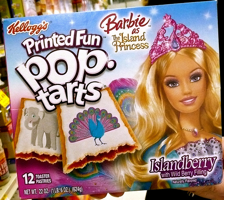
One of the recommendations intended to speed things up is for the food industry to “take broad, common, and urgent voluntary action to make substantial improvements” to marketing aimed at kids. This is certainly important, as advocates have for years been sounding the alarm about the intractable problem of junk food marketing to children and its connection to poor health. But another part of the IOM dictate sounded vaguely familiar:
If such marketing standards have not been adopted within two years by a substantial majority of food, beverage, restaurant, and media companies that market foods and beverages to children and adolescents, policy makers at the local, state, and federal levels should consider setting mandatory nutritional standards for marketing to this age group to ensure that such standards are implemented.
Two years? Where have I heard that deadline before? Oh yes, it was another IOM report, this one focused entirely on food marketing to children, from 2005, which reviewed the science showing a clear connection between junk food marketing and children’s dietary habits. That report said if voluntary efforts by industry to clean up its act were unsuccessful, “Congress should enact legislation mandating” a shift in advertising. Also, that “[w]ithin 2 years the Secretary [of health] should report to Congress on the progress and on additional actions necessary to accelerate progress.”
So it’s been 5 years since that earlier deadline has passed and now the food industry has 2 more years to show how much it really cares about kids? Did anyone at IOM bother to check its earlier reports before writing this one? But it’s hardly IOM’s fault. If anyone is to blame for lack of action on this issue, it’s Congress and the White House, as two recent reports make painfully clear.
An in-depth investigation by Reuters describes the dirty details of the onslaught of Big Food lobbying in the wake of an effort by the federal government to improve voluntary guidelines on food marketing to kids. Reuters found that food and beverage lobbyists spent more than $175 million lobbying since President Obama took office in 2009, more than double that spent in the previous three years, during the Bush Administration. “In contrast, the Center for Science in the Public Interest, widely regarded as the lead lobbying force for healthier food, spent about $70,000 lobbying last year — roughly what those opposing the stricter guidelines spent every 13 hours.”
Reuters also examined lobbying visits to the White House, finding that a “who’s who of food company chief executives and lobbyists visited the White House” including:
CEOs of Nestle USA, Kellogg, General Mills, and top executives at Walt Disney, Time Warner, and Viacom, owner of the Nickelodeon children’s channel — companies with some of the biggest financial stakes in marketing to children. Those companies have a combined market value of more than $350 billion.
 Another damning report emerged this month from the Sunlight Foundation found similar influence from Big Food. The strategy was for industry lobbyists to give money to members of Congress in exchange for their sending letters objecting to federal agency efforts. Here is how Sunlight describes one such transaction:
Days after receiving several campaign checks from the food lobby last May, Sen. Amy Klobuchar, a Minnesota Democrat who is up for re-election this year, sent a letter raising concerns about the Federal Trade Commission’s efforts to develop voluntary guidelines aimed at toning down the marketing of junk food to kids.
Seems Klobuchar wasn’t the only Democrat on the dole. Sunlight found that while most letter-writers were Republicans, lobbyist campaign donations held particular sway with Senate Democrats. Those who wrote letters of objection “collected on average, more than twice as much campaign money from food lobbying interests since 2008 as those who did not write letters.” A similar pattern also held in the House, where 38 Democrats wrote letters of protest.
As Jeff McIntyre, policy director for the advocacy group Children Now told Reuters: “We just got beat. Money wins.” That’s why it’s irrelevant how many more recommendations or deadlines come from the Institute of Medicine or any other panel of experts on how to “accelerate” progress. The only thing getting accelerated is lobbying dollars into politicians’ pockets. And kids’ poor health.
Originally posted at Center for Food Safety.
Image 2 Credit:
Chinese Melamine and American Vioxx: A Comparison
In an article in The American Conservative, Ron Unz compares the media response to the 2008 contamination of infant formula in China with the response to the coverage of the 2004 coverage of Merck’s withdrawal of the pain killer Vioxx. He notes that “in comparing China and America, pundits often cite our free and independent media as one of our greatest strengths.” However, he concludes that “American journalists seemed to focus more attention on a half-dozen fatalities in China than they did on the premature deaths of as many as 500,000 of their fellow American citizens.”
Corporations Win in Battle Against Investment Regulation
In a world where governments are increasingly subservient to global finance capital, multinationals are gaining ground in the fight against state regulations that aim to protect the environment, public health or social policies. According to data reported by the United Nations Conference on Trade and Development, the total number of known treaty-based investor–State dispute settlement cases filed by the end of 2011 grew to 450, an increase of more than 900% since 2000. Bilateral investment treaties establish the conditions for investment by companies of one country in another state. By allowing investors but not states to go to court to reverse the decisions of national governments, these treaties provide multinational corporations with new tools to fight state regulations against investments considered to harm health.
Obesity Prevalence and Costs Rise; House of Representatives and Supreme Court Hamstring Fight Against Obesity
A new report to be published in the American Journal of Preventive Medicine estimates a 33 percent increase in obesity prevalence and a 130 percent increase in severe obesity prevalence over the next two decades. By 2030, according to this forecast, 42 percent of Americans will be obese and 11 percent severely obese. The authors conclude that “if these forecasts prove accurate this will further hinder efforts for healthcare cost containment.” The authors also conclude that if obesity rates stayed at the 2010 levels, the combined savings in medical expenditures by 2030 would be $549.5 billion.
 Another new report published in the Journal of Health Care Economics estimated that the total cost of health care associated with U.S. obesity is now $190.2 billion a year, or 20.6 percent of total U.S. health spending – twice as much as previously reported.
Last month, the US House of Representatives voted to eliminate the Prevention and Public Health Fund in order to pay for legislation dealing with student loans. Although the measure is not expected to pass the Senate and President Obama has vowed to veto it, by this vote the House proposed to eliminate one of the few streams of funding to support preventive measures to reduce obesity and other health problems that contribute to diabetes, heart disease and cancer.
Last week Public Citizen and the National Association of Consumer Advocates released a report called Justice Denied One Year Later. The report notes that in the one year since the U.S. Supreme Court’s decision in AT&T Mobility v. Concepcion, consumers have regularly been blocked from pursuing class-action cases. In its Concepcion decision, the court vastly expanded the reach of arbitration by ruling that corporations could block the consumers they force into arbitration from pursuing cases as a class.
According to the report:
Since Concepcion, judges have cited the case in decisions that stopped at least 76 potential class-action lawsuits from going forward. Several judges have expressed frustration that the decision has forced them to stop consumer actions that are best suited to proceed as class actions. Class-action lawsuits historically have provided a means to combat illegal payday lending practices, contest poor business practices and confront discriminatory auto lending. But Concepcion has left many consumers without a means to pursue redress.
 In the case of tobacco, public health experts agree that class action lawsuits played a vital role in strengthening public health protection against a tobacco industry determined to make profits even at the expense of their customers’ health.
Whatever the intentions, by seeking to de-fund one of the few federal funding streams for prevention of obesity and other diet-related diseases and by denying consumers a powerful tool to change food industry practices that have been shown to contribute to obesity, the House of Representatives and the Supreme Court have voted to endorse the status quo of rising obesity rates.
Image Credits:
Obesity Prevalence and Costs Rise: House of Representatives and Supreme Court Hamstring Fight Against Obesity

A new report to be published in the American Journal of Preventive Medicine estimates a 33 percent  increase in obesity prevalence and a 130 percent increase in severe obesity prevalence over the next two decades. By 2030, according to this forecast, 42 percent of Americans will be obese and 11 percent severely obese. The authors conclude that “if these forecasts prove accurate this will further hinder efforts for healthcare cost containment.” The authors also conclude that if obesity rates stayed at the 2010 levels, the combined savings in medical expenditures by 2030 would be $549.5 billion.
Another new report published in the Journal of Health Care Economics estimated that the total cost of health care associated with U.S. obesity is now $190.2 billion a year, or 20.6 percent of total U.S. health spending – twice as much as previously reported.
Last month, the US House of Representatives voted to eliminate the Prevention and Public Health Fund in order to pay for legislation dealing with student loans. Although the measure is not expected to pass the Senate and President Obama has vowed to veto it, by this vote the House proposed to eliminate one of the few streams of funding to support preventive measures to reduce obesity and other health problems that contribute to diabetes, heart disease and cancer.
Last week Public Citizen and the National Association of Consumer Advocates released a report called Justice Denied One Year Later. The report notes that in the one year since the U.S. Supreme Court’s decision in AT&T Mobility v. Concepcion, consumers have regularly been blocked from pursuing class-action cases. In its Concepcion decision, the court vastly expanded the reach of arbitration by ruling that corporations could block the consumers they force into arbitration from pursuing cases as a class.
According to the report:
Since Concepcion, judges have cited the case in decisions that stopped at least 76 potential class-action lawsuits from going forward. Several judges have expressed frustration that the decision has forced them to stop consumer actions that are best suited to proceed as class actions. Class-action lawsuits historically have provided a means to combat illegal payday lending practices, contest poor business practices and confront discriminatory auto lending. But Concepcion has left many consumers without a means to pursue redress.
In the case of tobacco, public health experts agree that class action lawsuits played a vital role in  strengthening public health protection against a tobacco industry determined to make profits even at the expense of their customers’ health.
Whatever the intentions, by seeking to de-fund one of the few federal funding streams for prevention of obesity and other diet-related diseases and by denying consumers a powerful tool to change food industry practices that have been shown to contribute to obesity, the House of Representatives and the Supreme Court have voted to endorse the status quo of rising obesity rates.
Image Credits:
Jump in Sales of Used SUVs
The New York Times reports that retail prices for five-year-old full-size S.U.V.’s are 23 percent higher than a year ago, according to Edmunds.com, an automotive information Web site. That is more than double the average price increase of 11 percent for all five-year-old vehicles. Prices for three-year-old S.U.V.’s are up 6 percent, triple the 2 percent average increase for all vehicles that age. However, auto safety experts fear that used SUVs, driven by younger, less skilled drivers and less well maintained than new vehicles may cause even higher rates of driver and pedestrian injuries and fatalities than new SUVs, illustrating the long shadow of an environmentally destructive product.
Stop “Drink Responsibly” Charade, says Alcohol Justice
Market Watch reports that Alcohol Justice, the U.S. based alcohol industry watchdog, released an in-depth report debunking Big Alcohol’s cynical “Drink Responsibly” messages. “Alcohol producers and marketers are more interested in their public relations than public health,” said Sarah Mart, MPH, director of research at Alcohol Justice and co-author of the new report, How Big Alcohol Abuses “Drink Responsibly” to Market Its Products. “So it’s not surprising that they hide behind a vague, ineffective slogan that does nothing to reduce the annual catastrophe of harm caused by their products.”
New Report on Policies to Slow Down Fast Food
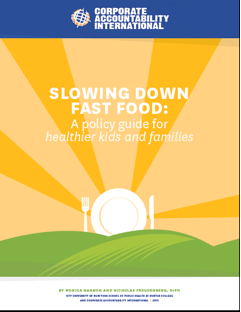
On the heels of a new study in the Journal of Health Economics, which finds that the U.S. spends more than $190 billion a year on medical costs associated with obesity, Corporate Accountability International and Dr. Nicholas Freudenberg and Monica Gagnon of The City University of New York have released a report that will serve as a tool to address the rising epidemic of diet-related disease.
The report, Slowing Down Fast Food: A policy guide for healthier kids and families, documents ways in which city and county policymakers can address the toll that diet-related disease is taking on their municipalities and on their communities’ health.
It offers specific solutions to curb a primary contributor to the problem – the overconsumption of fast food and the ubiquitous marketing of fast food to children.
 “Parents and policymakers have long felt at a disadvantage to counter the ubiquity of junk food and its marketing,” said Dr. Freudenberg. “This guide will empower families and communities to create healthier food environments for current and future generations.” Slowing Down Fast Food focuses on four local policy approaches: school policy, “healthy” zoning, curbing kid-focused marketing, and redirecting subsidies to healthier businesses.
As case studies in the report demonstrate, dedicated grassroots initiatives can overcome the food industry’s staunch opposition and build the political will sufficient for the passage of strong public health policies. For example, in San Francisco, the groundbreaking Healthy Meals Incentive Ordinance set basic nutritional standards for kids’ meals that are accompanied by toy giveaways. It was the power of grassroots initiatives involving parents, health professionals, and community leaders that helped secure the passage of this ordinance.
“What we can take from the city’s action is that all cities and towns could pursue and institute like-minded policies,” said San Francisco City Supervisor Eric Mar, the sponsor of the measure. “While no single community or organization can match the political and economic might of the fast food industry, we can make change on the community level that effectively challenges the fast food industry’s negative impact on public health.”
Such policies have positive and direct effects, but also have helped provoke critical changes across the food industry at large. While McDonald’s and its trade association attempted to block the ordinance, ultimately the burger giant and its competitors altered their practices internationally. For example, shortly after the San Francisco ordinance passed, Jack in the Box, the nation’s fifth largest burger chain, pulled the toy giveaways from its kids’ meals.
 National media coverage of the San Francisco ordinance also helped foster public discourse and a deeper understanding of the harmful impact of marketing fast food to children. A growing number of studies have found that ending junk food marketing directed at kids could spare the health of millions of children. In June, the American Academy of Pediatrics even urged a ban on junk food advertising to children as part of a new research review published in the Pediatrics journal.
The report also identifies the obstacles to the passage of policies addressing fast food, namely industry opposition, interference, cooption and avoidance of regulation. It documents how fast food corporations use their political and financial clout to advance their interests, even when their products or practices jeopardize health. While this type of pervasive corporate interference has translated into inaction in Congress, local policy solutions have proven an effective means of countering special interests and protecting public health.
“Corporate influence may be drowning out the will of the people in our nation’s capital right now, but it cannot be allowed to remain this way,” said Kelle Louaillier, executive director of Corporate Accountability International. “Change needs to and can start at the local level, and the policies in this report are a critical place to start.”
The report and its companion Action Guide offer specific, practical guidance for putting policy concepts into motion, offering additional resources from a wide range of organizations engaged in protecting our health from the abuses of fast food corporations.
Individuals and policymakers can access and download the report at Slowing Down Fast Food: A policy guide for healthier kids and families.
Corporate Accountability International (formerly Infact) is a membership organization that, for the last 35 years, has successfully advanced campaigns protecting health, the environment and human rights. Value [the] Meal is Corporate Accountability International’s campaign dedicated to reversing the global epidemic of diet-related disease by challenging the fast food industry to curb a range of its practices.
 Corporations and Health Watch
